
ABAC design ABA questions test sequence, not just letters. Learn what each phase means, why a second treatment phase can strengthen interpretation, how ABAC differs from ABAB, and when withdrawing an effective intervention is not appropriate.
Table of Contents
- What Is an ABAC Design ABA?
- How Is ABAC Different From ABAB?
- How Do You Read an ABAC Graph?
- What Does Phase C Tell You?
- When Should You Avoid a Reversal?
- What Does the BCBA Exam Test?
- What Is the Bottom Line?
- Quick Review Checklist
- Take the Free BCBA Mock Exam
An ABAC design ABA sequence is a single-case reversal arrangement with a baseline phase A, an intervention phase B, a return to baseline or comparison phase A, and a second intervention or treatment phase C. The letters describe conditions in order; they do not tell you automatically whether C is a stronger treatment or whether the design is ethically appropriate. The BCBA Test Content Outline expects candidates to identify single-case designs, systematic manipulation, and data-based decisions. Read the condition labels and the question’s purpose before deciding what the design demonstrates.
What Is an ABAC Design ABA?
In a basic ABAC arrangement, A is the baseline or comparison condition, B is the first intervention, the second A is a return to the comparison condition, and C is a different intervention or a modified version of B. For example, A could be baseline, B could be functional communication training alone, the second A could be a planned comparison, and C could be functional communication training plus a schedule change.
The return to A creates a test of whether behavior changes when the first intervention is withdrawn or replaced. The C phase then shows what happens under the second treatment. The design is informative only when the changes are implemented as described and the behavior can ethically and practically be reversed.
How Is ABAC Different From ABAB?
ABAB returns to the same intervention B after the second A. ABAC ends with a different treatment C. ABAB can provide a replication of the B effect. ABAC can compare a second intervention or modification after the reversal. Neither design is automatically superior; the research question determines the useful arrangement.
| Sequence | Last phase | Main question |
|---|---|---|
| ABAB | Return to B | Does the original intervention effect replicate? |
| ABAC | New or modified treatment C | How does the second treatment compare after the reversal? |
| Multiple baseline | Staggered intervention | Can change be replicated across behaviors, people, or settings without withdrawal? |
How Do You Read an ABAC Graph?
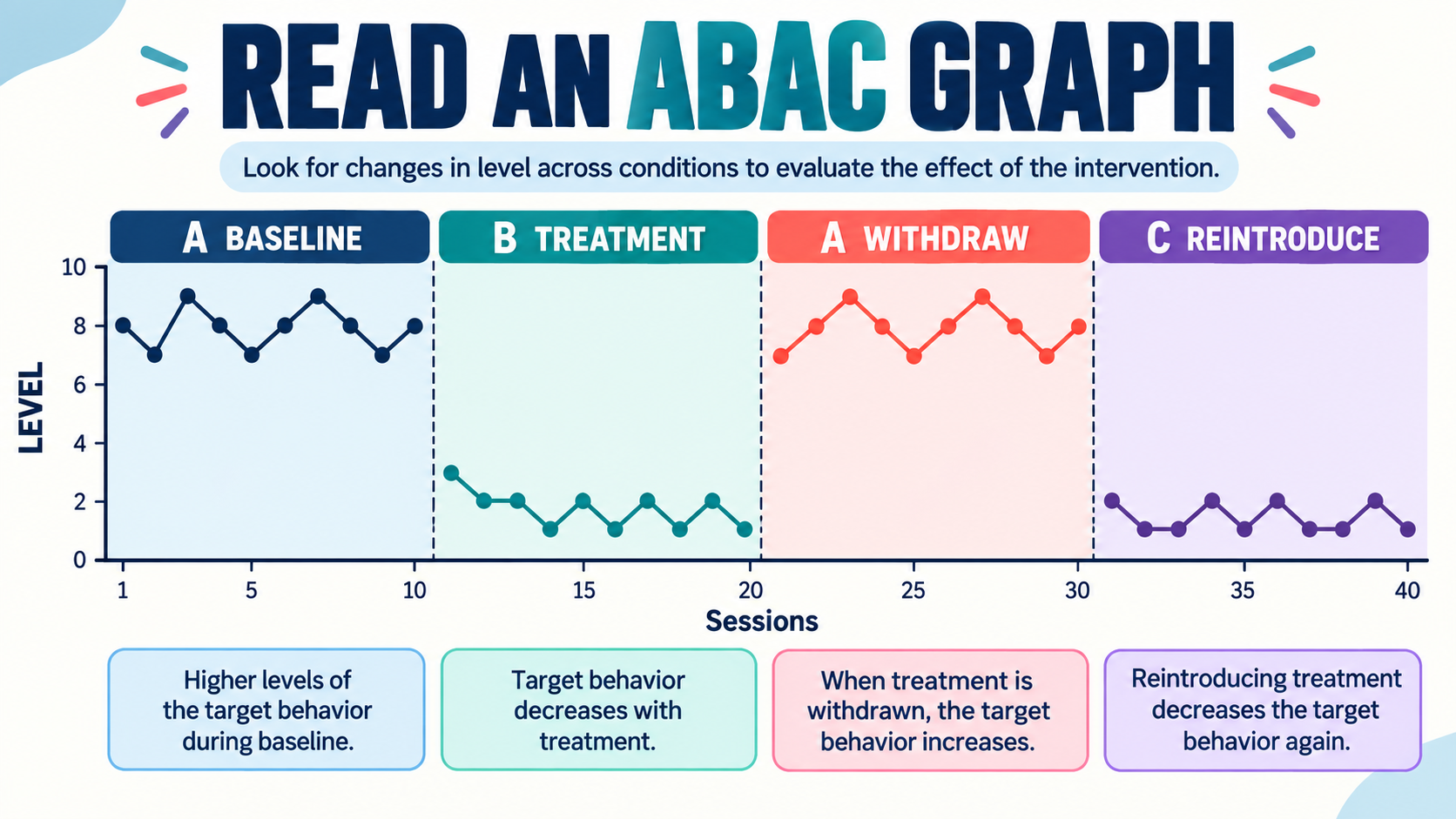
Start with level, trend, and variability in A. Then ask whether B produces a meaningful change. When the graph returns to A, look for a corresponding return toward baseline. Finally, compare C with B using the same dependent-variable definition and observation system.
A strong reversal pattern has changes that coincide with condition changes and replicate in the expected direction. If behavior does not return when B is removed, several explanations are possible: the behavior change may maintain, the intervention may have produced learning that does not reverse, the A condition may not be equivalent, or implementation may have changed. Do not force the graph into a textbook pattern.
What Does Phase C Tell You?
Phase C can show whether a modified or alternative intervention produces a different level, trend, or efficiency. For example, B may be a dense reinforcement schedule and C may be a thinner schedule after the same replacement response is established. The comparison should state what changed and hold other relevant variables as constant as possible.
ABAC does not prove that C is better merely because it appears last. Examine the data path, treatment integrity, response effort, collateral effects, generalization, and social validity. If C includes two changes at once, the design may not isolate which change matters.
Keep the phase logic visible in the data record. Mark the date of each transition, describe the exact procedures in a phase note, and avoid changing the target definition between B and C. If the first A is brief or unusually variable, the later comparisons become harder to interpret. A reader should be able to tell whether a difference between B and C reflects the treatment package, a change in observer or setting, or simple maturation. This is why phase labels, treatment-integrity checks, and a consistent measurement plan matter as much as the arrows on the graph.
When Should You Avoid a Reversal?
Do not withdraw an effective treatment casually when doing so could expose the person to serious harm, loss of essential communication, or a dangerous increase in behavior. A reversal may also be inappropriate when the behavior change is irreversible or when learning is expected to persist after the intervention is removed. The BACB Ethics Code supplies the ethical frame; the design must serve the person, not the other way around. Alternatives may include a multiple-baseline design, changing-criterion design, or another arrangement that does not require withdrawing a beneficial procedure. The choice should be justified by the question, risk, feasibility, and need for experimental control.
What Does the BCBA Exam Test?
- Read the last letter: C is not automatically a replication of B.
- ABAB versus ABAC: ABAB returns to B; ABAC introduces C.
- Phase change is not proof: inspect immediacy, replication, and competing explanations.
- Do not confuse treatment package with component analysis: C must be defined well enough to know what changed.
- Ethics can rule out reversal: experimental logic does not override client safety and welfare.
- Later is not better: compare data and social validity rather than phase order.
What Is the Bottom Line?
ABAC design ABA questions are solved by identifying each condition and asking what inference the sequence supports. Compare B and C carefully, examine the return to A, and consider whether reversal is safe and feasible. For more practice with single-case design and graph interpretation, try the free BCBA mock exam. It is study support, not a substitute for individualized supervision.
For targeted review, use our ABAC design ABA practice questions to apply the concept in exam-style scenarios.
Quick Review Checklist
Use this final checklist to turn ABAC design ABA into exam-ready reasoning. The goal is not to memorize a label in isolation; it is to identify the relevant evidence and explain why the best answer fits the scenario. Key ideas to review:
- State the central definition or decision point for ABAC design ABA in your own words.
- Identify the detail that makes ABAC design ABA different from its closest related ABA term.
- Separate the observable facts in a scenario from assumptions that are not supported by the facts.
- Write one example and one nonexample so you can recognize the concept in a new setting.
Exam application checks:
- Ask what the question is actually requesting before comparing the answer choices.
- Mark the antecedent, response, consequence, or other evidence that supports the selected answer.
- Look for a distractor that describes a related process but does not answer the specific question.
Final self-check:
- Explain how you would verify the interpretation with clear observations or data.
- Change one detail in the scenario and decide whether your answer should change.
- Give a one-sentence rationale that a supervisor or study partner could evaluate.
Take the Free BCBA Mock Exam
When you are ready to apply the idea, use the free practice resource below for additional feedback. Take the Free BCBA Mock Exam



