
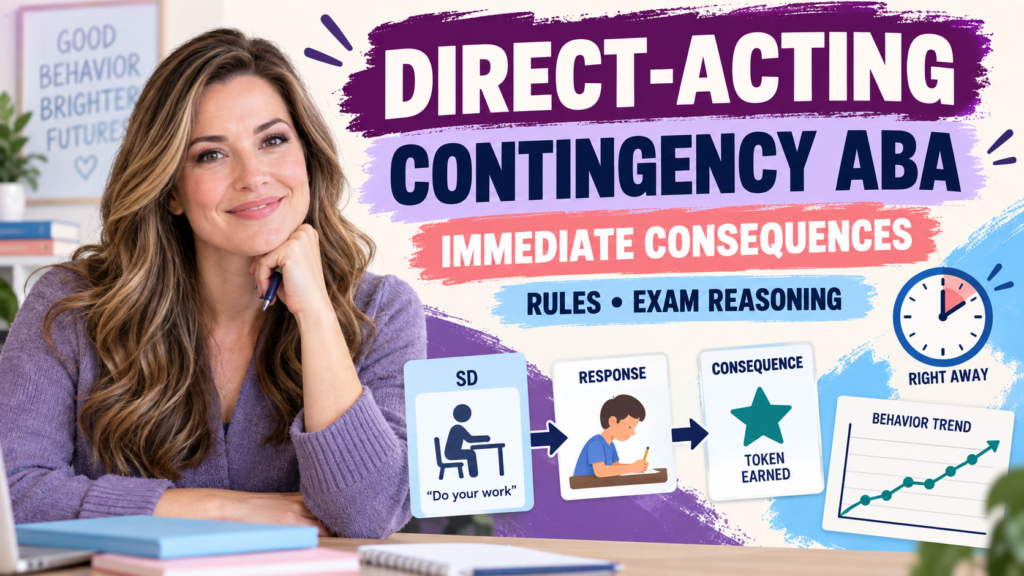
Direct acting contingency ABA describes a contingency in which the consequence that changes behavior follows the response closely enough to function as part of the behavior-environment relation. The important idea is immediacy: the learner contacts the outcome through the response itself, rather than relying only on a verbal rule about a much later result.
Table of Contents
- What Is Direct Acting Contingency ABA?
- What Makes a Contingency Direct-Acting?
- How Do Direct and Indirect Contingencies Differ?
- What Are Direct-Acting Contingency Examples?
- How Do Rules Change the Analysis?
- How Should a BCBA Evaluate the Arrangement?
- What Ethical Boundaries Matter?
- What Are the BCBA Exam Traps?
- Direct-Acting Contingency ABA FAQ
- Take the Free BCBA Mock Exam
This concept is especially useful when a BCBA exam question contrasts contingency-shaped behavior with rule-governed behavior. It is also useful for analyzing teaching arrangements, reinforcement systems, and performance-management examples. A direct-acting contingency is not simply any “if-then” sentence, and delayed outcomes do not automatically become ineffective. The timing, learning history, verbal rule, and actual data all matter.
This article is an educational study guide, not an individualized treatment protocol. A qualified behavior analyst must select and evaluate contingencies in context, with attention to assessment, client preferences, communication, safety, assent when applicable, and professional ethics. Table of Contents
What Is Direct Acting Contingency ABA?
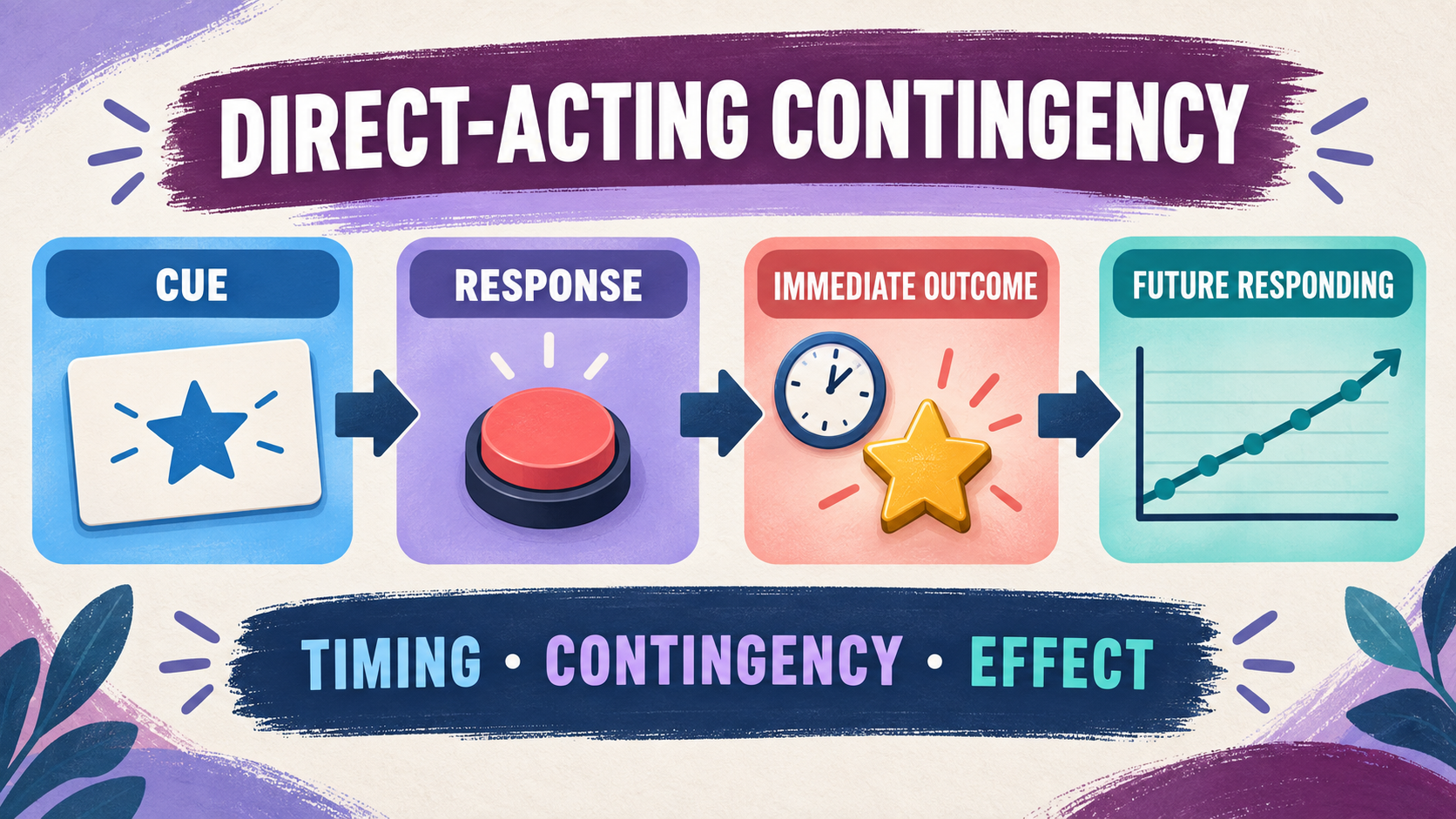
A direct-acting contingency is a behavior-consequence relation in which the consequence occurs close enough to the response that it can directly strengthen or weaken that response. If a learner selects the correct communication card and immediately receives the requested assistance, the assistance can reinforce the card selection. If a response immediately produces a loss that reduces future responding, the arrangement may involve punishment. The label depends on the observed behavioral effect, not on whether an adult intended the consequence to be reinforcing or punishing.
“Direct-acting” does not mean that the contingency must be simple, pleasant, or clinically appropriate. It describes how the consequence functions in relation to the behavior. A direct-acting contingency can be arranged during instruction, daily routines, caregiver coaching, or performance management. The analyst still needs to define the response, identify the consequence, and examine data. The term is often taught alongside three related ideas:
- Contingency-shaped behavior: behavior changes through a person’s contact with consequences, often without needing an explicit verbal description of the relation.
- Rule-governed behavior: behavior is influenced by a verbal statement that describes what will happen if a response occurs, even when the ultimate outcome is delayed.
- Indirect-acting contingency: a delayed outcome can influence behavior through a rule, instruction, or other verbal mediation rather than through immediate contact with the final outcome.
These categories are study tools, not labels for a person. The same learner may show contingency-shaped responding in one routine and rule-governed responding in another.
What Makes a Contingency Direct-Acting?
Several features help you analyze a direct-acting contingency without reducing it to a stopwatch rule. First, identify the response that is supposed to change. Next, identify the event that follows it and the measurable effect on future responding. Then ask whether the learner can contact that event through the response itself.
Immediacy is important, but there is no universal BACB cutoff that turns a contingency from direct to indirect at a particular number of seconds. Some behavior-analytic teaching materials use short-delay heuristics, and examples may mention a delay of less than a minute. Treat those examples as instructional approximations, not as a current exam rule. A delay that is brief for one response may be long for another, and the learning history can change how the relation functions. A strong analysis therefore checks:
- Temporal relation: how soon did the consequence follow the response?
- Contingency: did the consequence depend on that response, or would it have occurred anyway?
- Effect: did responding increase, decrease, or remain unchanged across repeated opportunities?
- Accessibility: could the learner understand and perform the response that contacts the outcome?
- Competing variables: were motivation, prompting, effort, pain, fatigue, or other consequences also changing?
For example, praise delivered immediately after an independent request may be part of a direct-acting reinforcement arrangement. Praise delivered at the end of a month, based on a summary no one can connect to individual responses, is much less likely to directly select each response. The monthly result may still influence behavior through a rule, feedback history, or another intervening process.
How Do Direct and Indirect Contingencies Differ?
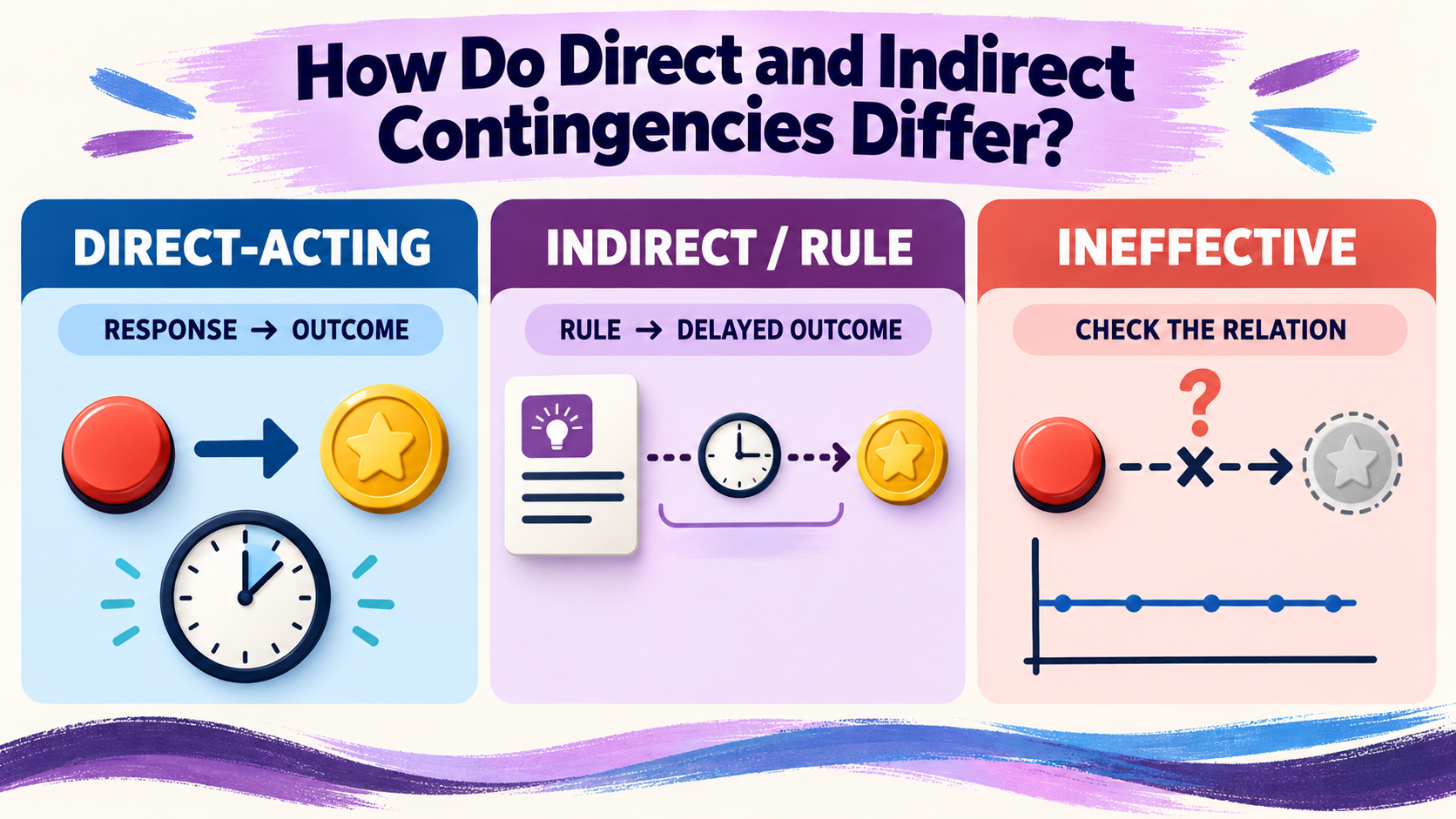
The cleanest exam strategy is to map the response and the outcome before choosing a label. A direct-acting contingency has a close response-outcome relation. An indirect-acting contingency has a delayed outcome that can influence behavior because a rule or verbal description makes the relation meaningful. An ineffective contingency lacks enough contact, information, motivation, or history to reliably change behavior under the stated conditions.
| Pattern | What connects behavior and outcome? | Exam question to ask |
|---|---|---|
| Direct-acting | The response produces a relatively immediate consequence that can select the response. | What happens right after the response, and does future responding change? |
| Indirect-acting | A delayed outcome influences behavior through a rule, instruction, feedback history, or verbal mediation. | What rule describes the delayed relation, and what makes the rule effective? |
| Ineffective | The stated outcome does not reliably affect responding under the current conditions. | Is the consequence available, meaningful, contingent, and within the learner’s response control? |
| Mixed arrangement | Immediate consequences and delayed rule-described outcomes operate together. | Which consequence is actually maintaining the response you are asked about? |
The comparison is not a ranking. Delayed outcomes can be important and can influence behavior. The error is assuming that a delayed outcome automatically reinforces the earlier response directly. Ask how the learner contacts the outcome and what verbal or environmental events bridge the delay.
What Are Direct-Acting Contingency Examples?
Study examples should make the response-consequence relation visible. They should also avoid implying that one example is a universal treatment recommendation. Communication and assistance. A learner presses an AAC button for help during a difficult task, and the teacher immediately provides brief assistance. If the help increases future independent help requests under similar conditions, the assistance is functioning as reinforcement for the communication response. The analyst should still evaluate whether the prompt, task difficulty, and access to help are appropriate.
Skill acquisition. A learner completes a defined step in a task analysis and immediately gains access to a selected activity. The activity may reinforce the step if the learner’s responding becomes more independent or more persistent. If the activity is not preferred, if the step is too large, or if access is delayed until the session ends, the intended contingency may not operate as planned.
Performance feedback. An employee receives immediate, specific feedback after accurately recording data, followed by a meaningful workplace consequence that has a history of affecting performance. The direct-acting part is not the existence of a distant evaluation score; it is the consequence that follows the performance closely enough to influence the response. A BCBA analyzing staff performance should define the behavior, protect confidentiality, train the procedure, and review data.
Notice that the same event can be a consequence in one arrangement and merely an event that follows behavior in another. “The learner got a sticker” does not prove reinforcement. Reinforcement is a functional process demonstrated by an increase in the future probability of the response.
How Do Rules Change the Analysis?
A rule describes a contingency, often in an if-then format: “If you finish the assignment, you will earn the privilege on Friday.” The delayed privilege may influence behavior when the person understands the rule and has a learning history that makes rule-following effective. In that case, the response may be rule-governed even though the final outcome is not immediate.
Rules do not erase the importance of direct consequences. A rule can establish a verbal bridge to a delayed outcome, while immediate consequences still compete with it. For example, studying may produce a distant exam result, but checking a phone may produce immediate social contact. The analyst should identify which consequences are affecting the current response pattern instead of assuming that the stated rule is controlling behavior.
On an exam, do not label every instruction as a direct-acting contingency. An instruction is a verbal stimulus that may describe an arrangement; it is not itself proof that the described consequence is contacting the response directly. Look for the actual timing, response requirement, and observed effect.
How Should a BCBA Evaluate the Arrangement?
The current BCBA Test Content Outline places related reasoning across concepts and principles, measurement, behavior-change procedures, and intervention selection. A practical analysis can follow a short sequence:
- Define the response: state exactly what begins, what ends, and what counts as an occurrence.
- Name the consequence: identify the event that follows and whether it is contingent on the response.
- Check timing: record the delay between the response and the outcome instead of describing it vaguely as “later.”
- Measure the effect: select frequency, rate, duration, latency, accuracy, prompt level, or another dimension that answers the clinical question.
- Test competing explanations: inspect motivation, response effort, instructions, prompts, task difficulty, and other consequences.
- Review generality: determine whether the response changes with different people, settings, materials, and naturally occurring outcomes.
A direct-acting contingency is not confirmed by a single successful trial. Look for a repeated relation and meaningful change across opportunities. If the target response does not change, investigate whether the supposed reinforcer is actually valuable, whether delivery is contingent, whether the response is too difficult, or whether another consequence is more powerful.
What Ethical Boundaries Matter?
The BACB ethics resources emphasize consumer protection and the current Ethics Code for Behavior Analysts. A direct-acting contingency should never be treated as permission to use a coercive or demeaning arrangement just because it produces a rapid behavior change.
Before implementation, consider whether the response is socially meaningful, whether the learner can communicate assent or refusal as applicable, whether the consequence is safe and genuinely available, and whether less intrusive alternatives have been considered. Do not make food, medical care, toileting, necessary communication, or basic dignity contingent on completing an arbitrary demand. For severe behavior, safety planning and qualified clinical oversight are essential.
In staff or organizational settings, protect privacy and avoid public feedback systems that humiliate people. In client services, collaborate with the relevant stakeholders, document the rationale, train implementers, and establish rules for monitoring and revising the arrangement. The shortest delay is not automatically the best intervention; the best arrangement is the one that supports meaningful, durable, and respectful behavior change.
What Are the BCBA Exam Traps?
Direct-acting contingency questions often test discrimination rather than memorization. Use these checks:
- Do not equate “after” with “reinforcement.” A consequence must increase future responding to be reinforcement.
- Do not use a fixed seconds rule. Timing matters, but no universal 60-second cutoff replaces analysis of the response, learner, and context.
- Do not confuse a rule with direct contact. A statement about a delayed outcome may support rule-governed behavior.
- Do not ignore the actual contingency. Ask whether the outcome depends on the response or happens independently.
- Do not call a failed arrangement an ineffective learner. Recheck preference, response effort, communication access, prompting, and the consequence.
- Do not mistake a rapid change for a complete success. Review generalization, maintenance, collateral effects, and client-informed outcomes.
The most defensible answer usually names the relation precisely: an immediate response-produced consequence may be direct-acting; a delayed outcome described by a rule may be indirect-acting or rule-governed; and an outcome that does not change responding may not be functioning as intended.
Direct-Acting Contingency ABA FAQ
What is the simplest definition of a direct-acting contingency?: It is a contingency in which a consequence follows a response closely enough to directly influence that response, as shown by a change in future responding. The consequence must be contingent and functionally effective; mere sequence is not enough.
Is a direct-acting contingency always immediate?: It is relatively immediate compared with a delayed outcome, but “immediate” is a functional and contextual description rather than a universal BACB seconds cutoff. Analyze the delay, the response, the learner’s history, and the observed effect.
What is the difference between direct-acting and rule-governed behavior?: Direct-acting behavior is shaped by contact with consequences. Rule-governed behavior is influenced by a verbal description of a contingency, often involving an outcome that may be delayed. A person can be influenced by both at the same time.
Does a direct-acting contingency have to involve reinforcement?: No. A consequence can increase or decrease behavior, so the analysis may involve reinforcement or punishment. Identify the operation, the effect, and the ethical safeguards rather than assuming the label from the consequence’s appearance.
How should I study this term for the BCBA exam?: Practice drawing a simple timeline: antecedent or context, response, delay, consequence, and later response pattern. Then ask whether a rule bridges the delay and whether the data show a functional change. For additional practice, use the free direct acting contingency ABA mock exam as a study checkpoint. It is independent study support, not official BACB material or a clinical authorization.
The core takeaway is that a direct acting contingency ABA question is asking how the response contacts its consequence. Define the behavior, inspect the timing and contingency, measure the effect, distinguish direct contact from rule-mediated delay, and keep the arrangement individualized, safe, and respectful.
Take the Free BCBA Mock Exam
If you want a low-pressure way to check your recall, use the free practice resource below. Take the Free BCBA Mock Exam



