

Quality assurance BCBA work is the disciplined process of checking whether a behavior-analytic service is measurable, implemented as intended, ethically delivered, and producing meaningful outcomes. It is broader than proofreading a note or confirming that a form is complete. A quality review asks what the team intended to do, what actually happened, what the data can support, and what should improve next.
Table of Contents
- What Does Quality Assurance BCBA Mean?
- Quality Assurance Versus Quality Control, Compliance, and Outcomes
- How the Quality Assurance BCBA Improvement Loop Works
- What Data Should a BCBA Review?
- A Practical BCBA Quality Assurance Checklist
- Procedural Fidelity, Supervision, and Training
- Ethics, Client Experience, and Documentation
- How to Choose Quality Assurance Metrics
- Common BCBA Exam and Fieldwork Mistakes
- FAQ
- Sources to Verify the Topic
- Take the Free BCBA Mock Exam
For a BCBA, quality assurance connects operational definitions, reliable measurement, procedural fidelity, supervision, client-centered goals, documentation, and data-based decisions. These checks should support better care—not become a paperwork exercise or a way to blame one implementer for a system problem.
This guide separates quality assurance from quality control and compliance, gives a repeatable improvement loop, and shows how to build a practical review checklist. It is educational study material, not individualized clinical, legal, payer, or employment advice. Always use the current requirements and policies that apply to your setting. Table of Contents
What Does Quality Assurance BCBA Mean?
Quality assurance is a system-level approach to maintaining and improving the quality of services. In BCBA practice, that system may include the referral process, assessment, treatment-plan design, staff training, implementation, data review, supervision, communication, discharge planning, and record security. The exact workflow varies by organization, but the logic is consistent: define a standard, collect evidence, compare the evidence with the standard, and improve the process when there is a meaningful gap.
The phrase does not describe one special BCBA credential or one mandatory dashboard. A BCBA may participate in quality assurance as a clinical supervisor, program designer, reviewer, trainer, manager, or member of an interdisciplinary team. The BACB employer resources and BACB professional information provide the official context for credential verification, ethics, training, and responsible use of behavior-analytic services.
A useful quality question is specific: “Are the four planned teaching steps being implemented in at least 90% of observed opportunities, and are the data definitions stable across observers?” A weak question is “Is the program high quality?” The first question identifies a standard, a measurement method, a sample, and a decision. The second invites opinion without enough evidence.
Quality Assurance Versus Quality Control, Compliance, and Outcomes
These terms are related, but they answer different questions. Quality assurance is the improvement system. Quality control is the inspection or verification of a particular product, record, session, or deliverable. Compliance asks whether a requirement was met. Outcome review asks whether the client’s meaningful behavior or participation changed. A single review can contain all four perspectives, but they should not be treated as interchangeable.
| Term | Primary question | BCBA example |
|---|---|---|
| Quality assurance | How does the system consistently produce and improve quality? | Set a monthly review cycle for definitions, fidelity, supervision, outcomes, and action items. |
| Quality control | Does this specific record, session, or product meet the stated standard? | Audit a sample of notes for required fields, objective language, and accurate dates. |
| Compliance | Was a law, code, contract, payer, or organizational requirement followed? | Verify credentials, required supervision documentation, consent, and applicable reporting steps. |
| Outcome review | Did the intervention produce a meaningful change for the client? | Review level, trend, generalization, maintenance, social validity, and the client’s priorities. |
For exam questions, do not infer a good outcome from perfect paperwork. A complete note can document an ineffective plan, and a data trend can be misleading when the intervention was implemented inconsistently. Review the right layer before making the next decision.
How the Quality Assurance BCBA Improvement Loop Works
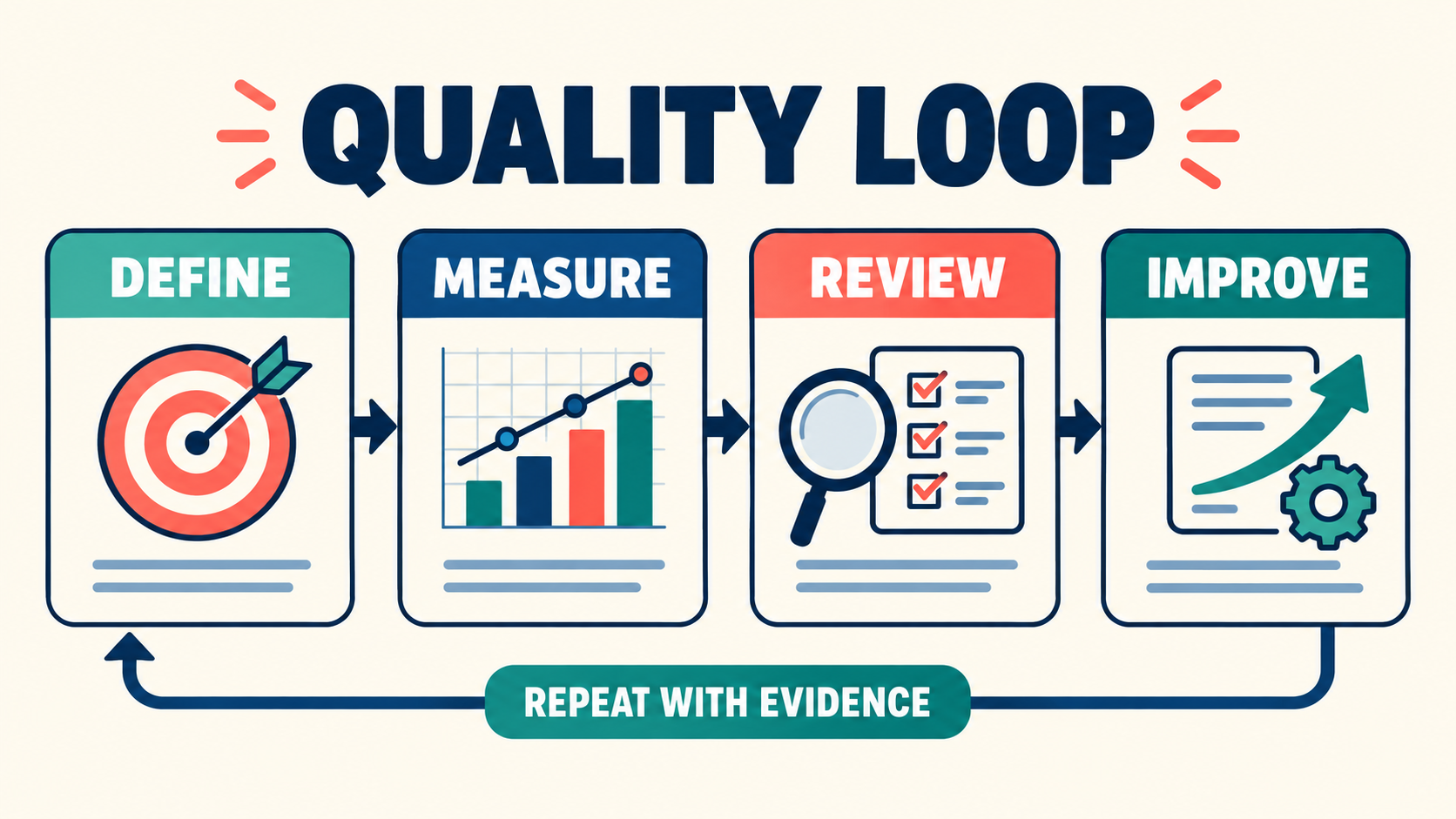
A practical loop can be remembered as Define, Measure, Review, Improve. It is a cycle, not a one-time inspection:
- Define the standard. State the behavior, process step, record requirement, or outcome that matters. Specify who is responsible, when it should occur, and what counts as acceptable performance.
- Measure the current process. Select a defensible sample and record the relevant data. Identify missing sessions, unusual conditions, observer training, and any changes to the measurement system.
- Review the pattern. Compare the data with the standard and look for level, trend, variability, context, and possible barriers. Ask whether the gap is a definition problem, training problem, resource problem, plan problem, or implementation problem.
- Improve and recheck. Choose a proportionate action, assign an owner and due date, document the change, and collect follow-up data. A meeting without a recheck is not a completed improvement cycle.
Suppose a team’s goal is for staff to deliver a functional communication prompt within five seconds of a defined precursor. A quality review might sample sessions, score whether the step occurred, compare observers, interview the implementer about barriers, provide focused coaching, and repeat the sample. It should not simply label a staff member “noncompliant” without checking whether the plan was clear, the materials were available, and the opportunity actually occurred.
What Data Should a BCBA Review?
Quality assurance uses more than client outcome graphs. A balanced review includes measurement, implementation, supervision, and the experience of people receiving and delivering services. Collect enough evidence to answer the decision question; do not collect every possible metric.
| Domain | Evidence to sample | Question to ask |
|---|---|---|
| Data quality | Definitions, timing, missing data, scoring, IOA samples | Would trained observers score the same event the same way? |
| Procedural fidelity | Checklist scores, direct observations, coaching records | Was the intervention delivered as the current plan specifies? |
| Supervision and training | Competency checks, feedback, supervision notes, retraining | Did the team receive practice and feedback for the steps being evaluated? |
| Client outcomes | Target and replacement behavior, generalization, maintenance, social validity | Is the change meaningful, durable, and connected to the client’s priorities? |
Interobserver agreement (IOA) is useful when the question is whether observers agree on recorded events. It is not the same as treatment integrity, which asks whether the implementer followed the intervention steps. Neither measure proves that the treatment is effective. Keep measurement reliability, implementation fidelity, and client outcome as separate columns in the review.
A Practical BCBA Quality Assurance Checklist
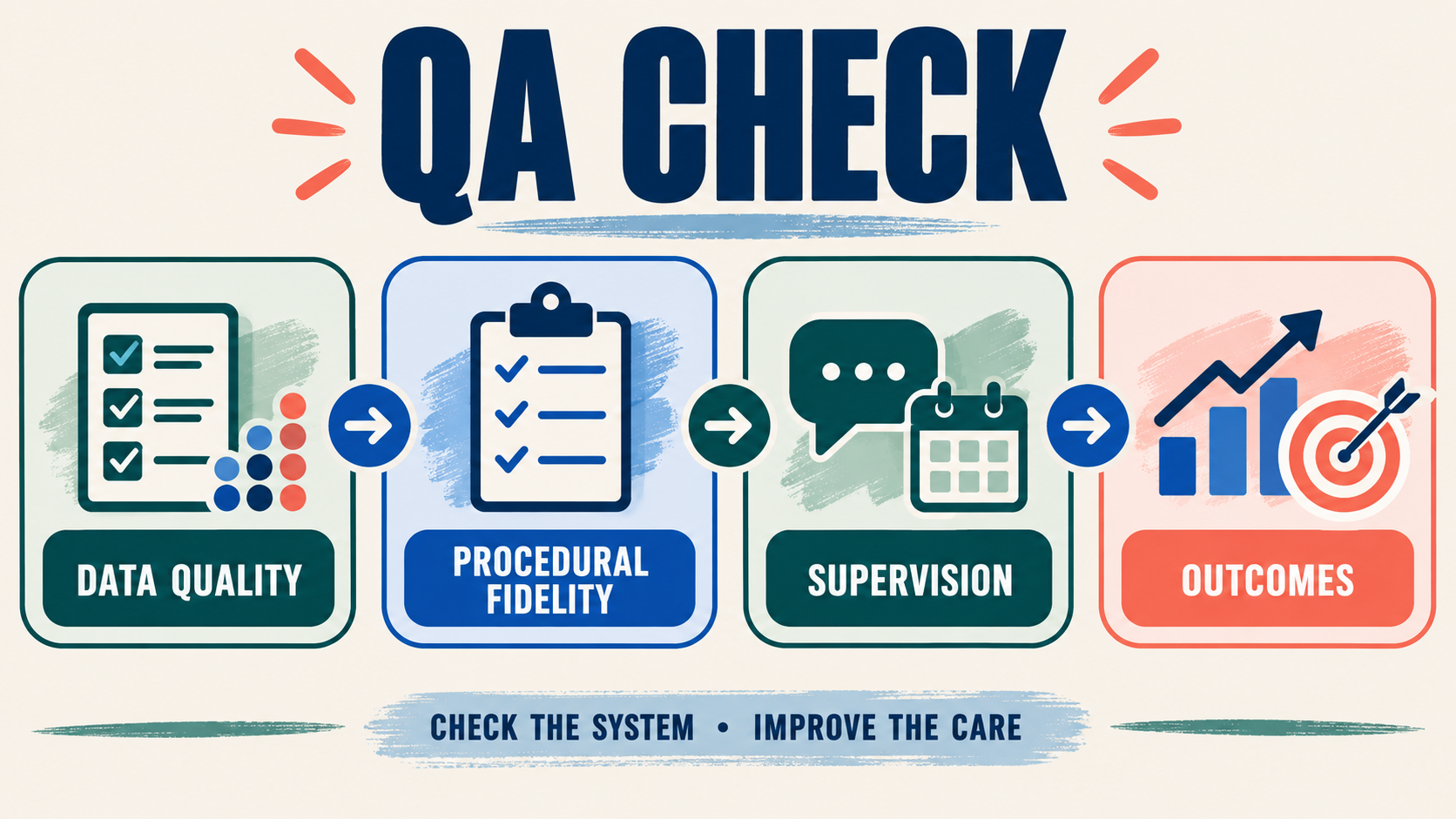
A checklist should be derived from the actual process. A generic form can create false confidence if it checks easy-to-document items while missing the steps that affect safety, learning, autonomy, or interpretation. Before using a checklist, identify the current protocol, its version date, the observation unit, and the response options.
- Scope: Is the review question clear, and is the sample large or varied enough for the decision?
- Definition: Are the target responses, opportunities, prompts, errors, and mastery criteria observable and current?
- Data: Are the measurement dimensions, missing-data rules, dates, and context recorded consistently?
- Fidelity: Are the critical intervention steps scored from direct evidence rather than assumed from a completed note?
- Training: Does the implementer know the steps, have materials, and receive behavioral skills training or other appropriate coaching?
- Outcome: Do graphs and summaries show progress, stagnation, variability, generalization, or possible harm?
- Client experience: Were preferences, communication, assent, dignity, safety, and meaningful participation considered?
- Action: Does the review end with an owner, a due date, a decision rule, and a follow-up sample?
Use a “not observed” option when the opportunity did not occur. Do not force a yes or no when the reviewer lacks evidence. Also distinguish “not applicable” from “not completed.” Those categories lead to different improvement actions and prevent a dashboard from hiding missing opportunities.
Procedural Fidelity, Supervision, and Training
When outcome data are disappointing, the first question is not always whether the intervention concept failed. The team may have implemented the plan differently from the written procedure, or the procedure may be too complex for the available context. A fidelity sample helps the BCBA interpret the outcome and choose a proportionate response.
Training should make the relevant behavior observable. Explain the step, model it, arrange practice, give feedback, and check performance in the real context. A low fidelity score should trigger problem solving and support, not automatic assumptions about motivation or competence.
Keep versions visible. If the intervention changed on Tuesday, a reviewer should know which version applied to each session. Otherwise, a combined graph may mix different procedures and create a misleading conclusion. Document the date of the change, the reason, the training provided, and the first follow-up review. The site’s fidelity checklist ABA guide covers treatment-integrity scoring in more detail. Use it as a related study resource rather than duplicating that narrower checklist topic here.
Ethics, Client Experience, and Documentation
Quality is not only “more correct trials” or “more completed notes.” The BACB Ethics Codes provide the professional context for competence, individualized services, informed consent, privacy, truthful documentation, and protecting clients from harm. A quality review should therefore ask whether the goal is socially meaningful, whether the learner’s communication is respected, and whether the intervention is being evaluated honestly.
Document what was observed and what was decided. Separate a missed opportunity from a client refusal, a staff error from a plan ambiguity, and an outcome change from a data-collection change. Avoid language that turns a single score into a trait judgment. Objective notes make it easier for the team to repair the system and easier for another qualified reviewer to understand the reasoning.
Privacy also belongs in quality assurance. Use the minimum necessary information for the review, follow the applicable record-security process, and do not place identifiable client details in an unapproved spreadsheet or public dashboard. Quality data that compromise confidentiality are not a quality success.
How to Choose Quality Assurance Metrics
Choose a small set of leading and lagging indicators. Leading indicators show whether conditions for quality are present, such as current training, observations, definition checks, or timely supervision. Lagging indicators show client progress, generalization, maintenance, complaints, missed services, or safety events. Reporting only outcomes may react too late; reporting only completed forms may measure activity instead of quality.
- Write the decision the metric will support.
- Name the numerator, denominator, time period, and data source.
- Set a review threshold without pretending it is a universal clinical rule.
- Assign an owner who can act on the result.
- Review context and client experience alongside the number.
- Retire metrics that do not change a decision or improve the process.
“90% fidelity” is incomplete without the checklist items, sessions sampled, critical steps, observer training, and missing-data rule. A percentage can be mathematically precise while still being clinically uninformative.
Common BCBA Exam and Fieldwork Mistakes
- Confusing compliance with quality: meeting a documentation requirement does not prove that the intervention is effective or meaningful.
- Confusing IOA with treatment integrity: observer agreement checks measurement agreement; fidelity checks implementation.
- Auditing the person before the process: first check definitions, training, materials, scheduling, and plan clarity.
- Using one outcome point: inspect the pattern, context, generalization, and data quality before changing treatment.
- Building a dashboard without a decision rule: a metric is useful when someone knows what action follows the result.
- Ignoring client experience: a technically neat program can still miss assent, dignity, preference, safety, or social validity.
- Failing to recheck: coaching or a revised form is not evidence of improvement until follow-up data show what changed.
For exam practice, identify whether the question is testing measurement reliability, implementation fidelity, supervision, ethics, or outcome evaluation. The free BCBA mock exam can provide optional scenario practice with those distinctions; it is not a BACB protocol, clinical supervision service, or certification guarantee.
FAQ
What does a quality assurance BCBA do?: A BCBA involved in quality assurance may define service standards, review data and records, observe implementation, check procedural fidelity, coach staff, evaluate outcomes, identify system barriers, and document improvement actions. The exact role depends on the organization and the person’s competence and authority.
Is quality assurance the same as treatment integrity?: No. Treatment integrity is one important part of quality assurance: it asks whether a plan was implemented as specified. Quality assurance is broader and can also include measurement quality, supervision, ethics, documentation, outcomes, client experience, and continuous improvement.
What is the difference between IOA and quality assurance?: IOA is a measurement procedure used to evaluate agreement between observers. Quality assurance is the larger improvement system that may use IOA, fidelity scores, outcome data, audits, feedback, and follow-up actions. High IOA alone does not show that the intervention was implemented correctly or that it worked.
What should be on a BCBA quality assurance checklist?: Include the review scope, current definition and plan version, measurement and missing-data rules, direct fidelity evidence, supervision and training, client outcomes, generalization, client experience, privacy, action ownership, due dates, and a follow-up decision rule. Mark “not observed” when the opportunity was not available.
Sources to Verify the Topic
- BACB Employer Resources — official context for employers, credential verification, ethics, and training.
- BACB BCBA information — official BCBA role and credential context.
- BACB Ethics Codes — professional and ethical context for behavior-analytic services.
- NCBI Bookshelf: Applied Behavior Analysis — clinical and implementation context for ABA service quality and coordination.
- Procedural integrity survey in behavior analysis — peer-reviewed context for implementation and procedural-integrity practice.
- School-based behavior analyst collaboration standards — peer-reviewed context for collaboration and quality in school settings.
Bottom line: quality assurance BCBA work turns broad expectations into observable standards, trustworthy data, supported implementation, ethical decision-making, and a documented improvement loop. Define the question, measure the right layer, review the pattern, act proportionately, and recheck the result.
Take the Free BCBA Mock Exam
If you want a low-pressure way to check your recall, use the free practice resource below. Take the Free BCBA Mock Exam



