
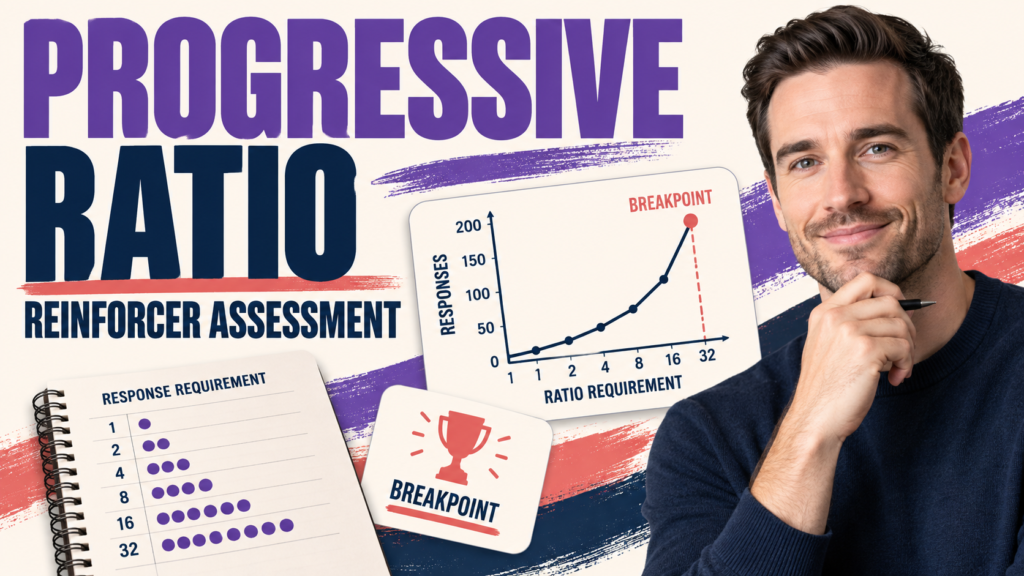
A progressive ratio schedule reinforcer assessment measures how much responding occurs as the response requirement for reinforcement increases. The schedule begins with a relatively small requirement and progressively raises it after reinforcement. The highest requirement completed before responding stops is often called the breakpoint. In behavior analysis, that result can help compare the relative reinforcing value of stimuli under the conditions of the assessment.
Table of Contents
- What Is a Progressive Ratio Schedule Reinforcer Assessment?
- How Does a Progressive Ratio Schedule Work?
- How Is Progressive Ratio Different From Preference Assessment?
- How Should You Interpret the Breakpoint?
- How Can the Assessment Inform Treatment?
- What Data and Design Checks Matter?
- How Does the BCBA Exam Test Progressive Ratio?
- Common Misunderstandings
- Frequently Asked Questions
- Sources for Further Study
- Take the Free BCBA Mock Exam
The exam-ready distinction is this: a preference assessment asks what a person selects or ranks, while a progressive-ratio assessment asks how much work the person will complete for access under increasing requirements. Those results can be related, but they are not interchangeable. A selection is not automatically proof that an item will maintain behavior when response effort rises.
What Is a Progressive Ratio Schedule Reinforcer Assessment?
A progressive-ratio assessment arranges reinforcement so that the response requirement increases across reinforcer deliveries or across sessions. For example, a learner might receive a reinforcer after one response, then after two, four, eight, and sixteen responses. The exact progression can be arithmetic, geometric, or another planned sequence; the defining feature is that the requirement becomes progressively more demanding.
This arrangement creates a functional question about effort: under the current motivating conditions and assessment arrangement, how much responding will the reinforcer support? A larger breakpoint can indicate greater relative reinforcing efficacy than a smaller breakpoint when the relevant conditions are comparable. It does not mean that an item is universally reinforcing, that the learner “likes” it in every context, or that one breakpoint is a permanent trait.
Research on progressive-ratio schedules has used the procedure to study reinforcer potency, demand, and response strength. Applied behavior-analytic studies have also used progressive-ratio results to inform differential reinforcement or to compare the durability of a communication response. The result is a data point for decision-making, not a standalone diagnosis or treatment prescription.
How Does a Progressive Ratio Schedule Work?
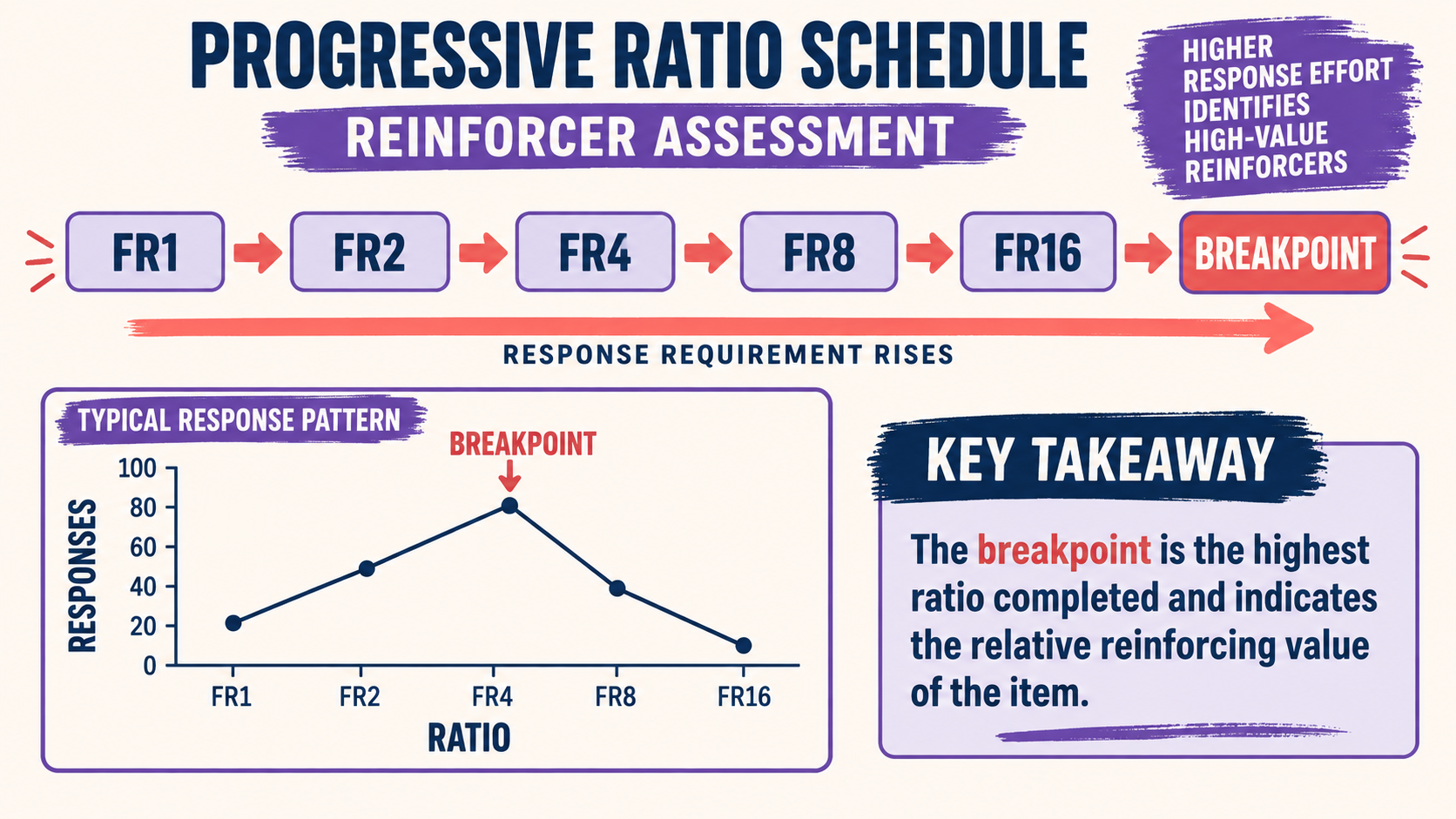
The first requirement is often easy enough for the learner to contact reinforcement quickly. After the reinforcer is delivered, the next requirement increases. The assessment continues until a termination rule is met, such as no responding for a defined period or a predefined safety criterion. The last completed requirement is the breakpoint for that session under that particular arrangement.
Consider a simplified sequence: FR 1, FR 2, FR 4, FR 8, and FR 16. If the learner completes FR 8, receives the reinforcer, and then does not complete FR 16 before the termination rule, the breakpoint is FR 8. The analyst should record the progression, number of responses, reinforcer deliveries, time, pauses, and termination reason rather than reporting only a single number. Several variables can change the result:
- Current motivation: deprivation, satiation, competing activities, and recent access can change responding.
- Response effort: a vocal response, a selection response, and a complex task may not carry the same effort.
- Reinforcer magnitude and quality: amount, duration, variety, and immediacy can affect the breakpoint.
- Schedule progression: a rapid increase can produce a different result from a gradual increase.
- Termination rule: a pause criterion or safety rule determines when the assessment ends.
That list is why a breakpoint should be interpreted within the design. A high number under one response form may not compare fairly with a lower number under a more effortful response form. The analyst needs to ask whether the measurement arrangement was equivalent enough for the comparison being made.
How Is Progressive Ratio Different From Preference Assessment?
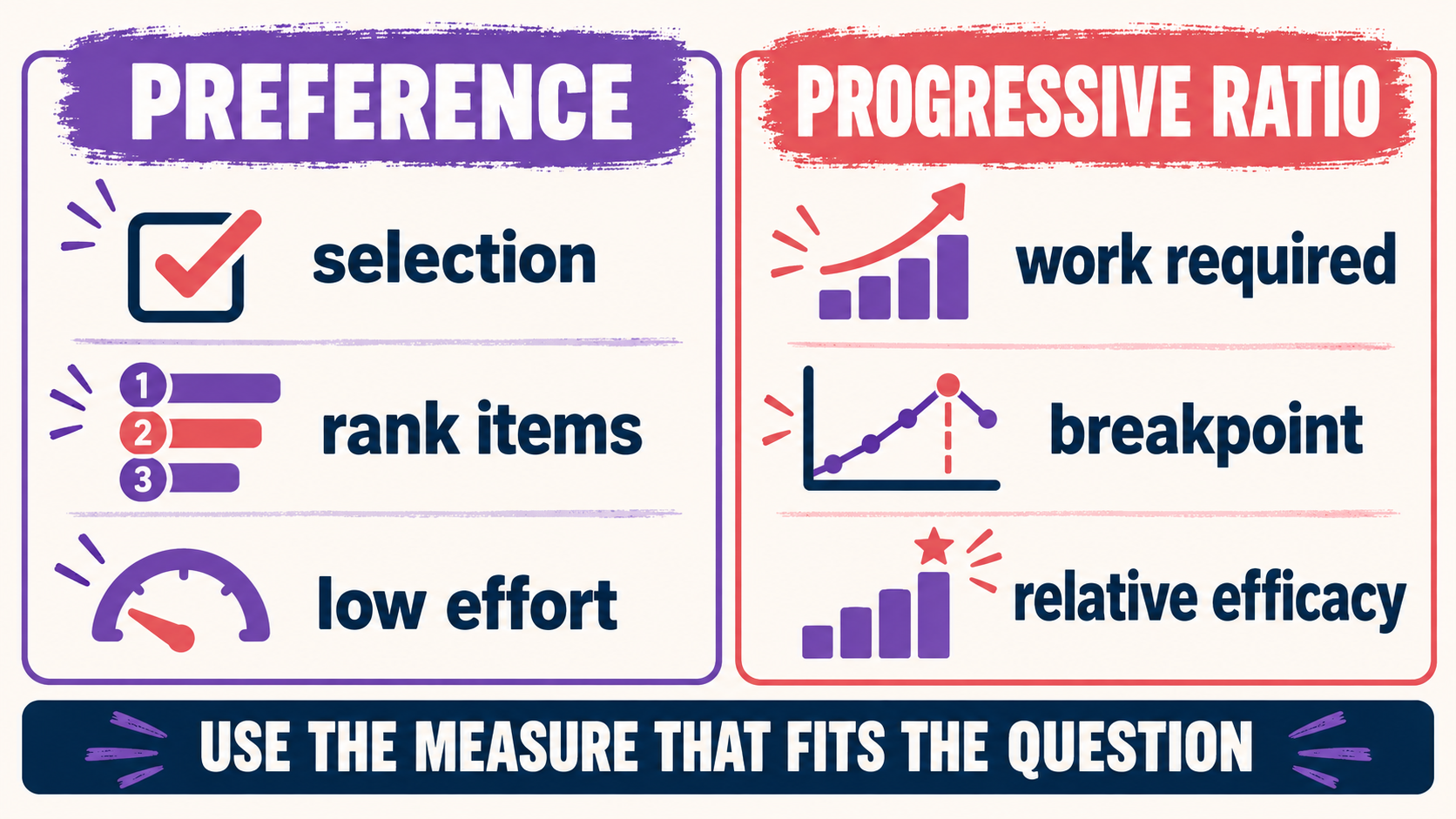
A preference assessment typically identifies items or activities a person selects, approaches, ranks, or chooses under a defined format. It is often useful when the analyst needs a starting point for possible reinforcers. A progressive-ratio assessment adds an increasing response requirement and observes persistence or breaking strength under that requirement.
| Question | Preference assessment | Progressive-ratio assessment |
|---|---|---|
| Primary question | Which item or activity is selected or ranked? | How much responding will the item support as effort increases? |
| Main outcome | Selection, approach, rank, or engagement pattern | Responses completed, breakpoint, pauses, and termination pattern |
| Response requirement | Often low or controlled by the selection format | Systematically increases after reinforcement |
| Interpretation caution | Selection does not guarantee the item will maintain a difficult response | Breakpoint is conditional and should not be treated as a permanent personal characteristic |
The two assessment types can be used in sequence. A preference assessment may help identify candidate stimuli; a progressive-ratio assessment may then examine relative efficacy when the response requirement increases. The appropriate choice depends on the clinical question, learner variables, risk, response form, and available time.
How Should You Interpret the Breakpoint?
The breakpoint is the last response requirement completed before the stopping rule. In a study guide, that is the definition to remember. In practice, its meaning depends on what was held constant and what changed. If one item produces a breakpoint of FR 16 and another produces FR 4, the first item supported more responding under those assessment conditions. That does not prove it will be the best reinforcer in a classroom, home, or natural routine.
Do not confuse breakpoint with a fixed “maximum ability.” A learner may stop responding because of satiation, fatigue, competing reinforcement, an unclear response requirement, poor stimulus quality, an aversive task, or a termination rule—not only because the reinforcer lost value. Replications across sessions and conditions can improve confidence, but they also take time and must be balanced with dignity and burden.
Also separate relative reinforcing efficacy from preference. A person can choose an item in a brief choice arrangement but work longer for another item under an increasing requirement. The measures answer different questions. A strong exam answer recognizes the measurement dimension instead of treating every “preferred item” result as the same construct.
How Can the Assessment Inform Treatment?
Progressive-ratio data can help a BCBA compare candidate reinforcers, select an initial schedule, or evaluate whether a treatment package changes persistence for a functional response. For example, if a functionally equivalent communication response reaches a higher breakpoint after treatment than before treatment, that may suggest improved response strength under the tested conditions. The analyst still reviews problem behavior, independence, generalization, social validity, and treatment integrity.
One applied use is to compare the response effort required for a problem response with the effort required for an appropriate alternative. If the appropriate response is much harder, slower, less accessible, or less reliably reinforced, it may not compete with the problem behavior. That does not justify making demands without a plan. It tells the analyst to examine the response class, reinforcement arrangement, prompting, and access conditions.
A progressive-ratio assessment should therefore support a broader decision, not replace one. If the result is used to set a treatment schedule, the team should monitor whether the schedule is practical, whether the learner can contact reinforcement, and whether the plan remains safe and socially meaningful.
What Data and Design Checks Matter?
When reading a progressive-ratio graph or study description, look for the following:
- What response was measured? Identify the topography, definition, and effort required for each response.
- What reinforcer was delivered? Note quality, amount, duration, immediacy, and whether access was actually contingent.
- How did the ratio increase? Record the sequence rather than assuming every PR schedule doubles or adds one response.
- What was the breakpoint rule? Check the last completed requirement and the rule that ended the session.
- Were conditions comparable? Consider motivation, session length, materials, staff, competing reinforcement, and order effects.
- What decision follows? Use the data to compare or revise a plan, not to make a permanent claim about the learner.
How Does the BCBA Exam Test Progressive Ratio?
Exam questions may give you a sequence such as FR 1, FR 2, FR 4, and FR 8, then ask for the breakpoint. Choose the highest requirement completed before responding stops according to the stated termination rule. If the question instead asks which item is more reinforcing under increasing effort, compare the completed ratio requirements rather than the initial selection.
Common distractors include calling the highest response rate the breakpoint, treating an FR 1 result as a progressive ratio, or choosing the item selected first in a preference assessment without reading the response requirement. Another distractor is assuming that a high breakpoint proves the item is the only or best reinforcer in every setting.
The current BCBA Test Content Outline emphasizes assessment, measurement, data-based decisions, and intervention evaluation. A progressive-ratio item can therefore test schedule identification, measurement interpretation, reinforcer assessment, experimental control, or the limits of generalizing a result. Start by naming the dependent variable and the schedule arrangement before selecting an answer.
Common Misunderstandings
- “Progressive ratio” means a variable-ratio schedule. No. A progressive ratio increases the response requirement; a variable ratio varies around an average requirement.
- The breakpoint is the first pause. Usually it is the last completed requirement before the defined termination rule, not any brief pause.
- Preference and efficacy are identical. Selection and work under increasing effort are different measurements.
- A larger breakpoint always means a better treatment choice. The result is conditional on motivation, effort, access, risk, and the purpose of the plan.
- The procedure can be copied without adaptation. A qualified analyst must define the response, select the arrangement, set safety rules, and interpret the result for the individual.
Frequently Asked Questions
What is a progressive ratio schedule in ABA?: It is a reinforcement schedule in which the response requirement increases after reinforcement, across successive reinforcers or sessions. The progression may be arithmetic, geometric, or another planned sequence.
What does breakpoint mean in a reinforcer assessment?: Breakpoint usually means the highest response requirement completed before the session ends under the stated termination rule. It is interpreted as a conditional measure of responding, not a permanent trait. Is progressive ratio the same as a preference assessment?: No. A preference assessment measures selection or ranking in a defined choice arrangement. A progressive-ratio assessment measures responding as the requirement for reinforcement increases.
Can a breakpoint identify a reinforcer?: It can provide evidence about relative reinforcing efficacy under the assessment conditions. The analyst should combine it with the functional relation, preference information, treatment data, and context rather than relying on one number.
A progressive ratio schedule reinforcer assessment is valuable because it turns the vague question “What does the learner prefer?” into a more precise effort-and-reinforcement question. Define the response, identify the progression, locate the breakpoint, compare the conditions fairly, and keep the interpretation tied to the assessment design. After reviewing the concept, use the free BCBA mock exam to practice schedule identification, measurement, reinforcer assessment, and data-based decisions. The mock exam is a study aid, not a BACB protocol or certification guarantee.
Sources for Further Study
- Using a Progressive Ratio Schedule of Reinforcement as an Assessment Tool to Inform Treatment — applied behavior-analysis study on breakpoint and treatment planning.
- Assessing reinforcers under progressive schedule requirements — Journal of Applied Behavior Analysis research record.
- On the Applied Use of Progressive-Ratio Schedules of Reinforcement — open-access review of applied uses.
- BCBA Test Content Outline — official BACB source for assessment, measurement, and data-based decisions.
For targeted review, use our progressive ratio schedule reinforcer assessment practice questions to apply the concept in exam-style scenarios.
Take the Free BCBA Mock Exam
If you want a low-pressure way to check your recall, use the free practice resource below. Take the Free BCBA Mock Exam



