

In vivo ABA usually means that observation, modeling, practice, or implementation happens live and in person rather than only through a recording or a simulated example. The phrase is useful, but it is not a treatment name by itself. The exact meaning depends on what is being observed or taught.
Table of Contents
- What Does In Vivo ABA Mean?
- How Is In Vivo Used in ABA?
- How Is In Vivo Different From Video Modeling and Naturalistic Teaching?
- What Should Be Measured During In-Vivo Work?
- What Does In Vivo ABA Look Like in a Scenario?
- What Are the BCBA Exam Clues?
- What Mistakes Should You Avoid?
- In Vivo ABA FAQ
- Sources and Date Check
- Take the Free BCBA Mock Exam
In behavior analysis, in vivo describes contact with a live event, person, or setting. It can refer to direct observation of behavior as it occurs, a live person modeling a skill, a trainee practicing with real-time feedback, or an implementer carrying out a plan during an actual session. That is different from saying that the procedure is naturalistic, effective, or automatically better. Those are separate questions.
What Does In Vivo ABA Mean?
In vivo ABA means live, real-time behavior-analytic observation, modeling, training, or implementation. For example, a supervisor may observe a technician during an actual session, a learner may watch a live model demonstrate a response, or a trainee may rehearse a skill while an instructor gives immediate feedback. In each example, the important feature is that the event is happening in the moment rather than being presented only as a recording.
The term can appear in several kinds of questions. “The analyst observes the target behavior in the classroom” points toward in-vivo observation. “The learner watches an adult demonstrate the task in person” points toward in-vivo modeling. “The trainee practices with the instructor and receives feedback” may be in-vivo role-play or live behavioral skills training, depending on whether the practice is a real session or a rehearsal. Read the noun after in vivo; it tells you what is live.
One caution matters for exam reasoning: in vivo and naturalistic are related, but they are not interchangeable. An observation can be live but occur in a clinic room arranged for training. A naturalistic teaching opportunity can be arranged in an everyday context and still be demonstrated through a recorded example before practice. The format and the context should be identified separately.
How Is In Vivo Used in ABA?
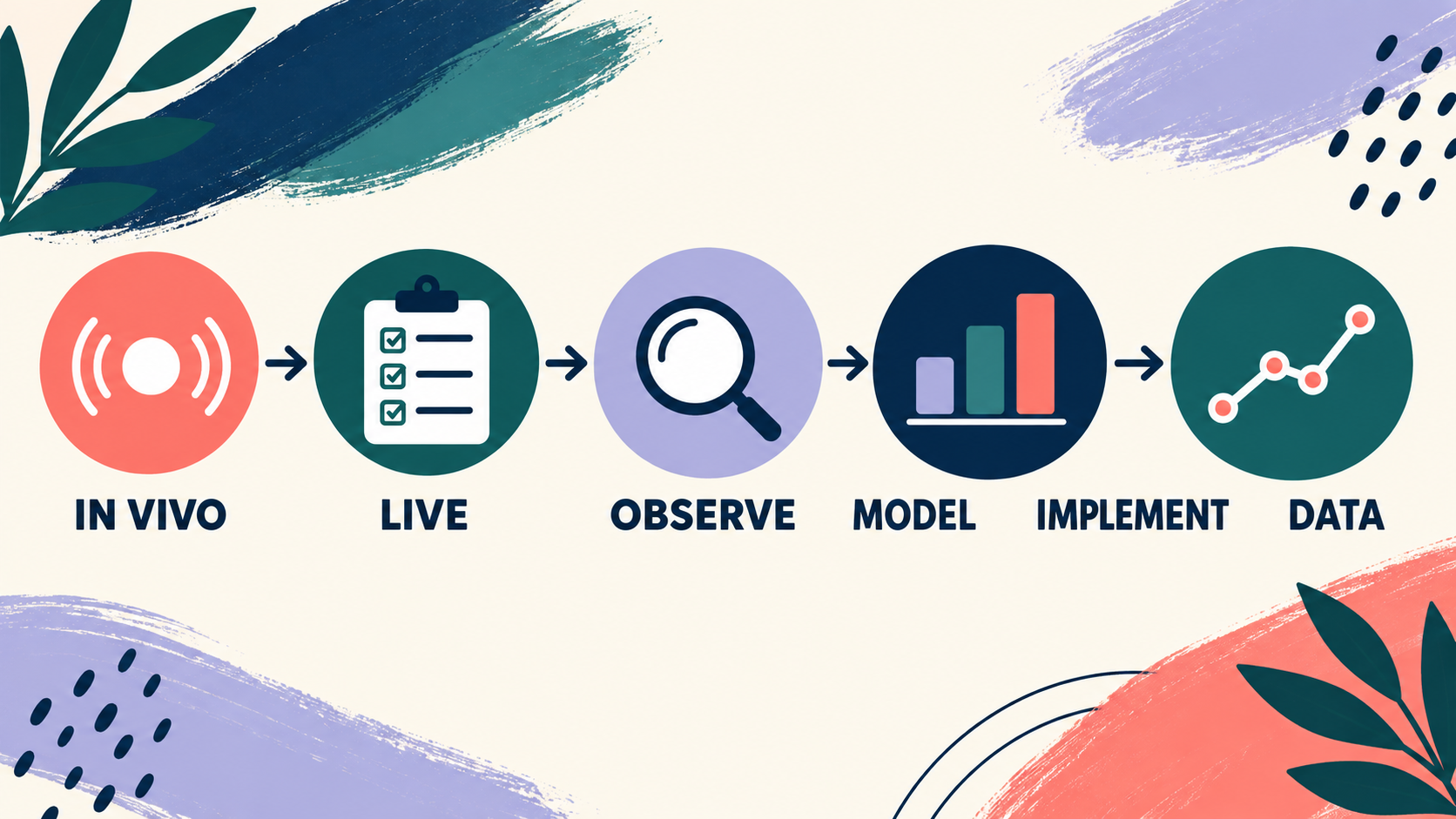
In vivo is a modifier, so the use changes with the activity. Three applications appear often in ABA education and practice. 1. In-vivo observation: In-vivo observation means watching behavior and relevant environmental events as they occur. A BCBA might observe a learner’s transition routine in a classroom, collect frequency or duration data during a community activity, or observe an implementer delivering a teaching protocol. The advantage is access to the actual sequence of antecedents, behavior, and consequences rather than relying only on memory or a written report.
Direct observation still requires a clear operational definition, a sampling plan, and an ethical reason for collecting the information. “Watch the session” is not enough. The observer should know what behavior is being measured, which environmental events matter, how data will be recorded, and whether the observation itself could change the situation.
2. In-vivo modeling: In-vivo modeling is a live demonstration of a target response. The model may demonstrate a communication response, a task step, an interaction, or an implementation skill while the learner or trainee watches. The learner then has an opportunity to respond, and the team can measure imitation, independent performance, prompts, errors, latency, or other relevant outcomes.
Research often compares live modeling with video modeling, but a study result should not be turned into a universal rule. A live model allows immediate responsiveness and can demonstrate a behavior that depends on another person’s moment-to-moment response. A video may provide a stable, repeatable example and can be replayed without requiring the model to perform again. The best choice depends on the target skill, learner variables, setting, resources, and data.
3. In-vivo training, role-play, or implementation: In behavioral skills training, a person may receive instruction, watch a model, rehearse the skill, and receive feedback. When the model or rehearsal occurs live, the training may be described as in vivo. The practice could be a role-play rather than a real client session, so “live” does not automatically mean “natural client context.” That distinction is why a careful description names both the format and the setting.
In-vivo implementation can also refer to carrying out an intervention during the real routine in which the target behavior matters. Here, the analyst should still check treatment integrity and outcome data. Merely being present in the natural setting does not prove that the intervention was implemented accurately or that generalization has occurred.
How Is In Vivo Different From Video Modeling and Naturalistic Teaching?
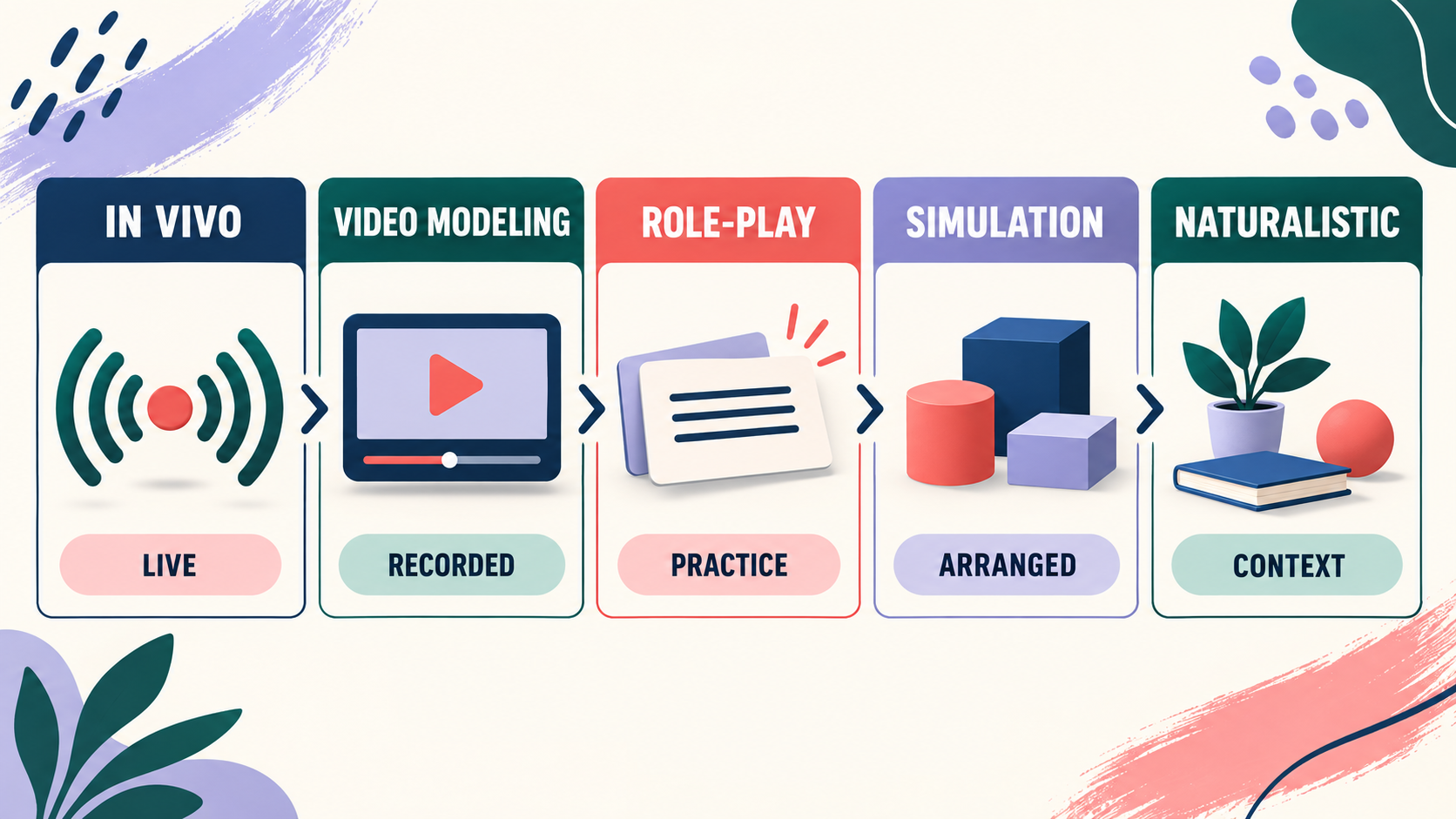
These terms answer different questions. In vivo mainly answers “Is it live and occurring in the moment?” Video modeling answers “Is the demonstration recorded and shown on a screen?” Naturalistic teaching answers “Is the teaching arranged around naturally occurring activities, motivation, materials, and consequences?” The same program may combine more than one feature.
| Term | What is happening? | Exam clue |
|---|---|---|
| In vivo | A live event, observation, demonstration, rehearsal, or implementation occurs in real time. | Look for “live,” “in person,” “directly observed,” or “real-time feedback.” |
| Video modeling | A recorded model is presented for the learner to watch before an opportunity to respond. | Look for a recording, screen, replay, or consistent filmed example. |
| Role-play | A person rehearses a situation under arranged practice conditions. | A live rehearsal can be in vivo, but role-play itself does not prove that the context is natural. |
| Simulation | A training arrangement approximates important features of the target situation. | A simulated session may be live or recorded; the key is that it is arranged rather than the target routine itself. |
| Naturalistic teaching | Teaching is arranged within meaningful activities and uses naturally relevant materials, motivation, or consequences. | The clue is the context and arrangement, not simply whether a person is physically present. |
The comparison is not a contest between formats. A recorded example can be used to prepare a learner for a live activity. A live observation can occur during a highly structured clinic routine. A naturalistic teaching opportunity can include live prompting and reinforcement. The correct label depends on the feature the question asks you to identify.
What Should Be Measured During In-Vivo Work?
Because in vivo is a format rather than an outcome, the measurement plan must be tied to the purpose of the activity. For in-vivo observation, record the target behavior and relevant environmental events. For in-vivo modeling, measure whether the learner attends, imitates, responds independently, needs prompts, or generalizes the skill. For live training, measure the trainee’s implementation accuracy and the effect of feedback. A practical checklist may include:
- What is live? Specify whether the live element is the observation, model, rehearsal, intervention, or feedback.
- What is the target? Define the learner behavior or implementer action in observable terms.
- What is the context? Record the setting, materials, people, cues, and level of structure.
- What is the response measure? Select a measure such as frequency, duration, latency, percentage correct, independent responses, or procedural-integrity percentage.
- What happens next? Plan for feedback, practice, generalization probes, maintenance checks, or a change in the teaching arrangement based on data.
Direct access to a live event can improve ecological information, but it can also introduce distractions, observer effects, or uncontrolled variation. A video can standardize what is presented and allow replay, but it may omit the learner’s real-time context. Neither method removes the need for operational definitions, reliable measurement, consent, privacy, and ethical decision-making.
What Does In Vivo ABA Look Like in a Scenario?
Imagine that a team is teaching a learner to ask for a break during a difficult classroom task. In one condition, the learner watches a recorded adult demonstrate the request. In a second condition, an adult demonstrates the request live in the classroom and then gives the learner an opportunity to respond. The second condition includes in-vivo modeling because the demonstration is live.
Now change the setting. The same adult demonstrates the request live in a quiet clinic room while the team uses arranged materials and scripted prompts. It is still in-vivo modeling, but it is not automatically a naturalistic classroom opportunity. The team would need additional data in the classroom to determine whether the response transfers to the routine where it is needed.
Finally, suppose a supervisor watches a technician implement the break procedure during the actual classroom routine. That is in-vivo observation of implementation. The supervisor should score the agreed-upon protocol steps, give respectful feedback, and review learner outcome data. “Observed live” tells you the format; it does not tell you whether the technician followed the plan or whether the plan worked.
What Are the BCBA Exam Clues?
On a BCBA-style question, identify the feature being tested before choosing an answer. The current BCBA Test Content Outline is the appropriate source for current exam content, while training documents may use in-vivo modeling and role-play as examples of live skill practice.
- “The analyst watches the behavior as it occurs in the classroom.” Think in-vivo observation or direct observation.
- “The learner watches an adult demonstrate the skill in person.” Think in-vivo modeling.
- “The learner watches a recording and then practices.” Think video modeling, not in-vivo modeling.
- “The trainee practices the procedure with an instructor who gives immediate feedback.” Think live rehearsal, in-vivo role-play, or behavioral skills training, depending on the stem.
- “The teaching uses the learner’s motivation and naturally occurring activity.” Think naturalistic teaching; do not select in vivo only because another person is present.
- “The intervention was observed live.” Ask what was measured next: observation format, treatment integrity, or client outcome.
When an item asks which method is in vivo, choose the option that explicitly describes a live event. When it asks which method is naturalistic, choose the option that describes the context and arrangement. When it asks whether the intervention was implemented correctly, look for treatment-integrity measurement rather than simply the fact that a supervisor was present. For additional scenario practice, the free BCBA mock exam is an independent study aid. It is not an official BACB product and does not replace the current TCO, handbook, supervision, or professional judgment.
What Mistakes Should You Avoid?
Keep these errors out of your notes and your exam reasoning:
- Treating in vivo as the name of a complete ABA treatment package.
- Assuming every live event occurs in the learner’s natural environment.
- Calling a recorded demonstration in vivo because the learner watches it during a real session.
- Assuming live modeling is always more effective than video modeling.
- Confusing direct observation with proof that an intervention was implemented with integrity.
- Using “naturalistic” when the stem is actually testing a live-versus-recorded distinction.
- Generalizing from one live observation without checking other sessions, implementers, settings, or data patterns.
In Vivo ABA FAQ
What does in vivo ABA mean in one sentence?: It means that an ABA-related observation, demonstration, rehearsal, training event, or intervention is happening live and in real time rather than only through a recording or simulated media.
Is in vivo the same as naturalistic teaching?: No. In vivo describes the live format. Naturalistic teaching describes the context and arrangement of teaching. A live clinic rehearsal can be in vivo without being naturalistic, and a naturalistic program can use recorded video as one part of preparation.
What is the difference between in-vivo and video modeling?: In-vivo modeling uses a live model whom the learner observes in the moment. Video modeling uses a recorded model presented on a screen or other playback device. The two can be compared, combined, or selected based on the skill and learner data. Does in vivo prove that the intervention is effective? No. It tells you how the event was delivered or observed. Effectiveness still requires appropriate outcome measurement, while implementation accuracy requires a procedural-integrity check.
Sources and Date Check
This article was reviewed on September 29, 2026 against the BACB sixth-edition Test Content Outline, the current RBT 40-hour training requirements, and the supervisor training curriculum outline. It also checked peer-reviewed comparisons of video and in-vivo modeling and in-vivo and video instruction. Terminology and professional requirements can change; verify current BACB materials before making a practice or exam decision.
Take the Free BCBA Mock Exam
If you want a low-pressure way to check your recall, use the free practice resource below. Take the Free BCBA Mock Exam



