
BACB ETHICS · SELF-REPORTING Searching for a self-report BACB answer usually means you need to distinguish a routine account update from information that may affect certification or ethics review. Start with the current BACB instructions, preserve accurate facts, and do not treat a study guide as a case-specific legal decision.
Table of Contents
- What Does Self-Reporting to the BACB Mean?
- What Kinds of Information May Require a Self-Report?
- How Do You Route the Situation Correctly?
- What Should You Check Before a BACB Self-Report?
- What Is the Self-Report Form Workflow?
- How Should You Think About Timing?
- What Mistakes Should Applicants Avoid?
- What Are the BCBA Exam Takeaways?
- Frequently Asked Questions
- Sources for Further Study
- Take the Free BCBA Mock Exam
What Does Self-Reporting to the BACB Mean?
Self-reporting means that an applicant or certificant provides information about a professional or personal event through the BACB’s designated reporting process when the current BACB requirements say that information must be reported. It is different from answering a study question, updating a profile, or asking a general support question. The reason for the report is usually that the event could affect certification status, ethical review, or the BACB’s ability to communicate with the person.
The phrase “self report BACB” is therefore a routing question before it is a form question. First identify whether the situation is an account-maintenance issue, a self-report, a report about another person, or a matter that belongs with an employer, licensing board, court, or emergency service. The BACB’s current self-reporting page and the applicable handbook control. A search snippet can help you find those sources, but it should not replace them.
Self-reporting is not the same as admitting every rumor or writing an unverified narrative. A useful submission is truthful, complete to the best of your knowledge, limited to relevant facts, and supported by the documents the BACB requests. If the situation involves an active investigation, criminal or civil matter, health condition, substance-use concern, client safety, or legal rights, obtain appropriate professional advice while following any applicable reporting deadline.
What Kinds of Information May Require a Self-Report?
The current BACB self-reporting guidance describes categories of events that applicants and certificants may need to report. The exact category and deadline depend on the facts and the current version of the BACB materials. Common examples include certain investigations, court or agency actions, agreements or orders, and conditions that could affect the safe and competent provision of services. Do not infer that an event is reportable—or not reportable—only because it sounds similar to a headline or to another person’s case. Keep three questions separate:
- What happened? Write the date, source of the information, people or agencies involved, and current status.
- What rule applies? Open the current BACB page, handbook, ethics code, and form instructions that match your credential or application status.
- What route is required? Decide whether the BACB self-report, another BACB reporting route, a profile update, or an outside agency is the correct next step.
How Do You Route the Situation Correctly?
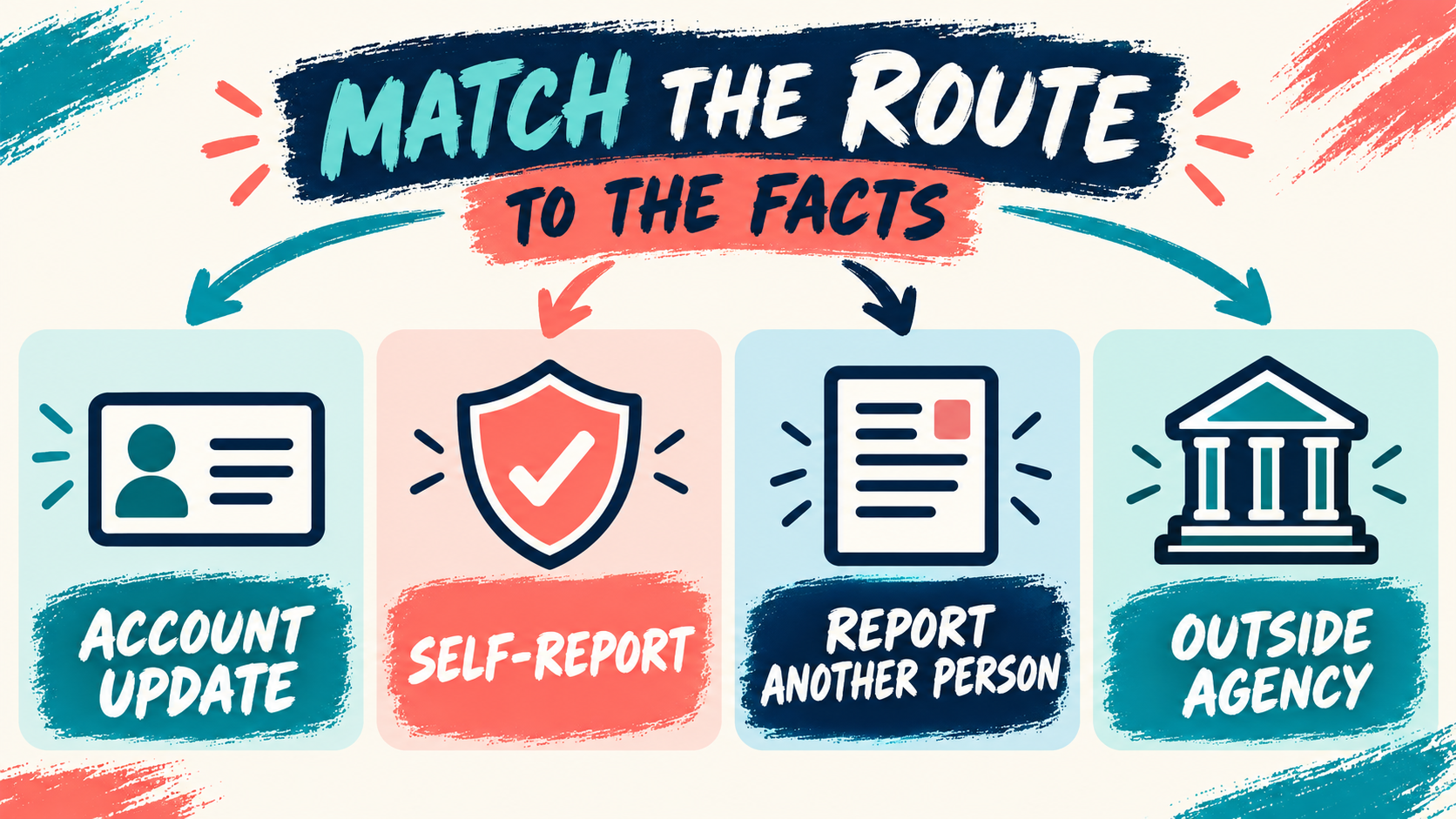
Routing matters because the BACB provides different processes for self-reporting, reporting an alleged violation by another person, reporting publicly available documentation, and correcting information in an account. The BACB also does not have jurisdiction over every organization or non-certificant. A complaint about a service provider may need to go to a state licensing body, employer, payer, law-enforcement agency, or another authority depending on the concern.
| Situation | Do not assume | First verification step |
|---|---|---|
| Name, address, or email changed | That every profile change is an ethics self-report. | Update the BACB account using the current account instructions and check whether another event is also present. |
| You learn of an investigation, order, charge, or qualifying agreement | That you should wait for the matter to end before checking the reporting rule. | Read the current self-reporting page for the event category, trigger, deadline, and required documentation. |
| You are concerned about your own conduct or competence | That deleting a record or privately fixing the issue removes the reporting obligation. | Protect clients, consult the appropriate supervisor or professional adviser, preserve records, and review the BACB self-report route. |
| You are worried about another certificant | That the self-report form is the correct form for someone else. | Use the BACB reporting hub to identify the route for an alleged violation and report only relevant, supportable information. |
What Should You Check Before a BACB Self-Report?
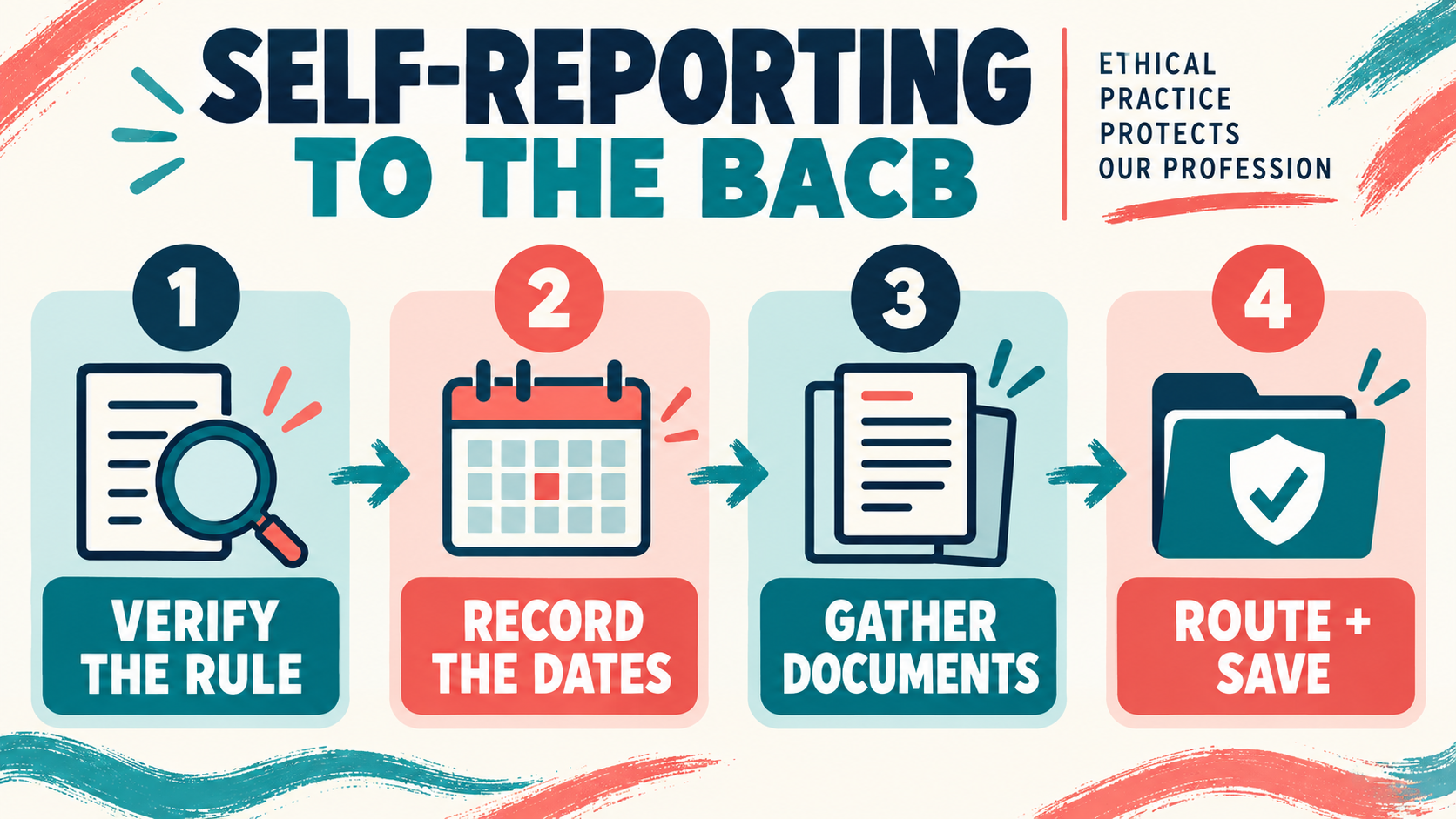
Before opening the form, create a short source-and-facts checklist. This reduces the risk of submitting a rushed explanation, omitting an attachment, or mixing assumptions with verified information.
- Confirm the credential status. Note whether you are a BCBA, BCaBA, RBT, BCBA-D, applicant, or another status named in the current instructions.
- Locate the controlling page and form. Use the current BACB self-reporting page and the form linked from it rather than an old screenshot or a third-party template.
- Record dates precisely. Separate the date an event occurred, the date you learned about it, the date an investigation began, and the date an order or agreement was received or signed.
- Collect relevant documents. Keep copies of notices, orders, agreements, or other requested records. Remove unrelated private information when the form instructions permit or require it.
- Describe facts, not conclusions. Identify who issued a document, what it says, and its current status. Do not label an allegation as a final finding.
- Check safety and competence. If a health, substance-use, or other condition may affect safe service delivery, follow the current BACB instructions and obtain appropriate care or professional advice.
- Confirm submission evidence. Save the confirmation, submitted statement, attachments, and any follow-up request in a secure location.
This checklist does not decide whether your individual situation is reportable. It makes the decision reviewable. If the official wording remains unclear, contact the BACB through its current channel and obtain qualified legal or professional advice when your rights or safety are involved.
What Is the Self-Report Form Workflow?
The current BACB process presents a sequence that typically includes an attestation, personal and certification information, details about the situation, supporting documentation, and a signature. Read every field before writing a long narrative. A form may ask different follow-up questions depending on the type of event, health or competence concern, professional role, or document available. Use a plain, chronological structure for the narrative:
- Trigger: how you learned of the situation and which source notified you;
- Facts: what occurred, when it occurred, and what has or has not been decided;
- Action: what you did to protect clients, comply with an order, obtain care, notify an appropriate party, or correct a record;
- Documents: what you are attaching and why a requested item is unavailable;
- Current status: what remains open, what has been resolved, and how the BACB can contact you.
Do not use the form to argue that you deserve a particular outcome. The role of the submission is to provide the information the BACB needs for its process. Keep a private copy, respond to follow-up requests through the official channel, and update your records if the underlying matter changes.
How Should You Think About Timing?
Timing is fact-specific. The BACB self-reporting page gives different triggers and time windows for different categories, including certain investigations and orders. That is why a generic sentence such as “report within 30 days” is unsafe when it is detached from the event type. Start the clock from the trigger the current BACB instruction identifies, not from a convenient date in your calendar.
When you discover a possible reportable event, write a mini timeline immediately and mark the earliest plausible deadline. Then verify the category and required timing against the current page and form. If a deadline may be close, do not delay source checking while trying to create a perfect narrative. Submit the information required by the current process and keep a record of questions or missing documents.
What Mistakes Should Applicants Avoid?
The most serious mistakes are usually routing and accuracy mistakes, not formatting mistakes:
- using an old third-party checklist after the BACB has changed its form or instructions;
- treating a profile update as a substitute for an ethics self-report;
- waiting for an investigation or court matter to end before checking the current trigger;
- including rumors, diagnoses, accusations, or private details that are not relevant to the requested process;
- deleting or altering records instead of preserving the original and documenting a correction;
- assuming that a self-report guarantees a particular certification decision or closes the matter.
If you have already made an incomplete or inaccurate submission, do not create a second contradictory story. Review the official follow-up route, preserve the original submission, and seek appropriate professional guidance about how to correct the record.
What Are the BCBA Exam Takeaways?
For a BCBA ethics question involving a self-report BACB scenario, separate the event from the route. The best answer usually checks the current BACB requirement, distinguishes account maintenance from self-reporting, identifies the relevant date trigger, preserves truthful facts, and protects clients while the issue is reviewed.
- Do not treat a search snippet or an old form as the controlling source.
- Separate a profile update, self-report, report about another person, and outside-agency complaint.
- Use dates, documents, and current status rather than speculation or labels.
- Check the event-specific timing and keep proof of submission.
- Do not claim that a self-report guarantees certification, reinstatement, or a particular outcome.
After you understand the ethics-routing distinction, the site’s free BCBA mock exam can provide additional practice with scenario-based ethics and certification questions. It is an independent study resource, not official BACB content and not a guarantee of certification.
Frequently Asked Questions
Is changing my address a BACB self-report?: The current BACB self-reporting page distinguishes ordinary account information from events that may affect certification or ethics review. Update account information through the current account process, and check separately whether another reportable event exists.
Should I wait until an investigation is finished?: Do not assume that waiting is permitted. The current BACB instructions identify the trigger and timing for specific categories. Review the applicable page as soon as you learn of the investigation and follow the official process.
Can I use a self-report to report another person?: Usually you should use the reporting route that matches the concern. The BACB reporting hub separates self-reporting from reports about alleged violations by another person and from publicly available documentation.
Sources for Further Study
- BACB Self-Reporting — current categories, account-update distinction, form sequence, and timing guidance.
- BACB Reporting to the Ethics Department — reporting routes and jurisdiction context.
- BACB Self-Reporting Statement — official statement resource and requested information.
- BACB Ethics Code for Behavior Analysts — current ethics standards and professional responsibilities.
Take the Free BCBA Mock Exam
If you want a low-pressure way to check your recall, use the free practice resource below. Take the Free BCBA Mock Exam



