
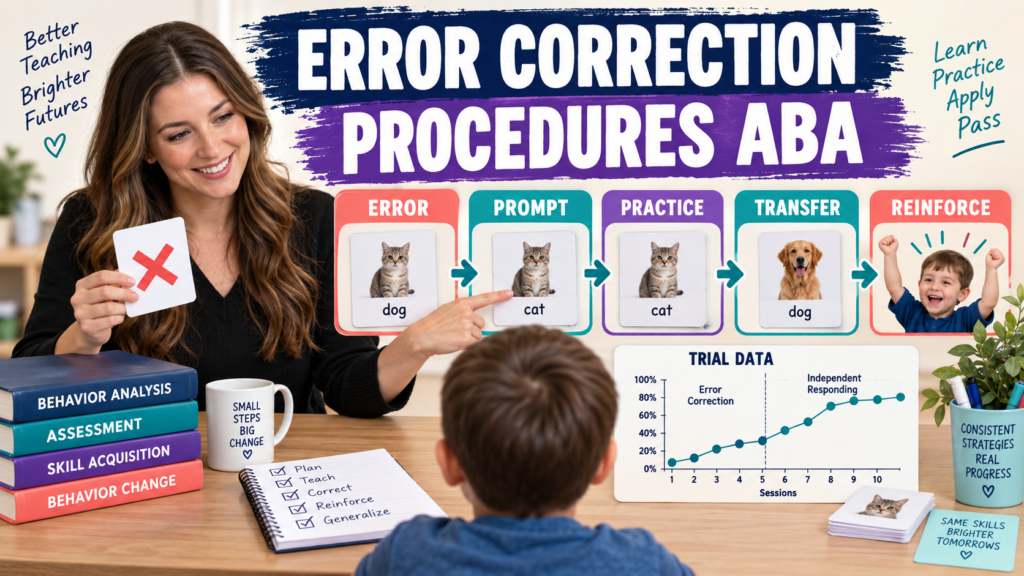
error correction procedures ABA are planned responses to an incorrect, absent, or prompted response during teaching. The goal is not to shame the learner or force a perfect trial; it is to interrupt the error, model or prompt the correct response, provide an appropriate practice opportunity, and check whether the learner can respond independently on a transfer trial.
Table of Contents
- What Are Error Correction Procedures ABA?
- What Happens After an Error?
- Which Error Correction Procedures Are Common?
- How Is Error Correction Different From Errorless Learning?
- How Should Error-Correction Data Be Recorded?
- How Do You Choose a Procedure?
- What Mistakes Weaken Error Correction?
- What Does the BCBA Exam Test?
- What Safeguards Belong in the Plan?
- Error Correction Procedures ABA FAQ
- Take the Free BCBA Mock Exam
For BCBA exam questions, the important clue is timing. Error correction happens after an error has occurred. Errorless teaching places a prompt before the learner is likely to make an error. Neither label tells you which procedure is automatically best for every learner. The program should specify the response definition, prompt, consequence, data rule, and conditions for changing the plan.
This guide explains common error-correction arrangements, why the steps vary across programs, how to separate prompted from independent performance, and how to choose an answer without treating one agency’s script as a universal BACB requirement. The current BCBA Test Content Outline provides the examination context; a supervisor and treatment team must determine the individualized teaching procedure. Table of Contents
What Are Error Correction Procedures ABA?
Error correction procedures ABA are instructional arrangements used after a learner gives an incorrect response, does not respond within the defined interval, or responds with the wrong topography during a teaching opportunity. The procedure describes what the instructor does next. It may include neutral feedback, a prompt or model, a practice response, a brief distractor, a re-presentation of the original instruction, and reinforcement for the correct response.
The central function is instructional: arrange another opportunity for the correct response to contact the programmed consequence while avoiding reinforcement for the error itself. That does not mean every error should be physically blocked or that “correcting” means delivering a reprimand. The response should be defined in advance, implemented calmly, and selected for the learner, skill, context, and risk.
Error correction is not a single copyrighted script or BACB-mandated sequence. Different programs use different names, numbers of steps, prompt levels, transfer-trial rules, and reinforcement arrangements. On the exam, identify the functional sequence described in the question instead of memorizing a label without reading the timing and consequence.
What Happens After an Error?
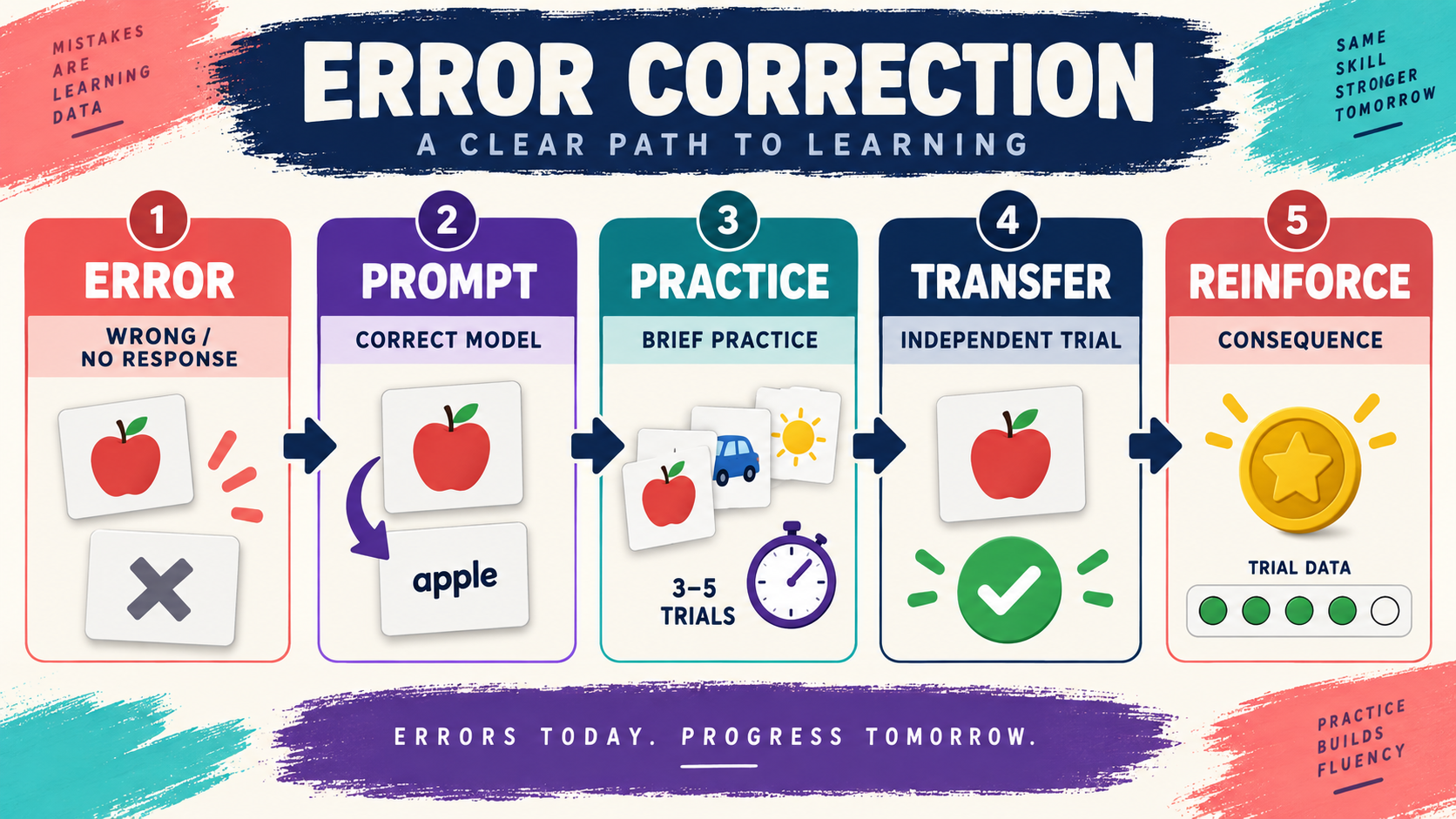
A common correction sequence can be represented as five decisions:
- Identify the response. Decide whether the learner made an error, did not respond, or produced a response that was correct only with a prompt.
- Deliver the planned feedback. Use the neutral statement, interruption, or consequence written in the teaching plan. Do not improvise a lecture or show that the error produced attention.
- Prompt the correct response. Model, gesture, point, repeat the instruction, or use another approved prompt at the level specified by the plan.
- Practice the response. Give the learner a brief opportunity to contact the correct response, sometimes with a known or easy item between the correction and the re-presented target.
- Run a transfer trial and record it. Re-present the instruction with less or no help when appropriate, then score whether the response was independent and what consequence followed.
Which Error Correction Procedures Are Common?
Names vary, so define each procedure by observable actions rather than a label alone. Four-step or transfer-trial correction. A commonly taught arrangement is to stop or give neutral feedback, prompt the correct response, insert a brief mastered or distractor trial, and then re-present the original instruction for an independent transfer response. Some versions count the initial correction, prompted practice, distractor, and transfer trial as four steps; others separate the consequence or include a second practice response. The important features are the prompt timing, the opportunity to respond without the prompt, and the rule for reinforcement.
Model-lead-test or prompt-practice-transfer. The instructor first demonstrates or prompts the correct response, has the learner practice it, and then tests the response again with the original cue. “Test” does not mean a high-stakes exam; it means an opportunity to see whether the response occurs under the relevant instruction with less assistance. If the learner requires the same prompt again, record prompted performance rather than calling the transfer response independent.
No-no-prompt and related arrangements. Some programs use a brief “no-no-prompt” sequence or another repeated-prompt format after an incorrect response. The instructor may block the incorrect answer, repeat the instruction, and increase the prompt until the correct response occurs. The exact steps, stopping rule, and reinforcement plan must be written clearly. A label is not enough to determine whether the procedure is appropriate, and physical guidance requires especially careful authorization, training, assent, and safety review.
Correction embedded in naturalistic teaching. Error correction is not limited to table-based discrete-trial teaching. In naturalistic instruction, the instructor may arrange another opportunity within play, conversation, a routine, or a functional activity. The prompt can be embedded in the environment, the consequence can be natural, and the transfer opportunity can occur during the next meaningful interaction. The data still need a clear opportunity definition and a distinction between independent, prompted, and missed responses.
How Is Error Correction Different From Errorless Learning?
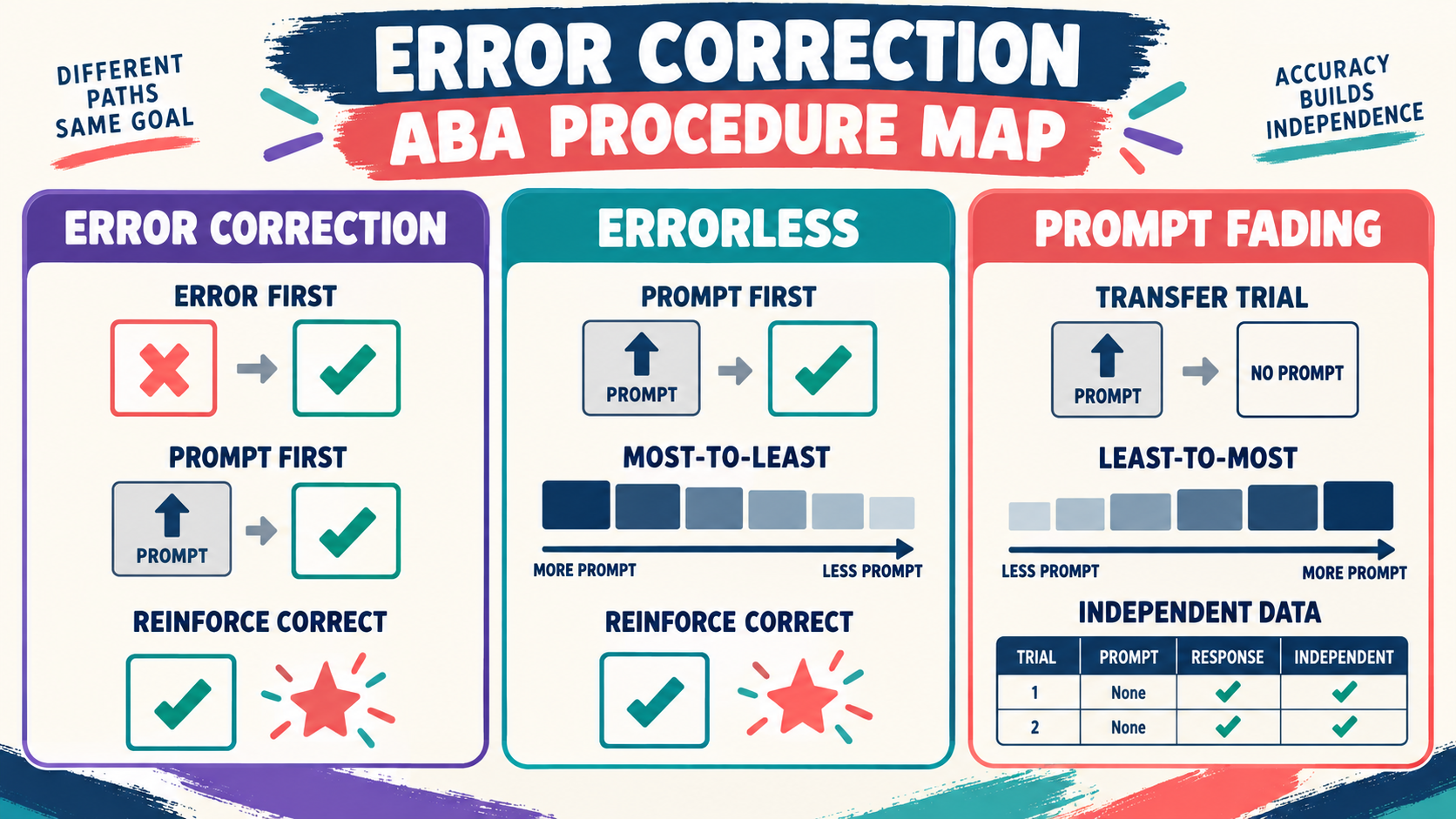
The cleanest distinction is when the learner gets the opportunity to respond without the controlling prompt. Error correction allows an error or no response to occur first and then provides a planned correction. Errorless learning arranges a prompt early enough that the learner is unlikely to make the error. Prompt fading is the process of transferring control from the prompt to the natural instruction or stimulus; it can be used in errorless teaching and in other teaching arrangements.
| Arrangement | When support appears | Exam clue |
|---|---|---|
| Error correction | After an incorrect, absent, or otherwise defined error response. | Error first, then prompt or model, practice, and possible transfer trial. |
| Errorless teaching | Before an error is likely, often immediately after the instruction or stimulus. | The prompt is arranged first to minimize incorrect responding. |
| Most-to-least fading | Starts with a stronger prompt and systematically reduces prompt intensity. | Prompt level decreases across teaching while independent responding is probed. |
| Least-to-most prompting | Begins with the least intrusive prompt and adds assistance only if needed. | The learner gets an independent opportunity before more help is added. |
One randomized clinical trial comparing error correction with most-to-least errorless learning for tact relations found both procedures effective and efficient in that study, with more independent correct and incorrect responding in the error-correction group. It was specific to that sample and skill, not a universal winner.
How Should Error-Correction Data Be Recorded?
Record enough information to show what the learner did without help. At minimum, define the opportunity, initial response, prompt level, final response, consequence, and whether the transfer trial was independent. A single “correct” mark can hide prompt dependence if a prompted response and an independent response are placed in the same column.
- Initial response: independent correct, incorrect, no response, or another defined category.
- Prompt level: model, gesture, positional, verbal, partial physical, full physical, or the system used in the plan.
- Transfer response: independent correct, prompted correct, incorrect, or no response.
- Consequence: what followed the response, including natural reinforcement or the programmed reinforcer.
- Context: target, instructor, materials, position, setting, and any relevant protocol deviation.
Do not count a prompted correction as independent mastery merely because the learner eventually said or selected the correct answer. The correction may be useful practice, but the independent transfer trial answers a different question. Graph those outcomes separately when the teaching decision depends on independence, fluency, or prompt fading.
How Do You Choose a Procedure?
Start with the learning question, not the most familiar script. If the learner has a stable error pattern, the team may need to examine the stimulus arrangement, distractors, response effort, prompt, reinforcer, and history of instruction before adding more correction. If an error is costly, distressing, or unsafe, an errorless arrangement or a different teaching context may deserve consideration. If independent responding is the main goal, the plan must contain frequent opportunities to test independence.
- Define the target: specify what response counts as correct and what counts as an error.
- Review assessment information: consider prerequisite skills, communication mode, preferences, response effort, and relevant environmental variables.
- Specify the prompt and fade rule: say what the instructor will do, when, and how support will be reduced.
- Specify reinforcement: define what follows independent and prompted responses without making essential needs contingent on performance.
- Set a decision rule: use data to decide when to change materials, prompt level, error correction, task difficulty, or mastery criterion.
- Train implementers: use modeling, rehearsal, feedback, and fidelity checks so two instructors do not run two different procedures.
The best procedure is the one that fits the skill and produces meaningful, independent, generalized performance with acceptable learner experience. A correction script should not become a substitute for examining whether the instruction is clear, the task is accessible, or the goal matters to the learner.
What Mistakes Weaken Error Correction?
Many weak correction procedures fail because they describe the instructor’s intention but not the observable contingency. “Correct the child and praise them” does not state what happens after an incorrect response, how the correct response is prompted, or whether praise follows a prompted response, an independent transfer response, or both.
- Using a different correction sequence from one instructor to the next.
- Giving the error extended attention, repeated explanations, or an emotional reaction.
- Skipping the transfer trial and calling the prompted response independent.
- Keeping the same distractor, card position, or verbal wording until the learner memorizes a pattern.
- Continuing a procedure even when errors, distress, escape behavior, or prompt dependence increase.
- Changing prompts, reinforcement, materials, and mastery criteria at the same time, making the data uninterpretable.
An error is information about the interaction between the learner and the teaching arrangement. Treat it as a reason to inspect the program, not as a reason to blame the learner. If performance stalls, the BCBA should review the target definition, task analysis, assessment, stimulus control, reinforcement, treatment integrity, and generalization plan.
What Does the BCBA Exam Test?
On a BCBA exam item, reconstruct the trial in order. Ask whether the learner was allowed an independent opportunity, when the prompt appeared, what happened after the error, and which response was reinforced. Then classify the procedure from those observable details.
- Error correction: the correction follows an error or no response.
- Errorless teaching: the prompt is delivered early to prevent or minimize an error.
- Transfer trial: the original cue is presented again with less or no help to test stimulus control.
- Prompt dependence: accuracy remains high only when a prompt is present.
- Procedural integrity: the implementer follows the written steps accurately and consistently.
Be cautious with answer choices that call a procedure “always best,” “always unethical,” or “proven effective for every learner.” The BACB outline includes prompt and prompt-fading procedures, teaching procedures, contextual fit, and data-based evaluation, but it does not turn one named error-correction sequence into a universal protocol for every case.
What Safeguards Belong in the Plan?
Error correction should support learning, communication, dignity, and meaningful participation. Avoid using correction to force a learner to perform a response that is painful, inaccessible, or unrelated to a socially significant goal. The plan should account for assent and refusal, accessible communication, safety, cultural and contextual variables, and the learner’s ability to understand and use the response.
Do not withhold food, medication, essential care, or a needed break to make a correction procedure work. When a target is associated with severe behavior or medical risk, the team needs qualified assessment, a safety plan, and appropriate supervision. A study article can explain the logic of a procedure; it cannot authorize implementation for a particular learner.
Error Correction Procedures ABA FAQ
What is error correction in ABA?: It is a planned teaching response after an incorrect, absent, or otherwise defined error. The instructor provides the specified feedback or prompt, arranges a correct response, and records the outcome according to the program.
What is the difference between error correction and errorless learning?: Error correction allows an error or no response to occur before the correction. Errorless learning arranges a prompt before the learner is likely to respond incorrectly. Prompt fading may be used in either broader teaching arrangement.
Is a four-step correction procedure required by the BACB?: No. Four-step or transfer-trial formats are commonly taught, but the BACB does not require one universal error-correction script. The written, individualized procedure and current professional requirements control the implementation.
Should prompted correct responses count as correct?: They can be recorded as prompted correct responses, but they should not be combined with independent correct responses when the goal is to measure unprompted performance. Keep the prompt level visible.
What should happen if errors keep increasing?: Pause and review the teaching arrangement with the responsible BCBA. Check the target definition, prerequisite skills, materials, prompt, reinforcement, response effort, learner assent, and treatment integrity before simply adding more correction. After reviewing the distinctions, use the free BCBA mock exam as a study checkpoint. It is an independent study aid, not an official BACB product, clinical authorization, or guarantee of certification.
The exam-ready summary is simple: error correction comes after the error, the prompt should produce a useful correct response, the transfer trial tests independence, and the data must show what happened with and without help. That is the logic behind defensible error correction procedures ABA.
Take the Free BCBA Mock Exam
If you want a low-pressure way to check your recall, use the free practice resource below. Take the Free BCBA Mock Exam



