
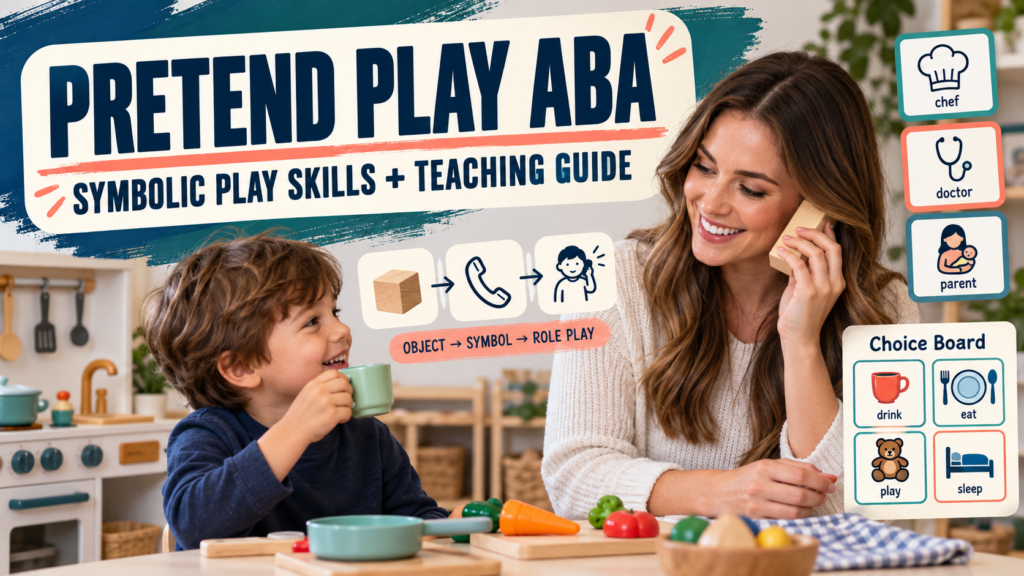
Pretend play ABA is not one single behavior. It is a teachable group of play skills in which a learner uses an object, action, role, or sequence to represent something beyond its immediate physical function. A block may become a phone, a toy animal may be fed, or a learner may act out a short doctor visit.
Table of Contents
- What Is Pretend Play ABA?
- Pretend Play Versus Functional, Parallel, Joint, and Sustained Play
- A Pretend Play Skill Progression: Functional Action to Role Sequence
- How to Choose a Pretend Play Goal
- How to Teach Pretend Play in Small Steps
- Prompting, Modeling, and Fading Without Taking Over
- Use Choice, Assent, and Learner Interests
- How to Generalize Pretend Play
- How to Measure Pretend Play
- Common BCBA Exam and Fieldwork Mistakes
- FAQ
- Sources to Verify the Topic
- Take the Free BCBA Mock Exam
For behavior analysts, the useful question is not whether a learner looks imaginative enough. The useful question is: what observable play response would be meaningful for this learner, in which context, and how will progress be measured? A good plan protects choice, builds from interests, and makes the target specific enough to teach and generalize.
This guide explains pretend and symbolic play in ABA, separates it from functional, parallel, joint, and sustained play, and shows how to write goals, use modeling and prompting, fade support, measure progress, and avoid turning play into a rigid performance test. The research literature includes adult-directed teaching, video modeling, and naturalistic approaches, but it also warns that generalization and learner experience matter. Table of Contents
What Is Pretend Play ABA?
Pretend play, also called symbolic or imaginative play, occurs when an object, action, or role is used in a nonliteral way. The learner may use a block as a phone, pretend to pour tea into an empty cup, make a toy animal “sleep,” or take on a role such as chef, doctor, or bus driver. The behavior is observable even though the imagined story is private: the analyst can define the object use, action, sequence, or verbal statement that will count.
Pretend play is different from simply manipulating a toy. Turning a car’s wheels, stacking blocks, or pushing a vehicle along a track may be functional play. Pretending that a block is a phone adds a representational or symbolic component. A learner does not need to perform every type of pretend play, and a preference for sensory, construction, movement, or object-focused play is not automatically a deficit. The target should be selected because it supports the learner’s own participation, communication, access, or social goals.
Research reviews describe pretend play as complex and caution against assuming that pretend play alone causes broad developmental outcomes. Define the skill narrowly, teach in a motivating context, and check it with new toys, people, and settings.
Pretend Play Versus Functional, Parallel, Joint, and Sustained Play
These terms can overlap, but they describe different features. A learner can engage in pretend play alone or with a partner; a joint-play routine can include pretend play, but joint play is defined by shared participation and connected actions rather than by imagination alone.
| Play type | Observable focus | Example |
|---|---|---|
| Functional play | Uses an item according to its ordinary or designed function. | Pushes a toy car along a track. |
| Pretend / symbolic play | Uses an object, action, or role to represent something nonliteral. | Uses a block as a phone and talks into it. |
| Parallel play | Plays near another person without requiring connected actions. | Two learners build separately at the same table. |
| Joint play | Shares a theme, turn, action, or product with a partner. | One partner pretends to cook while the other serves. |
| Sustained play | Measures continued engagement over time. | Remains engaged with a play activity for a defined duration. |
For exam questions, match the wording to the feature: a block-as-phone is symbolic play, playing beside a peer is parallel play, and shared turns are joint play.
A Pretend Play Skill Progression: Functional Action to Role Sequence
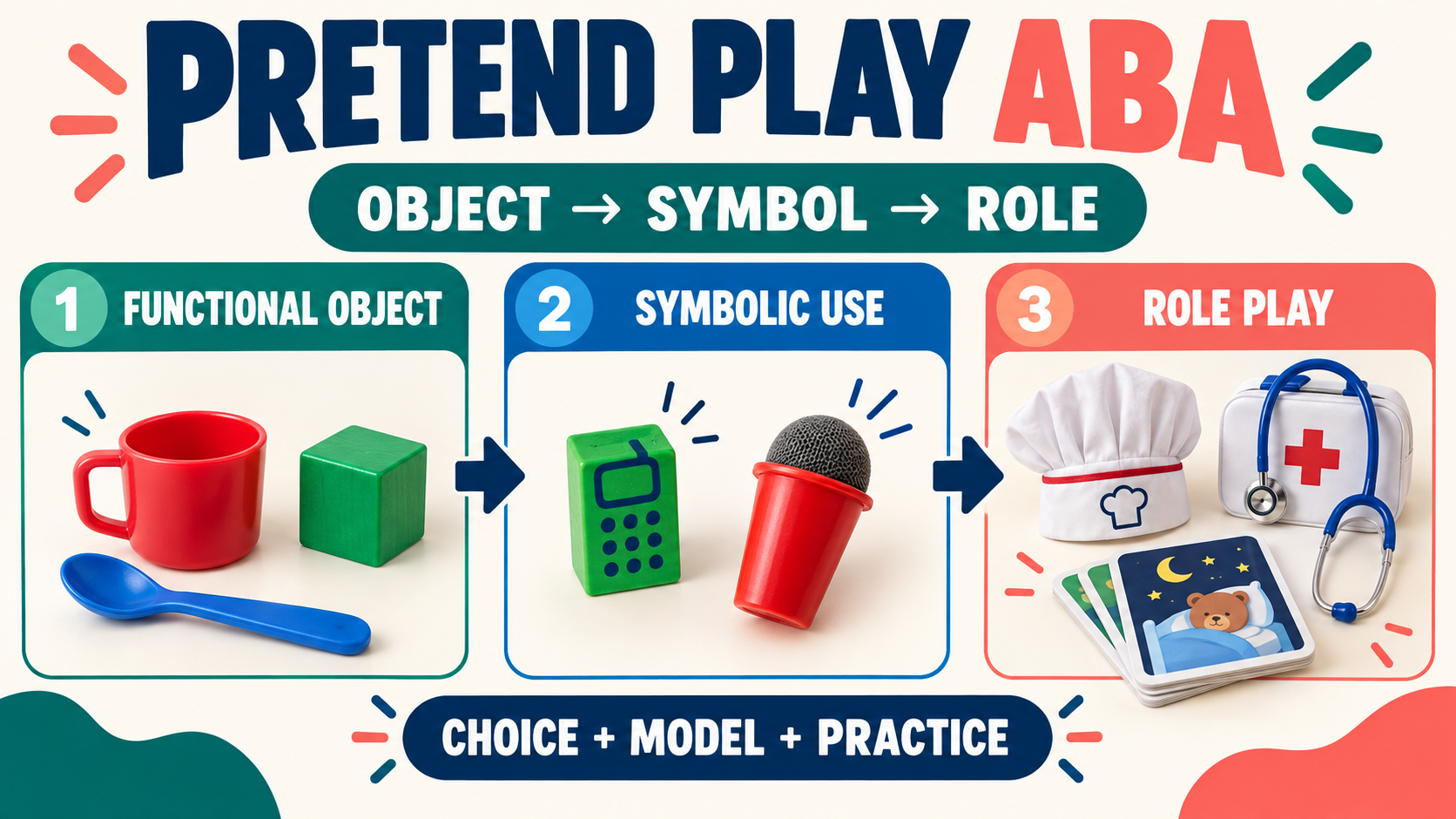
A progression is a teaching hypothesis, not a universal developmental ladder. One useful sequence moves from familiar actions to flexible symbolic combinations:
- Functional action: the learner uses the item as designed, such as stirring with a spoon or rolling a car.
- Single pretend action: the learner performs one representational action, such as feeding a doll or pretending to drink from an empty cup.
- Object substitution: the learner uses a neutral item for another object, such as using a block as a phone.
- Action combination: the learner links two or more actions, such as preparing food and serving it.
- Role or story sequence: the learner performs a short, flexible routine with a beginning, middle, or end and can respond to a partner’s variation.
Start at the lowest step that is meaningful and achievable, then build only when the learner is contacting reinforcement and showing stable responding. A child who already engages in symbolic actions does not need to repeat easier steps simply because they appear in a curriculum. The sequence should guide assessment, not replace it.
How to Choose a Pretend Play Goal
Good goals describe a response that can be observed, measured, and connected to a meaningful opportunity. “Will use more imagination” is not a measurable target. “During a chosen play routine, will complete three related pretend actions with no more than a gestural prompt in 4 of 5 opportunities” is closer, but the team should still define the routine, prompt, opportunity, and reinforcement.
Before writing the goal, sample play across preferred and less familiar materials. Look for spontaneous actions, imitation, choice-making, partner tolerance, and the learner’s way of communicating “no.” Ask what the goal will make easier: joining a sibling, communicating a request, expanding an interest, or participating in a self-selected story.
Keep the goal specific enough to teach but flexible enough to honor variation. A learner might pretend to cook with a toy pan, a real bowl, or a cardboard box. If the functional outcome is symbolic action or shared participation, do not make one exact toy the only acceptable response unless that limitation is necessary.
How to Teach Pretend Play in Small Steps
A practical teaching sequence can combine naturalistic play, modeling, shaping, and reinforcement:
- Join the existing play. Observe what the learner chooses and imitate or comment without immediately redirecting.
- Add one small variation. If the learner pushes a car, add a short “car stops” or “car goes to the garage” action.
- Model the target. Demonstrate one brief pretend action, then pause long enough for the learner to respond or communicate.
- Prompt only as needed. Use the least intrusive prompt that helps the learner contact the relevant action.
- Reinforce meaningful participation. Continue the preferred routine, honor communication, and provide social or activity-based reinforcement when appropriate.
- Vary the materials gradually. Add a second toy, a different prop, a new action, or a small change in the story after the learner is successful.
Keep the routine playful: a pause and meaningful choice are often more informative than repeated instructions to “pretend.”
Prompting, Modeling, and Fading Without Taking Over
Modeling can show what a pretend action looks like; prompts can help the learner contact the response; fading transfers control to natural cues, materials, and the learner’s own play plan. Record the prompt level so an apparently independent sequence is not actually dependent on continuous adult direction.
A useful prompt hierarchy might move from a natural cue, to a model, to a gesture, to a brief verbal cue, and then to more intrusive assistance only when the plan justifies it. The exact order is not universal. The important questions are whether the prompt is necessary, whether it is delivered consistently, and whether it is systematically faded.
If the adult creates every idea, prop, and line, the learner may be demonstrating imitation rather than flexible pretend play. Measure independent initiations, variations, and response to a partner separately when those are part of the goal.
Use Choice, Assent, and Learner Interests
Play is not valuable merely because it looks typical to an adult. The BACB Ethics Code provides the professional context for respecting clients, using individualized goals, and considering assent and client preference. In practice, offer meaningful choices, watch for communication that the learner wants to pause or stop, and do not punish a learner for choosing a different form of play.
Interests can be a bridge to pretend play. A learner who loves trains may practice a station routine; a learner who loves letters may create a pretend mail route; a learner who prefers sensory movement may act out a delivery or rescue sequence with built-in movement. The theme can change while the behavioral target remains clear: object substitution, imitation, sequencing, requesting, turn-taking, or flexible variation.
Be careful with goals that exist only to make a learner appear more typical. A good plan asks whether the skill increases access, communication, autonomy, enjoyment, or participation. It should not erase harmless self-directed play or require eye contact, forced affect, or scripted language unrelated to the learner’s actual goal.
How to Generalize Pretend Play
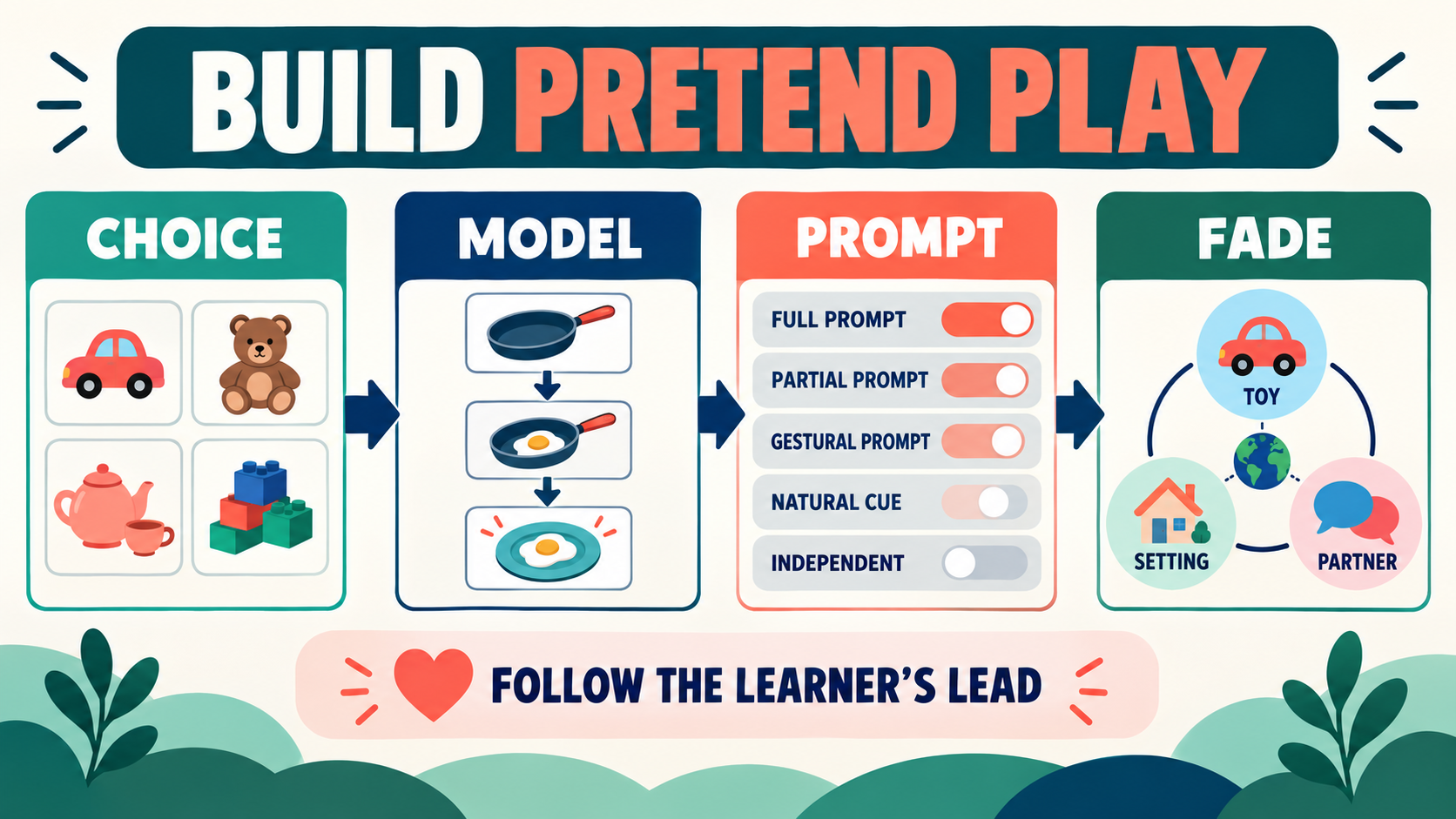
A pretend action learned with one toy in one therapy room may not transfer automatically. Plan variation deliberately, but change one variable at a time so you can identify what supports or disrupts the skill.
- Materials: use a preferred toy, a similar toy, and a neutral or improvised object.
- Actions: vary the verb or outcome while preserving the symbolic idea.
- Setting: practice in the clinic, home, classroom, or playground when appropriate.
- Partner: vary the adult, sibling, peer, or independent-play context.
- Story: introduce a small change and reinforce flexible responding rather than one memorized script.
Measure generalization instead of assuming it. If the learner pretends to feed one doll only after an adult models the action, that is useful progress but not the same as independently using the action with a new figure. Report the materials, setting, partner, prompt level, and response definition with the data.
How to Measure Pretend Play
Choose the measurement system that matches the target:
| Target dimension | Possible measure | Example data question |
|---|---|---|
| Independent pretend actions | Frequency or percentage of opportunities | How many defined chances included an independent symbolic action? |
| Length of engagement | Duration | How long did the learner remain engaged in the chosen routine? |
| Sequence completion | Task analysis or permanent product when a product remains | Which defined actions occurred in the story sequence? |
| Partner participation | Event recording or opportunity-based scoring | Did the learner respond to or initiate a partner’s play idea? |
Define what counts as an action, an opportunity, an independent response, and a prompt. If the target is a flexible story, do not score only whether the learner repeated the adult’s exact script. If the target is shared play, measure reciprocity separately from symbolic object use. The data should answer the goal, not simply reward the easiest behavior to count.
Common BCBA Exam and Fieldwork Mistakes
- Confusing symbolic play with joint play: pretend play can be solitary; joint play requires connected participation with another person.
- Assuming a developmental sequence is universal: assess the learner instead of forcing every step in order.
- Counting adult prompts as independent play: record prompt level and fade support.
- Using duration to answer a symbolic-action question: duration shows time engaged, not necessarily the quality or type of play.
- Ignoring generalization: one toy, adult, and room do not demonstrate flexible use across contexts.
- Defining success as looking typical: select socially meaningful, individualized goals and honor communication to stop or change the activity.
For BCBA exam preparation, translate the scenario into the response, opportunity, prompt level, and measurement dimension. The free BCBA mock exam can provide optional practice with those distinctions, but it is not individualized clinical guidance or a substitute for supervision.
FAQ
What is an example of pretend play in ABA?: A learner uses a block as a phone, pretends to feed a toy animal, or acts out a short cooking routine. The target should be operationally defined so the observer can score the action without guessing the learner’s private thoughts.
Is pretend play the same as joint play?: No. Pretend play describes symbolic or nonliteral use of objects, actions, or roles. Joint play describes connected participation with another person. A shared pretend cooking routine can be both, but pretend play can also happen independently.
How do you measure pretend play?: Measure the dimension named in the goal: frequency or percentage of opportunities for independent actions, duration for sustained engagement, task-analysis steps for a sequence, or event recording for partner initiations and responses. Always record prompts and context.
Should ABA make a child engage in pretend play?: A program should not force a learner to perform a preferred-looking play style for appearance alone. Use choice, assent, interests, and socially meaningful outcomes. If pretend play is a meaningful goal, teach it gradually and respect communication to pause, refuse, or choose another activity.
Sources to Verify the Topic
- Pretending to Play or Playing to Pretend: The Case of Autism — review of pretend play, autism, teaching approaches, and generalization questions.
- Playing to Pretend or “Pretending” to Play — review of play characteristics and assessment considerations.
- Teaching Pretend Play to Toddlers with Autism — dissertation research on modeling, prompting, and play-scenario teaching.
- Play-Based Interventions for Children and Adolescents with Autism — systematic-review context for play interventions.
- BACB Ethics Codes — professional context for individualized, respectful practice.
Bottom line: pretend play ABA should mean a clear, meaningful, and measurable symbolic-play goal—not a demand to perform one “normal” way to play. Start with the learner’s interests, define the response, model and prompt lightly, fade support, vary the context, and measure the skill that actually matters.
Take the Free BCBA Mock Exam
If you want a low-pressure way to check your recall, use the free practice resource below. Take the Free BCBA Mock Exam



