
Practical functional assessment and skill based treatment (PFA-SBT) describes a connected way to assess severe or persistent problem behavior and then teach useful replacement and life skills. The practical functional assessment identifies the environmental events that may be influencing behavior, while skill-based treatment uses that information to teach communication, tolerance, and contextually appropriate behavior. The two parts are related, but they answer different questions.
Table of Contents
- What Is Practical Functional Assessment and Skill Based Treatment?
- What Is Practical Functional Assessment (PFA)?
- What Is Skill-Based Treatment (SBT)?
- PFA and SBT: How the Pieces Fit Together
- How Does the PFA-SBT Sequence Work?
- Safety, Choice, and Clinical Boundaries
- What Data Should a Learner Track?
- How BCBA Exam Questions Test PFA-SBT
- Common PFA-SBT Misunderstandings
- Frequently Asked Questions
- Sources for Further Study
- Quick Review Checklist
- Take the Free BCBA Mock Exam
The key BCBA exam distinction is simple: PFA is the assessment process; SBT is the treatment process informed by that assessment. PFA-SBT is not a universal worksheet or a shortcut around clinical judgment. A qualified behavior analyst must individualize the process, protect safety and dignity, and interpret data in context.
What Is Practical Functional Assessment and Skill Based Treatment?
PFA-SBT is best understood as a sequence rather than as one intervention. The analyst begins by learning from people who know the learner and the behavior well, then designs an individualized assessment to test the relevant contingency. The treatment that follows teaches a safer, more efficient response and gradually builds the learner’s ability to tolerate delay, change, and ordinary demands.
In the research literature, practical functional assessment commonly includes an open-ended interview and an individualized functional analysis, often described as an interview-informed synthesized contingency analysis (IISCA). Skill-based treatment commonly includes functional communication training, tolerance training, and teaching contextually appropriate behaviors. The exact components and names can vary across research and practice, so the reader should not treat one diagram or course handout as the only valid version.
What Is Practical Functional Assessment (PFA)?
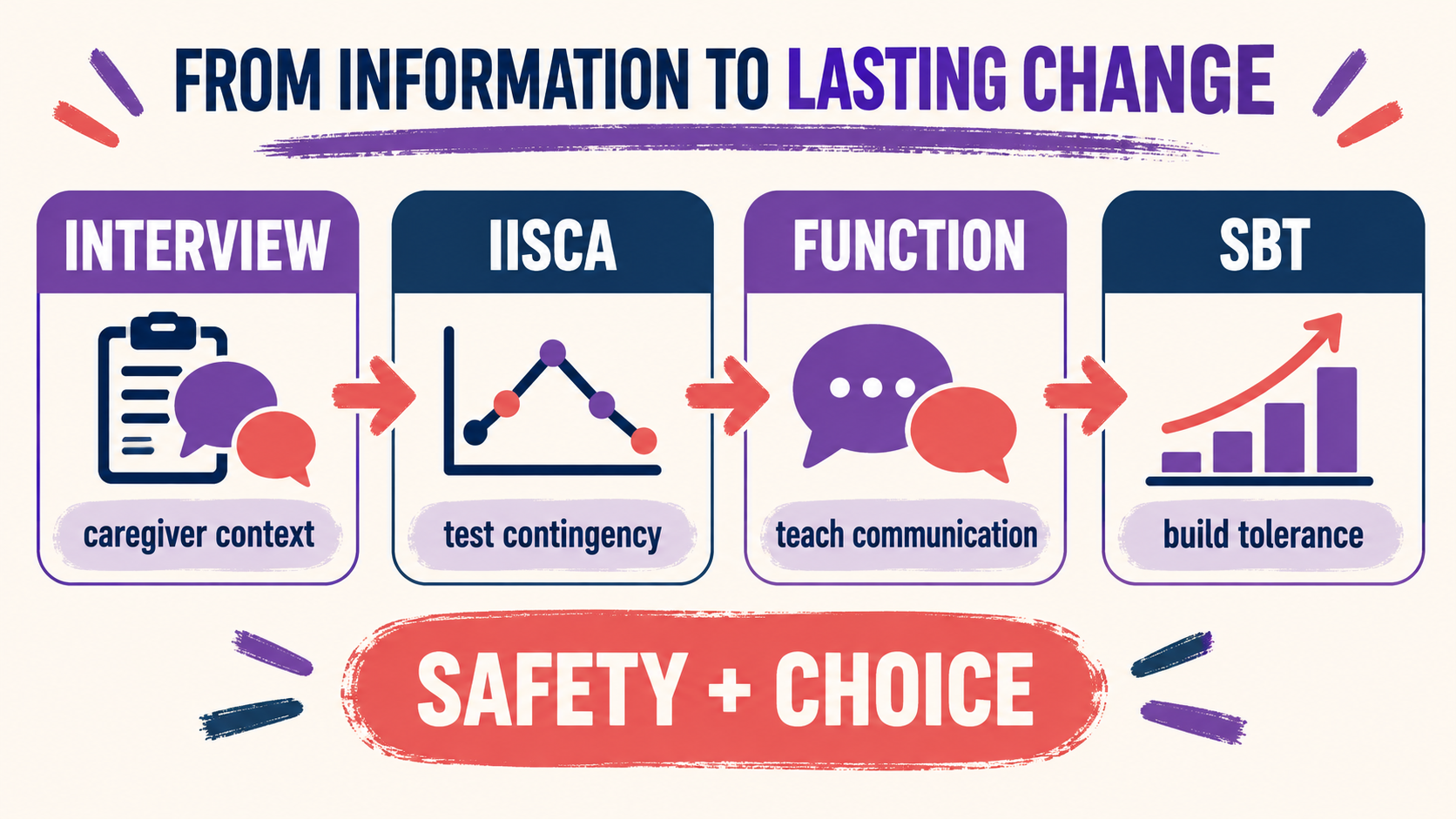
Practical functional assessment starts with the learner’s real context. Instead of beginning with completely standardized test conditions, the analyst uses an open-ended interview to identify what tends to happen before and after problem behavior, what the person may obtain or escape, and which events help the person stay regulated. The interview is a source of hypotheses, not proof of function.
The analyst then translates those hypotheses into a safe, individualized assessment. In an interview-informed synthesized contingency analysis, relevant events may be arranged together in a test condition and compared with a matched control. This can help evaluate whether the synthesized contingency is associated with the target behavior. The point is not to label the learner; it is to clarify the environmental relation that should guide treatment. A useful study sequence is:
- Start with context. Ask caregivers, staff, and the learner when possible about routines, precursors, communication, preferences, and situations in which the behavior is or is not likely.
- Define the behavior. Use an observable response definition rather than a judgment such as “defiant,” “manipulative,” or “out of control.”
- Form a contingency hypothesis. Identify the events that may be establishing value and the consequences that may be maintaining the response.
- Test the hypothesis carefully. Select an assessment arrangement that answers the referral question while managing risk and preserving meaningful choice.
- Use the result to guide teaching. The assessment should lead to a plan for communication, tolerance, safety, and participation—not merely to a function label.
What Is Skill-Based Treatment (SBT)?
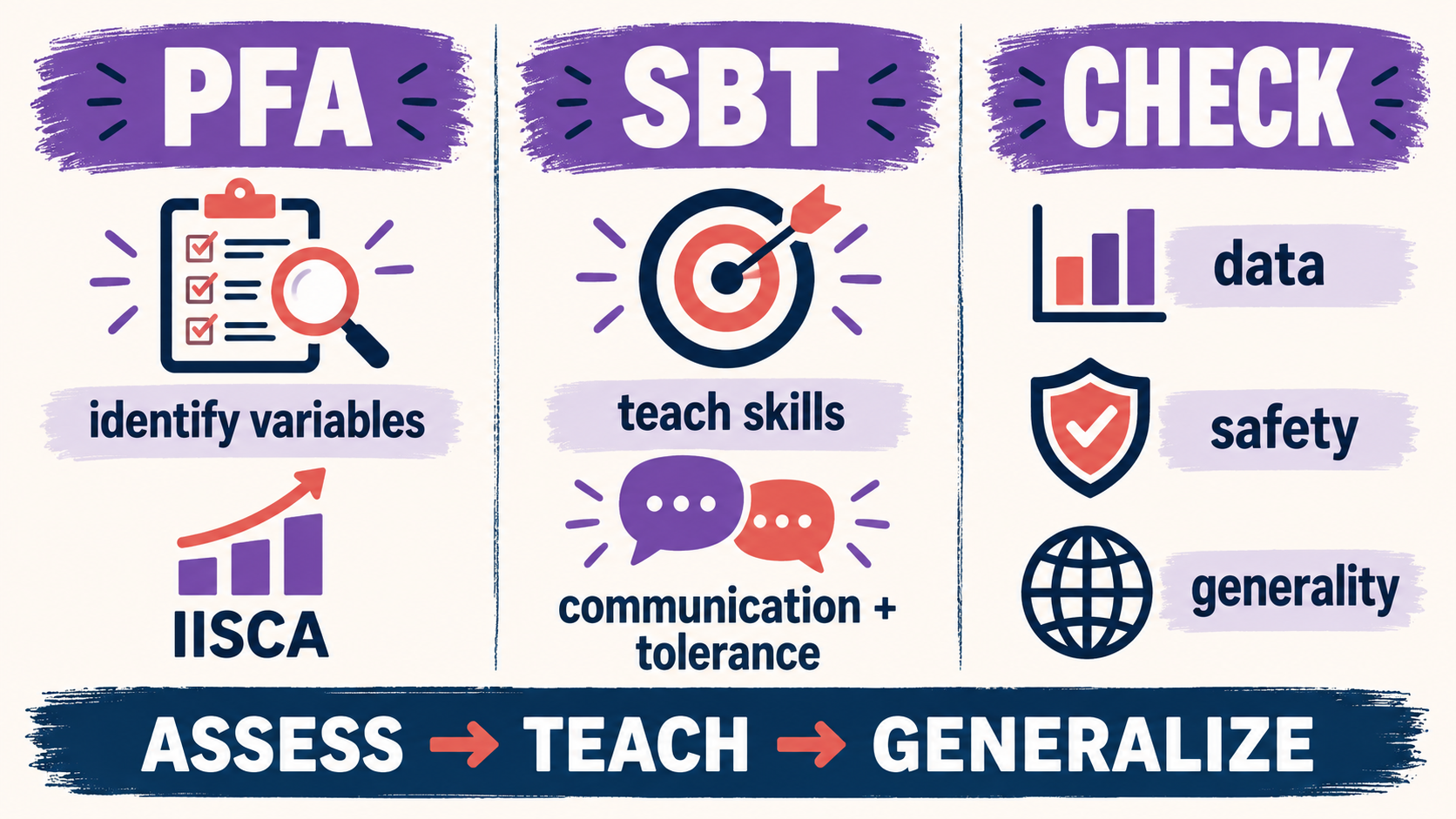
Skill-based treatment uses the assessment findings to teach a functional alternative and a broader repertoire of adaptive skills. The first target is often a communication response that allows the learner to request an important outcome, such as help, a break, attention, or access to an activity. The analyst then gradually shapes tolerance and contextually appropriate behavior so the learner can succeed when reinforcement is delayed, conditions change, or another routine must occur.
In many descriptions of SBT, the skill sequence moves from functional communication to tolerance and then to contextually appropriate behavior. The sequence is not a rigid ladder that looks identical for every learner. It is a decision framework: teach a response that works, make the teaching context safe and reinforcing, and systematically broaden what the learner can do while still having an effective way to communicate.
Schedule thinning is an important treatment consideration. A response may initially contact reinforcement quickly so the learner experiences that communication works. As the skill becomes reliable, the team may gradually introduce delay, competing activities, transitions, or other natural expectations. The aim is not to remove communication or force compliance, but to build a durable repertoire for real life.
PFA and SBT: How the Pieces Fit Together
The comparison below keeps assessment and treatment separate so an exam option does not confuse a hypothesis with an outcome.
| Dimension | Practical functional assessment | Skill-based treatment |
|---|---|---|
| Primary question | What environmental variables are relevant to the problem behavior? | Which skills can help the learner access outcomes and participate safely? |
| Typical information | Interview responses, direct observations, assessment conditions, and behavior data | Communication, tolerance, contextually appropriate behavior, maintenance, and generalization data |
| Decision point | Does the assessment support the contingency hypothesis? | Are the new skills increasing while problem behavior and risk move in the intended direction? |
| Common error | Treating an interview hypothesis as if it were experimental confirmation | Calling forced compliance “skill acquisition” or thinning reinforcement before communication is reliable |
How Does the PFA-SBT Sequence Work?
The sequence has six connected decisions:
- Clarify the referral. Identify the behavior, the people affected, the situations that matter, the safety concerns, and the outcome the learner and stakeholders want.
- Gather contextual information. Use an open-ended interview and observation to understand precursors, communication, preferences, routines, medical considerations, and existing supports.
- Design an individualized assessment. Arrange relevant events in a way that can test the contingency without treating safety as an afterthought.
- Teach functional communication. Establish a response that is understandable, efficient, accessible, and likely to contact a meaningful outcome.
- Shape tolerance and participation. Introduce delay, transitions, competing activities, and contextually appropriate behavior in small, data-based steps.
- Program for generality. Check whether skills continue across people, places, materials, times, and naturally occurring routines, and whether caregivers can use the plan safely.
The sequence is iterative. If the communication response is not efficient, the analyst may need to revisit the reinforcer, response effort, prompting, or access arrangement. If problem behavior increases as demands are added, the team may need to slow down, improve the teaching context, or reconsider the assessment hypothesis. A PFA-SBT label never removes the need to look at the data.
Safety, Choice, and Clinical Boundaries
PFA-SBT is often discussed as a safer or more socially acceptable approach, but safety is not created by the acronym. It comes from competent assessment, individualized risk planning, trained implementers, clear stopping rules, and ongoing review. The analyst should know what behavior can be safely assessed, what medical or environmental factors need attention, and when to seek additional professional support.
Choice and assent matter throughout the process. A communication response should not be taught only so adults can get compliance. Learners need an accessible way to request a break, refuse, ask for help, or signal that something is wrong. When a routine is necessary for health or safety, the plan should still explain the least restrictive support, the communication options, and the decision makers responsible for the risk assessment.
This article is not a protocol for conducting an IISCA or treating dangerous behavior. A learner-specific plan belongs with a qualified behavior analyst and the relevant caregivers, educators, medical professionals, and safeguards. The BCBA exam may test the vocabulary, but implementation requires more than recognizing the acronym.
What Data Should a Learner Track?
The right measures depend on the referral question. During assessment, the analyst may examine the level and pattern of the target behavior across conditions, precursor responses, latency to respond, and whether the arranged contingency changes the behavior as expected. During treatment, the team may track independent communication, prompt level, tolerance duration, successful transitions, contextually appropriate behavior, problem behavior, and treatment-integrity measures.
| Data question | Why it matters |
|---|---|
| Did the assessment distinguish the relevant condition from control? | It helps the analyst decide whether the contingency hypothesis is supported or needs revision. |
| Does communication occur independently and efficiently? | A replacement response must be usable in the situation where the old behavior used to work. |
| Do tolerance and contextual skills generalize? | A skill that appears only with one therapist or one material may not yet be functional in daily life. |
| Is the plan implemented as designed? | Poor treatment integrity can look like a weak intervention or hide a safety problem. |
How BCBA Exam Questions Test PFA-SBT
On a BCBA-style question, first identify whether the stem is asking about assessment or treatment. If the question asks how to discover the variables influencing problem behavior, look for interview, observation, functional assessment, or an individualized analysis. If it asks what happens after the relevant contingency is identified, look for functional communication, tolerance, schedule thinning, contextually appropriate behavior, or generalization.
Also watch for answer choices that skip the assessment step. “Immediately use extinction,” “increase demands,” or “teach compliance” may sound like interventions, but they do not show that the analyst understands the behavior’s function, the learner’s communication, or the risks of the context. A stronger answer usually connects assessment findings to a functionally relevant alternative and then evaluates change with data.
The BCBA Test Content Outline emphasizes functional assessment, observable and measurable intervention goals, client variables, treatment integrity, data-based decisions, and generalization. PFA-SBT questions can therefore test more than vocabulary: they can ask whether you can preserve the assessment-treatment distinction, select a meaningful replacement response, and recognize when a treatment result does not generalize.
Common PFA-SBT Misunderstandings
- PFA is just an interview. The interview informs the hypothesis; the assessment must still be interpreted with direct data and clinical judgment.
- SBT means allowing every request immediately. Early teaching may make communication efficient, but the broader goal is a flexible repertoire that includes tolerance and safe participation.
- One successful session proves the treatment works. Review trend, variability, independence, generalization, social validity, and treatment integrity.
- Compliance is the outcome. Communication, self-advocacy, safety, access, and meaningful participation are more precise and person-centered outcomes than obedience alone.
- The acronym replaces individualized planning. PFA-SBT is a framework for reasoning, not permission to copy another learner’s contingencies or treatment steps.
Frequently Asked Questions
What does PFA stand for in ABA?: PFA usually means practical functional assessment. It is an individualized assessment approach that combines contextual information, an open-ended interview, and a functional analysis arrangement designed to evaluate relevant contingencies. What does SBT stand for in ABA?: SBT means skill-based treatment. In the PFA-SBT literature, it commonly refers to teaching functional communication, tolerance, and contextually appropriate behavior while monitoring safety, data, and generalization.
Is PFA-SBT the same as functional communication training?: No. Functional communication training may be one important part of SBT, but PFA-SBT includes the assessment that identifies relevant variables and the broader teaching sequence beyond the first communication response.
Can a BCBA use PFA-SBT with every learner?: No single approach is automatically appropriate for every person or referral. The BCBA must consider the behavior, setting, communication system, risks, preferences, available support, evidence, and whether the assessment can be conducted safely and ethically.
In short, practical functional assessment and skill based treatment connects careful assessment to meaningful skill building. PFA asks what variables matter; SBT teaches a functional way to communicate, tolerate, and participate; data and clinical judgment determine whether the plan should continue or change. After reviewing the concept, you can use the free BCBA mock exam to practice separating assessment, intervention, ethics, and generalization in BCBA-style scenarios. The mock exam is a study aid, not a BACB protocol or certification guarantee.
Sources for Further Study
- Long-term effectiveness and generality of practical functional assessment and skill-based treatment — PubMed record for a 2024 Journal of Applied Behavior Analysis study.
- Practical Functional Assessment and Skill-Based Treatment — Grand Valley State University START Project overview.
- Minimizing Escalation by Treating Dangerous Problem Behavior Within an Enhanced Choice Model — peer-reviewed open-access discussion of choice, safety, PFA, and SBT.
- BCBA Test Content Outline — official BACB source for assessment, intervention, data, and generalization competencies.
For targeted review, use our practical functional assessment and skill based practice questions to apply the concept in exam-style scenarios.
Quick Review Checklist
Use this final checklist to turn practical functional assessment and skill based into exam-ready reasoning. The goal is not to memorize a label in isolation; it is to identify the relevant evidence and explain why the best answer fits the scenario. Key ideas to review:
- State the central definition or decision point for practical functional assessment and skill based in your own words.
- Identify the detail that makes practical functional assessment and skill based different from its closest related ABA term.
- Separate the observable facts in a scenario from assumptions that are not supported by the facts.
- Write one example and one nonexample so you can recognize the concept in a new setting.
Exam application checks:
- Ask what the question is actually requesting before comparing the answer choices.
- Mark the antecedent, response, consequence, or other evidence that supports the selected answer.
- Look for a distractor that describes a related process but does not answer the specific question.
Final self-check:
- Explain how you would verify the interpretation with clear observations or data.
- Change one detail in the scenario and decide whether your answer should change.
- Give a one-sentence rationale that a supervisor or study partner could evaluate.
Take the Free BCBA Mock Exam
If you want a low-pressure way to check your recall, use the free practice resource below. Take the Free BCBA Mock Exam



