

In DRP in ABA, the practitioner reinforces a behavior for occurring at a target pace—not merely for occurring more often or less often. Differential Reinforcement of Pace (DRP) is useful when the timing and spacing of responses matter, such as completing a routine without rushing, speaking at a workable rate, or producing responses with a steady rhythm.
Table of Contents
- What Is DRP in ABA?
- What Does “Pace” Mean in Behavior Analysis?
- How Does DRP Work?
- What Is a DRP in ABA Example?
- How Do You Set a DRP Criterion?
- How Do You Implement DRP Step by Step?
- How Do You Measure and Graph DRP?
- How Is DRP Different From DRH, DRL, and DRO?
- How Is DRP Tested on the BCBA Exam?
- What DRP Mistakes Should You Avoid?
- DRP in ABA FAQ
- Quick Review Checklist
- Take the Free BCBA Mock Exam
DRP can look similar to DRH or DRL because all three use a rate or pace criterion. The exam-level distinction is whether the target is spacing, a higher rate, a lower rate, or the absence of behavior. The current BCBA Test Content Outline provides the exam-study context. Examples below are simplified learning illustrations, not a universal protocol or individualized clinical advice. Table of Contents
What Is DRP in ABA?
DRP in ABA means Differential Reinforcement of Pace. It is a differential-reinforcement procedure in which reinforcement is delivered for responding at a specified pace or rhythm. The criterion may describe the desired time between responses, the number of responses within a time window, or a pattern of spacing that is more functional than the learner’s current pattern.
The important word is pace. The goal is not automatically “more behavior” or “less behavior.” The goal is a workable temporal pattern. A learner might need to slow down when answering questions so responses are accurate, increase the rhythm of an adaptive routine so the task can be completed, or space requests so communication is effective without becoming frantic or unsafe.
Like every reinforcement procedure, DRP is only confirmed when the selected consequence increases the future likelihood of the target pace. Giving praise or tokens after a response does not prove reinforcement by itself. The team must define the response pattern, apply the contingency consistently, and inspect data over time.
What Does “Pace” Mean in Behavior Analysis?
Pace describes the timing relationship among repeated responses. It can include response rate, the interval between responses, and the regularity or rhythm of a sequence. The correct measure depends on the practical question.
- Response spacing: How much time should pass between two responses?
- Response rate: How many responses should occur during a defined period?
- Routine rhythm: Should steps or verbal responses occur in a steady, usable pattern rather than in a rush or a long delay?
Operationally define the response, observation period, timing system, and acceptable range. “Responds at a better pace” is too vague; “begins the next step within 10 to 20 seconds” is measurable.
How Does DRP Work?
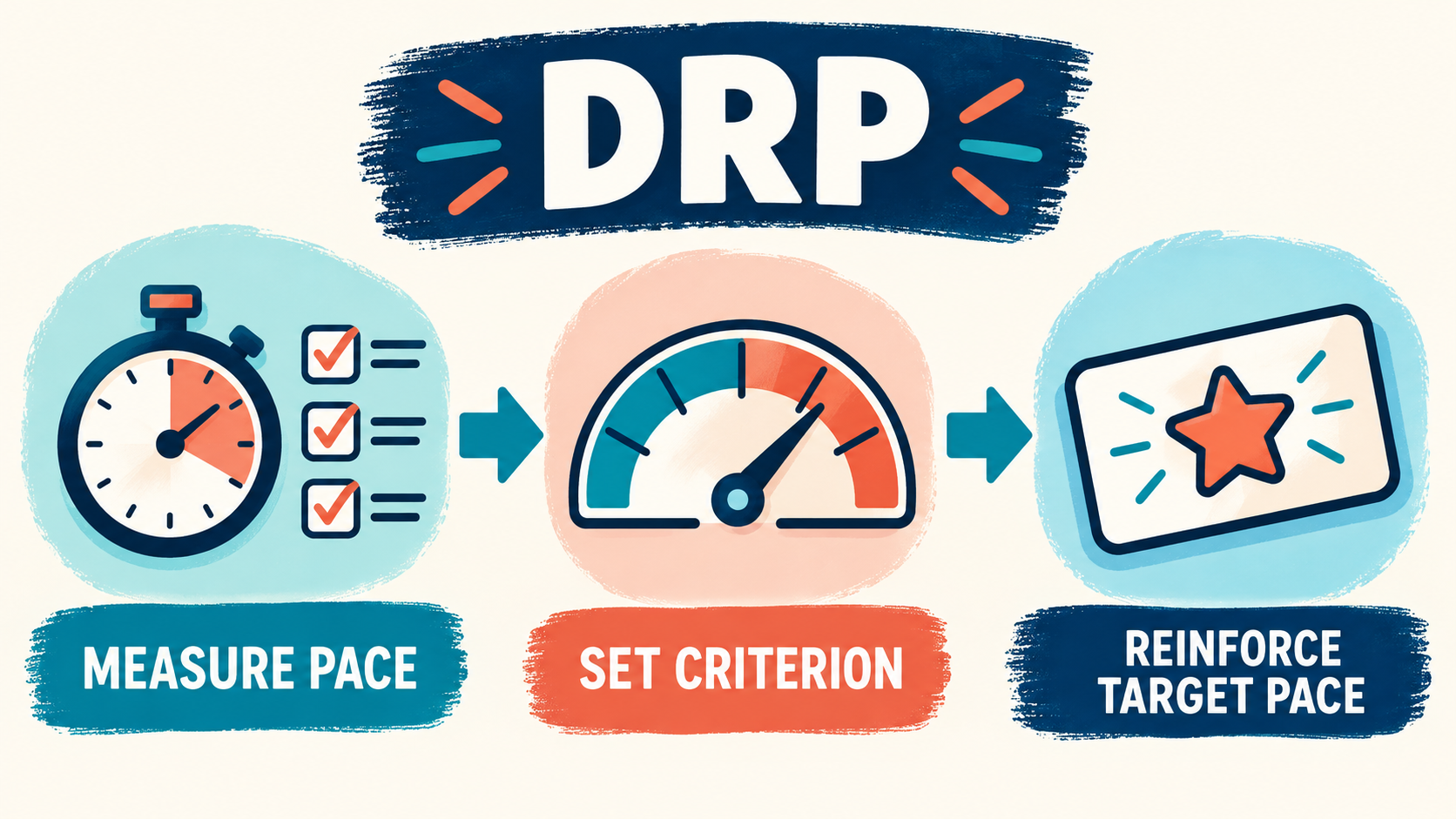
DRP arranges a contingency around the temporal pattern of behavior. First, the practitioner observes baseline performance and identifies what the current pace looks like. Next, the team selects a criterion that is achievable and socially meaningful. Reinforcement is then delivered when the response meets that criterion, while the criterion is adjusted gradually as data show stable improvement.
The procedure can be summarized as measure pace → set criterion → reinforce the target pace. If the learner responds too quickly, the plan may reinforce waiting for a specified interval before the next response. If the learner responds too slowly, the plan may reinforce completing a sequence within a functional time range. The consequence must be delivered according to the plan and should be meaningful to the learner.
DRP is not the same as telling someone to “slow down” or “work faster.” A verbal instruction may be an antecedent, a prompt, or a rule. DRP is the consequence arrangement that makes a specific pace more likely in future opportunities.
What Is a DRP in ABA Example?
Imagine a learner who completes a three-step classroom routine, but the timing is so rushed that materials are knocked over and the final step is often missed. The team records the interval between steps and finds that the learner begins the next step after approximately one or two seconds. The plan defines a functional pace as beginning the next step after 8 to 15 seconds, with all materials handled safely.
During practice, the learner completes the first step, waits within the target range, and begins the next step. The planned reinforcer is delivered after the criterion is met. The team records whether the interval fell below, within, or above the range and also records whether the routine was completed accurately. If the learner can meet the criterion consistently, the team may thin or fade the arranged support while checking whether the natural classroom routine maintains the skill.
How Do You Set a DRP Criterion?
A fair criterion begins with baseline data and the learner’s actual context. Avoid choosing an attractive number that is disconnected from what the learner can currently do or what the routine requires. Consider the following questions:
- What is the exact target response? Define the response so different observers can identify its onset and offset.
- What timing feature matters? Choose spacing, rate, latency between steps, or another temporal feature that directly relates to the goal.
- What range is functional? A range is often more realistic than a single exact second because people and contexts vary.
- What baseline pattern is present? Record enough opportunities to see whether the current pace is stable, variable, too fast, or too slow.
- What consequence is available? Confirm that the consequence is acceptable, practical, and actually functions as reinforcement for this learner.
Use small changes when the behavior is sensitive to timing. A criterion that is too strict can create repeated failures, prompt dependence, or frustration. A criterion that is too easy may not change the functional problem. The best decision is data-based and individualized.
How Do You Implement DRP Step by Step?
Although the exact plan belongs to the responsible behavior analyst, a study-friendly sequence looks like this:
- Define the behavior and timing variable. State what counts as a response and what event starts and stops the timing window.
- Collect baseline. Measure the current pace without adding an unplanned reinforcement contingency.
- Select an initial criterion. Use baseline and functional demands to set an achievable target or range.
- Choose and test the reinforcer. A consequence is not assumed to be reinforcing; monitor its effect on later responding.
- Explain the contingency in an accessible way. Use a brief rule, visual, model, or prompt only when it is part of the plan.
- Deliver reinforcement consistently. Reinforce the defined pace rather than an accidental feature, such as simply finishing first.
- Review data and adjust gradually. Change the criterion only when data support the decision, and check generalization across relevant people and settings.
- Plan for fading. Reduce artificial prompts or arranged supports when the learner can contact natural consequences safely and independently.
How Do You Measure and Graph DRP?
Measurement should make the pace visible. A data sheet might record each response time, the interval since the previous response, whether the interval fell within the target range, and whether reinforcement was delivered. For a routine, the team might record completion time, time between steps, accuracy, and prompt level.
Graph the measure that matches the decision. A line graph of mean seconds between responses can show whether the pace is moving toward the criterion. A percentage graph can show the proportion of opportunities within the acceptable range. A separate accuracy or safety measure prevents the team from declaring success when speed improves but quality declines.
How Is DRP Different From DRH, DRL, and DRO?
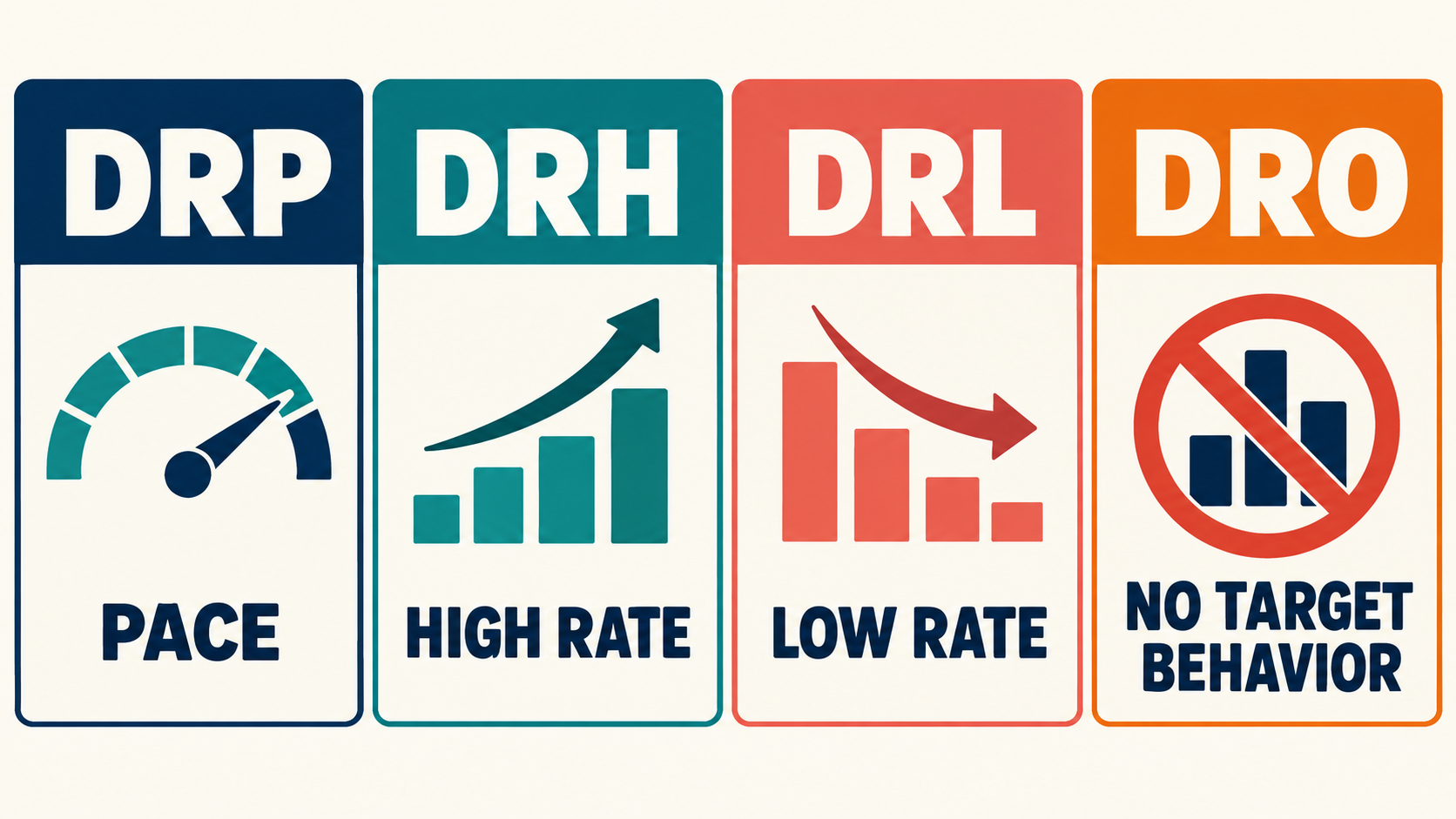
These procedures all use differential reinforcement, but their criteria answer different questions. The exact labels can vary across study materials, so read the scenario for what is being reinforced.
| Procedure | What earns reinforcement? | Exam clue |
|---|---|---|
| DRP | A specified pace, rhythm, or spacing pattern. | The timing relationship among responses is the target. |
| DRH | A higher rate of a target response. | More responses in the interval is the main criterion. |
| DRL | A lower, but usually not zero, rate of a target response. | The behavior may continue, but excessive frequency is reduced. |
| DRO | The absence of the target behavior during a defined interval or opportunity. | The question emphasizes no occurrence, not a particular pace. |
A scenario can include more than one dimension. For example, a team might care about both a minimum number of responses and appropriate spacing. Identify which dimension the question names as the reinforcement criterion. Do not choose DRP merely because a timer appears in the vignette.
How Is DRP Tested on the BCBA Exam?
For a question about DRP in ABA, first locate the temporal target. Ask: “Is the answer choice changing how many responses occur, whether the behavior occurs at all, or how the responses are spaced?” If spacing, rhythm, or a response interval is the defining feature, DRP is a strong candidate.
- DRP: reinforce responding at a target pace or spacing pattern.
- DRH: reinforce a higher number of responses per unit of time.
- DRL: reinforce a lower rate while allowing some responding to continue.
- DRO: reinforce the absence of the target behavior for the specified interval.
A common trap is treating any timing-based procedure as DRP. A timer is only a measurement or delivery tool; the procedure is identified by the behavior dimension tied to reinforcement. Another trap is confusing the instruction “wait” with the reinforcement contingency. The prompt may set the occasion, but the DRP criterion is the pace that produces the consequence.
What DRP Mistakes Should You Avoid?
Do not define pace as “better” without observable limits. Do not reinforce speed when the plan is meant to improve spacing. Do not increase the criterion after one successful session, and do not ignore accuracy, safety, assent, or the learner’s experience simply because a graph moved in the desired direction. Do not assume that a preferred item is automatically a reinforcer. If the consequence does not strengthen the target pace, reassess the arrangement with the responsible BCBA.
Finally, plan for generalization. A pace that works with one instructor and one timer may not transfer to a classroom, workplace, home routine, or conversation partner. Probe relevant contexts and fade artificial supports carefully so the learner can use the skill under natural conditions.
DRP in ABA FAQ
What does DRP stand for in ABA?: DRP stands for Differential Reinforcement of Pace. It reinforces a specified timing, rhythm, or spacing pattern of behavior. Is DRP the same as DRH?: No. DRH reinforces a higher rate of responding. DRP focuses on the pace or spacing of responses, which may involve a particular interval or rhythm rather than simply maximizing the number of responses. Is DRP the same as DRL?: No. DRL reinforces a lower rate of a behavior, usually when some responding is still acceptable. DRP is selected when the timing pattern itself is the important target.
Can DRP be used to increase a behavior?: Yes. If a learner responds too slowly, reinforcement can be arranged for a functional faster pace. If a learner responds too quickly, reinforcement can be arranged for a longer or more appropriate interval between responses.
What is the fastest exam clue for DRP?: Look for a scenario in which reinforcement depends on the spacing, rhythm, or timing of repeated responses. If the only criterion is more responses, consider DRH; if it is fewer responses, consider DRL; if it is no target behavior, consider DRO. Use the free BCBA mock exam as a study checkpoint after reviewing the distinction. It is a study aid, not an official BACB product and not a substitute for supervision or individualized assessment.
The practical takeaway is simple: define the temporal pattern, measure baseline, reinforce the pace that matters, and inspect whether the change is functional outside the teaching arrangement. That is the core logic of DRP in ABA.
Quick Review Checklist
Use this final checklist to turn DRP in ABA into exam-ready reasoning. The goal is not to memorize a label in isolation; it is to identify the relevant evidence and explain why the best answer fits the scenario. Key ideas to review:
- State the central definition or decision point for DRP in ABA in your own words.
- Identify the detail that makes DRP in ABA different from its closest related ABA term.
- Separate the observable facts in a scenario from assumptions that are not supported by the facts.
- Write one example and one nonexample so you can recognize the concept in a new setting.
Exam application checks:
- Ask what the question is actually requesting before comparing the answer choices.
- Mark the antecedent, response, consequence, or other evidence that supports the selected answer.
- Look for a distractor that describes a related process but does not answer the specific question.
Final self-check:
- Explain how you would verify the interpretation with clear observations or data.
- Change one detail in the scenario and decide whether your answer should change.
- Give a one-sentence rationale that a supervisor or study partner could evaluate.
Take the Free BCBA Mock Exam
If you want a low-pressure way to check your recall, use the free practice resource below. Take the Free BCBA Mock Exam



