
ABA OPERATIONS · BCBA PRACTICE Reducing administrative burden in ABA is not the same as deleting notes, shortening clinical reasoning, or asking staff to document less. A safer goal is to remove avoidable rework so the right information is captured once, reviewed by the right person, and available when a clinical or operational decision requires it.
Table of Contents
- What Does Reducing Administrative Burden in ABA Mean?
- How Do You Map Administrative Work in ABA?
- Where Does Rework Usually Come From?
- What Principles Reduce Burden Safely?
- How Can a Team Reduce Rework Without Cutting Safeguards?
- What Can a 30-Day Improvement Pilot Look Like?
- What Are the BCBA Exam Takeaways?
- Frequently Asked Questions
- Sources for Further Study
- Take the Free BCBA Mock Exam
What Does Reducing Administrative Burden in ABA Mean?
Administrative burden is the time and effort required to schedule, authorize, document, route, reconcile, and report services in addition to the clinical work itself. Some of that work is necessary. A session note, supervision record, treatment-integrity check, authorization request, or incident record may protect the learner and support continuity of care. Burden appears when the same facts are typed repeatedly, when ownership is unclear, when forms collect information nobody uses, or when a late correction triggers a chain of rework.
Start with a neutral definition: the goal is not “less documentation.” The goal is less unnecessary effort per accurate, timely, clinically useful record. That distinction matters because a fast workflow that produces missing data, vague notes, privacy exposure, or unreviewed clinical decisions is not efficient. It simply moves the cost to an audit, a treatment error, a denied claim, or a frustrated team.
For a BCBA learner, the same principle applies to fieldwork and exam preparation. Work that looks administrative may be unrelated to behavior analysis, while data organization, analysis, program writing, and supervision preparation may be clinically relevant. Classify the task by its purpose and requirements rather than by whether it feels like paperwork.
How Do You Map Administrative Work in ABA?
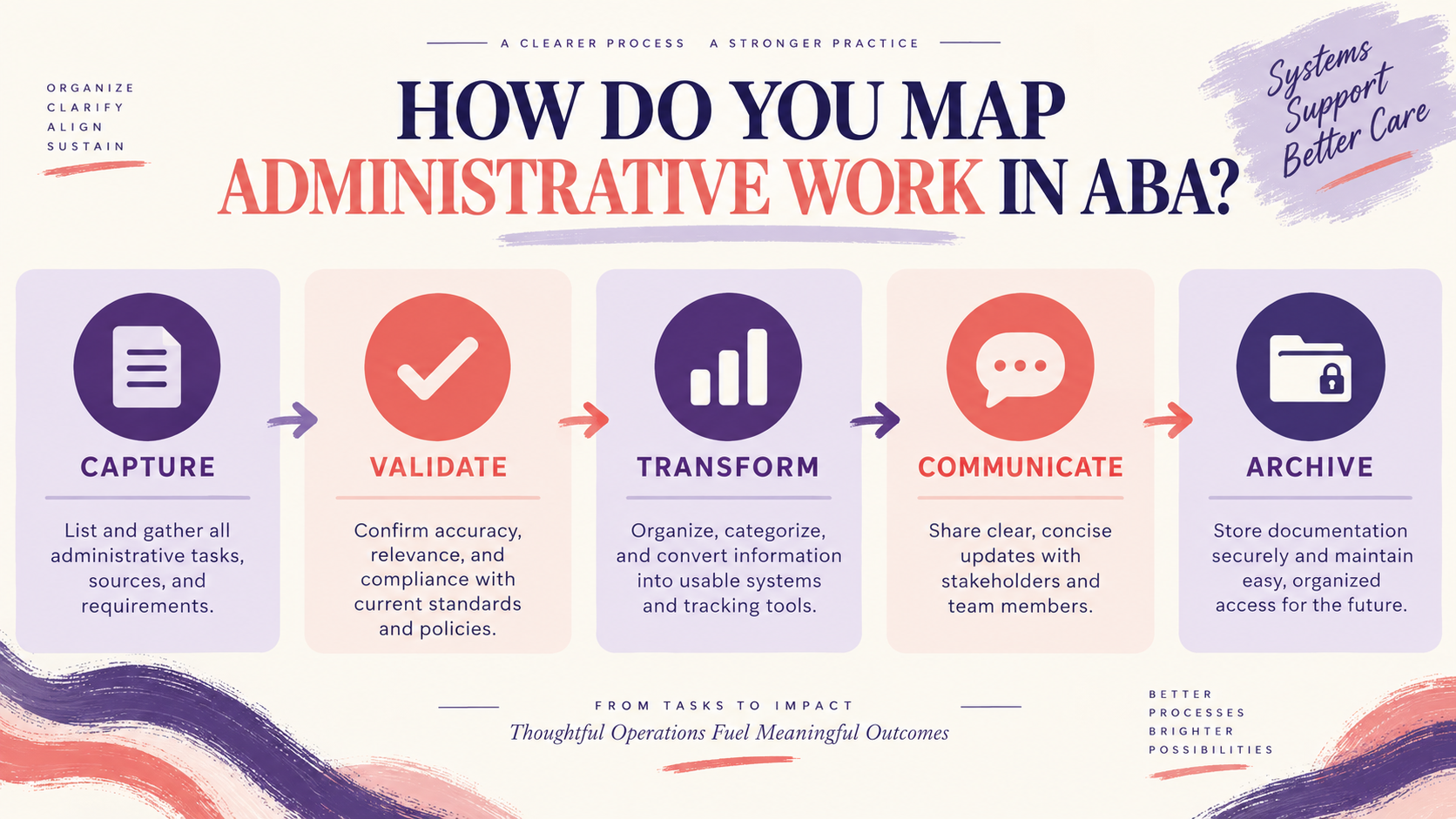
Choose one recurring workflow and follow it from trigger to finished decision. For example, map what happens after a session:
- Capture: who records attendance, targets, behavior data, caregiver information, and safety events?
- Validate: who checks completeness, measurement definitions, unusual values, and required signatures?
- Transform: who converts raw observations into graphs, summaries, claims, reports, or programming decisions?
- Communicate: who needs the result, in what format, and by what deadline?
- Archive: where is the source record stored, who can access it, and how are corrections handled?
Do not map only the official process. Ask staff to mark where they wait, copy information, switch systems, ask the same question twice, or save a personal workaround. Those moments reveal the hidden workflow. Measure a baseline such as minutes per completed note, number of returned notes, time from session to graph update, or percentage of records needing correction.
| Workflow signal | Likely source of burden | First improvement question |
|---|---|---|
| The same fact is entered in multiple places | No clear source of truth or systems that do not exchange data. | Which record is authoritative, and can another field reference it instead of duplicating it? |
| Notes are returned for the same corrections | Unclear definitions, training gaps, or a review checklist that arrives too late. | Can the team define “complete” with examples before submission? |
| Graphs are updated in batches from memory | Data capture and review are separated by too much time or ownership is unclear. | What small review cadence keeps raw data and decisions connected? |
| Everyone uses a different spreadsheet | Local workarounds, unclear access rules, or a system that does not fit the task. | What minimum shared structure would make handoffs reliable? |
Where Does Rework Usually Come From?
Common sources include inconsistent operational definitions, forms that mix clinical and billing questions, unclear responsibility for missing information, and late supervisor review. Another source is “documentation by exception”: staff remember the unusual event but not the ordinary data needed to interpret it. When a team later reconstructs what happened, everyone spends time searching messages, calendars, and separate files.
Look for handoff gaps between roles. An RBT may collect a precise measure, a BCBA may need a different summary, an authorization team may need a service detail, and a caregiver may need plain-language feedback. If the team has no agreed translation layer, the same person becomes a human converter for every handoff.
Technology can create burden too. Auto-populated fields, dashboards, and artificial-intelligence tools may reduce typing, but they can also carry forward an incorrect value, expose protected information, or make a polished summary look more certain than the raw data. Automation should be treated as a controlled workflow change with human review, not as a substitute for clinical judgment.
What Principles Reduce Burden Safely?
Use five design principles:
- Capture once where practical. Keep a clearly owned source of truth for stable facts, and avoid asking every downstream user to re-enter them.
- Make the next decision visible. Every required field should have a reason: clinical review, supervision, safety, billing, authorization, compliance, or communication.
- Separate raw data from interpretation. Preserve the observation and label the professional summary as an interpretation, hypothesis, or decision.
- Build early quality checks. Catch missing units, impossible values, wrong dates, and incomplete signatures before the record travels downstream.
- Reduce variation deliberately. Use examples, a short checklist, and role-based training instead of assuming a new form will create consistency.
Do not reduce burden by copying a generic template into every client record. Templates should support individualized, accurate documentation. A required field that does not apply should have a safe way to indicate that fact; a field that matters for one case should not be silently hidden because it is inconvenient.
How Can a Team Reduce Rework Without Cutting Safeguards?
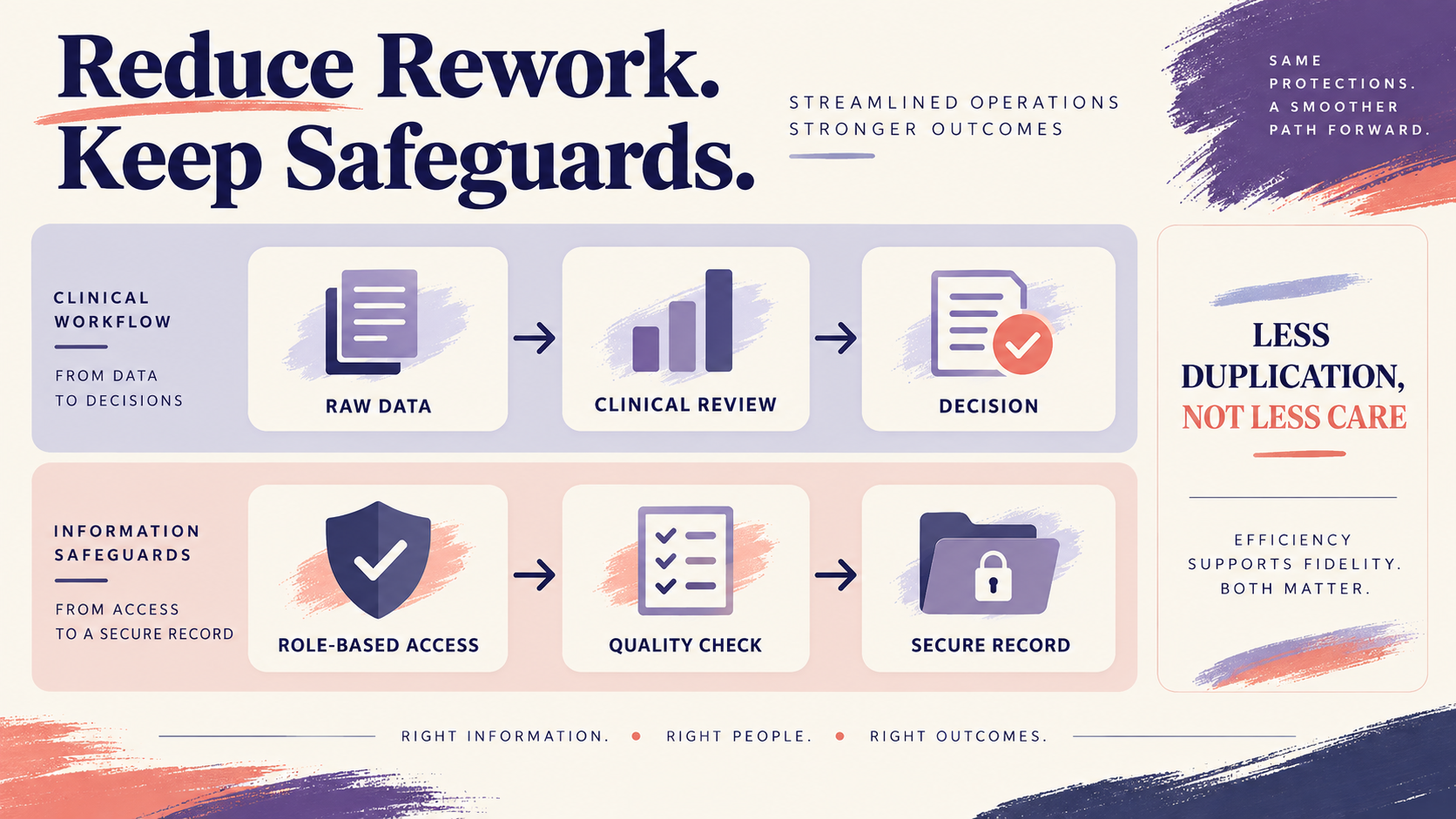
Design the handoff around the receiving decision. A useful handoff packet might contain the raw measure, the date and context, a brief visual display, a statement of what changed, the uncertainty or limitation, and the next question for the reviewer. It should not contain every piece of protected information merely because the sender can access it.
Privacy rules vary by organization and legal context. Where HIPAA applies, HHS describes a minimum-necessary principle that limits use, disclosure, and requests for protected health information to what is reasonably needed for the purpose. That is not a universal “short note” rule, and treatment-related exceptions and organizational policies matter. Follow the organization’s privacy officer, policy, applicable law, and secure systems. Set ownership explicitly:
- The person closest to the observation owns accurate raw-data capture.
- The qualified reviewer owns clinical interpretation and programming decisions.
- The operations role owns routing, deadline visibility, and nonclinical reconciliation.
- The privacy or compliance role owns access rules, retention guidance, and incident escalation.
A team meeting should not be the only place where ownership exists. Put the role, trigger, deadline, and escalation path in the workflow. Then measure whether the change reduces waiting and rework without reducing accuracy, review quality, or client-centered communication.
What Can a 30-Day Improvement Pilot Look Like?
Choose one workflow and run a small pilot:
- Days 1–5: observe the current process, interview the people who perform it, and measure time, corrections, delays, and privacy risks.
- Days 6–10: remove one duplicate field, clarify one ownership rule, and draft a short definition-of-complete checklist.
- Days 11–20: test the change with a limited team or workflow. Preserve the old record or a safe rollback path while reviewing accuracy.
- Days 21–30: compare the baseline with time, correction, completeness, and user-experience measures. Keep, revise, or stop the change based on the results.
A successful pilot might reduce returned notes from 18% to 10% while keeping required fields complete and improving the time from session to supervisor review. A failed pilot might reduce typing but increase missing context, late corrections, or unauthorized sharing. Count both sides of the result.
What Are the BCBA Exam Takeaways?
For a BCBA question about reducing administrative burden in ABA, choose the option that removes unnecessary duplication while preserving accurate measurement, documentation, supervision, privacy, consent, and client-centered decision-making. “Less paperwork” is not automatically the best answer.
- Map the workflow before changing the form or software.
- Distinguish raw observations, clinical interpretation, and administrative routing.
- Use role clarity and early quality checks to prevent rework.
- Limit access and disclosure according to applicable privacy requirements and organizational policy.
- Evaluate an efficiency change with both workload and quality outcomes.
For additional BCBA study practice on measurement, supervision, and ethics scenarios, the site’s free BCBA mock exam is an independent resource. It is not official BACB content and does not guarantee a certification result.
Frequently Asked Questions
Does reducing administrative burden mean writing shorter notes?: Not necessarily. A shorter note may be better if it remains accurate, complete for its purpose, and understandable to the next reviewer. The goal is to remove duplication and ambiguity, not to omit clinically relevant context.
Can automation replace BCBA review?: Automation can route information, flag missing fields, or prepare a draft summary, but the responsible professional still needs to review accuracy, context, privacy, and clinical meaning. Never treat an automatically generated conclusion as a verified observation.
What is the first workflow to improve?: Choose a recurring workflow with visible rework and a measurable outcome, such as returned session notes, delayed graph updates, or duplicate data entry. Start small enough to observe the effect and preserve a safe rollback.
Sources for Further Study
- BACB Ethics Codes — current professional ethics resources.
- Ethics Code for Behavior Analysts — confidentiality, competence, and client-centered standards.
- Documenting Fieldwork: Helpful Answers to Your FAQs — current documentation guidance.
- HHS Minimum Necessary Requirement — privacy guidance and scope notes.
For targeted review, use our reducing administrative burden in ABA practice questions to apply the concept in exam-style scenarios.
Take the Free BCBA Mock Exam
If you want a low-pressure way to check your recall, use the free practice resource below. Take the Free BCBA Mock Exam



