

What does procedural integrity mean in the context of ABA? It means checking whether an intervention was implemented as it was written, planned, or intended. In plain language, procedural integrity asks whether the independent variable that was supposed to change behavior was actually delivered with enough accuracy and consistency to interpret the outcome.
Table of Contents
- What Does Procedural Integrity Mean in the Context of ABA?
- How Is Procedural Integrity Different From Related Terms?
- How Is Procedural Integrity Measured?
- What Does a Low Integrity Score Tell You?
- What Does Procedural Integrity Look Like in a Scenario?
- How Should You Answer a BCBA Exam Question?
- What Mistakes Should You Avoid?
- Procedural Integrity in ABA FAQ
- Sources and Date Check
- Take the Free BCBA Mock Exam
Procedural integrity is also called treatment integrity, treatment fidelity, procedural fidelity, or procedural adherence. The labels vary across articles and settings, but the core idea is similar: compare what the intervention plan says should happen with what the implementer actually did. That comparison protects both the client and the quality of the conclusion.
What Does Procedural Integrity Mean in the Context of ABA?
Procedural integrity is the degree to which an intervention is implemented according to its written protocol. If a plan says to deliver a discriminative stimulus, wait three seconds, prompt according to a specified hierarchy, and provide reinforcement for the defined response, an integrity check asks whether those steps occurred as planned. It is not a rating of whether the staff member is a good person or whether the client cooperated.
In research, procedural integrity helps the analyst decide whether the independent variable was actually present. In practice, it helps the team decide whether a slow response to treatment means the intervention needs modification, the implementer needs support, the plan is unclear, or the procedure itself is not producing enough change. Without that distinction, a team can mistakenly label an intervention ineffective when it was never implemented as designed.
A useful exam-ready definition is: procedural integrity is the accuracy and consistency with which intervention steps are carried out compared with the prescribed protocol. It is usually measured as an implementation percentage, but the percentage is meaningful only when the checklist, observation opportunities, and scoring rules are clear.
How Is Procedural Integrity Different From Related Terms?
Several terms appear together in ABA literature. They overlap, but a multiple-choice question may use one term to point to a particular measurement question. Use the comparison below as a study map.
| Term | Main question | Study clue |
|---|---|---|
| Procedural integrity | Were the intervention steps implemented as written? | A checklist compares observed actions with the protocol. |
| Interobserver agreement | Did two observers record the behavior similarly? | It evaluates agreement about measurement, not treatment delivery. |
| Treatment acceptability | Do stakeholders view the plan as reasonable and acceptable? | It reflects stakeholder judgment, not step-by-step accuracy. |
| Intervention effectiveness | Did behavior change enough to matter? | It is an outcome question; integrity helps interpret the outcome. |
| Competency | Can the implementer perform the procedure accurately and safely? | Training, modeling, rehearsal, feedback, and follow-up may be needed. |
A person can follow a protocol accurately even when the protocol is poorly designed, and a well-designed protocol can be implemented inaccurately. Procedural integrity therefore does not prove that an intervention is ethical, socially valid, or effective. It tells you how closely the delivered procedure matched the plan.
How Is Procedural Integrity Measured?
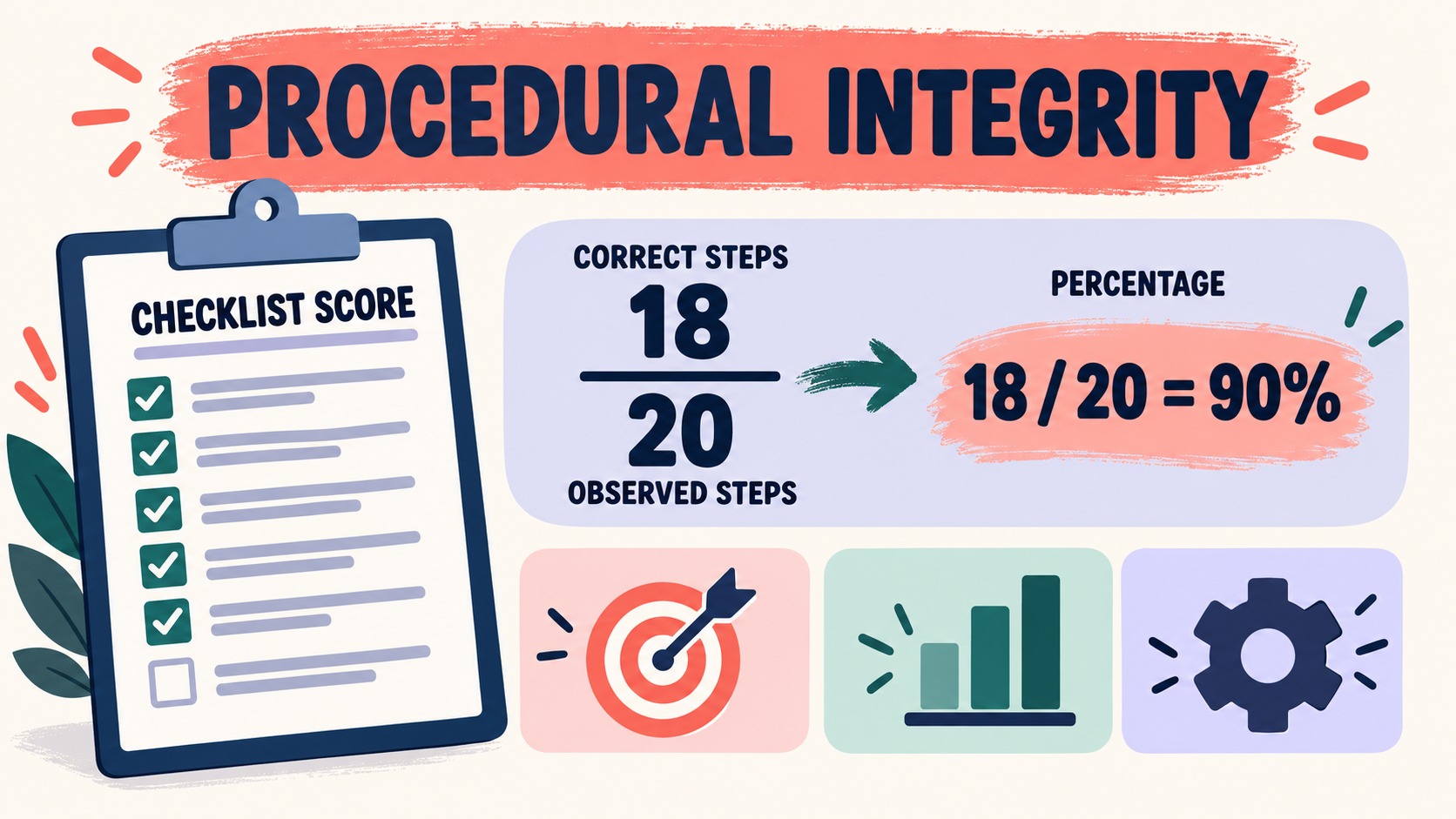
Start by turning the intervention into observable steps. A checklist might include the antecedent arrangement, instruction, prompt, response interval, consequence, data recording, and any safety or dignity safeguard that must occur. Each item needs a scoring rule. “Used prompting appropriately” is too vague unless the team defines what counts as appropriate. A simple integrity percentage is: Procedural integrity = correctly implemented checklist items ÷ observed checklist items × 100.
For example, if an observer scores 18 correctly implemented steps out of 20 opportunities, the observed integrity is 90%. That number describes the sampled implementation. It does not guarantee that every session was 90% accurate, and it does not establish a universal pass mark for every procedure. The team should define its decision rule before collecting or interpreting the data. A defensible measurement plan usually specifies:
- The unit of observation: a trial, teaching opportunity, session, component, or other clearly defined opportunity.
- The checklist: the exact steps that can be observed and scored as correct, incorrect, or not applicable.
- The sampling plan: when, where, and how often observations occur, including whether observations are announced or routine.
- The scoring rule: how the team calculates percentage, handles missing items, and decides when follow-up is needed.
- The feedback loop: how data lead to clarification, coaching, modeling, practice, or a protocol revision.
Direct observation is often the strongest way to see what happened, but indirect methods such as self-report or permanent-product review can sometimes supplement it. Indirect checks may be efficient, yet they can miss steps that leave no record. The method should match the decision being made and the risk of an inaccurate conclusion.
What Does a Low Integrity Score Tell You?
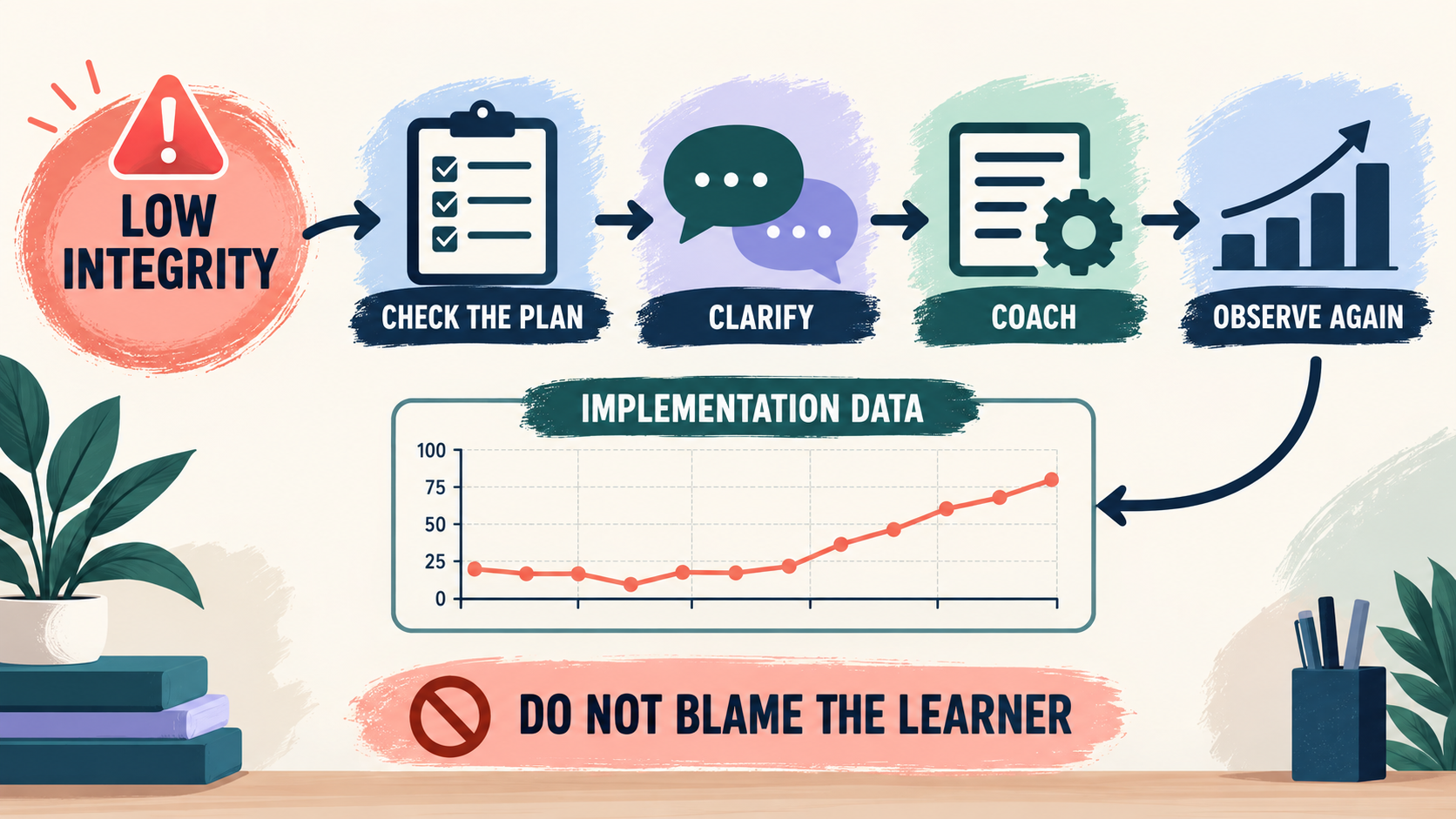
A low score means the delivered intervention differed from the written procedure in the observed sample. It is a signal for assessment and support, not a verdict about the client or the staff member. Before changing the intervention, ask why the score was low.
Common explanations include unclear instructions, insufficient training, competing demands, materials that are unavailable, a response effort that is too high, an unsafe or culturally mismatched plan, or a checklist that does not reflect the actual workflow. The team should examine these variables rather than treating implementation accuracy as a character trait.
Interpretation also depends on the direction and pattern of the errors. Missing reinforcement may affect the client’s response differently from delivering a prompt too early. A single missed step may be less informative than a repeated omission of the same critical component. If a safety-related step is missed, the response should be immediate and proportionate to the risk.
Low procedural integrity can weaken a causal conclusion. If behavior does not improve, the analyst cannot confidently say the intervention failed when the independent variable was inconsistently delivered. Conversely, a temporary improvement should not be treated as proof that a plan is ready for expansion if essential components were not implemented consistently.
What Does Procedural Integrity Look Like in a Scenario?
Imagine a fictional teaching plan for requesting help. The written protocol says the implementer presents a task, waits five seconds, gives the least intrusive prompt needed, honors the request, and records whether the response was independent or prompted. During an observation, the implementer presents the task and honors the request but skips the wait interval and records every response as independent.
The learner’s increase in requests may still be important, but the team should not describe the session as a faithful implementation of the protocol. The integrity checklist would show which components occurred, which did not, and which data fields may be unreliable. The next step might be task clarification and rehearsal, not an immediate conclusion that the learner has mastered the skill or that the intervention is ineffective.
How Should You Answer a BCBA Exam Question?
The current BCBA Test Content Outline includes evaluating client progress and procedural integrity within intervention implementation. When a question asks about procedural integrity, look for the relationship between the written independent variable and the intervention that was actually delivered.
- “Were the intervention steps followed?” points to procedural integrity or treatment fidelity.
- “Did two observers agree on the behavior data?” points to interobserver agreement.
- “Did the intervention change behavior?” points to effectiveness or outcome data.
- “Is the goal or procedure important and acceptable?” points to social validity or acceptability.
- “What should the supervisor do after inconsistent implementation?” points toward clarification, training, modeling, rehearsal, feedback, and continued measurement.
Do not choose a response that blames the learner for a treatment plan that was not delivered as written. Also avoid assuming that a high integrity score proves that the intervention is effective. It supports a cleaner interpretation; it does not replace outcome measurement, ethical review, or clinical judgment. For additional scenario practice, the free BCBA mock exam is an independent study aid. It is not an official BACB product and does not replace the current TCO, handbook, supervision, or professional judgment.
What Mistakes Should You Avoid?
Keep these distinctions clear when reviewing a graph, a session note, or a multiple-choice stem:
- Using a vague checklist that cannot be scored consistently.
- Reporting an integrity percentage without describing the observation sample.
- Confusing procedural integrity with interobserver agreement.
- Changing an intervention before checking whether the written steps were implemented.
- Treating a low score as proof of poor motivation or poor staff character.
- Assuming one observation represents every implementer, setting, or session.
Procedural Integrity in ABA FAQ
What does procedural integrity mean in the context of ABA?: It means measuring how accurately and consistently an intervention was implemented compared with its written or intended protocol. The common output is a percentage based on observed checklist items.
Is procedural integrity the same as treatment fidelity?: In many ABA sources, procedural integrity, treatment integrity, treatment fidelity, and procedural fidelity refer to closely related ideas. Follow the definition supplied by the question or source, then focus on whether the intervention was delivered as planned.
What is a good procedural integrity percentage?: There is no single percentage that automatically applies to every procedure, client, or risk level. A team should define its decision rule, pay attention to critical components, and use the data to guide support and interpretation.
Why does procedural integrity matter when behavior does not change?: If the intervention was not implemented as designed, a lack of behavior change may reflect inconsistent exposure rather than an ineffective procedure. Integrity data help the analyst decide whether to improve implementation, revise the plan, or evaluate the intervention itself.
Sources and Date Check
This article was reviewed on September 29, 2026 against the BACB sixth-edition Test Content Outline, the current BCBA Handbook, and peer-reviewed discussions of treatment integrity and procedural fidelity, including Treatment Integrity Reporting in Behavior Analysis in Practice and Trends in Reporting Procedural Integrity. Terminology and professional requirements can change; verify current BACB materials before making a practice or exam decision.
Take the Free BCBA Mock Exam
If you want a low-pressure way to check your recall, use the free practice resource below. Take the Free BCBA Mock Exam



