
A permanent product recording data sheet helps you score the lasting outcome of a behavior after the behavior has occurred. Instead of trying to tally every response in real time, the observer reviews a worksheet, finished task, written sample, cleaned area, assembled item, recording, or other product that can be saved and evaluated. The sheet turns that product into organized data.
Table of Contents
- What Does a Permanent Product Recording Data Sheet Measure?
- What Goes on a Permanent Product Recording Data Sheet?
- Printable Permanent Product Recording Data Sheet Template
- How to Use the Data Sheet Step by Step
- How to Write a Product Definition
- How to Score the Product
- When the Data Sheet Is a Good Fit
- When It Is Not a Good Fit
- Permanent Product Data Sheet Versus Other ABA Measures
- How to Check Reliability and Data Quality
- BCBA Exam and Fieldwork Traps
- FAQ
- Sources to Verify the Method
- Take the Free BCBA Mock Exam
The form is only as good as the connection between the behavior and the product. A completed worksheet may show a learner’s written performance, but it does not automatically prove how long the learner worked, who completed the answers, or how many responses occurred before the worksheet was reviewed. A useful form makes those limits visible.
This guide gives BCBA candidates, RBT learners, and behavior-analysis teams a printable structure for a permanent-product data sheet: fields, scoring, fit, reliability, and exam boundaries. The BCBA Test Content Outline, Sixth Edition addresses product measures and measurement evaluation; the RBT Test Content Outline, Third Edition separately names implementing permanent-product procedures. Table of Contents
What Does a Permanent Product Recording Data Sheet Measure?
Permanent-product recording measures an observable outcome or environmental effect that remains after a response. The observer scores the product rather than watching and recording each response as it happens. Examples include the number of correctly completed math problems, a written paragraph that meets a rubric, a sorted set of objects, a cleaned area defined by observable criteria, or a completed assembly that can be inspected later.
On a data sheet, the product should answer a specific measurement question. Are you counting completed products? Scoring accuracy? Recording whether a task met a quality standard? Calculating the percentage of components completed? Those are different scoring rules. A form that only has a blank box labeled “data” hides the most important part of the measurement system.
The method is sometimes described in coursework as indirect measurement because the observer evaluates the effect after the behavior rather than observing every response directly. For BCBA exam questions, follow the terminology given in the scenario and the relevant test outline. The more important distinction is functional: the data represent a retained product, and the team must justify why that product is a valid proxy for the behavior or skill of interest.
What Goes on a Permanent Product Recording Data Sheet?
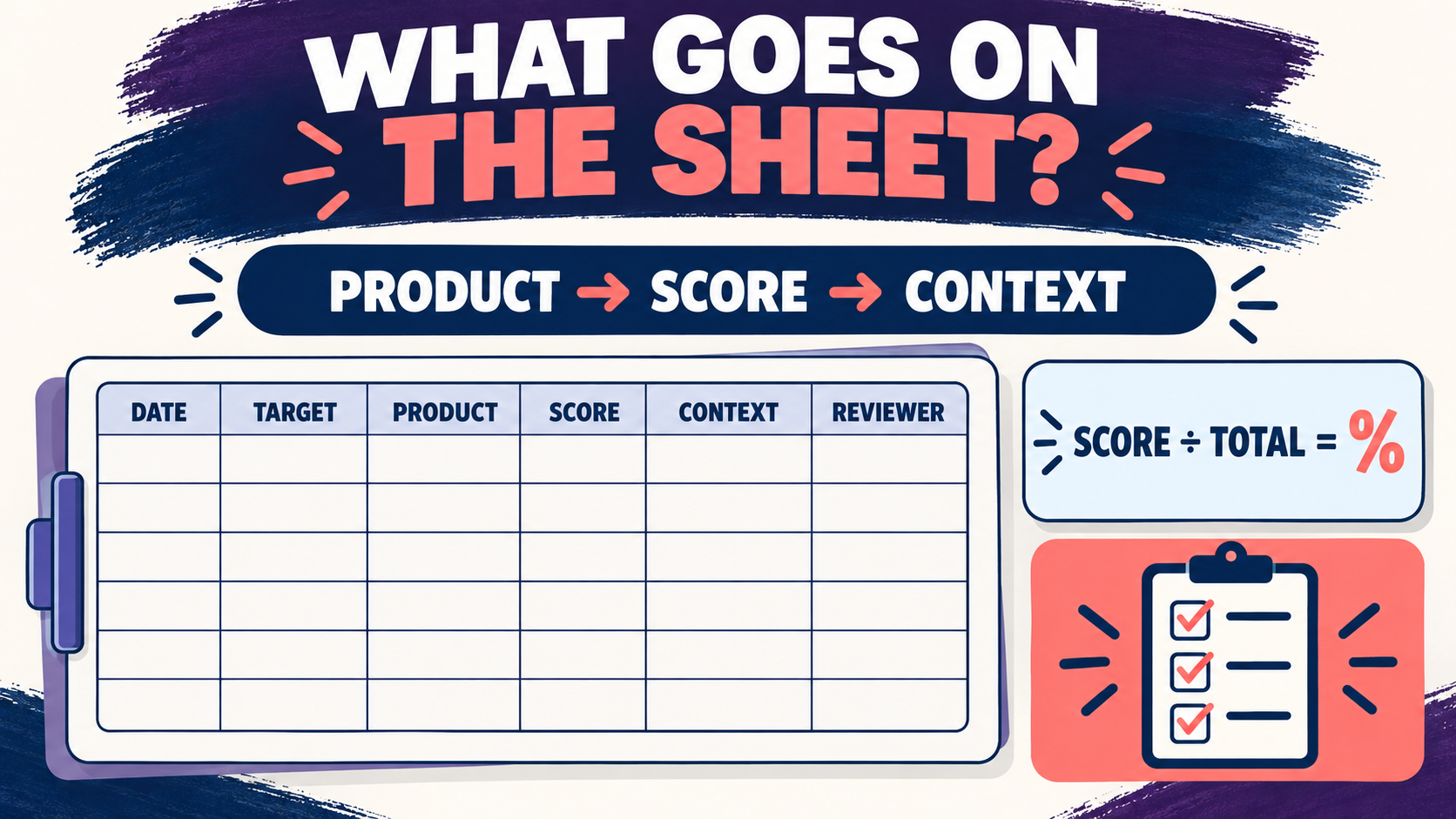
A practical sheet should be quick to complete but detailed enough to protect interpretation. At minimum, include:
- Date and session context: record the date, setting, task, condition, and relevant phase or session label.
- Target or skill: identify the operationally defined behavior or skill being measured.
- Product description: name exactly what is retained, such as a worksheet, completed task sequence, written sample, or inspected item.
- Scoring rule: state what counts as correct, complete, independent, accurate, or acceptable.
- Score and denominator: record the count, total possible, percentage, rubric level, or other selected summary.
- Prompt or assistance information: separate independent performance from prompted, corrected, or assisted performance when that distinction matters.
- Reviewer and identity: identify who scored the product and how the sample can be located without exposing unnecessary personal information.
- Notes and exceptions: document missing products, damage, late scoring, suspected assistance, unusual conditions, or protocol deviations.
These fields keep the sheet from becoming a decontextualized number. The same score can mean different things when a product was independent, corrected, assisted, or altered before review.
Printable Permanent Product Recording Data Sheet Template
You can print the table below or adapt it to an electronic form. Add rows for each product or scoring occasion. If your goal is to calculate percentage correct, fill in the score and total columns; if your goal is a quality rubric, replace those columns with the rubric levels and define them above the table.
| Date | Target / Skill | Product | Score | Total / Rule | Reviewer / Notes |
|---|---|---|---|---|---|
Place the operational definition, scoring rule, and missing-product policy above the rows. For a percentage, write: score meeting the criterion ÷ total scorable products × 100. Do not treat a missing product as zero unless the protocol justifies it.
How to Use the Data Sheet Step by Step
- Define the target behavior or skill. Use observable, measurable terms rather than labels such as “on task” or “good work.”
- Identify the product. State what will remain and how it will be protected, stored, or retrieved for scoring.
- Choose the scoring dimension. Decide whether the sheet records count, accuracy, completion, quality, percentage, or a rubric level.
- Set the review point. Record whether the product is scored immediately, at the end of a session, the next day, or on a scheduled review date.
- Score without changing the rule. Apply the same inclusion and exclusion criteria to every product.
- Record context and exceptions. Note prompts, assistance, missing items, damage, interruptions, or another person’s access to the product.
- Summarize and graph. Keep the raw product score available even when a percentage or rubric average is graphed.
For example, 8 accurate worksheet items out of 10 can be reported as 80%. If two answers followed staff correction, preserve that information instead of presenting the whole percentage as independent performance.
How to Write a Product Definition
A product definition states what qualifies for scoring and what does not. “Completed homework” is usually too vague. A stronger definition might say: “A product is a worksheet assigned during the session, containing the learner’s written response for each of the 12 numbered items, scored for accuracy using the answer key. Items written by another person are not scored as learner products.”
Include the product’s identity, required components, quality criteria, and ownership rule. For a cleaned area, define the surfaces and acceptable condition; for an assembled item, define the required parts and inspection standard. A product can be permanent but still be a poor measure if it does not uniquely reflect the target response.
How to Score the Product
Choose one scoring rule and name it clearly. Common options include:
- Count: number of products that meet the defined criterion.
- Accuracy: correct components divided by total scorable components.
- Completion: whether all required steps or components are present.
- Quality rubric: a defined level such as 0, 1, 2, or 3, with examples for each level.
- Percentage: a calculated summary that keeps the numerator and denominator visible.
Do not switch between “correct,” “complete,” and “independent” as though they were interchangeable. A response can be complete but inaccurate, accurate but prompted, or present but produced by someone else. If those distinctions affect the decision, give them separate columns.
When the Data Sheet Is a Good Fit
Permanent-product recording is often useful when direct observation is difficult, the behavior produces a durable outcome, and the outcome can be reviewed later. It can also reduce disruption when an observer cannot continuously watch the behavior but can reliably inspect the retained result.
- Academic work leaves a worksheet, written sample, or completed problem set.
- A vocational task produces an item that can be inspected against a quality standard.
- A chore produces a defined environmental condition, such as a cleaned surface.
- A communication or performance sample is saved as an audio or video record.
- A multi-step skill produces a product that shows which components are present.
The method is strongest when each relevant response produces a consistent product, another event cannot easily produce it, and the observer can score it without guessing what happened.
When It Is Not a Good Fit
A permanent product data sheet is not a universal substitute for direct measurement. It may be a poor choice when the behavior does not leave a lasting effect, when the product can be altered or created by someone else, or when the team needs moment-to-moment information for an immediate decision.
- Latency: a finished product usually does not show how long the learner waited before starting.
- Timing: a completed task does not reveal duration or latency.
- Repeated events: one product may result from many responses, so it may not equal frequency.
- Ownership uncertainty: a worksheet may have been completed with unrecorded help or by another person.
- Rapid decisions: if staff must respond during the behavior, waiting for a product review may be too slow.
When the product does not answer the question, choose another measurement system. Do not force the question to fit the available form.
Permanent Product Data Sheet Versus Other ABA Measures
The right comparison is not “which form looks easiest?” It is “which unit of measurement answers the question?”
| Method | Best question | Main caution |
|---|---|---|
| Permanent product | What lasting outcome or product can be scored after the behavior? | The product may not uniquely represent each response. |
| Frequency or rate | How many events occurred, and how often per unit of time? | Requires clear event boundaries and accurate observation. |
| Duration | How long did the behavior last? | A final product alone cannot show elapsed time. |
| Latency | How long did it take to begin after the cue? | The product does not usually preserve onset timing. |
| Interval recording | Did behavior occur during a sampled interval? | An interval percentage is not automatically a product score. |
How to Check Reliability and Data Quality
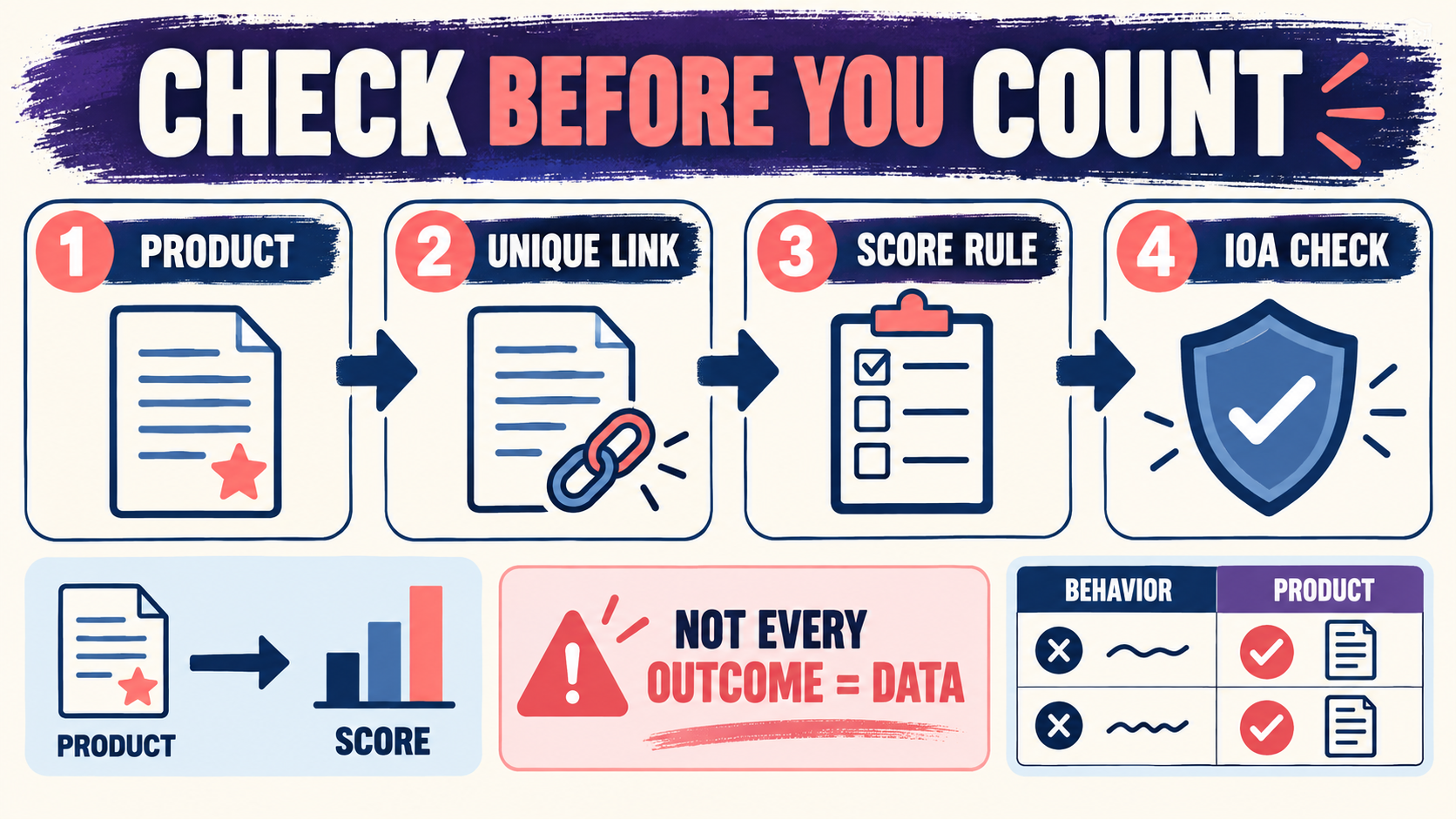
Before trusting a score, check four links in the chain: the product exists, the product belongs to the relevant behavior, the scoring rule is stable, and the reviewer can apply the rule consistently. The peer-reviewed review of academic permanent-product data and reliability procedures shows why product records still need careful measurement design; a retained artifact does not remove the need for clear definitions or agreement checks.
- Product availability: confirm that the item or file can be located and has not been damaged, edited, or replaced.
- Product ownership: document who produced it and whether assistance, correction, or another person’s work could affect the score.
- Scoring agreement: have a second reviewer independently score a sample of products and compare the results.
- Protocol fidelity: verify that reviewers use the same rubric, answer key, inclusion rule, and missing-data policy.
- Decision fit: ask whether the score is sensitive enough to answer the clinical, educational, or exam question.
Record disagreements rather than silently averaging them. If reviewers disagree about whether a product is complete, revise the definition or rubric before using the data for a major decision. Preserve the raw observations needed for an agreement calculation.
BCBA Exam and Fieldwork Traps
- “Permanent” does not mean “automatically valid.” The product still needs a defensible relation to the behavior.
- “Product” does not always mean frequency. One completed item may represent several responses, and several responses may create one item.
- Do not confuse accuracy with completion. A completed worksheet can contain incorrect answers.
- Do not erase prompting information. Prompted performance and independent performance answer different questions.
- Do not treat missing as zero without a rule. Missing, damaged, or unscorable products need a documented policy.
- Separate the BCBA and RBT blueprint. The RBT outline explicitly names implementing permanent-product procedures; the BCBA outline asks broader measurement-selection and evaluation questions.
For study purposes, translate a scenario into three questions: What behavior or skill is being measured? What product remains? What score would honestly represent the target dimension? The free BCBA mock exam can provide optional practice with these distinctions, but it does not replace a supervisor-approved measurement protocol or individualized clinical guidance.
FAQ
What should a permanent product recording data sheet include?: Include the date and context, target behavior or skill, product description, scoring rule, score and denominator, reviewer, prompt or assistance information when relevant, and notes for missing or unusual products. The form should make the measurement decision visible.
Can I use a permanent product data sheet for percentage correct?: Yes, when the product contains a defined set of scorable components. Record the number correct, the total scorable items, and the answer key or rubric. Keep prompted, corrected, and unscorable items visible when they change the meaning of the percentage.
What is the biggest limitation of permanent product recording?: The product may not uniquely or completely represent the behavior. It may not show timing, duration, repeated response count, prompting, or who produced the outcome. A strong product definition and reliability check reduce—but do not erase—these limitations.
Sources to Verify the Method
- BACB BCBA Test Content Outline, Sixth Edition — product measures, measurement selection, validity, and reliability.
- BACB RBT Test Content Outline, Third Edition — A.3, implement permanent-product recording procedures.
- A Review of Academic Permanent-Product Data Collection and Reliability Procedures — peer-reviewed discussion of product data and reliability.
- Permanent Product Data Sheet resource result — an example of the form-oriented search intent this article addresses.
Bottom line: a permanent product recording data sheet is useful when a lasting outcome can be scored consistently and meaningfully. Put the product, rule, context, and reviewer on the form; keep the raw score visible; and choose another measurement system when the product cannot answer the question.
Take the Free BCBA Mock Exam
If you want a low-pressure way to check your recall, use the free practice resource below. Take the Free BCBA Mock Exam



