

What Is Selectionism in ABA?
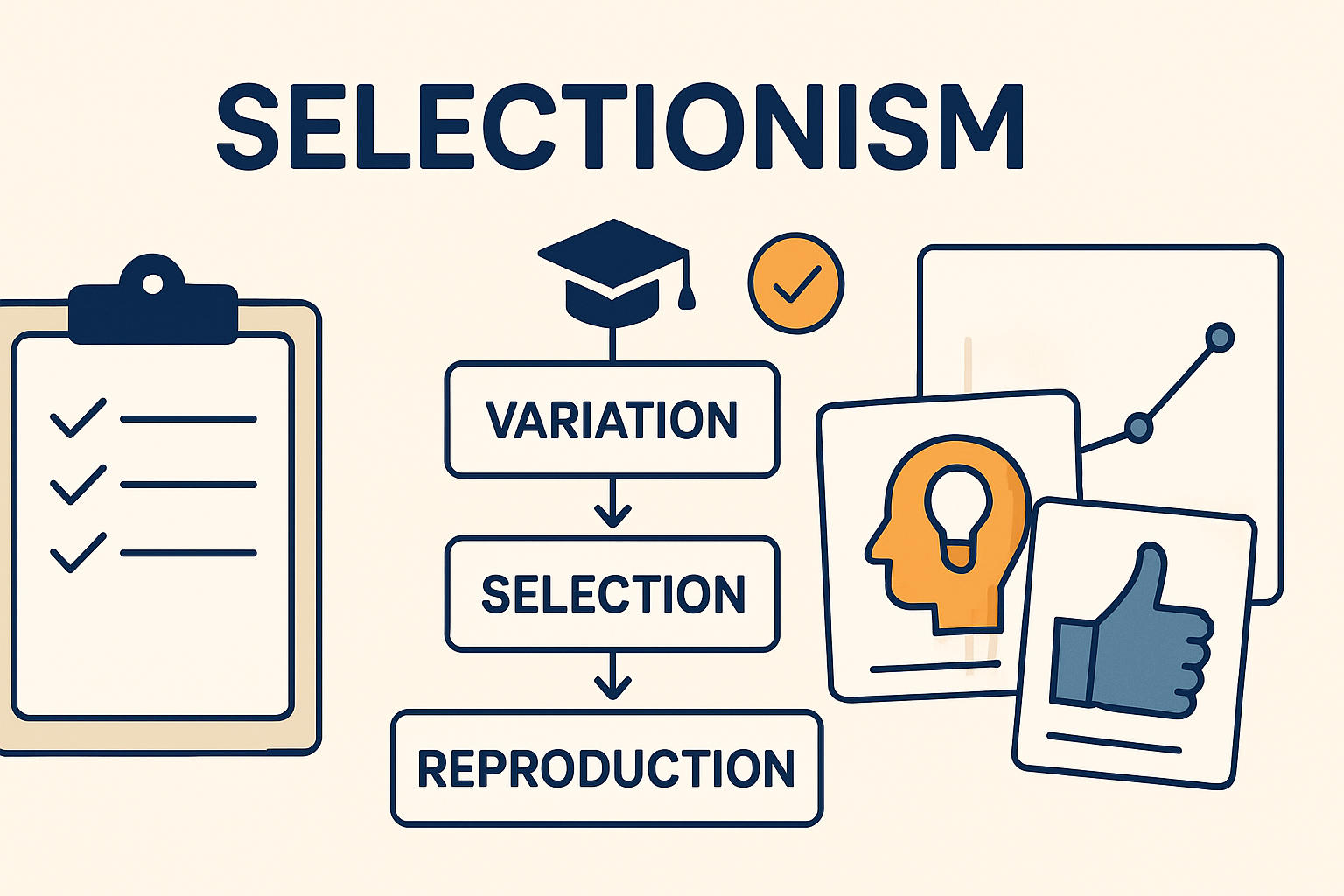
Selectionism is the principle that behavior is shaped and maintained by selection by consequences, much as natural selection shapes species. Skinner described selection operating at three levels:
- Phylogenic selection — selection across the evolutionary history of the species (innate tendencies, reflexes).
- Ontogenic selection — selection of behavior by consequences during the individual’s lifetime (this is operant conditioning).
- Cultural selection — selection of cultural practices passed among people and across generations.
Exam tip: selection within one organism’s lifetime = ontogenic; across species history = phylogenic; across a group’s practices = cultural.
Selectionism in ABA: What is Selectionism? The Foundational Assumption Explained
Selectionism is a core philosophical assumption in applied behavior analysis that explains how behavior evolves and persists through environmental consequences. This principle draws directly from Darwinian natural selection, applying the same evolutionary logic to behavioral patterns rather than biological traits.
Table of Contents
- Selectionism in ABA: What is Selectionism? The Foundational Assumption Explained
- Selectionism in Action: Worked ABA Examples
- Selectionism on the BCBA Exam: Relevance and Common Traps
- Quick-Reference Checklist and Summary
At its essence, selectionism posits that behaviors are selected by their consequences over time. Behaviors that produce reinforcing outcomes become more likely to occur in similar future situations, while those without functional consequences diminish.
Selection by Consequences: The Core Mechanism
The central mechanism of selectionism operates through the three-term contingency: antecedent-behavior-consequence. The consequence component is what selects for future behavior, not the antecedent conditions alone. This distinguishes behavior analysis from structural or physiological explanations that might attribute behavior to internal traits or predispositions.
Selection occurs at multiple levels in behavior analysis:
- Phylogenetic selection: Species-specific behaviors shaped by evolutionary history
- Ontogenetic selection: Individual learning through operant and respondent conditioning
- Cultural selection: Practices and traditions maintained by group consequences
Selectionism vs. Other Philosophical Assumptions
Understanding how selectionism differs from other core assumptions is crucial for exam success. While all philosophical assumptions work together, each has distinct characteristics:
- Determinism: Focuses on cause-and-effect relationships and lawful behavior
- Empiricism: Emphasizes data-driven observation and measurement
- Parsimony: Prefers simplest explanations that account for all facts
- Pragmatism: Values practical solutions and real-world effectiveness
Selectionism specifically addresses how behaviors are selected and maintained through environmental interactions, making it unique among these assumptions.

Video Study: A2 Selectionism / Philosophical Underpinnings
Watch: A02: Selectionism, Determinism, Empiricism, Parsimony, Pragmatism | BCBA Exam Study Guide #bcba
Use this lesson as a visual study companion, then return to the definitions and examples below to apply the same concept to BCBA® exam questions.
Prefer a second pass? Open this lesson on YouTube.
Selectionism in Action: Worked ABA Examples
Seeing selectionism applied to real scenarios clarifies this abstract concept. Each example demonstrates how consequences select for future behavior through different behavioral functions.
Example 1: Social Attention in a Classroom
Consider a student during independent work time (antecedent) who makes a silly noise (behavior), resulting in laughter from peers (consequence). The social positive reinforcement of peer attention selects for the future occurrence of noise-making behavior in similar academic settings.
This example shows how selection by consequences operates through social mediation. The behavior is selected not because of any inherent quality, but because it reliably produces reinforcing social outcomes.
Example 2: Escape from Demands
A client presented with a difficult worksheet (antecedent) engages in task refusal (behavior), leading to removal of the academic demand (consequence). Here, negative reinforcement selects for refusal behavior by allowing escape from aversive tasks.
This demonstrates selection through escape or avoidance consequences. The behavior is selected because it effectively terminates or prevents unpleasant situations, a principle central to understanding many challenging behaviors.
Example 3: Automatic Reinforcement and Skill Acquisition
A child manipulates a toy (behavior) that produces lights and sounds (consequence). The automatically reinforcing sensory feedback selects for the manipulative skill without social mediation.
This illustrates selection through direct sensory consequences. Understanding automatic reinforcement is essential for analyzing behaviors maintained by their inherent sensory properties, as explained in our guide to automatic reinforcement concepts.
Selectionism on the BCBA Exam: Relevance and Common Traps
Selectionism appears frequently on the BCBA exam, often testing your ability to identify this philosophical assumption in various contexts. Questions may present scenarios requiring you to recognize selection by consequences as the explanatory principle.
How the Exam Tests This Concept
The exam typically assesses selectionism through several question formats:
- Identifying which philosophical assumption best explains a behavioral pattern
- Differentiating selectionism from determinism or empiricism in given scenarios
- Applying selectionist principles to interpret behavioral phenomena
- Recognizing selection at phylogenetic, ontogenetic, or cultural levels
These questions require more than memorization; they demand application of selectionist thinking to novel situations.
Frequent Exam Pitfalls and How to Avoid Them
Several common traps can lead candidates to incorrect answers on selectionism questions:
- Confusing selectionism with determinism: Remember that determinism addresses lawful cause-and-effect, while selectionism specifically concerns how consequences select behaviors
- Misattributing selection to antecedents: Selection occurs through consequences, not antecedent conditions alone
- Overlooking multiple levels of selection: Consider whether phylogenetic, ontogenetic, or cultural selection best explains the scenario
- Failing to recognize selection in respondent conditioning: Selectionism applies to both operant and respondent behavior evolution
To deepen your understanding of behavioral principles, explore our comprehensive guide to philosophical assumptions in behavior analysis.
Quick-Reference Checklist and Summary
Use this checklist to reinforce your understanding of selectionism before the exam:
- Define selectionism as behavior selected by consequences over time
- Identify the three-term contingency as the mechanism of selection
- Distinguish selectionism from determinism, empiricism, parsimony, and pragmatism
- Recognize selection at multiple levels: phylogenetic, ontogenetic, and cultural
- Apply selectionist thinking to analyze behavioral functions in scenarios
- Avoid common traps like confusing selection with causation or overlooking automatic reinforcement
Selectionism remains a foundational concept that permeates all of applied behavior analysis. By understanding how behaviors are selected through their consequences, you gain a powerful lens for analyzing behavioral patterns and designing effective interventions.
For additional exam preparation resources, including practice questions covering philosophical assumptions, visit our BCBA exam prep guide. The BACB’s official resources on task list content also provide essential guidance on tested concepts.
Test yourself on behaviorism & foundations
Practice with a free, full-length BCBA mock exam — real exam-style questions, instant scoring, and answer explanations.
Frequently Asked Questions
What is selectionism in ABA?
The principle that behavior is selected by its consequences, paralleling natural selection, operating at the phylogenic, ontogenic, and cultural levels.
What are the three levels of selection by consequences?
Phylogenic (species evolution), ontogenic (operant learning in a lifetime), and cultural (practices passed between people).
What is cultural selectionism?
The selection and transmission of cultural practices based on their consequences for the group.
References
- Cooper, J. O., Heron, T. E., & Heward, W. L. (2020). Applied Behavior Analysis (3rd ed.). Pearson.
- Behavior Analyst Certification Board. BACB.com — 6th Edition Task List.
Next step for BCBA exam prep
Turn this topic into exam-day practice
You have reviewed the key ideas. Take a full-length practice test to see what you can apply under exam conditions, then use your results to choose your next study step.
Take the Free BCBA Mock Exam
Continue with Five Full-Length Mocks — $99
Start with the free mock if you are still measuring your readiness. No pass guarantee is implied.



