
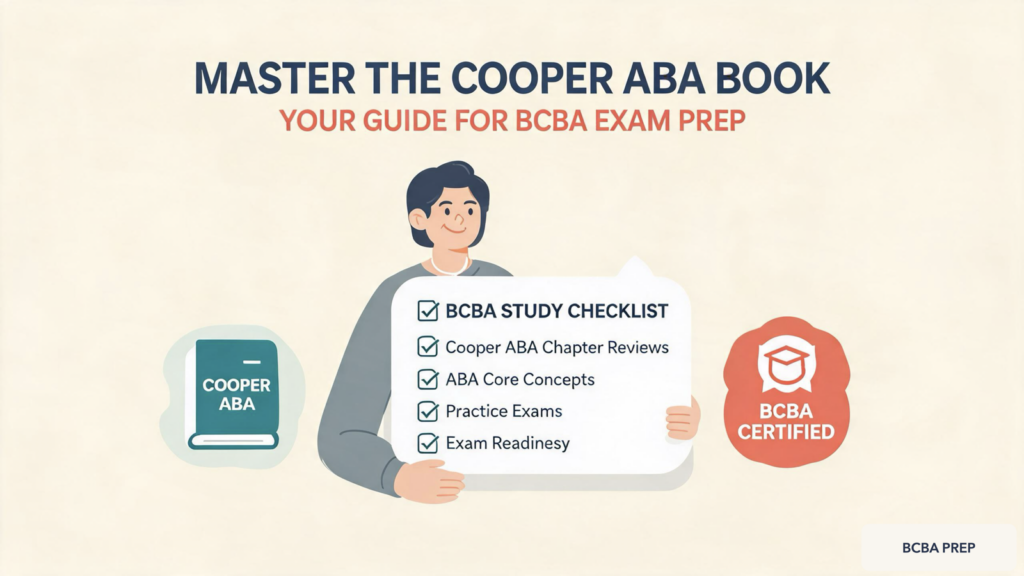
What Is the Cooper ABA Book and Why Does It Matter for the BCBA Exam?
The Cooper ABA book, officially titled Applied Behavior Analysis by John O. Cooper, Timothy E. Heron, and William L. Heward, is widely regarded as the definitive textbook in the field. It serves as the foundation for most graduate programs in ABA and is the primary resource for BCBA exam content. Understanding how to navigate this book can significantly boost your exam performance.
Table of Contents
- What Is the Cooper ABA Book and Why Does It Matter for the BCBA Exam?
- Key Concepts from the Cooper ABA Book for the BCBA Exam
- Worked Examples: Applying Cooper ABA Concepts to BCBA Exam Questions
- Common Exam Traps and How the Cooper ABA Book Helps You Avoid Them
- Quick Study Checklist: Using the Cooper ABA Book Effectively
- Final Summary: Mastering the Cooper ABA Book for Exam Success
- References
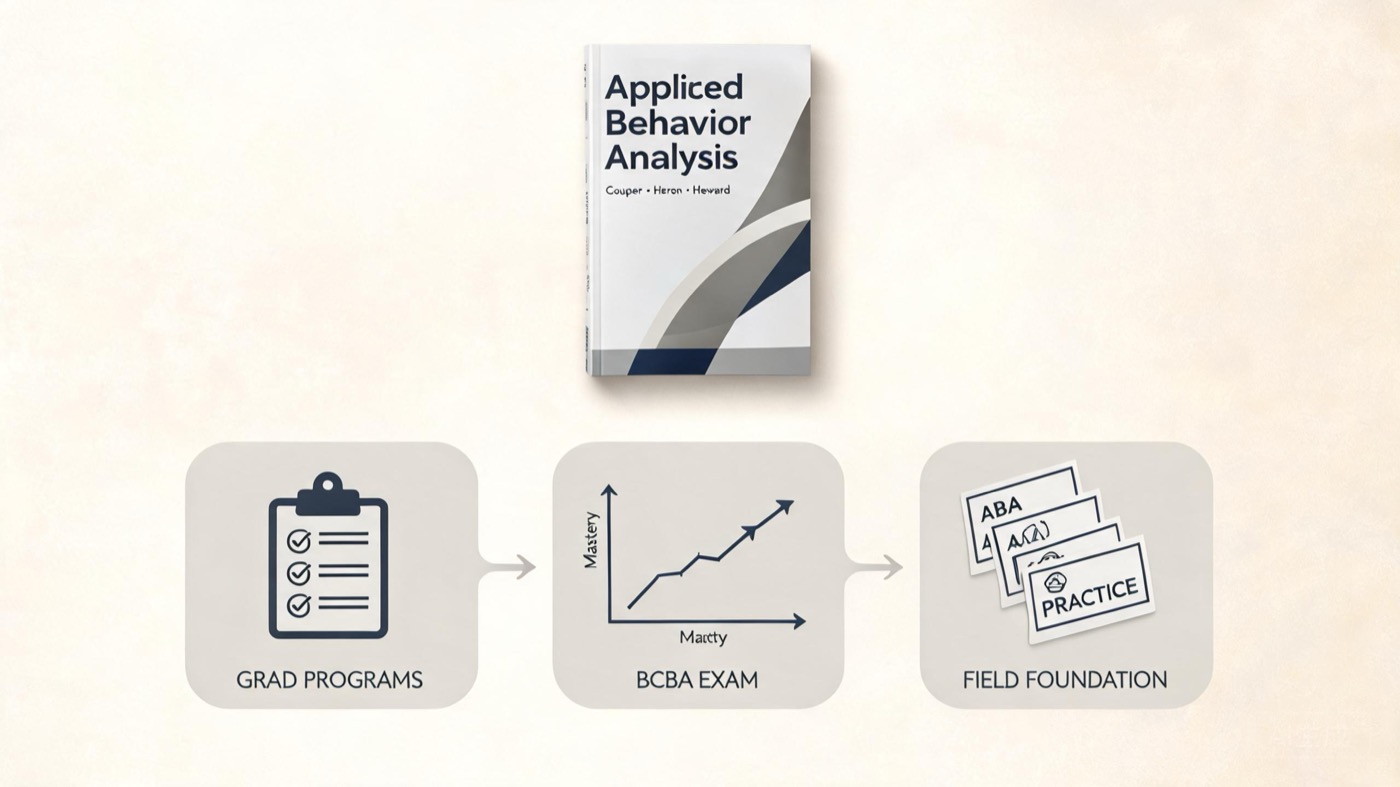
Definition and Scope
The book covers the full spectrum of ABA from philosophical underpinnings to practical application. It is organized into sections on basic principles, measurement and design, assessment, and intervention. For BCBA candidates, it is essential to master the chapters on reinforcement, motivating operations, functional assessment, and behavior change procedures. The text includes detailed examples, graphs, and review questions that mirror exam scenarios.
Key Concepts from the Cooper ABA Book for the BCBA Exam
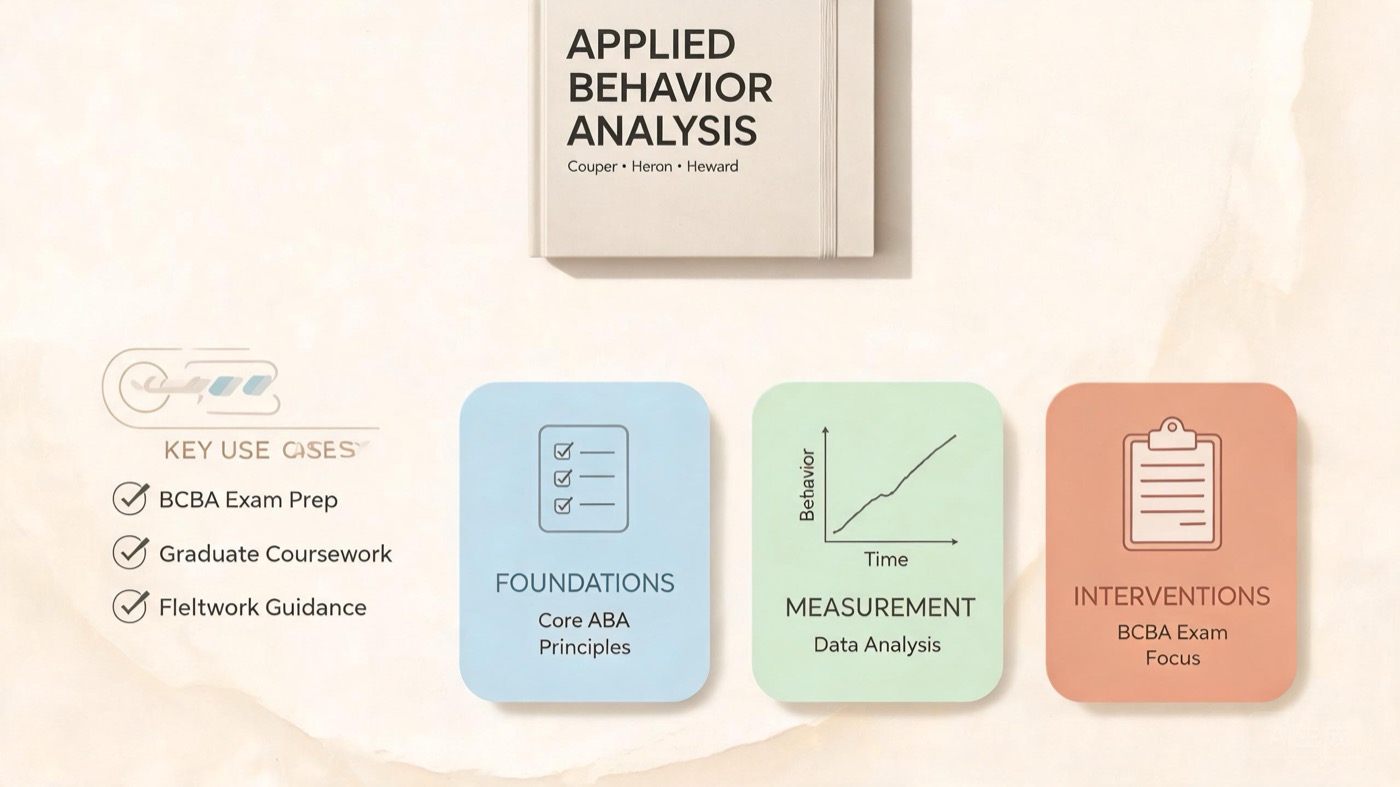
Reinforcement and Punishment Principles
The Cooper ABA book dedicates multiple chapters to reinforcement and punishment. Positive reinforcement involves adding a stimulus to increase behavior, while negative reinforcement removes an aversive stimulus to increase behavior. Punishment follows similar logic but decreases behavior. On the exam, you must distinguish these in scenarios. For example, if a child completes homework to escape a chore, that is negative reinforcement. Mastery of these definitions is crucial for BCBA exam success.
Motivating Operations and Their Effects
Motivating operations (MOs) alter the value of a reinforcer and the frequency of behavior that has previously produced it. An establishing operation (EO) increases value, while an abolishing operation (AO) decreases value. The book explains both value-altering and behavior-altering effects. Exam questions often ask you to identify whether a condition is an EO or AO, and to determine its effect on behavior. For a deeper dive, see our guide on SD vs. MO differences.
Functional Assessment and Function-Based Interventions
Functional assessment methods include indirect (interviews), descriptive (ABC data), and functional analysis (experimental). The Cooper ABA book emphasizes identifying the function of behavior to select effective interventions. For example, if a behavior is maintained by escape, the intervention might involve functional communication training (FCT) to request a break. Understanding this process is a high-yield topic for the BCBA exam.
Worked Examples: Applying Cooper ABA Concepts to BCBA Exam Questions
Example 1: Escape-Motivated Behavior
A child engages in tantrum behavior during math worksheets. The antecedent is the worksheet presentation, the behavior is crying and throwing items, and the consequence is removal of the worksheet. The hypothesized function is escape from the task. A function-based intervention would include teaching the child to request a break (FCT) and using DRA (differential reinforcement of alternative behavior) for compliance. Practice applying such examples with free BCBA mock exam questions.
Example 2: Attention-Motivated Behavior
A student calls out in class without raising a hand. The antecedent is the teacher asking a question, the behavior is blurting out an answer, and the consequence is teacher reprimand (attention). The function is attention. An effective intervention is to provide reinforcement for hand-raising (DRI) while using extinction for call-outs (ignore). The Cooper ABA book provides detailed guidelines on extinction procedures.
Example 3: Tangible-Motivated Behavior
An adult with intellectual disability repeatedly asks for snacks throughout the day. The antecedent is the absence of snacks, the behavior is verbal requests (mands), and the consequence is receiving a snack. The function is tangible access. The intervention should teach the individual to mand appropriately and provide scheduled access to snacks, reducing the motivation to request persistently. This example highlights how motivating operations influence behavior.
Example 4: Automatic Reinforcement
A child rocks back and forth in a chair, especially when alone. The behavior produces its own sensory consequence, so the function is automatic reinforcement. The Cooper ABA book suggests providing alternative sensory activities or enriching the environment to reduce the behavior. This example is often tricky on exams because there is no social consequence.
Common Exam Traps and How the Cooper ABA Book Helps You Avoid Them
Confusing Negative Reinforcement with Punishment
A common mistake is thinking negative reinforcement is punishment. The Cooper ABA book clarifies that negative reinforcement increases behavior by removing an aversive stimulus, while punishment decreases behavior. Remember: reinforcement always increases, punishment always decreases. Exam questions often present scenarios where you must identify this distinction.
Misidentifying Motivating Operations vs. Discriminative Stimuli
Another trap is confusing an MO with an SD. An MO alters the value of a reinforcer (e.g., food deprivation makes food more valuable), while an SD signals that a reinforcer is available (e.g., a menu in a restaurant). The book dedicates a chapter to this distinction. For more practice, see motivating operations in ABA.
Overlooking Ethical Considerations in Functional Assessment
Functional analysis, while powerful, can pose ethical risks if not conducted properly. The Cooper ABA book emphasizes least restrictive assessment and the need for social validity. For example, conducting a functional analysis in a clinic setting may not generalize to natural settings. Always consider the individual’s safety and dignity. The BACB ethical guidelines also stress these points.
Quick Study Checklist: Using the Cooper ABA Book Effectively
Use this checklist to structure your study sessions with the Cooper ABA book:
- Review chapter objectives before reading each chapter to focus on key concepts.
- Create flashcards for definitions and key terms (e.g., reinforcement, MO, FA).
- Complete end-of-chapter questions and review incorrect answers.
- Apply concepts to mock scenarios using ABC analysis.
- Discuss with study groups to clarify difficult topics like behavioral momentum or matching law.
- Use the index to cross-reference topics that appear in multiple chapters.
Final Summary: Mastering the Cooper ABA Book for Exam Success
The Cooper ABA book is your most valuable resource for BCBA exam preparation. By focusing on key concepts like reinforcement, motivating operations, and functional assessment, and by practicing with worked examples, you can build a solid foundation. Avoid common traps by carefully reading definitions and understanding distinctions. Use a structured checklist to ensure comprehensive review. With consistent effort, you will be well-prepared for exam day. For additional support, explore our BCBA exam prep 2025 guide.
References
Next step for BCBA exam prep
Build a focused BCBA exam practice plan
You are already comparing exam structure and weak areas. Start with five full-length 6th Edition mocks, then add the complete prep system only if you need the study guide and flashcards.
See Five Full-Length BCBA Mocks — $99
See the All-in-One Prep Pack — $120
Review the included materials and access details before ordering. No pass guarantee is implied.



