
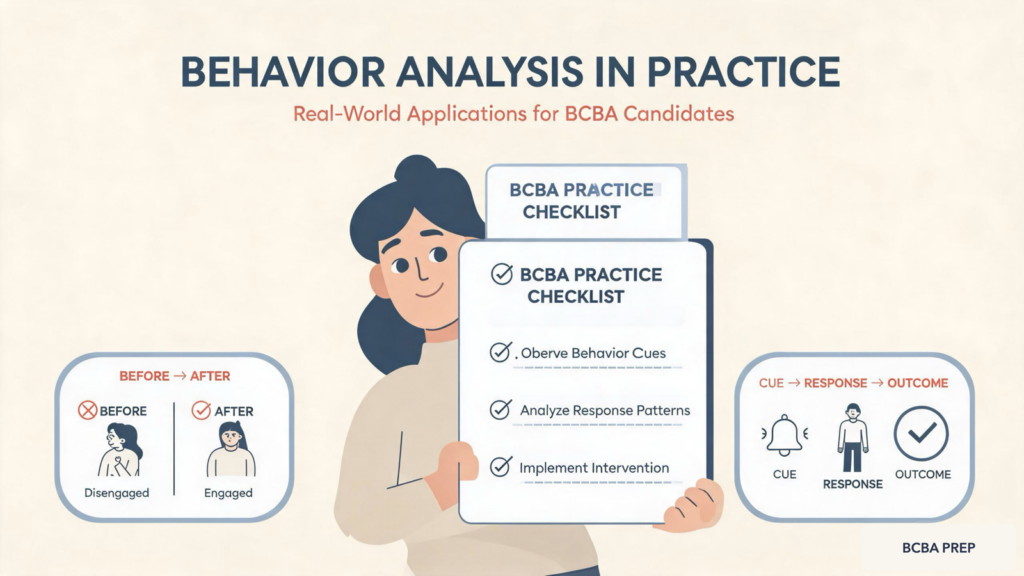
What is Behavior Analysis in Practice?
Behavior analysis is the science of understanding and improving behavior. When we talk about behavior analysis in practice, we mean applying the principles of applied behavior analysis (ABA) to real-world settings—schools, clinics, homes, and community environments. For BCBA candidates, mastering this application is not just about passing the exam; it is about becoming an effective practitioner who can create meaningful change for clients.
Table of Contents
- What is Behavior Analysis in Practice?
- Applying Behavior Analysis in Real-World Settings
- Exam Relevance and Common Traps
- Quick Checklist for Applying Behavior Analysis in Practice
- Summary: Bringing It All Together
- References
The foundation of behavior analysis rests on the seven dimensions of ABA outlined by Baer, Wolf, and Risley. These dimensions—applied, behavioral, analytic, technological, conceptually systematic, effective, and generality—ensure that interventions are practical, measurable, and scientifically grounded. Understanding these dimensions is crucial for any aspiring BCBA.
In practice, behavior analysts use the ABC contingency (Antecedent-Behavior-Consequence) to understand why behavior occurs and to design function-based interventions. The BCBA exam tests this knowledge repeatedly through scenario-based questions. A solid grasp of behavior analysis in practice will help you answer those questions confidently.
Applying Behavior Analysis in Real-World Settings
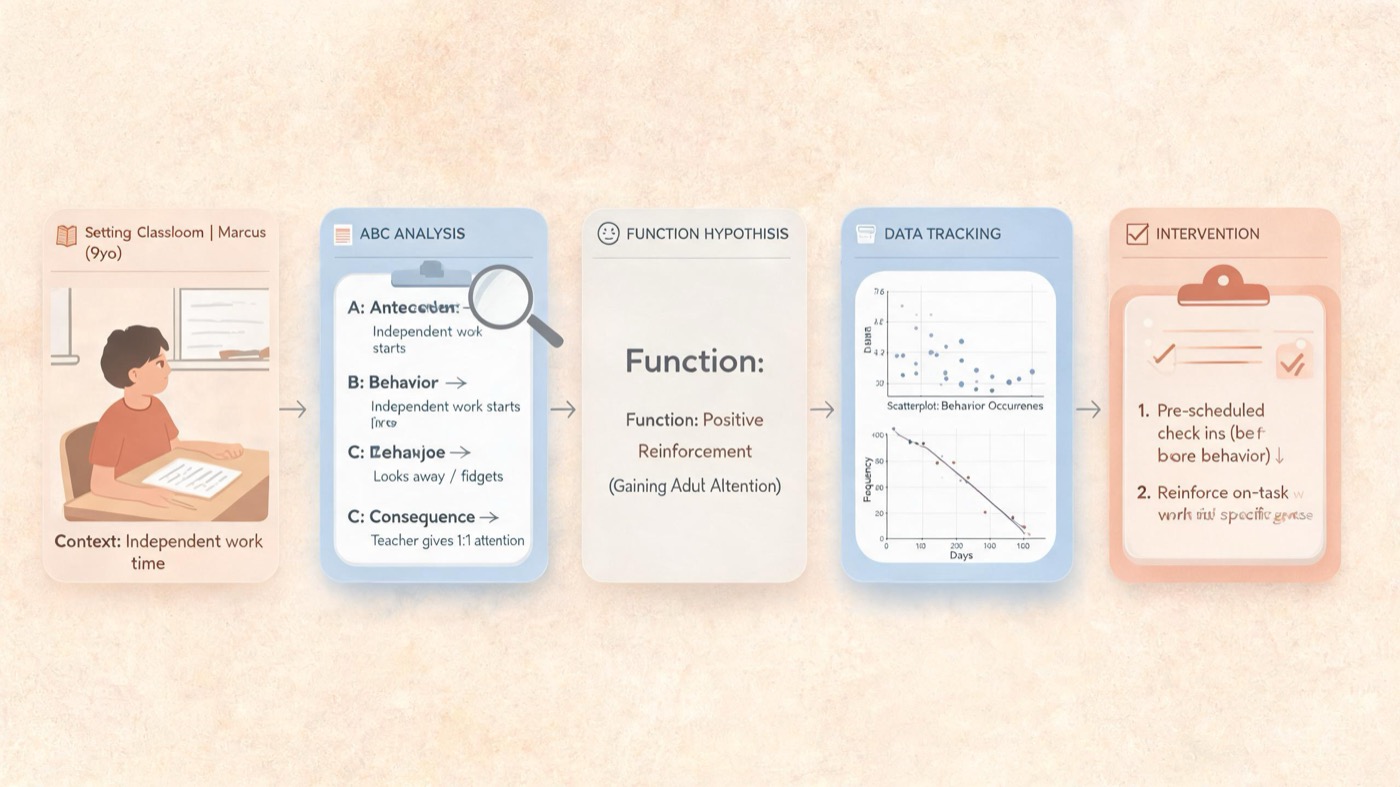
Let’s walk through three detailed examples that illustrate how behavior analysis is applied across different settings. Each example includes an ABC analysis, a hypothesized function, and an evidence-based intervention.
Example 1: Increasing On-Task Behavior in a Classroom
Scenario: A 9-year-old student, Marcus, frequently looks away from his worksheet, talks to peers, and fidgets when given independent math tasks. His teacher often reprimands him, which temporarily stops the off-task behavior but it quickly returns.
ABC Analysis: Antecedent—teacher presents a math worksheet; Behavior—Marcus looks away and talks; Consequence—teacher reprimands him. The hypothesized function is escape from demand: the reprimand provides a brief break from the task.
Intervention: The BCBA implements antecedent modifications: break the worksheet into smaller chunks, offer choice of which problem to start with, and include preferred activities between tasks. The consequence is changed to differential reinforcement: the teacher provides praise and a token for every two problems completed. Within two weeks, on-task behavior increases from 30% to 80% of intervals.
Example 2: Reducing Aggression in a Clinic Setting
Scenario: During therapy sessions, a 5-year-old with autism, Lily, hits her therapist when a preferred toy is taken away or when she is told ‘no.’ After hitting, the therapist sometimes gives the toy back to calm her down.
ABC Analysis: Antecedent—therapist denies access to a toy; Behavior—Lily hits; Consequence—therapist gives the toy. The function is access to tangibles: hitting produces the desired item.
Intervention: The BCBA teaches Lily to mand (request) for the item using a picture card or a simple phrase like ‘my turn.’ Every appropriate request is reinforced immediately with the toy for a short period. Aggression is placed on extinction: no eye contact or verbal reaction when hitting occurs, and the toy is never provided after aggression. After two weeks, manding increases and aggression drops to near zero.
Example 3: Improving Self-Care Skills at Home
Scenario: A 7-year-old, Ethan, throws a tantrum every evening when his mother says ‘it’s time to brush your teeth.’ His mother eventually lets him skip brushing to avoid the screaming. The function is avoidance of non-preferred tasks.
ABC Analysis: Antecedent—mother states ‘brush teeth’; Behavior—Ethan tantrums; Consequence—mother withdraws the demand.
Intervention: The BCBA introduces a visual schedule showing each step of the routine, uses a token economy where Ethan earns a sticker for each step completed (e.g., entering bathroom, picking up toothbrush, brushing for 30 seconds), and uses shaping to gradually increase the brushing duration. After one week, Ethan completes the routine with minimal prompting.
These examples demonstrate how behavior analysis in practice requires identifying the function of behavior and designing individualized, function-based interventions. The same principles apply across settings, whether it’s a classroom, clinic, or home.
Exam Relevance and Common Traps
The BCBA exam heavily tests your ability to apply behavior analysis in practice. Many questions present a brief scenario and ask you to identify the function of behavior, select the most appropriate intervention, or avoid common pitfalls.
How the BCBA Exam Tests Applied Knowledge
Scenario-based questions require you to quickly analyze an ABC contingency. You must identify the antecedent, behavior, and consequence, then hypothesize the function. From there, you choose an intervention that matches that function. For example, if a behavior is maintained by escape, an intervention should involve functional communication training for requesting a break or demand fading.
Common Mistakes Candidates Make
Here are the most frequent errors BCBA candidates make when applying behavior analysis in practice:
- Misidentifying the function: For instance, confusing ‘access to attention’ with ‘escape from demand’ if the consequence is not clear.
- Confusing positive and negative reinforcement: Remember that ‘positive’ means adding a stimulus, and ‘negative’ means removing a stimulus—the effect is the same (behavior increases).
- Overlooking setting events: Factors like sleep deprivation, illness, or changes in routine can influence behavior. The exam often includes these details to test your attention.
- Failing to consider ethical implications: Always prioritize least restrictive procedures and obtain informed consent. The BACB ethics code is a core part of practice.
- Choosing a non-function-based intervention: An intervention that does not match the function is likely to fail. For example, using a timeout (escape from demands) for a behavior maintained by escape will reinforce it.
To avoid these traps, practice analyzing mock scenarios out loud, explaining the ABC contingency and function. Use our free BCBA mock exam practice questions to test your skills under time pressure.
Quick Checklist for Applying Behavior Analysis in Practice
Use this checklist when designing any behavior intervention. It will keep your practice aligned with the seven dimensions and the BACB Task List.
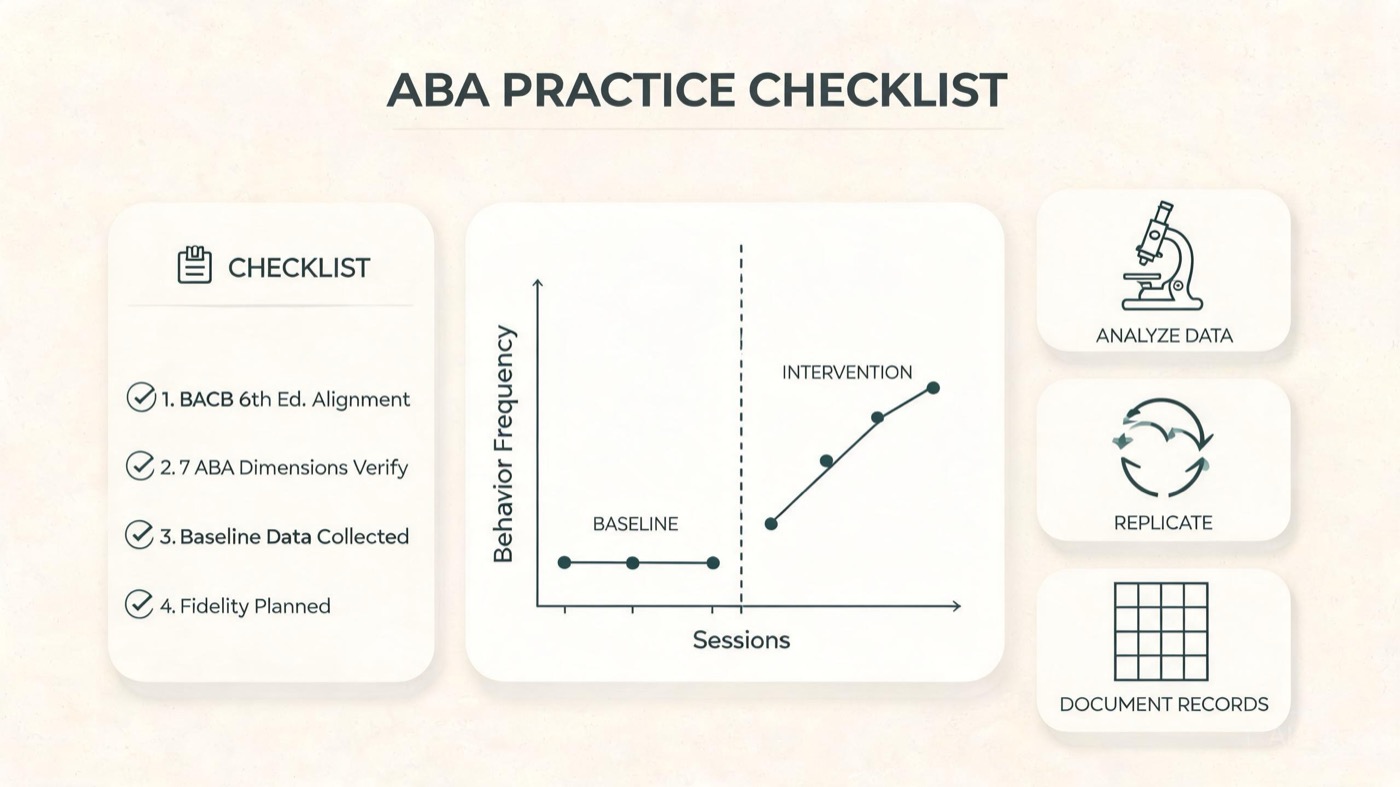
- Define the behavior in observable, measurable terms. Avoid labels like ‘angry’—use ‘hits others with an open palm’ or ‘cries for more than 1 minute.’
- Conduct ABC recording. Collect at least 3-5 instances of the behavior in natural contexts to identify patterns.
- Hypothesize the function. Determine whether the behavior is maintained by social positive (attention/access), social negative (escape), or automatic reinforcement.
- Select a function-based intervention. Choose an intervention that either addresses the antecedent, teaches an alternative behavior, or changes the consequence—always matched to the function.
- Ensure social validity. Confirm that goals, procedures, and outcomes are acceptable to the client and stakeholders.
- Monitor progress and adjust. Graph data daily and make data-based decisions. If the behavior does not improve within a reasonable timeframe, re-assess the function and modify the plan.
- Plan for generalization and maintenance. Program for natural contingencies and teach caregivers to implement the plan consistently across settings.
This checklist aligns with the BACB Task List for the 6th edition. For more in-depth study, review our BCBA exam prep 2025 guide to build a comprehensive study plan.
Summary: Bringing It All Together
Behavior analysis in practice is about more than memorizing terms—it is about using the science of behavior to improve lives. By understanding the ABC contingency, identifying functions of behavior, and designing function-based interventions, you become an effective practitioner. The BCBA exam tests these exact skills through scenario-based questions.
Remember the three examples from this article: the classroom, the clinic, and the home. Each illustrates how behavior analysis in practice can be tailored to different settings and clients. Avoid the common traps by practicing with real-world scenarios and using the quick checklist we provided.
For further practice, explore our guide to the four functions of behavior and try applying the checklist to new scenarios. The more you practice, the more natural it becomes.



