
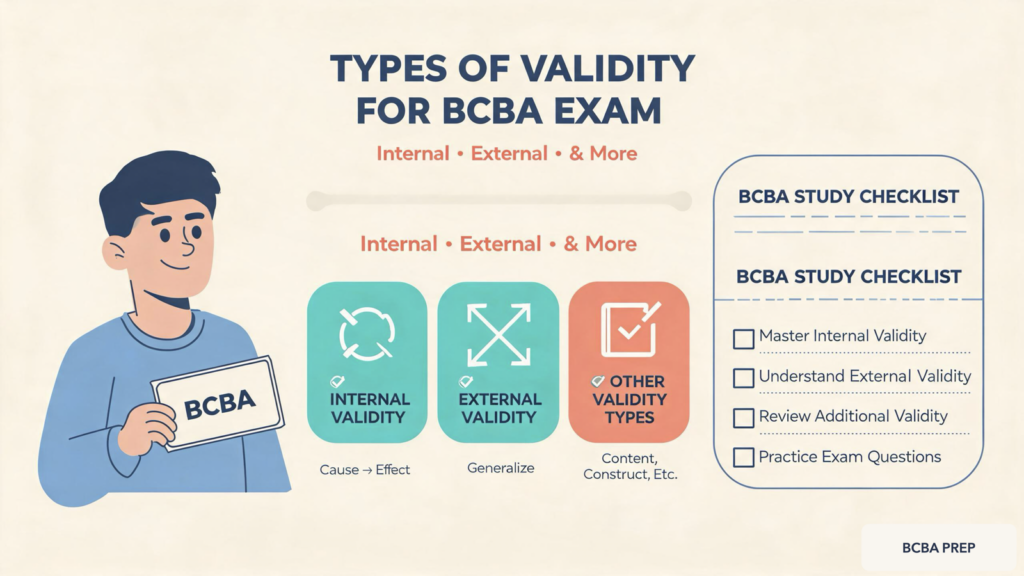
What Are Types of Validity?
Validity refers to the extent to which an assessment, intervention, or experiment measures what it claims to measure. For BCBA candidates, understanding the types of validity is essential for designing effective behavior-change programs and interpreting research. The four main types are internal validity, external validity, construct validity, and social validity. Each addresses a unique question about your data and conclusions.
Table of Contents
- What Are Types of Validity?
- Internal Validity in ABA: Ensuring the Experiment Measures What It Claims
- External Validity: Generalizing Findings Across Settings and Learners
- Construct and Social Validity: Beyond the Data
- Exam Relevance and Common Traps
- Quick Checklist for BCBA Candidates
- Summary: Key Takeaways for Your Exam Prep
Internal vs. External Validity
Internal validity asks: Did the independent variable truly cause the change in the dependent variable? External validity asks: Can these results be generalized to other settings, people, or behaviors? In ABA, a highly controlled single-case design may have strong internal validity but limited external validity if conducted only in a clinic. The key is balancing both.
Construct and Social Validity
Construct validity ensures that your intervention actually targets the intended behavior (e.g., measuring ‘aggression’ correctly, not just ‘loud voice’). Social validity evaluates whether the goals, procedures, and outcomes are acceptable and meaningful to the client and stakeholders. Both are increasingly tested on the BCBA exam and in ethical practice.
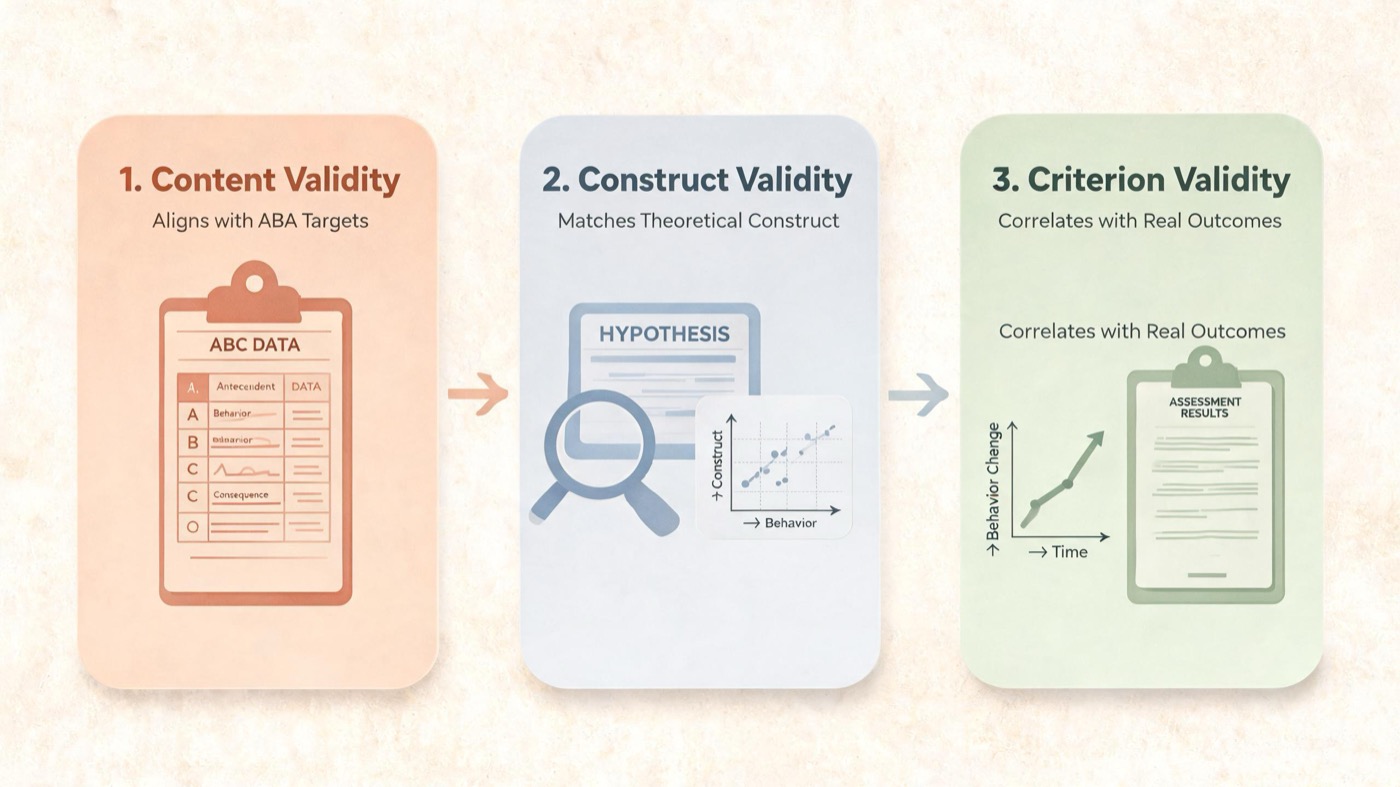
Internal Validity in ABA: Ensuring the Experiment Measures What It Claims
Without internal validity, you cannot confidently say your intervention worked. Threats like history, maturation, and instrumentation can confound results. For example, consider a token economy implemented in a classroom to increase on-task behavior.
ABC Example: Measuring a Token System
- Setting: A self-contained classroom with three students.
- Design: ABAB reversal design (baseline, token system, withdrawal, reintroduction).
- Threat to internal validity: During the withdrawal phase, a substitute teacher changed the seating arrangement, potentially affecting behavior (history threat).
- Solution: Use a multiple-baseline design across settings to control for such confounds, strengthening internal validity.
Common exam traps ask you to identify which threat is present in a scenario. Practice differentiating history (external event) from maturation (internal changes over time).
External Validity: Generalizing Findings Across Settings and Learners
External validity determines if your intervention works beyond the experimental context. BCBAs often need to show that a behavior change persists across people, environments, and time. A common exam question presents a successful clinic-based intervention and asks whether it would generalize to a school.
Example: From Clinic to Classroom
- Clinic: A token system reduced tantrums in a one-on-one therapy room by 80%.
- Classroom: When implemented in a busy classroom, only a 30% reduction occurred due to different motivating operations and staff consistency.
- Implication: The intervention had limited external validity; it needs systematic programming for generalization (e.g., teaching in the natural environment).
To improve external validity, use multiple exemplars, train loosely, and incorporate natural contingencies. The exam may ask you to identify a design that enhances generalizability, such as a multiple-probe design across participants.
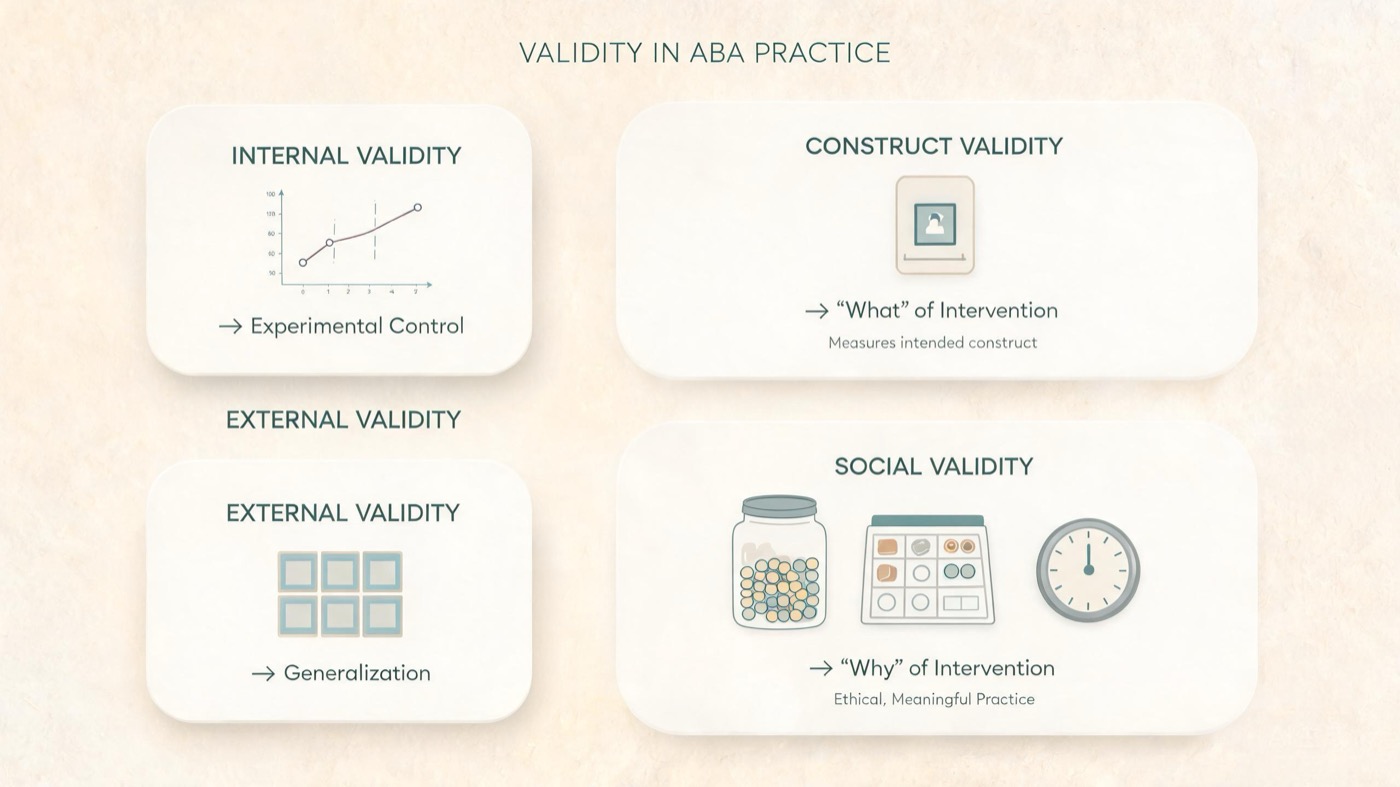
Construct and Social Validity: Beyond the Data
While internal and external validity focus on experimental control and generalization, construct validity and social validity address the ‘what’ and ‘why’ of your intervention. These are critical for ethical and meaningful ABA practice.
Construct Validity: Is Your Measure Valid?
Construct validity ensures that the dependent variable genuinely reflects the target behavior. For example, measuring ‘social skills’ by counting eye contacts may miss other important aspects like turn-taking or vocal intonation. Common threats include reactivity (behavior changes due to observation) and observer drift (inconsistent recording over time). The BCBA exam often tests your ability to identify whether the operational definition matches the construct.
Social Validity: Acceptability and Significance
Social validity evaluates whether the goals, procedures, and outcomes are acceptable to the client, family, and community. A classic example is parent training: if parents find the intervention too time-consuming, they may not implement it with fidelity, reducing overall effectiveness. To measure social validity, use questionnaires or interviews with stakeholders. Key exam points: social validity is linked to treatment integrity and client dignity.
Exam Relevance and Common Traps
The BCBA exam frequently presents scenarios that require you to identify which type of validity is compromised or how to improve it. Here are common traps for each type.
Common Exam Traps for Each Type
- Confusing internal with external validity: A question may describe a change in setting (external) but be framed as an internal threat. The key is: if the confound is about generalization, it’s external.
- Overlooking social validity: Many candidates focus only on experimental validity and miss questions about stakeholder acceptance. Always consider if the intervention is socially valid when the scenario involves parents or teachers.
- Construct vs. internal: If the measure does not match the behavior (e.g., using ‘compliance’ to measure ‘aggression’), the threat is construct validity, not internal.
- Attrition as internal threat: Participant dropout can affect internal validity, especially in group designs. In single-case designs, it may also reduce external validity if only certain participants remain.
Quick Checklist for BCBA Candidates
Use this checklist to self-assess your understanding of the types of validity before the exam. Check off each item as you prepare.
- Can you define internal validity and list three major threats (history, maturation, instrumentation)?
- Can you explain how a multiple-baseline design controls for threats to internal validity?
- Can you describe a scenario where external validity is limited and suggest a fix (e.g., train in natural setting)?
- Can you identify construct validity issues in an operational definition?
- Can you list two methods to measure social validity (e.g., questionnaires, interviews)?
- Can you distinguish between treatment integrity and social validity? (They are related but different.)
Summary: Key Takeaways for Your Exam Prep
The four types of validity are foundational for every BCBA. Internal validity ensures your experiment shows causation; external validity ensures results generalize; construct validity ensures you measure the right behavior; and social validity ensures your intervention matters to stakeholders. Practice with scenario questions on BCBA mock exams to identify which type is being tested. For further reading, the BACB Ethics Code emphasizes ethical practice that aligns with social validity. Master these concepts, and you will be well-prepared for exam day.
Complete BCBA Exam Prep
Turn this topic into exam-day practice
Practice concepts in context with five full-length 6th Edition mock exams, two bonus practice exams, a 6th Edition study guide, and key-term flashcards—all in one $120 USD package.
Get the $120 All-in-One Prep Pack
Review everything included on the product page before ordering. No pass guarantee is implied.



