
Indirect and direct assessment in ABA answer different questions. Indirect methods gather information from people or records, while direct methods observe and measure the behavior or its immediate context. Indirect vs direct assessment ABA is a common comparison because both methods can contribute to a functional assessment, but they do not provide the same kind of evidence. An interview may reveal when a caregiver notices a behavior and what usually follows it. Direct observation can show what happened during a defined observation period. The best choice depends on the question, the behavior, the risk, and the information already available.
Table of Contents
- What Is Indirect Assessment in ABA?
- What Is Direct Assessment in ABA?
- How Are Indirect vs Direct Assessment ABA Methods Different?
- When Is Indirect Assessment Useful?
- When Is Direct Assessment Useful?
- Why Combine the Methods?
- What Are Common Assessment Mistakes?
- What Does the BCBA Exam Test?
- What Is the Bottom Line?
- Quick Review Checklist
- Take the Free BCBA Mock Exam
The BCBA Test Content Outline emphasizes measurement and data-based decision-making. When a question asks whether an assessment method is indirect or direct, focus on the source and the observation process rather than on whether the method feels clinical.
What Is Indirect Assessment in ABA?
Indirect assessment collects information about behavior without the assessor directly observing every occurrence. Examples include interviews, questionnaires, rating scales, record reviews, and structured conversations with people who know the learner. These sources can be efficient and can help identify patterns that are difficult to capture in a brief observation.
Indirect information is still data, but it is usually filtered through memory, interpretation, context, and the reporter’s opportunity to observe. A caregiver may accurately describe a behavior that occurs at home but not know what happens at school. Another reporter may use “tantrum” to describe a broad group of responses. Clarify the topography and the setting before treating the report as a measurement.
What Is Direct Assessment in ABA?
Direct assessment observes and records the behavior or the relevant environmental events as they occur. A practitioner may use ABC data, frequency, duration, latency, interval recording, scatterplot observations, or direct manipulation of conditions in a functional analysis. The method produces a record tied to defined observation rules.
Direct does not automatically mean experimental. Direct observation can be descriptive, such as recording what occurs during ordinary activities, or experimental, such as arranging test conditions. The distinction matters because descriptive observation can show correlation, while an experimental analysis is designed to test functional relations.
How Are Indirect vs Direct Assessment ABA Methods Different?
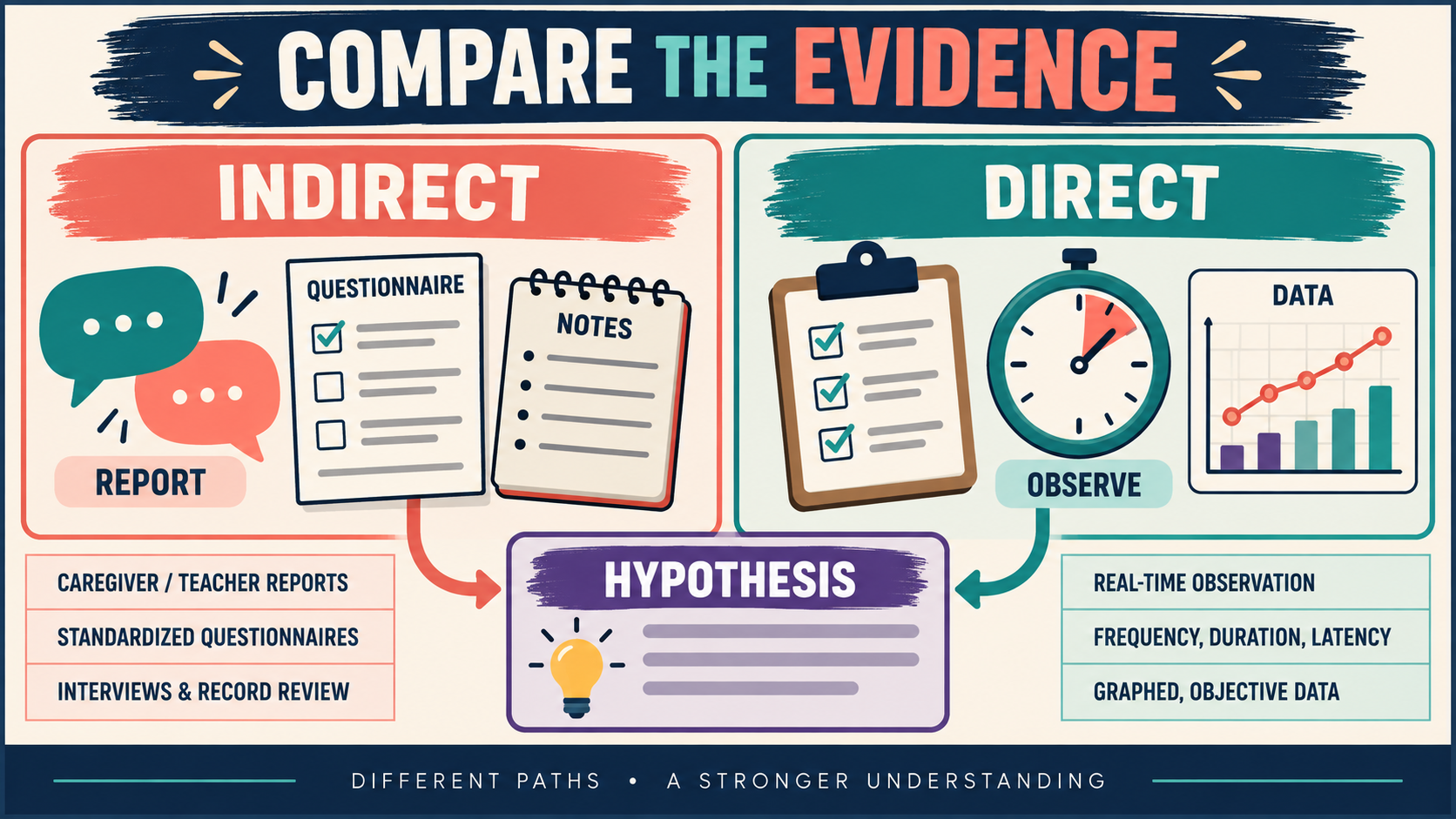
| Feature | Indirect assessment | Direct assessment |
|---|---|---|
| Main source | Reporter, questionnaire, or record | Observation and measurement |
| Strength | Efficient context and history | Behavior-specific evidence |
| Main caution | Recall and interpretation bias | Limited observation window or reactivity |
| Best use | Generate hypotheses and context | Test or describe observable patterns |
When Is Indirect Assessment Useful?
Start with indirect assessment when you need history, setting information, or a practical map of the concern. It can identify routines, medical or sleep changes, communication demands, and consequences that may not occur during a scheduled observation. It can also help prioritize which behavior to define and when to observe.
Use the report to guide observation, not to skip it when direct measurement is feasible and important. If a reporter says the behavior occurs “all day,” ask for examples, duration, setting, and what makes it stop. A more precise interview often turns a broad concern into an observable target.
When Is Direct Assessment Useful?
Direct assessment is especially useful when the decision depends on the rate, duration, latency, or sequence of behavior. It can test whether a behavior follows demands, attention, transitions, or access to items. Direct data can also evaluate whether an intervention changes the selected outcome.
Plan the observation around the behavior and the decision. A short observation during a calm period cannot answer a question about behavior during difficult transitions. Define the observation window, train the observer, and record enough context to know what the data mean.
Why Combine the Methods?
Triangulation means comparing information from multiple sources rather than treating one method as universally correct. An interview may suggest attention, direct ABC observation may show a different pattern, and a functional analysis may test the competing hypotheses. The disagreement is not a failure; it is a prompt to examine definitions, settings, and measurement.
- Interview first: identify routines, history, and practical concerns.
- Define the target: convert broad labels into observable responses.
- Observe directly: collect data during relevant activities and conditions.
- Compare sources: explain agreement, disagreement, and remaining uncertainty.
What Are Common Assessment Mistakes?
A common mistake is treating an indirect rating as proof of function. Another is collecting direct data without checking whether the observation includes the relevant setting. Analysts may also change the response definition across observers or collect a large amount of data that does not answer the treatment question. Respect privacy and consent, use the least intrusive reasonable method, and avoid asking a person to tolerate unnecessary risk. The BACB Ethics Code supplies the professional frame for assessment and communication.
What Does the BCBA Exam Test?
- Indirect means reported or reviewed information: it is not direct observation of each response.
- Direct means observe and measure: it does not necessarily mean experimental manipulation.
- Descriptive is not experimental: an ABC pattern is not automatically a functional relation.
- Use triangulation: compare multiple evidence sources when the decision is important.
- Define the behavior: a broad label weakens both interviews and observations.
- Protect the learner: efficiency never overrides consent, privacy, or safety.
What Is the Bottom Line?
Indirect vs direct assessment ABA is a comparison of evidence sources, not a choice between good and bad methods. Indirect assessment adds history and context; direct assessment adds observable measurement; together they can produce a stronger assessment picture. For more practice with assessment and measurement questions, try the free BCBA mock exam. It supports studying, not individualized assessment.
For targeted review, use our indirect vs direct assessment ABA practice questions to apply the concept in exam-style scenarios.
Quick Review Checklist
Use this final checklist to turn indirect vs direct assessment ABA into exam-ready reasoning. The goal is not to memorize a label in isolation; it is to identify the relevant evidence and explain why the best answer fits the scenario. Key ideas to review:
- State the central definition or decision point for indirect vs direct assessment ABA in your own words.
- Identify the detail that makes indirect vs direct assessment ABA different from its closest related ABA term.
- Separate the observable facts in a scenario from assumptions that are not supported by the facts.
- Write one example and one nonexample so you can recognize the concept in a new setting.
Exam application checks:
- Ask what the question is actually requesting before comparing the answer choices.
- Mark the antecedent, response, consequence, or other evidence that supports the selected answer.
- Look for a distractor that describes a related process but does not answer the specific question.
Final self-check:
- Explain how you would verify the interpretation with clear observations or data.
- Change one detail in the scenario and decide whether your answer should change.
- Give a one-sentence rationale that a supervisor or study partner could evaluate.
Take the Free BCBA Mock Exam
When you are ready to apply the idea, use the free practice resource below for additional feedback. Take the Free BCBA Mock Exam



