
If you are researching virtual bcba supervision, the short answer is that online meetings may be part of supervised fieldwork, but “virtual” is not a blanket approval. The Behavior Analyst Certification Board (BACB) says remote supervision is allowed only in limited situations. Fieldwork must still involve real clients, the BCBA supervisor must already know and oversee those clients, clients must know about and agree to remote observation or another virtual activity during treatment, and state licensing rules may require a supervisor to be licensed where the services occur.
Table of Contents
- virtual bcba supervision: what is the short answer?
- What does virtual BCBA supervision actually include?
- Which activities can happen online, and what must be checked?
- Who may provide BCBA fieldwork supervision?
- Why does state licensing matter for remote supervision?
- What should you check before starting remote fieldwork?
- How should virtual fieldwork be documented?
- What changes should candidates recheck for 2027?
- Which virtual supervision mistakes cause problems?
- How does exam practice fit into the plan?
- Virtual BCBA supervision FAQ
- Take the Free BCBA Mock Exam
That distinction matters because a video call, a remote observation, and a documentation review are not automatically the same kind of activity. This guide separates those functions, explains the supervisor and state-law checks, gives a practical remote-fieldwork checklist, and shows what to recheck for the 2027 BCBA transition. It is educational planning information, not legal, licensing, privacy, or clinical advice. Use the current BACB handbook, your state board, your employer, and your supervisor as the final authorities. Table of Contents
virtual bcba supervision: what is the short answer?
Virtual supervision can be a practical way to connect a trainee and a qualified BCBA when distance, scheduling, or local availability makes fully in-person supervision difficult. It is not a separate BACB certification pathway, and it does not erase the requirements for supervised fieldwork. Before counting an online activity, confirm five points:
- The activity involves a real client and behavior-analytic work rather than a hypothetical case discussion.
- The supervisor already knows and oversees the clients connected to the fieldwork.
- The client and relevant caregivers or stakeholders know about and agree to remote observation or virtual treatment-related activity.
- The state or jurisdiction where services occur allows the arrangement and does not require a specific license or in-person component.
- The supervisor and trainee document the activity, supervision, feedback, and fieldwork category accurately.
The BACB’s current Fieldwork: Getting It Right resource says that remote supervision may help trainees who have few local options, but it also warns that restrictions apply. The page is useful because it answers the real question behind this keyword: not “can I use Zoom?” but “under what conditions can a remote arrangement support valid fieldwork?”
What does virtual BCBA supervision actually include?
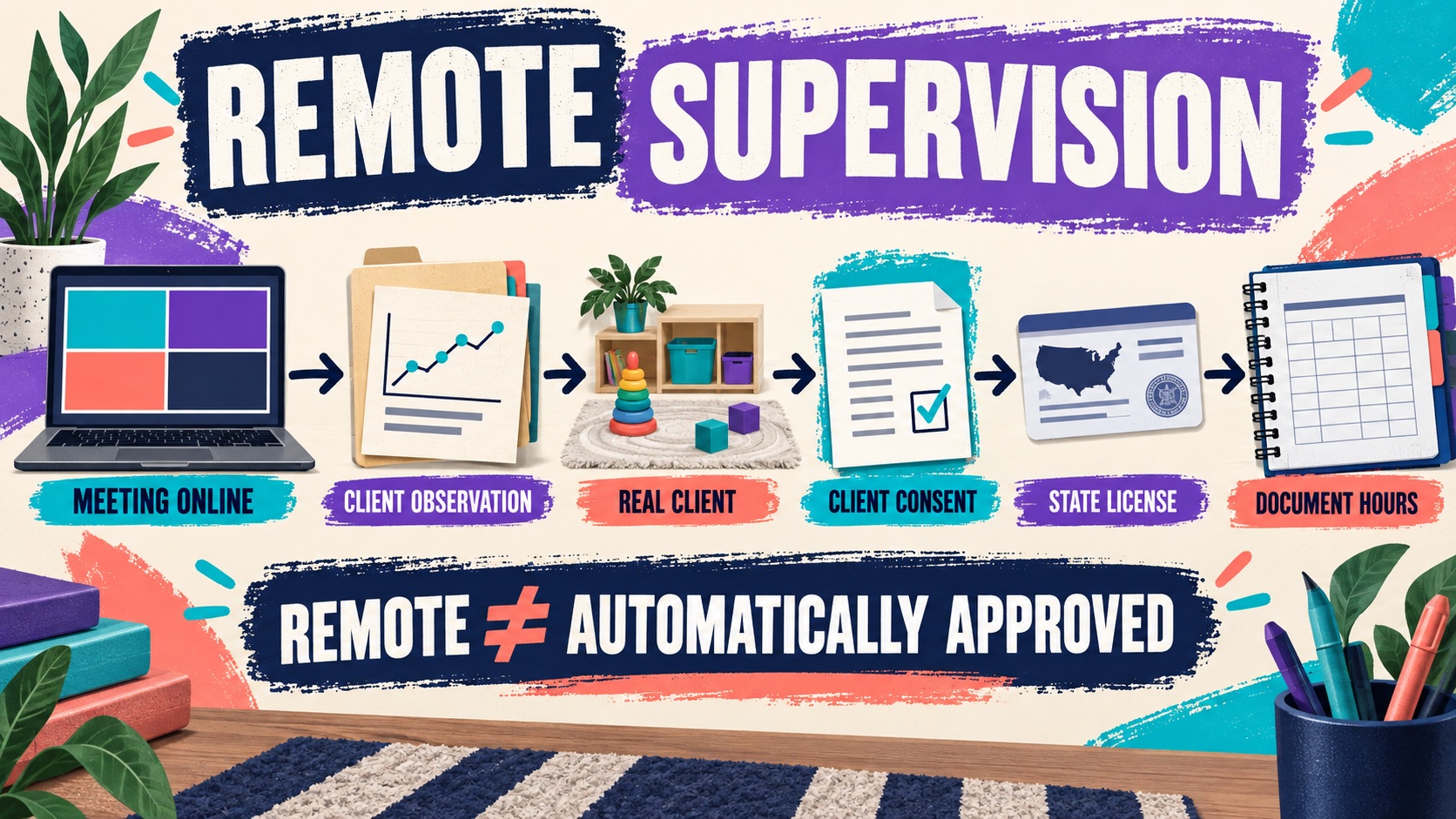
The phrase can describe several different activities. Naming the activity before you schedule it prevents a technology decision from becoming a compliance assumption.
- Online supervision meeting: a scheduled video or audio conversation in which the supervisor reviews performance, gives feedback, discusses goals, and plans the next observation or activity.
- Remote client observation: the supervisor watches a real client session through an approved connection or recording process, with the required knowledge, agreement, privacy protection, and professional oversight.
- Remote review of documentation: the supervisor examines data, graphs, treatment records, assessments, or written work and gives feedback. A review is not automatically a client observation.
- Remote consultation: a supervisor and trainee discuss a case, program design, ethical question, or professional decision. The activity still needs to be classified and documented honestly.
A trainee may have an online supervision meeting without conducting a remote observation in that same session. Conversely, watching a recording does not automatically prove that all required supervision or client-observation conditions were met. Record what actually happened, who participated, what evidence was reviewed, and how the supervisor followed up.
Which activities can happen online, and what must be checked?
The safest approach is to treat remote supervision as a conditional method rather than a category that is always valid. Use this decision table before you count hours.
| Activity | Can it be online? | Checks before counting or relying on it |
|---|---|---|
| Supervision meeting | Often possible when the arrangement is permitted | Qualified supervisor, secure connection, agenda, feedback, and accurate log |
| Client observation | Possible only under the applicable remote-observation conditions | Real client, supervisor connection, informed agreement, privacy, and state rules |
| Data or record review | Often possible through an approved system | Access permission, de-identification where appropriate, date, records reviewed, and feedback |
| Hypothetical study call | Yes as study, not automatically as fieldwork | Do not label exam practice or a hypothetical discussion as client-based supervision |
The table is a planning tool, not a replacement for the handbook. The BACB’s language about real clients and client agreement is especially important. A trainee cannot create a valid client connection simply by opening a video room, and a supervisor cannot assume that a recording may be watched because it is technically available.
Who may provide BCBA fieldwork supervision?
Remote delivery does not lower the supervisor qualification standard. The current BCBA Handbook describes qualified fieldwork supervisors as active BCBAs with no current disciplinary sanctions who have been certified for at least one year and meet the ongoing supervision CEU requirement. A newer BCBA may supervise when the additional consultation conditions described by the BACB are met.
The BACB’s Supervision, Assessment, Training, and Oversight resource also says that supervisors overseeing individuals acquiring BCBA or BCaBA fieldwork must complete an 8-hour supervision training based on the Supervisor Training Curriculum Outline before providing supervision. The trainee can verify relevant information through the BACB Certificant Registry or ask the supervisor for the documentation required by the current handbook. Ask the supervisor these questions before signing a contract or logging hours:
- Is your BCBA certification active, and do you have any current disciplinary sanction that affects supervision?
- Have you completed the required supervision training and ongoing supervision CEUs?
- Do you already know and oversee the clients connected to my fieldwork?
- Which parts of the work will be observed live, reviewed through records, or discussed in a meeting?
- How will we protect client information and document consent for a remote connection?
- Which state or local license rules apply to the service location?
Why does state licensing matter for remote supervision?
The trainee’s location, the client’s location, the service site, and the supervisor’s location may be different. A national certification rule does not answer every state-practice question. The BACB specifically cautions that some states require a supervisor to hold a license in the same state where services are provided, even when the supervision occurs remotely. Before starting, identify the jurisdiction that regulates the behavior-analytic service. Then check:
- whether the state licenses behavior analysts separately from BACB certification;
- whether the supervisor must hold an active license in that state;
- whether telehealth or remote observation has a state-specific rule;
- whether the employer, school, clinic, or payer imposes a stricter policy;
- whether the client or caregiver must sign a remote-service or observation agreement; and
- who is responsible for responding if the connection fails during treatment.
For example, a trainee receiving supervision from another state should not rely on the supervisor’s national BCBA status alone. If services occur in North Carolina, the North Carolina behavior analyst licensure statute and the North Carolina Board FAQ may be relevant. That does not make North Carolina’s rules universal; it shows why the service jurisdiction must be identified before the arrangement starts.
What should you check before starting remote fieldwork?
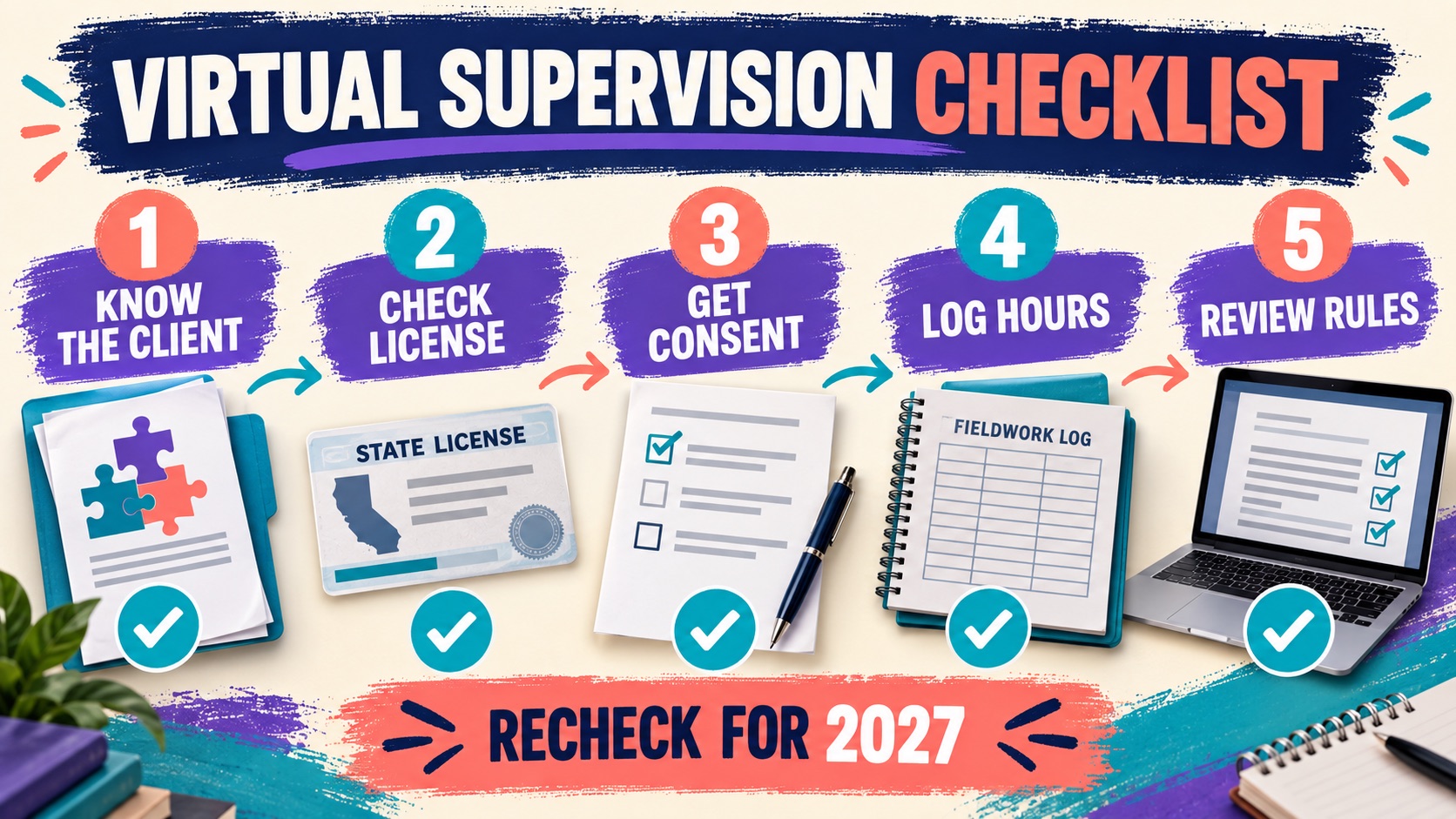
Build a pre-start file rather than relying on an informal agreement in a text message. The file should identify the people responsible, the clients and settings covered, the technology, the consent process, the state check, and the documentation method.
- Confirm client connection: the supervisor knows the clients and is involved in the work rather than observing an unknown case from a distance.
- Confirm state authority: check the jurisdiction where services are provided and document any license or telehealth requirement.
- Confirm client agreement: explain who will observe, what technology will be used, what information may be seen, and what happens if the client declines.
- Confirm privacy: use an approved platform, a private room, access controls, device security, and a plan for recordings. Do not record simply because the platform offers a recording button.
- Confirm a backup: establish what the on-site team does if audio, video, or internet access fails. A failed connection should not create a false record of observation.
- Confirm the log: decide how to record date, duration, activity type, client connection, supervisor feedback, and any follow-up before the first session.
Keep the agreement specific enough that another reviewer can reconstruct what happened. “Remote supervision completed” is weaker than “45-minute video meeting reviewed ABC data, discussed treatment integrity, and assigned next observation,” followed by the relevant client and documentation details stored securely.
How should virtual fieldwork be documented?
The BACB emphasizes that trainees are ultimately responsible for maintaining documentation that demonstrates they met the supervised fieldwork requirements. A software tracker can help, but it does not make an incorrect classification correct. Review the current documentation requirements in the handbook and ask the supervisor to inspect the system before hours accumulate. A useful remote-fieldwork log can include:
- date, start time, end time, and total duration;
- client or case identifier stored according to privacy policy;
- service setting and the jurisdiction where services occurred;
- activity description and whether it was observation, meeting, record review, or another fieldwork activity;
- supervisor present, supervisor feedback, and trainee response;
- consent or agreement status for the remote activity;
- technology or connection problem and the action taken;
- restricted or unrestricted classification when required by the applicable rules; and
- supervisor review, signature, or electronic approval according to the current form.
Do not inflate a one-hour video call into one hour of client observation if only part of the call involved the client. Do not count a group study session as individual supervision unless the applicable requirements genuinely support that classification. When a remote meeting covers multiple clients, document the client-specific work separately enough to show what was reviewed.
What changes should candidates recheck for 2027?
The BACB’s 2027 BCBA Requirements take effect January 1, 2027 and include revised eligibility and maintenance requirements. The transition affects the numbers, forms, and pathway details that a trainee and supervisor must use. It does not turn every remote arrangement into an approved arrangement. The current 2027 overview lists:
- 2,000 hours for Supervised Fieldwork or 1,500 hours for Concentrated Supervised Fieldwork;
- 5% or 7.5% supervision per supervisory period, depending on fieldwork type;
- a 20-hour minimum and 160-hour maximum per supervisory period;
- 60 or 90 cumulative minutes of trainee-with-client observation per supervisory period;
- at least 50% of supervised hours as individual supervision; and
- at least 60% of total supervised fieldwork hours in unrestricted activities.
These are national certification requirements. State licensing, privacy, consent, employer, and payer rules remain separate checks. If your application crosses the transition date, use the current BACB fieldwork resources, the current handbook, and the 2027 monthly and final forms. Record which rule version and form your supervisor used instead of copying figures from an old remote-supervision post.
Which virtual supervision mistakes cause problems?
- Assuming any video call qualifies as supervised fieldwork.
- Observing a client the supervisor does not already know or oversee.
- Failing to tell the client or caregiver about remote observation.
- Ignoring the license rule in the state where services occur.
- Recording sessions without checking policy, consent, security, and storage.
- Counting record review as direct client observation.
- Using a tracker whose calculations do not match the current BACB requirements.
- Logging hours before the supervisor reviews the classification.
- Using 2022 fieldwork numbers or forms after a 2027 application requires the updated set.
- Confusing exam preparation with client-based supervision.
How does exam practice fit into the plan?
Virtual supervision and BCBA exam preparation solve different problems. Supervision connects your work with real clients to qualified oversight; exam practice tests your ability to discriminate, apply, and explain behavior-analytic concepts under time pressure. A mock exam cannot replace a supervisor, a fieldwork log, client agreement, or state authorization. If the exam is still your next gate, use a measured loop:
- Take a timed diagnostic based on the current BCBA content outline.
- Sort misses into concept, application, ethics, calculation, and pacing errors.
- Review the reason each distractor fails, not only why one answer is correct.
- Retest the same concept in a new scenario and record whether the error changed.
Our free BCBA mock exam can be a study checkpoint while you organize your fieldwork plan. It is not BACB supervision, certification, a license, legal advice, or a guarantee of a passing result.
Virtual BCBA supervision FAQ
Can all BCBA supervision be completed online?: Do not assume that. The BACB describes remote supervision as limited and conditional. Real-client connection, supervisor knowledge of the clients, client agreement, state licensing, privacy, and accurate documentation still matter. Your supervisor should decide how each activity fits the current requirements.
Does remote supervision mean the supervisor can live in another state?: Not automatically. The BACB warns that some states require the supervisor to hold a license where services are provided. Check the service jurisdiction and state board before starting, especially when the trainee, client, employer, and supervisor are in different locations.
Can a recorded session replace live supervision?: A recording may support review only when the privacy, consent, client connection, supervision, and documentation conditions are satisfied. It does not automatically prove that the required observation or supervision occurred. Follow the current handbook and supervisor instructions.
Where should I verify the 2027 rules?: Start with the official 2027 BCBA Requirements, the current BCBA Handbook, and the BACB’s remote-supervision fieldwork guidance. Then confirm the state license and privacy rules that apply to your service location.
In short, virtual BCBA supervision can reduce distance without reducing responsibility. Start with real-client connection, a qualified supervisor, state authorization, client agreement, secure technology, and a precise log. Recheck the BACB and your state before the 2027 transition, and treat remote delivery as a method that must fit the rules—not as permission by itself.
Take the Free BCBA Mock Exam
When you are ready to apply the idea, use the free practice resource below for additional feedback. Take the Free BCBA Mock Exam



