
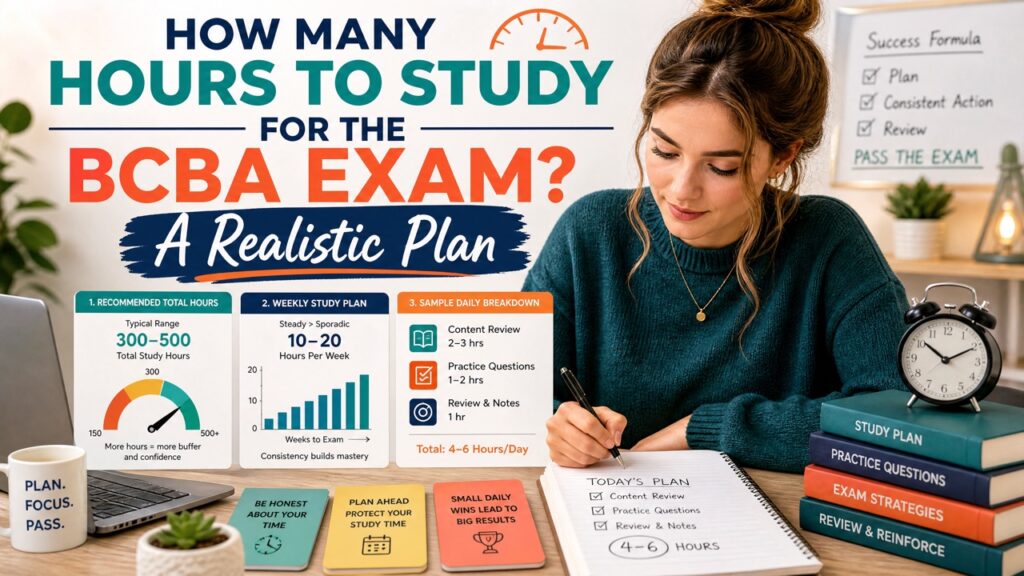
If you’re preparing for the BCBA exam, one of the first questions that comes to mind is how many hours to study for bcba exam. The answer isn’t a simple number, because your ideal study time depends on your background, your current knowledge, and how efficiently you use your study sessions. This guide will help you build a realistic plan that fits your schedule and maximizes your chances of passing.
Table of Contents
- BCBA Exam Study Time: What’s Realistic?
- How to Calculate Your Personal Study-Time Target
- How to Spend Your Study Hours Effectively
- Common Mistakes to Avoid When Estimating Study Hours
- Your Quick Study-Hour Checklist
- Final Thoughts on Study Hours
- Quick Review Checklist
- Take the Free BCBA Mock Exam
- References
BCBA Exam Study Time: What’s Realistic?
There is no universal study-hour count that guarantees success. Candidates with recent coursework in applied behavior analysis may need fewer hours, while those who have been out of school for years may need significantly more. Your learning style and your ability to retain information also play a major role. Instead of chasing a magic number, focus on what you can control: a structured plan that adapts to your strengths and weaknesses.
Why There's No One-Size-Fits-All Answer: The BCBA exam covers a broad range of topics, from basic behavior-change procedures to complex experimental designs. Your familiarity with these areas directly affects your needed study time. For example, if you work daily with token economies and functional assessments, those sections will require less review than, say, the philosophy of behaviorism. Additionally, your ability to answer scenario-based questions under time pressure, often called exam stamina, is a skill that must be trained separately.
Average Hours Reported by Candidates: While official data is not publicly available, many candidates report spending between 100 and 200 hours over several weeks or months. This range is a helpful starting point, but it’s not a prescription. Some people pass with fewer hours because they have strong real-world experience; others need more because they are learning the terminology from scratch. The most effective approach is to use a diagnostic tool to determine your starting point.
How to Calculate Your Personal Study-Time Target
Instead of relying on generic averages, calculate a target that reflects your actual needs. This process involves three steps: assessing your current knowledge, setting a completion date, and planning weekly hours. Doing this upfront prevents both over-studying and the last-minute panic that comes from underestimating the task.
Step 1: Assess Your Current Knowledge: Take a diagnostic mock exam early in your preparation. This gives you objective data on which content areas you’ve already mastered and which ones need attention. It also helps you become familiar with the exam format and the types of questions asked. Look for a mock exam that mirrors the BCBA 6th edition test blueprint, like the ones offered on bcbamockexam.com, to ensure your assessment is accurate.
Step 2: Set a Target Completion Date: Work backward from your scheduled exam date. If your exam is in 12 weeks, and you estimate you need 150 hours of study, that translates to about 12.5 hours per week. If you can only study 10 hours per week, you’ll need to extend your timeline or increase efficiency. This calculation gives you a concrete target and makes your plan feel manageable.
Step 3: Plan Weekly Hours: Decide how many hours you can realistically devote each week, and then break those hours into daily sessions. For example, a full-time student might study 20 hours per week, while a working professional might manage only 8. Consistency is more important than the total number of hours, so aim for short daily sessions rather than marathon weekends.
How to Spend Your Study Hours Effectively
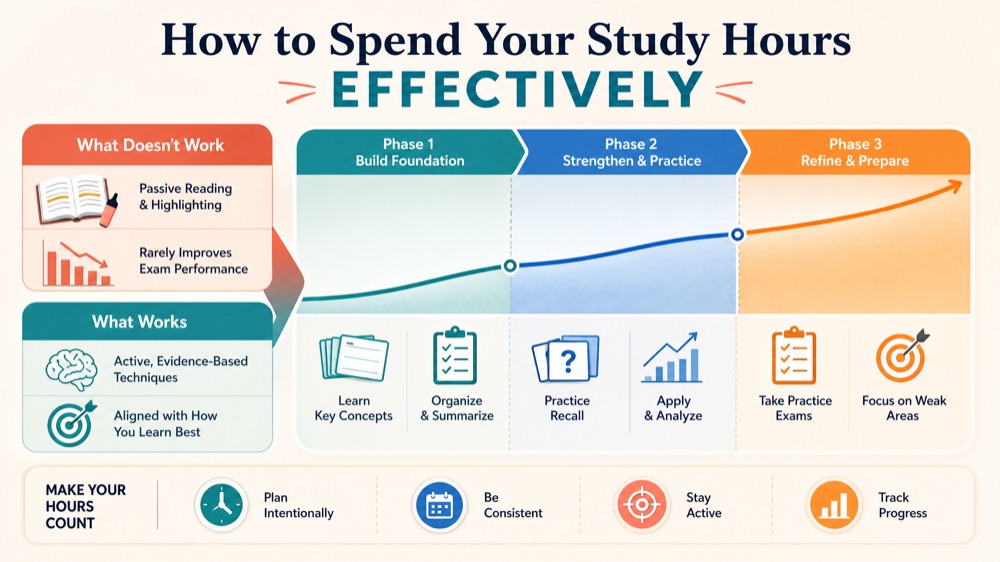
Once you know how many hours you need, the next question is how to use them. Passive reading and highlighting may feel productive, but they rarely improve exam performance. Instead, use evidence-based study techniques that align with how behavior analysts learn: through active recall, practice, and feedback.
Active vs. Passive Studying: Active studying involves engaging with the material, such as answering practice questions, explaining concepts aloud, or creating flashcards. Passive studying, in contrast, includes rereading notes or watching videos without interaction. The BCBA exam requires you to apply concepts to novel scenarios, so active retrieval is essential. For example, instead of reading about differential reinforcement, write out definitions and then create your own example.
Mock Exams: The Best Use of Time: Spend a significant portion of your study hours taking full-length mock exams under timed conditions. This not only builds stamina but also reveals patterns in your errors. After each mock exam, do a thorough error analysis: categorize each incorrect answer by topic and by error type (e.g., misread the question, confused terms, lacked knowledge). This data tells you exactly where to focus your next study sessions.
How to Break Down Content Areas: Allocate more time to high-weight topics, such as ethics and experimental design, as these appear frequently on the exam. Use the BACB Task List to create a checklist of every item, and mark your confidence level for each. Spend extra hours on items you rate as “unfamiliar” or “shaky.” This targeted approach ensures that your limited study hours have the maximum impact.
Common Mistakes to Avoid When Estimating Study Hours
Many candidates misjudge how many hours to study for the BCBA exam, leading to either burnout or insufficient preparation. Recognizing these common pitfalls can save you time and frustration. Below are three frequent mistakes and how to avoid them.
Underestimating the Need for Review: You might learn a concept today, but without regular review, you’ll forget it within days. This is known as the forgetting curve. Instead of studying a topic once and moving on, schedule periodic reviews using spaced repetition. For example, after learning about schedules of reinforcement, quiz yourself on it weekly for a month. This reinforces long-term retention, which is what the exam actually tests.
Relying on Feedback from Others: Your friend or supervisor may tell you that you’re “ready” based on their own experience, but their assessment may not reflect your actual knowledge. The only accurate way to know is to review your own performance data, such as scores from mock exams and quizzes. Rely on data, not anecdotes. If your practice scores are consistently above 80%, you’re likely on track; if they’re below that, add more study hours.
Cramming Close to Exam Day: In the final week before the exam, it’s tempting to study 12 hours a day. However, cramming can increase anxiety and actually reduce performance. Instead, use the last week to review your error logs, take one final mock exam, and practice relaxation techniques. Remember that the exam requires stamina and clear thinking, both of which suffer when you’re exhausted.
Your Quick Study-Hour Checklist
To help you turn this information into action, here’s a practical checklist you can follow before and during your preparation. Keep this handy to stay on track.
- Take a diagnostic mock exam to identify your weak areas.
- Calculate your study-time target based on your exam date and available weekly hours.
- Create a weekly schedule that includes daily, shorter study blocks.
- Use active recall techniques like flashcards, quizzes, and self-explanations.
- Schedule regular mock exams (at least weekly near the end).
- Allocate extra time to ethics and experimental design.
- Implement spaced repetition to review previously covered topics.
- Track your progress with a study log or spreadsheet.
- In the final week, focus on review and avoid cramming.
Following this checklist ensures that your study hours are spent productively. The key is to be flexible: if your mock exam scores aren’t improving, adjust your plan, perhaps by adding more practice questions or seeking clarification on difficult topics.
Final Thoughts on Study Hours
Determining how many hours to study for bcba exam is a personal journey, not a fixed formula. Use the 100–200 hour range as a starting point, but rely on your own data to refine your plan. Remember to assess your knowledge, set a target date, and study actively. Avoid the common traps of underestimating review time, trusting others’ opinions over your scores, and cramming at the last minute.
The BCBA exam is challenging, but with a strategic study plan, you can approach it with confidence. Start by taking a BCBA exam question distribution guide to understand the test structure, and consider using a retake strategy if you’ve already attempted the exam. For more in-depth guidance, explore our 6th edition blueprint weighting guide. Then, commit to your plan and trust the process. Good luck!
Quick Review Checklist
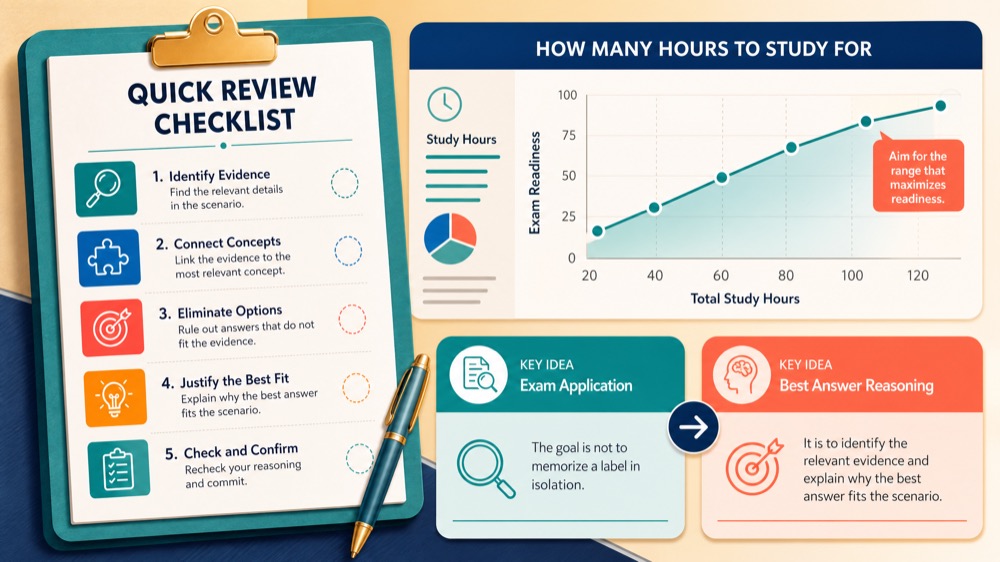
Use this final checklist to turn how many hours to study for into exam-ready reasoning. The goal is not to memorize a label in isolation; it is to identify the relevant evidence and explain why the best answer fits the scenario. Key ideas to review:
- State the central definition or decision point for how many hours to study for in your own words.
- Identify the detail that makes how many hours to study for different from its closest related ABA term.
- Separate the observable facts in a scenario from assumptions that are not supported by the facts.
- Write one example and one nonexample so you can recognize the concept in a new setting.
Exam application checks:
- Ask what the question is actually requesting before comparing the answer choices.
- Mark the antecedent, response, consequence, or other evidence that supports the selected answer.
- Look for a distractor that describes a related process but does not answer the specific question.
Final self-check:
- Explain how you would verify the interpretation with clear observations or data.
- Change one detail in the scenario and decide whether your answer should change.
- Give a one-sentence rationale that a supervisor or study partner could evaluate.
Take the Free BCBA Mock Exam
Ready for more practice? Use the free mock exam to keep testing your accuracy with realistic BCBA-style items. Take the Free BCBA Mock Exam



