
Introduction: Why the Functional Behavior Assessment
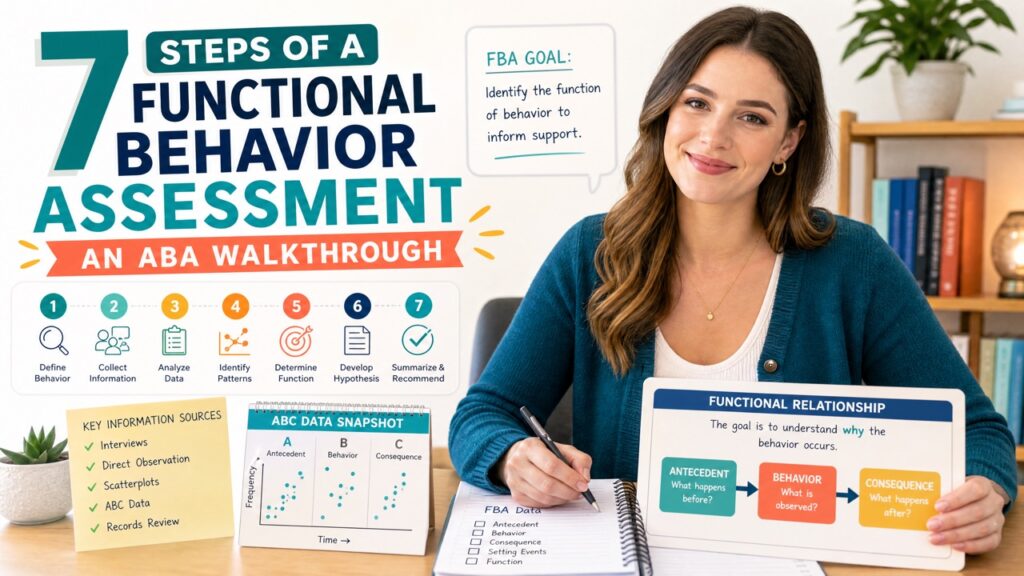
A functional behavior assessment (FBA) is a systematic process used in applied behavior analysis to identify the purpose or function of challenging behavior. For BCBA candidates, understanding the functional behavior assessment steps is not just about passing an exam; it is about developing the clinical reasoning skills you will use every day as a behavior analyst. The FBA is the foundation of ethical and effective intervention, as it ensures that treatment decisions are based on data rather than guesswork.
Table of Contents
- Introduction: Why the Functional Behavior Assessment
- The 7 Steps of a Functional Behavior Assessment: A Step-by-Step Breakdown
- Step 1: Define the Behavior in Observable Terms
- Step 2: Gather Data Through Indirect and Direct Methods
- Step 3: Analyze Data to Identify Patterns and Contexts
- Step 4: Formulate a Hypothesis About the Function of Behavior
- Step 5: Develop a Behavior Intervention Plan (BIP)
- Step 6: Implement the Plan with Fidelity
- Step 7: Monitor Progress and Make Data-Based Decisions
- Real-World ABA Examples: Applying the 7 Steps
- Exam Relevance: FBA Questions and Common Traps
- Quick Checklist for Conducting a Functional Behavior Assessment
- Summary and Final Takeaways
- Take the Free BCBA Mock Exam
- References
On the BCBA exam, you will encounter scenario-based questions that test your ability to apply each step of the FBA process. You will be asked to identify appropriate data collection methods, interpret ABC data, and select interventions that match the hypothesized function. This guide breaks down the 7 core steps, provides real-world examples, and highlights common traps so you can approach FBA questions with confidence.
The 7 Steps of a Functional Behavior Assessment: A Step-by-Step Breakdown
While there are variations in how individual practitioners outline the FBA process, the core sequence remains consistent. The following 7 steps provide a structured framework that aligns with both BACB guidelines and best practices in the field. Each step builds on the previous one, forming a logical flow from problem identification to intervention evaluation.
Imagine you are a BCBA asked to assess a student who shouts out during class. Without a systematic approach, you might jump to an intervention that is not based on evidence. The 7-step process prevents this by ensuring that your decisions are grounded in objective data and functional analysis.
- Step 1: Define the behavior in observable and measurable terms.
- Step 2: Gather data through indirect and direct assessment methods.
- Step 3: Analyze the data to identify patterns and contextual variables.
- Step 4: Formulate a hypothesis about the function of the behavior.
- Step 5: Develop a behavior intervention plan (BIP) based on the hypothesis.
- Step 6: Implement the plan with fidelity and ongoing supervision.
- Step 7: Monitor progress and make data-based decisions for plan modifications.
Each of these steps will now be explored in detail, with practical examples and exam-relevant insights to help you internalize the process.
Step 1: Define the Behavior in Observable Terms
Before you can begin collecting data, you must have a crystal-clear definition of the target behavior. A good operational definition describes the behavior in terms of what is observable and measurable, avoiding vague labels like ‘aggressive’ or ‘disruptive.’ For example, instead of saying ‘Melissa is aggressive,’ you would define aggression as ‘any instance of Melissa hitting, kicking, or biting others, causing physical contact.’
Why is this step so critical? In ABA, we emphasize objective measurement because it ensures that different observers can agree on what constitutes the behavior. This interobserver agreement is essential for reliable data collection and for evaluating intervention effectiveness. On the exam, you may be asked to select the best operational definition from a list of options. Look for definitions that are specific, measurable, and free from subjective terms.
Good definitions also specify what is not included, which helps avoid ambiguity. For example, you might note that ‘hitting’ does not include accidental bumps during play. This level of precision is a hallmark of high-quality ABA practice.
Step 2: Gather Data Through Indirect and Direct Methods
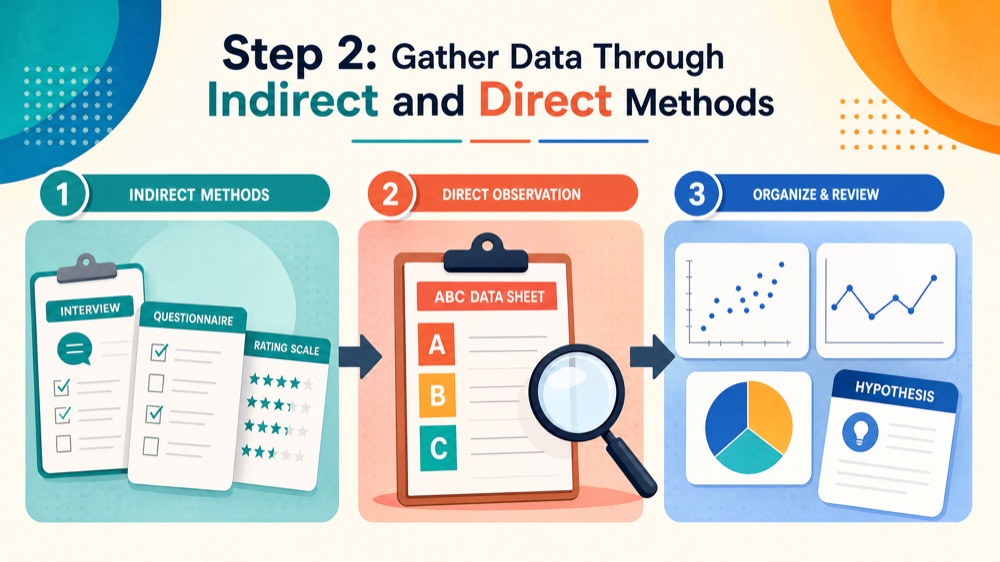
Once the behavior is defined, the next step is to gather information from multiple sources. Indirect assessments include interviews, questionnaires, and rating scales completed by the individual, caregivers, teachers, or others who interact with them. These methods provide valuable background information but rely on memory and perception, so they should be used as a starting point.
Direct observation involves systematically recording the behavior as it occurs in the natural environment. The most common method is ABC data collection, where you record the antecedent (what happened before), the behavior itself, and the consequence (what happened after). Another direct method is scatterplot analysis, which tracks the times and settings in which the behavior occurs. Direct data are usually more reliable because they capture actual events rather than recollections.
For example, if you are assessing a child who throws tantrums during homework time, you might ask the parents to complete a questionnaire and also conduct direct observations across several days. The indirect data might suggest that the tantrums occur ‘whenever he is tired,’ while the direct observation might reveal that they only occur when the parent gives a verbal instruction to start homework. This discrepancy highlights why multiple data sources are essential.
Common pitfalls at this stage include relying solely on indirect data or conducting too few direct observations. The BCBA exam often tests your ability to select the most appropriate data collection method for a given scenario. Remember that direct observation is a cornerstone of the FBA process.
Step 3: Analyze Data to Identify Patterns and Contexts
After collecting data, you need to organize and summarize it to reveal patterns. This involves calculating the frequency, duration, or intensity of the behavior and examining the contexts in which it is most likely to occur. Look for consistent antecedents and consequences that are correlated with the behavior. For example, you might notice that a student’s off-task behavior occurs primarily during math tasks that are above their skill level, and the consequence is often that the teacher redirects them or they are sent to the office.
Visual analysis of data is a key skill for BCBAs. You might use graphs, tables, or summary charts to see trends and variability. The goal is to identify behavioral patterns that point toward the function. For instance, if the behavior consistently results in attention from others, this suggests a social positive function.
During this step, you should also consider setting events and motivating operations that might influence behavior. A setting event, such as a lack of sleep, can alter the value of a reinforcer. For example, if a child is tired, they may be more likely to engage in escape-maintained behavior during difficult tasks.
Step 4: Formulate a Hypothesis About the Function of Behavior
Based on the data analysis, you will develop a hypothesis about why the behavior occurs. Behavior analysts typically consider four broad functions: social positive reinforcement (attention or access to items/activities), social negative reinforcement (escape or avoidance), automatic positive reinforcement (internal sensory stimulation), and automatic negative reinforcement (removal of internal aversive stimulation).
Your hypothesis must be grounded in the data you collected. For example, if the data show that the behavior frequently occurs when the learner is alone and produces no social consequences, an automatic function is more likely. If it occurs primarily in the presence of a specific person and results in that person leaving, escape may be the function.
To illustrate, consider a student who engages in head-hitting during academic tasks. The ABC data show that each time he hits his head, the teacher sends him to the calming corner, removing the task. The pattern strongly suggests that the behavior is maintained by escape from demands. This hypothesis would then guide the intervention, such as teaching a functional communication request for a break.
Exam questions often present a scenario and ask you to identify the most likely function based on the data given. Be sure to review every antecedent and consequence—look for the reinforcer that is consistently delivered or removed.
Step 5: Develop a Behavior Intervention Plan (BIP)
With a clear hypothesis, you can now design a behavior intervention plan (BIP) that addresses the function. The BIP should include strategies for preventing the behavior, teaching alternative skills, and changing consequences. A critical component is the replacement behavior—a socially appropriate behavior that serves the same function for the learner.
For example, if the function is attention, you might teach the child to raise their hand or say ‘excuse me’ to gain adult attention. If the function is escape, you might teach them to request a break using a card or a word. The BIP can also include environmental modifications, such as changing the difficulty of tasks or altering the seating arrangement.
The BIP must be practical and acceptable to the people who will implement it. This is known as contextual fit in ABA. A plan that is too complex or requires too much staff time is unlikely to be implemented with fidelity. Involve stakeholders in the planning process to increase buy-in.
Step 6: Implement the Plan with Fidelity
Implementation is where many well-designed plans fail. It is essential to train all individuals who will be implementing the plan, including teachers, parents, and direct care staff. Training should include modeling, rehearsal, and feedback to ensure they can execute the procedures accurately.
The BACB ethics code requires that behavior analysts supervise and monitor the implementation of behavior-change programs. This means you must be available to address questions, observe implementation, and provide additional training as needed. Treatment fidelity—the degree to which the plan is implemented as written—must be systematically assessed.
Consider a classroom setting where a teacher is implementing a DRA procedure for a student’s call-outs. A behavior analyst might conduct weekly observations and use a checklist to ensure the teacher is delivering praise for appropriate responses and not inadvertently reinforcing call-outs. If fidelity is low, the plan may appear ineffective when the real issue is inconsistent implementation.
Step 7: Monitor Progress and Make Data-Based Decisions
The final step is ongoing evaluation. You should continue to collect data on the target behavior and the replacement behavior to determine if the intervention is working. This involves graphing the data and visually analyzing trends. If the data show improvement, you may gradually thin reinforcement or adjust the plan. If there is no change or a worsening, you must modify the approach.
Data-based decision making is at the heart of ABA. Progress monitoring allows you to celebrate successes and catch problems early. For example, if a decrease in tantrums is not observed after two weeks, you might consider whether the replacement behavior is actually easier for the learner or if the reinforcement is powerful enough.
You should also conduct periodic fidelity checks and reassess the function if the behavior does not change as expected. Sometimes the original hypothesis was incorrect, or environmental factors have shifted. This step ensures that the FBA is a dynamic, responsive process.
Real-World ABA Examples: Applying the 7 Steps
To solidify your understanding, let’s walk through three examples that illustrate the 7 steps in action. Each example features a different function and setting. Example 1: Attention-Functioned Behavior in a Classroom: Sarah, a 7-year-old student, frequently calls out during independent work. Her teacher reports that she does this ‘for attention.’ A behavior analyst conducts an FBA. They define the behavior as ‘any vocalization that occurs without permission during independent seatwork.’ ABC data are collected over three days. The data show that the behavior most often occurs when the teacher is working with other students. The consequence is that the teacher often looks up and says ‘Sarah, we are working quietly.’
This pattern suggests that the function is social positive reinforcement in the form of teacher attention. Based on this hypothesis, the team decides to teach Sarah to raise her hand and wait, and the teacher will provide frequent noncontingent attention during independent work to reduce the motivation for calling out.
Example 2: Escape-Functioned Behavior During Transitions: Marcus, a 4-year-old in a preschool setting, engages in tantrums during transitions from free play to circle time. The behavior involves crying, falling to the floor, and refusing to move. Data collection includes interviews with staff and direct observation. The ABC data reveal that tantrums consistently occur when a staff member says ‘It’s time to clean up’ and are followed by the staff member allowing Marcus to stay at the activity for a few more minutes.
The data clearly point to escape from transitions as the function. The intervention plan includes a visual schedule, a warning timer, and teaching Marcus to request ‘one more minute’ using a picture card. The staff will ignore tantrums and reinforce appropriate requests.
Example 3: Automatic-Functioned Behavior (Sensory Stimulation): Ella, a 12-year-old with a diagnosis of autism, engages in repetitive hand-flapping. This occurs across settings and times, even when she is alone. Interviews with support staff indicate that antecedent events vary, and there is no consistent social consequence. Direct observation confirms that the behavior occurs frequently in solitary settings and that staff rarely react to it.
Because the behavior does not appear to be socially mediated, the likely function is automatic reinforcement—the hand-flapping produces sensory stimulation that is inherently reinforcing. This is often the most challenging function to address because the reinforcer cannot be easily withheld. The intervention may include providing alternative sources of sensory input, such as a fidget toy, or teaching Ella to engage in appropriate stimming that is less disruptive. Be sure to consider ethical considerations and client dignity.
Exam Relevance: FBA Questions and Common Traps
On the BCBA exam, FBA-related questions appear in various forms, often as scenario-based items that ask you to identify the function, choose a data collection method, or select an intervention. The 6th edition test content outline includes items on assessing behavior and developing behavior-change programs, so you can expect a healthy number of FBA questions.
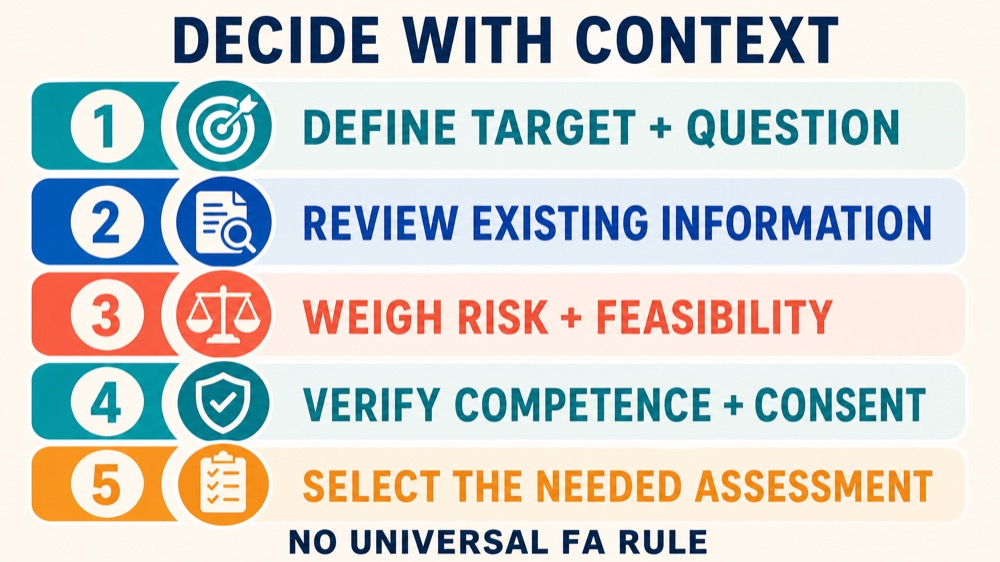
Common Traps to Avoid: One of the most frequent mistakes is confusing a functional behavior assessment (FBA) with a functional analysis (FA). An FBA is a broad process that includes indirect and direct methods, while an FA involves systematically manipulating environmental variables to demonstrate a functional relationship. On the exam, you may need to distinguish between the two.
Another trap is over-relying on indirect assessments. For example, a question might describe a teacher who believes a behavior is ‘manipulative’ without any data. In ABA, you must always prioritize direct observation. Also, be cautious about making conclusions about function without sufficient data. If only a few observations were conducted, you cannot confidently identify a single function.
- Over-interpreting: Assuming function from one incident.
- Ignoring setting events: Not accounting for context like illness or deprivation.
- Mixing up functions: Choosing ‘escape’ when evidence points to ‘attention.’
Strategies for Exam Questions: When you encounter an FBA question, first read the scenario thoroughly and identify any data that are provided. Then, systematically match the antecedents and consequences to the four functions. For example, if the consequence is ‘teacher reprimands,’ that is attention; if it is ‘removes the task,’ that is escape.
Use a process of elimination. If the behavior occurs when the person is alone and the consequence is not social, eliminate socially mediated functions. Pay attention to details like the presence of motivating operations. For instance, if the student has just had free access to a preferred toy and the task is difficult, escape becomes more likely. Additional strategies include reviewing the BACB ethics code and ensuring you understand the role of behavioral assessment in intervention planning. The exam rewards careful, data-based reasoning.
Quick Checklist for Conducting a Functional Behavior Assessment
Use this checklist as a quick reference during your exam prep or in practice:
- Define the target behavior in observable terms.
- Collect indirect data via interviews and questionnaires.
- Conduct direct observations using ABC recording.
- Look for patterns in antecedents and consequences.
- Hypothesize the function (social positive, social negative, automatic positive, automatic negative).
- Design a behavior intervention plan with replacement behaviors.
- Train implementers and monitor fidelity.
- Graph data and review progress regularly.
- Modify the plan based on data and new information.
Keep this checklist handy—it mirrors the procedural steps you’ll need to articulate in exam scenarios.
Summary and Final Takeaways
The 7-step functional behavior assessment process is a systematic approach that ensures behavior-analytic interventions are evidence-based and ethical. Each step is critical: from defining behavior precisely, to gathering and analyzing data, to formulating a hypothesis, developing and implementing a plan, and finally monitoring progress. Mastery of these steps will serve you well on the BCBA exam and in your professional practice.
Remember to always anchor your decisions in data and avoid jumping to conclusions. For more in-depth review, check out our resources on functional behavior assessment (FBA) exam guide and FBA data collection sheet guide. These pages offer additional practice examples and tips tailored for BCBA candidates. If you want to refine your understanding further, consider exploring how socially mediated reinforcement impacts function identification. Now, go forth and analyze behavior—with data in hand.
Take the Free BCBA Mock Exam
Ready for more practice? Use the free mock exam to keep testing your accuracy with realistic BCBA-style items. Take the Free BCBA Mock Exam



