
Introduction: Why Knowing the 3 Characteristics of Behavior Matters for the BCBA Exam
When you first study applied behavior analysis, you quickly learn that not everything a person does qualifies as behavior. The BCBA exam expects you to distinguish between true behavior and internal events like thoughts or feelings. Understanding the 3 characteristics of behavior is foundational for defining target behaviors, selecting measurement systems, and designing interventions. This guide breaks down each characteristic with clear definitions, practical ABA examples, and common exam traps so you can approach related questions with confidence.
Table of Contents
- Introduction: Why Knowing the 3 Characteristics of Behavior Matters for the BCBA Exam
- The 3 Characteristics of Behavior Defined
- Real-World ABA Examples of the 3 Characteristics
- Exam Relevance and Common Traps
- Quick Checklist: Does Your Behavior Meet All 3 Characteristics?
- Summary: Master the 3 Characteristics for BCBA Exam Success
- References
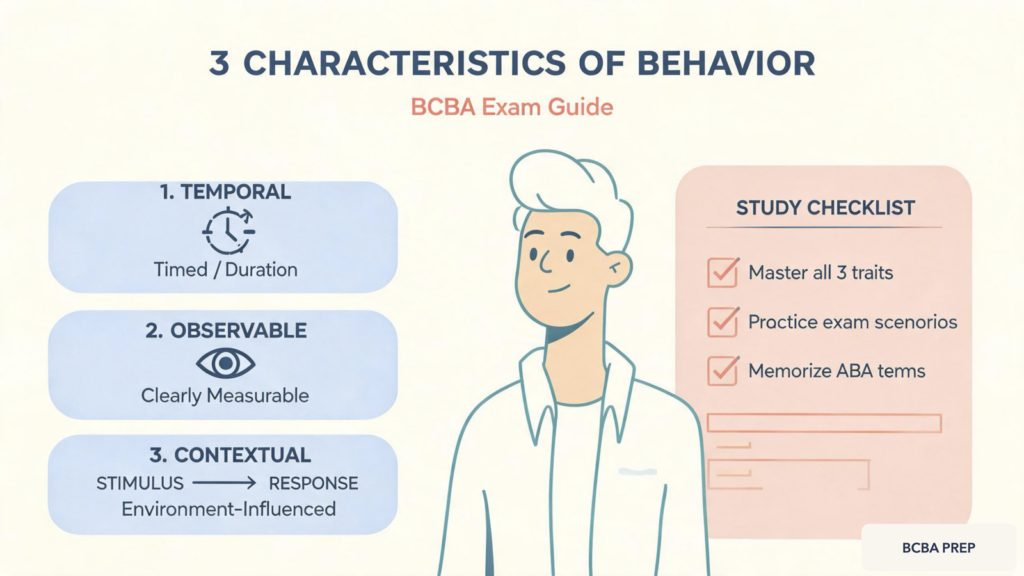
Behavior analysts define behavior as anything a person does that involves movement, can be measured, and is influenced by the environment. Without all three, it is not behavior in the scientific sense. The exam frequently tests this distinction, so mastering these three pillars will boost your score.
The 3 Characteristics of Behavior Defined
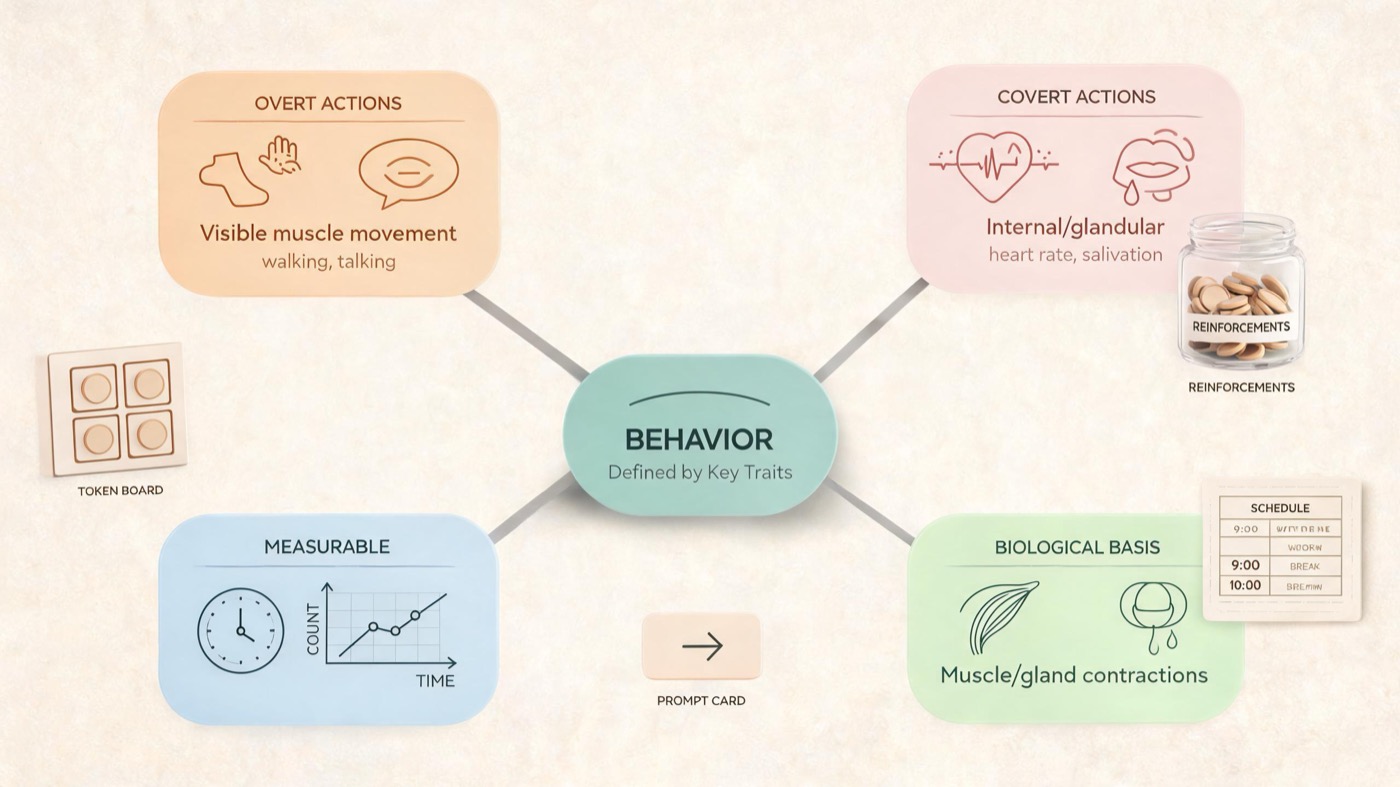
1. Behavior is Movement (Involving Muscle Contractions or Glandular Activity)
Behavior must involve some form of physical action, no matter how small. This includes overt actions like walking or talking, as well as covert actions like a beating heart or salivation. The key is that muscle contractions or glandular activity produce the behavior. Internal states like ‘feeling anxious’ or ‘being depressed’ are not behavior because they do not involve observable movement. Instead, the observable actions associated with those states (e.g., crying, nail biting) are the behavior.
2. Behavior is Measurable (Quantifiable via Count, Duration, etc.)
To be scientific, behavior must be measured. The BCBA exam uses several dimensions: frequency (count), duration (how long), latency (time to onset), and intensity (force). For example, you can count how many times a child hits, or record how long they stay on task. If you cannot measure it objectively, it is not a behavior for ABA purposes. The exam will ask you to identify the appropriate measurement system for a given behavior, so practice matching behaviors to measurement types.
3. Behavior is Influenced by the Environment (Antecedents and Consequences)
All behavior is lawful and determined by environmental events. The ABC framework (Antecedent, Behavior, Consequence) explains how environmental triggers and results shape behavior. Antecedents prompt behavior, and consequences strengthen or weaken it. For example, a request (antecedent) leads to compliance (behavior) followed by praise (consequence). This reinforces the behavior. The exam will test your ability to identify antecedents and consequences in scenarios.
Real-World ABA Examples of the 3 Characteristics
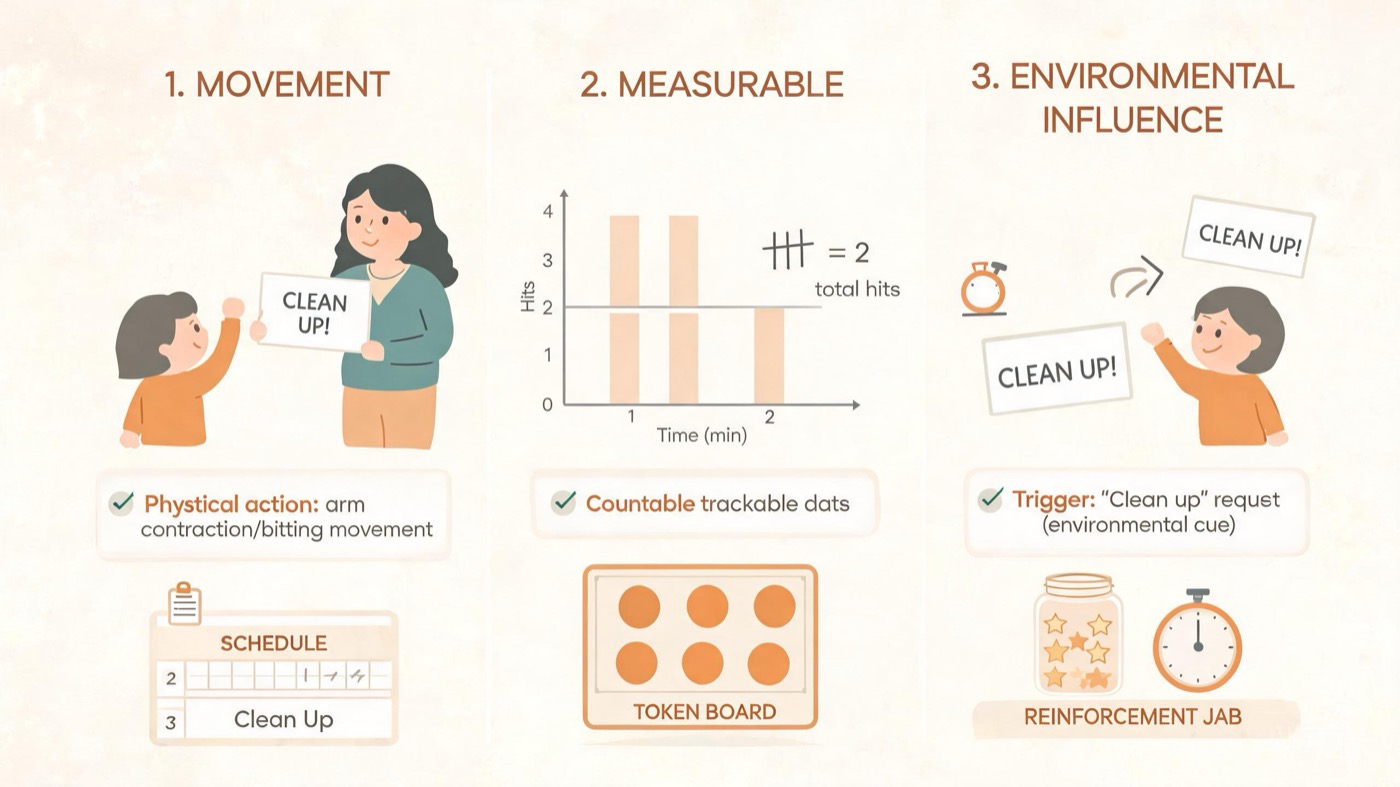
Example 1: Aggression During Transitions
A child hits a teacher when asked to clean up. Let’s apply the three characteristics: Movement? Yes, hitting involves arm muscle contractions. Measurable? Yes, count the number of hits. Environmental influence? Yes, the antecedent is the request to transition, and the consequence is escape from the task. This behavior is likely maintained by negative reinforcement.
Example 2: On-Task Behavior in Classroom
A student completes a worksheet while seated. Movement? Writing involves fine motor muscles. Measurable? Duration recording works well. Environmental influence? The worksheet (antecedent) and teacher praise (consequence) shape the behavior. This scenario tests your ability to choose the right measurement (duration) and identify the reinforcement.
Example 3: Self-Injurious Behavior (SIB)
A student hits their head against the wall during a demand. Movement? Head movement and muscle contraction. Measurable? Frequency is common. Environmental influence? The demand is the antecedent, and the removal of the demand is the consequence (automatic reinforcement may also be present). The exam may ask about automatic reinforcement here, so be prepared.
Example 4: Vocal Stereotypy (Humming)
A child hums repeatedly during independent work. Movement? Vocal cords produce sound. Measurable? Count occurrences or use momentary time sampling. Environmental influence? The antecedent is the work task, and the consequence is sensory stimulation (automatic reinforcement). This example illustrates that even subtle behaviors are included, as long as they meet all three criteria.
Exam Relevance and Common Traps
Why This Topic Frequently Appears on the BCBA Exam
The characteristics of behavior are a prerequisite for defining target behaviors and selecting measurement systems. The exam often presents a scenario and asks you to confirm whether the described response qualifies as behavior. It also connects to radical behaviorism, which emphasizes that private events (like thoughts) are also behavior if they involve muscle or gland activity. A solid understanding here sets the stage for later questions on the seven dimensions of ABA and radical behaviorism.
Common Exam Traps: What to Watch Out For
- Confusing behavior with internal events: ‘Feeling anxious’ is not behavior; crying, shaking, or pacing are behaviors.
- Forgetting measurability: If you cannot count or time it, it’s not a valid behavioral definition.
- Overgeneralizing environmental influence: Not every behavior is maintained by external consequences; automatic reinforcement is an environmental variable too.
- Mixing up measurement dimensions: Know when to use frequency vs. duration vs. latency. Practice with scenarios.
Quick Checklist: Does Your Behavior Meet All 3 Characteristics?
Use this checklist when defining a target behavior for the exam or in practice.
- Movement? Does it involve muscle contractions or gland activity? (yes/no)
- Measurable? Can you count, time, or record its intensity? (yes/no)
- Environmentally influenced? Is it related to antecedents and consequences? (yes/no)
If you answer ‘yes’ to all three, it’s a behavior. If any answer is ‘no,’ reconsider the response. This checklist is a quick mental tool during the exam.
For more practice with defining behaviors, check out our guide on the four functions of behavior.
Summary: Master the 3 Characteristics for BCBA Exam Success
By internalizing the three characteristics of behavior‘movement, measurability, and environmental influence’you build a strong foundation for the BCBA exam. Real-life examples like aggression, on-task behavior, SIB, and vocal stereotypy show how these characteristics apply across settings. Common traps include mistaking internal events for behavior and misselecting measurement systems. Use the quick checklist to stay on track. This knowledge will help you answer definitional and application questions accurately. For further study, review the seven dimensions of ABA and practice with mock exams to reinforce these concepts. Remember, all behavior is movement, measurable, and shaped by the environment’keep that in mind and you are well prepared.
References
Complete BCBA Exam Prep
Turn this topic into exam-day practice
Practice concepts in context with five full-length 6th Edition mock exams, two bonus practice exams, a 6th Edition study guide, and key-term flashcards—all in one $120 USD package.
Get the $120 All-in-One Prep Pack
Review everything included on the product page before ordering. No pass guarantee is implied.



