
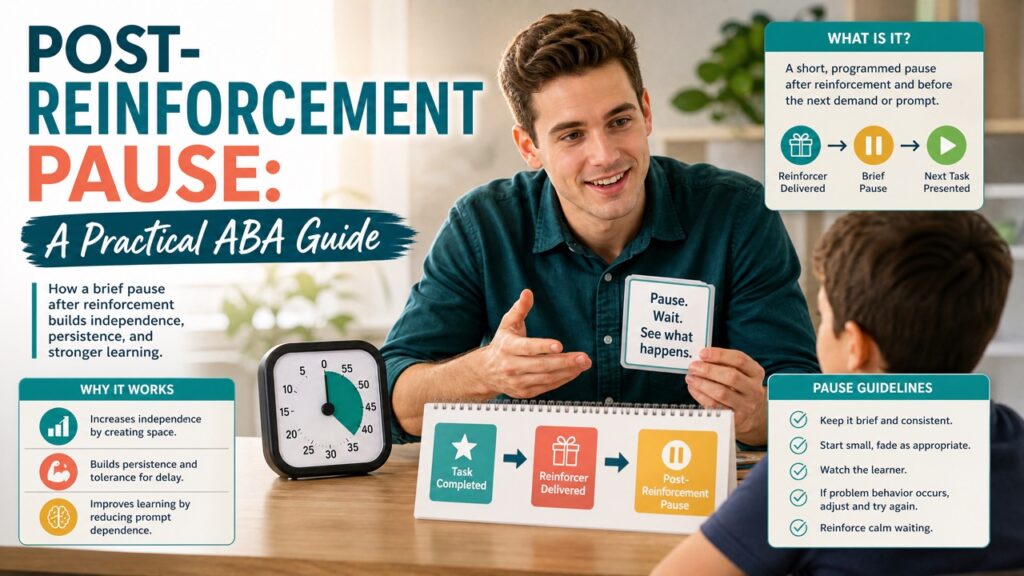
Defining Post-Reinforcement Pause
The post-reinforcement pause is a pattern of responding that appears on certain schedules of reinforcement. It is defined as a temporary cessation or slowing of responding immediately after a reinforcer is delivered. In applied behavior analysis, this pause is not random; it is a predictable schedule effect that can be observed and measured.
Table of Contents
- Defining Post-Reinforcement Pause
- Where Does Post-Reinforcement Pause Occur?
- Real-World ABA Examples of PRP in Action
- Exam Relevance and Common Traps
- Quick Checklist for Exam Day
- Summary and Key Takeaways
- Quick Review Checklist
- Take the Free BCBA Mock Exam
- References
For BCBA candidates, understanding this concept is essential because it appears in scenario-based exam questions and in real behavior plans. The pause is often mistaken for fatigue or loss of motivation, but it is actually a function of the reinforcement schedule itself. This distinction is critical for accurate analysis and intervention design.
To master this topic, you need to grasp the operational definition, recognize the schedules where it occurs, and be able to identify it in practice. We’ll break down each of these areas with concrete examples and exam-relevant insights.
What Does It Mean in ABA?: In technical terms, the post-reinforcement pause is a schedule-induced effect that occurs after a reinforcer is presented. It is most pronounced on fixed schedules, such as fixed ratio (FR) and fixed interval (FI), because the next reinforcer is not available immediately. The pause length often correlates with the size of the ratio or the length of the interval.
For example, on a fixed ratio 10 (FR 10) schedule, a student completes 10 math problems and earns a token. After receiving the token, the student may stop responding for 30 seconds before starting the next set. This pause is not due to physical exhaustion; rather, it is a predictable outcome of the schedule.
Common Misconceptions: One common misconception is that the pause is caused by satiation or boredom. While these factors can influence responding, the post-reinforcement pause is primarily a scheduled-induced pattern. It occurs even when the reinforcer remains highly valuable.
Another confusion is linking the pause to extinction. In extinction, responding eventually stops because reinforcement is withheld, but the post-reinforcement pause is a temporary break that occurs after reinforcement is delivered. Understanding this difference helps you avoid misinterpreting data in practice and on the exam.
Where Does Post-Reinforcement Pause Occur?
Post-reinforcement pauses are not uniform across all schedules. They are most prominent on fixed schedules, where the timing of reinforcement is predictable. On variable schedules, the pause is either brief or absent because the next reinforcement could occur at any moment. Let’s explore the specific schedules and conditions that produce this effect.
Fixed-Ratio Schedules: On a fixed ratio (FR) schedule, a reinforcer is delivered after a fixed number of responses. For example, a worker earns a commission after every 10 units packed. After receiving the commission, the worker may take a longer break before starting the next batch. The pause duration tends to increase with the ratio requirement; a larger FR produces a longer pause.
This pattern is sometimes called a break-and-run because the pause is followed by a high rate of responding until the next reinforcer is earned. This is a common observation in FR schedules and is a key feature to recognize.
Fixed-Interval Schedules: On a fixed interval (FI) schedule, a reinforcer becomes available after a fixed amount of time has passed since the last reinforcer, provided at least one response occurs. For example, a student checks their phone for messages every 30 minutes. After receiving a message, the student may stop checking for a while, then gradually increase checking as the interval nears its end.
This produces a scalloped pattern on a cumulative record: a pause after reinforcement, then a low response rate that accelerates as the interval ends. This contrasts with the break-and-run of FR schedules, but both include a post-reinforcement pause.
Variable Schedules: Why PRP Is Less Common: On variable schedules, such as variable ratio (VR) or variable interval (VI), the next reinforcer is unpredictable. Because a response could be reinforced at any time, there is little advantage to pausing. Consequently, the post-reinforcement pause is typically brief or nonexistent. Responding remains steady, which is why variable schedules are often used to maintain consistent behavior. For BCBA exam questions, you may be asked to identify whether a pause is more likely on a fixed or variable schedule. Remember: fixed schedules promote pausing, while variable schedules discourage it.
Real-World ABA Examples of PRP in Action
To apply the concept, let’s look at concrete examples that illustrate how post-reinforcement pause appears in everyday ABA practice. These examples are similar to what you might encounter in scenario-based exam questions. Example 1: Classroom Token Economy: In a classroom, a student earns a token for every 5 correctly completed math problems (FR 5). After receiving the token, the student typically stops working for 2 minutes. During this pause, the student looks around or sharpens a pencil. Once the pause ends, the student resumes working. This is a classic post-reinforcement pause on a fixed ratio schedule. Key observation: The pause duration is consistent, and it occurs only after reinforcement, not after unreinforced responses.
Example 2: Vocational Task Completion: An employee at a packaging company is required to pack 20 boxes to receive a supervisor’s approval (FR 20). After approval, the employee takes a longer break, sometimes up to 5 minutes, before starting the next cycle. The supervisor notices that this break is longer than typical micro-breaks. This is an example of PRP on a large fixed ratio. Practical implication: To increase productivity, the ratio could be reduced or a variable schedule could be introduced to diminish the pause.
Example 3: Self-Study Behavior: A self-studying adult uses a timer to read for 15 minutes, then takes a 5-minute break. After the break, they resume studying. The break is longer than necessary, and it occurs only after the reinforcement (the break) is delivered. This is a post-reinforcement pause on a fixed interval schedule, as the interval is time-based. Note: The pause might also be seen on FR if the behavior is reading a fixed number of pages, but the key is the schedule.
Exam Relevance and Common Traps
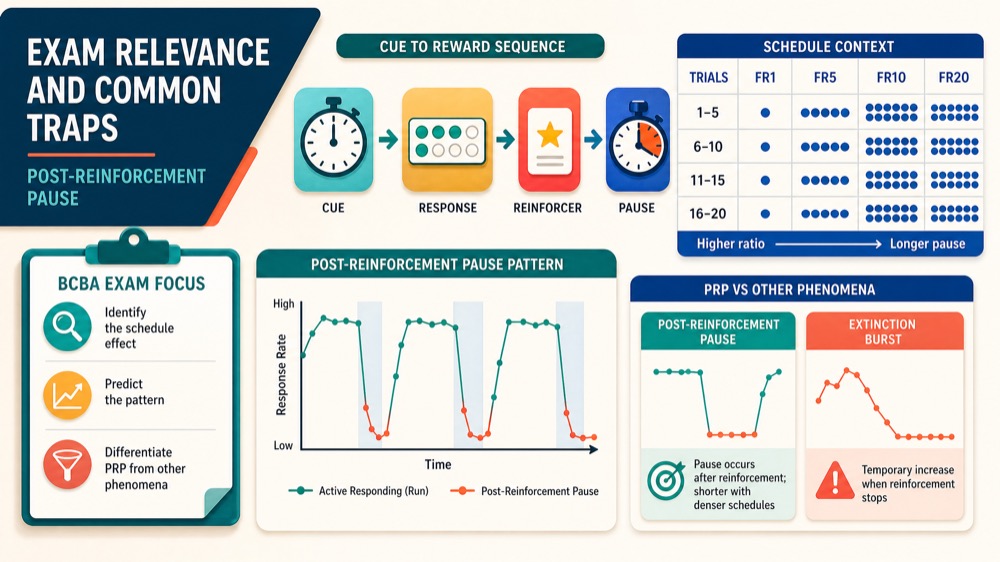
Post-reinforcement pause is a favored topic for scenario-based questions on the BCBA exam. You may be asked to identify the schedule effect, predict the pattern, or differentiate PRP from other phenomena. Let’s review how it appears and the common traps that candidates fall into.
How PRP Appears on the BCBA Exam: Exam questions often present a scenario with a graph or a description of behavior. You may be asked: “What is the most likely explanation for the pause after reinforcement?” or “Which schedule is most likely to produce this pattern?” The correct answer usually involves recognizing the fixed schedule and the resulting pause.
Some questions may ask you to determine if the pause is due to satiation or schedule effect. Remember that schedule effects are the primary cause, unless there is evidence of satiation (e.g., responding decelerates gradually, not just after reinforcement).
Common Misidentifications: A frequent trap is confusing PRP with an extinction burst. An extinction burst is a temporary increase in response rate when reinforcement is removed, not a pause after reinforcement. Another confusion is with satiation, where the reinforcing value decreases over time. In satiation, the pause would occur after multiple reinforcers, not immediately after each one. Also, don’t confuse PRP with a post-reinforcement “foot” – this is not a recognized term. Stick to the formal definition.
Distinguishing PRP from Break-and-Run Patterns: On FR schedules, you’ll see a break-and-run pattern: a pause followed by a high, steady response rate. This is different from the fixed interval scallop, where responding gradually increases. Both include a post-reinforcement pause, but the shape of the cumulative record differs. Key distinction: On FR, the pause is followed by an abrupt, high-rate run. On FI, the pause is followed by a gradual acceleration. Recognizing these patterns helps you answer graph interpretation questions accurately.
Quick Checklist for Exam Day
Use this checklist to quickly recall the essentials of post-reinforcement pause:
- Definition: Temporary pause in responding after reinforcement delivery.
- Schedules: Most likely on fixed ratio (FR) and fixed interval (FI).
- Variable schedules: Pause is brief or absent.
- Cause: Schedule-induced, not satiation or fatigue.
- FR pattern: Break-and-run.
- FI pattern: Scallop (gradual increase).
- Exam trap: Don’t confuse with extinction burst.
- Exam trap: Don’t attribute pause to satiation without evidence.
- Application: Use variable schedules or smaller ratios to reduce pauses.
Summary and Key Takeaways
Post-reinforcement pause is a predictable schedule effect that is essential for analyzing behavior under fixed schedules. It occurs after reinforcement delivery and is most prominent on FR and FI schedules. Understanding PRP helps you interpret graphs, design effective interventions, and answer exam questions with confidence.
Remember the core points: PRP is caused by the schedule, not by internal states; it manifests as a brief pause after reinforcement; and it can be minimized by using variable schedules. For more foundational knowledge on schedules of reinforcement, check out our guide to ABA schedules. Also, review how fixed ratio schedules influence behavior to deepen your understanding.
As you prepare for the exam, practice identifying PRP in sample graphs and scenarios. The more you apply this concept, the more automatic it becomes. Keep this checklist handy for a quick review before test day.
Quick Review Checklist
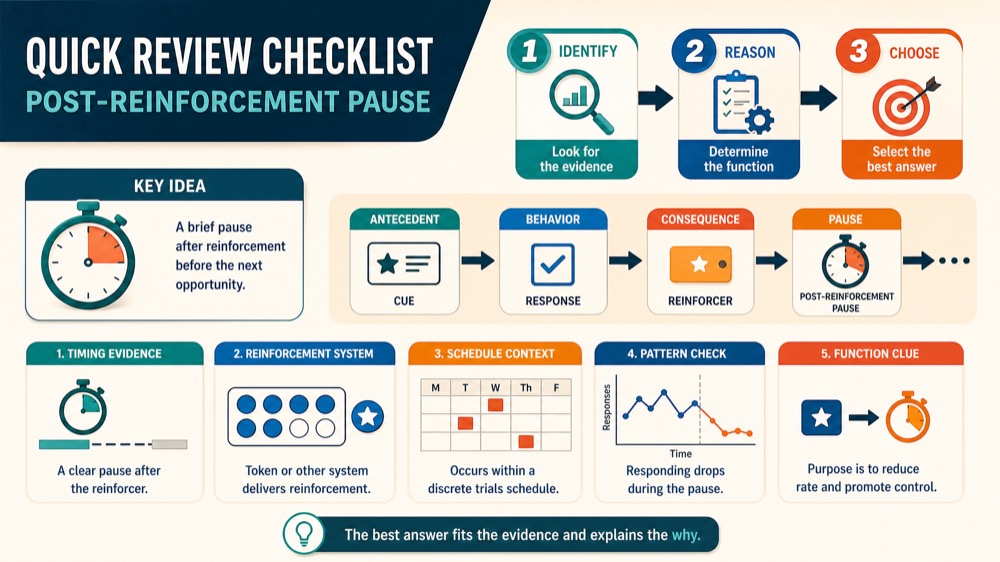
Use this final checklist to turn post-reinforcement pause into exam-ready reasoning. The goal is not to memorize a label in isolation; it is to identify the relevant evidence and explain why the best answer fits the scenario. Key ideas to review:
- State the central definition or decision point for post-reinforcement pause in your own words.
- Identify the detail that makes post-reinforcement pause different from its closest related ABA term.
- Separate the observable facts in a scenario from assumptions that are not supported by the facts.
- Write one example and one nonexample so you can recognize the concept in a new setting.
Exam application checks:
- Ask what the question is actually requesting before comparing the answer choices.
- Mark the antecedent, response, consequence, or other evidence that supports the selected answer.
- Look for a distractor that describes a related process but does not answer the specific question.
Final self-check:
- Explain how you would verify the interpretation with clear observations or data.
- Change one detail in the scenario and decide whether your answer should change.
- Give a one-sentence rationale that a supervisor or study partner could evaluate.
Take the Free BCBA Mock Exam
Ready for more practice? Use the free mock exam to keep testing your accuracy with realistic BCBA-style items. Take the Free BCBA Mock Exam
References
Next step for BCBA exam prep
Turn this topic into exam-day practice
Use this topic as a focused review, then test it in exam-style conditions with a free mock before deciding whether five full-length mocks are the right next step.
Start the Free BCBA Mock ExamContinue with Five Full-Length Mocks — $99
Review the included materials and access details before ordering. No pass guarantee is implied.



