
Introduction: Why Knowing the Independent and Dependent Variable Matters for the BCBA Exam
If you are preparing for the BCBA exam, you have likely encountered questions that ask you to identify the independent and dependent variable in a research scenario. This skill is not just a test item; it is foundational to understanding how interventions are designed, evaluated, and replicated in applied behavior analysis. Every time you read a study, a graph, or a behavior intervention plan, you are essentially looking at a relationship between an independent variable and a dependent variable.
Table of Contents
- Introduction: Why Knowing the Independent and Dependent Variable Matters for the BCBA Exam
- Defining the Independent and Dependent Variable in ABA Context
- A Step-by-Step Method to Determine Which Variable Is Which
- Worked ABA Examples: Applying the Concepts
- How to Distinguish the Independent Variable from the Antecedent in ABC Data
- Exam Relevance and Common Traps
- Quick Checklist for Identifying Variables in Exam Questions
- Summary and Final Study Tips
- Quick Review Checklist
- Take the Free BCBA Mock Exam
Mastering this distinction helps you analyze whether an intervention caused a behavior change, which is a core competency for a Board Certified Behavior Analyst. In this guide, we will break down how to determine the independent and dependent variable in ABA, using clear definitions, practical steps, and exam-style examples. By the end, you will be able to approach any scenario with confidence, whether it appears in a mock exam or in your daily practice.
Defining the Independent and Dependent Variable in ABA Context
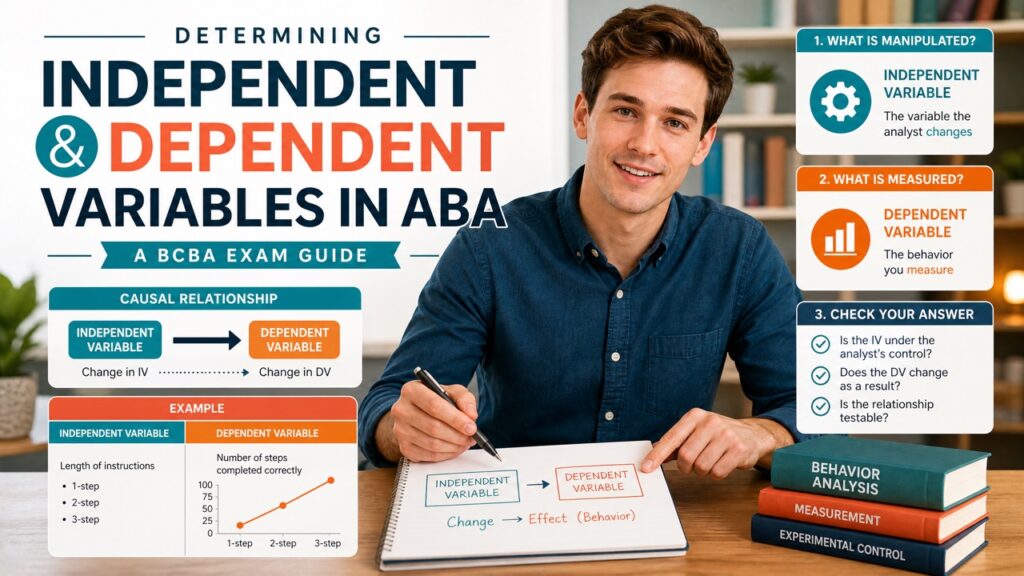
In applied behavior analysis, the terms independent variable and dependent variable come from experimental design, but they have a specific flavor in ABA. The independent variable is the environmental event or intervention that the practitioner systematically manipulates to see if it affects behavior. The dependent variable is the behavior itself, measured to detect changes that result from the manipulation.
These definitions align with the scientific method, but ABA emphasizes the direct observation and measurement of behavior. For the BCBA exam, you must recognize that the independent variable is not just any change you make; it is the planned, controlled intervention. The dependent variable must be a target behavior that is observable and measurable.
The Independent Variable in Applied Behavior Analysis: In ABA, the independent variable is often a teaching strategy, reinforcement schedule, or environmental arrangement. Common examples include a token economy, a prompting procedure, or a timeout condition. The key is that the intervention is intentionally altered across conditions to observe its effect on behavior.
For instance, if you are using a differential reinforcement of alternative behavior (DRA) procedure to reduce aggression, the DRA is the independent variable. You might compare a baseline condition with the DRA condition. This manipulation is what allows you to draw conclusions about cause and effect.
The Dependent Variable as the Measurable Behavior: The dependent variable is the behavior that is expected to change as a result of the independent variable. In clinical settings, this is often a challenging behavior like aggression, self-injury, or off-task behavior, but it can also be a skill acquisition target like requesting or reading. The dependent variable must be operationalized so that different observers can agree on its occurrence.
For example, if your dependent variable is tantrums, you need a precise definition that includes specific topographies, such as crying, flopping, or hitting. Without a clear operational definition, your measurement would be unreliable, jeopardizing the validity of your conclusions. The BCBA exam often tests your ability to identify whether a behavior is well-defined.
A Step-by-Step Method to Determine Which Variable Is Which
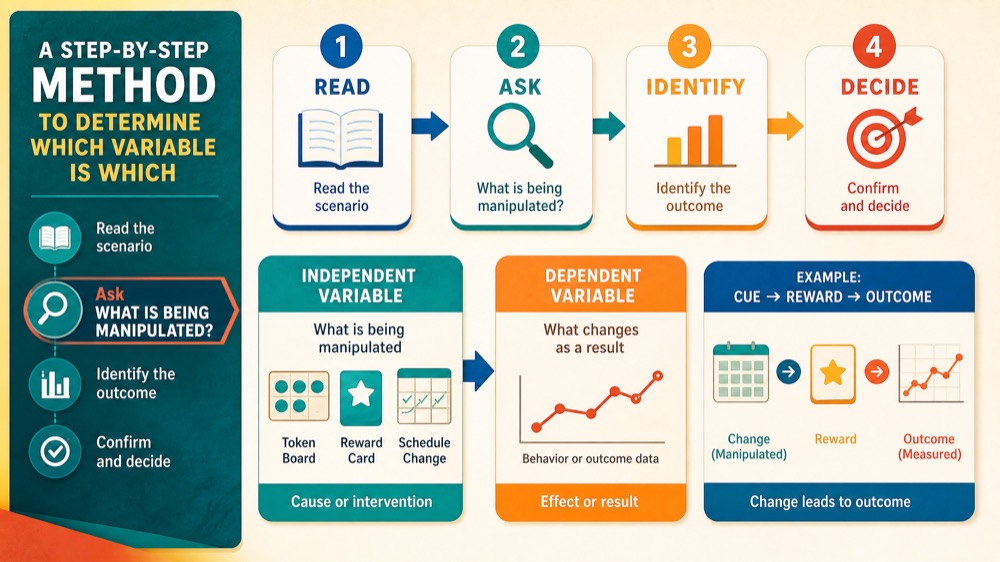
When you encounter a scenario in a test question or a research article, you can use a systematic approach to identify the variables. This method is designed to be quick and accurate, even under time pressure. Start by reading the scenario carefully and identifying the main components: what is being changed, what is being measured, and how the two are connected. Here is a practical framework that you can apply to any situation:
Ask 'What Is Being Manipulated?': The first question you should ask is, “What is the intervention or condition that the researcher or practitioner is changing?” This is almost always the independent variable. In ABA, this could be the introduction of a visual schedule, the implementation of extinction, or the switching from one reinforcement schedule to another.
For example, in a study examining the effect of a token economy on on-task behavior, the token economy is the manipulation. Baseline periods are not independent variables; they are comparison conditions. The key is that the intervention is systematically applied and withdrawn to test its effect.
Ask 'What Is Being Measured?': The second question is, “What behavior is being recorded?” The answer is the dependent variable. The dependent variable is always a behavior, and it must be measured in some way—frequency, duration, rate, or latency. In the token economy example, on-task behavior is the dependent variable because it is the behavior you are observing and measuring across conditions.
Make sure the behavior is the target behavior, not a secondary measure. For instance, if you measure not only on-task behavior but also staff implementation fidelity, the latter is a procedural integrity measure, not the dependent variable. Stick to the behavior that the intervention is designed to change.
Check for a Functional Relationship: Finally, consider whether the manipulation is systematically applied to affect the behavior. A functional relationship exists when changes in the independent variable produce consistent changes in the dependent variable. In ABA, this is often demonstrated through designs like ABAB or multiple baseline.
If you are simply observing a correlation without deliberate manipulation, you might be looking at a descriptive study, not an experimental one. For the exam, distinguish between active manipulation and passive observation. The independent variable is always actively manipulated by the practitioner or researcher.
Worked ABA Examples: Applying the Concepts
To solidify your understanding, let’s walk through three realistic ABA scenarios. Each example includes a description, the identification of the independent variable and dependent variable, and a brief discussion of the hypothesized function. These examples mirror the type of questions you may see on the BCBA exam.
Example 1: Reducing Aggression with Differential Reinforcement: A BCBA designs a treatment for a child who engages in aggression to escape from demands. The intervention consists of providing a break from demands whenever the child requests it appropriately, and withholding attention for aggressive behavior. This is a DRA procedure.
In this scenario, the independent variable is the DRA procedure, because it is the intervention being implemented. The dependent variable is the frequency of aggressive behavior, which is measured to see if the DRA reduces it. The hypothesized function is escape, as the child’s aggression historically resulted in demand removal. On the exam, you might be asked to identify the independent variable in a question like this. Remember that the DRA is manipulated, while aggression is the behavior that is expected to change.
Example 2: Increasing On-Task Behavior Using a Visual Schedule: Another common scenario involves increasing on-task behavior in a classroom. The teacher introduces a visual schedule that shows the sequence of tasks for the day. The target behavior is on-task behavior, defined as looking at the schedule and completing assigned tasks without redirection.
Here, the independent variable is the visual schedule, as it is the environmental manipulation. The dependent variable is the percentage of intervals with on-task behavior, which is measured using momentary time sampling. The hypothesized function might be task initiation support, as the schedule reduces the likelihood of off-task behavior due to unclear expectations. Notice that the visual schedule is a structural change, not an antecedent that occurs naturally. This distinction is crucial: the independent variable is the planned intervention, not a random environmental event.
Example 3: Teaching Communication with Functional Communication Training: Functional communication training (FCT) is a widely used intervention to replace challenging behavior with a communicative response. For instance, a child who engages in self-injury to gain access to tangibles is taught to request a preferred item using a picture exchange system.
In this case, the independent variable is the FCT procedure, which includes teaching the alternative response and providing reinforcement for mands. The dependent variable is the frequency of mands (requests), as well as the frequency of self-injurious behavior, but the primary target is increasing appropriate communication.
On the exam, you might be asked to identify the dependent variable as the behavior that is being directly shaped. Here, mands are the dependent variable because they are the new behavior being taught. The self-injury is likely a secondary measure to ensure reduction.
How to Distinguish the Independent Variable from the Antecedent in ABC Data
A common point of confusion for BCBA candidates is the difference between an independent variable and an antecedent as used in ABC data collection. In an ABC chart, antecedents are events that occur immediately before a behavior and may trigger it. These antecedents are not necessarily manipulated; they are observed in the natural environment.
The independent variable, on the other hand, is a systematic intervention that is deliberately introduced. For example, if a teacher gives a verbal instruction (antecedent) and a student engages in off-task behavior, the instruction is an antecedent. But if the BCBA implements a prompting procedure to increase compliance, the prompting procedure is the independent variable.
The key difference is control. An antecedent is not controlled by the practitioner; it is part of the existing environment. The independent variable is what the practitioner changes to bring about a behavior change. On the exam, look for verbs like “implemented,” “introduced,” or “withdrew” to signal the independent variable.
Also, the independent variable is often described in terms of a condition, such as “with token economy” vs. “without token economy.” Antecedents in ABC data are typically specific events like “teacher demanded,” “peer teased,” or “task difficult.”
Exam Relevance and Common Traps
The BCBA exam will test your ability to identify variables in various contexts, from research articles to practical scenarios. Being able to pinpoint the independent and dependent variable is a skill that transcends any one domain. However, there are some common traps that trip up even well-prepared candidates.
Here are the most frequent errors and how to avoid them: Trap 1: Confusing IV with Confounding Variables: A confounding variable is an extraneous factor that changes along with the independent variable and could influence the dependent variable. For example, if you are implementing a social skills group, but the room temperature changes at the same time, the temperature is a confounding variable, not your independent variable.
To avoid this, look for the variable that is intentionally manipulated. In a good experimental design, confounding variables are controlled. On the exam, be cautious about any factor that is not explicitly manipulated but could affect the behavior.
Trap 2: Forgetting to Operationalize the Dependent Variable: The dependent variable must be precisely defined so that it can be reliably measured. If a question describes “aggression” without specifying topographies, that is a red flag. In applied behavior analysis, we always need operational definitions.
When identifying the dependent variable, also ensure it is a behavior, not a label like “feeling happy.” Behaviors are actions that can be observed and measured. Practice writing operational definitions for common behaviors to improve your discrimination.
Trap 3: Misidentifying Baseline vs. Intervention as IV: In an ABAB design, the independent variable is the intervention condition, not the baseline condition. Baseline is simply a control condition where no intervention is in place. Some candidates mistakenly think that baseline is part of the independent variable because it is a condition.
Remember, the independent variable is what changes between conditions. If you see a graph with A and B phases, the independent variable is the treatment implemented in the B phase. The baseline is just a comparison point.
Quick Checklist for Identifying Variables in Exam Questions
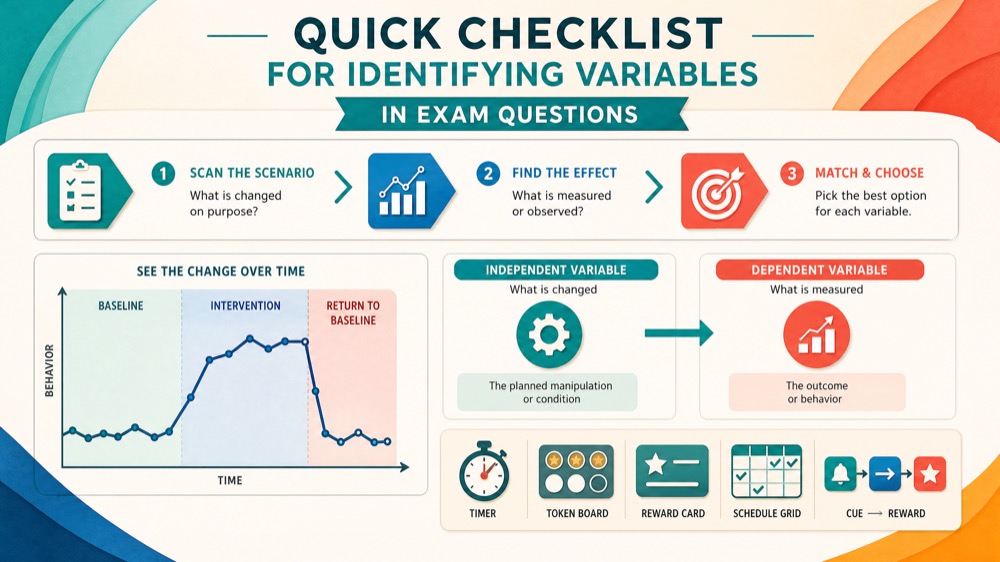
Here is a concise checklist you can use to quickly analyze any scenario:
- Identify the behavior being measured and ask if it is a clear, observable action.
- Look for the intervention or strategy that is systematically applied or withdrawn.
- Ask whether the intervention is presented as a condition shift (e.g., baseline vs. treatment).
- Check if the measured behavior is the target of the intervention, not a side effect.
- Ensure the independent variable is not a confound but is deliberately manipulated.
- Confirm that the dependent variable can be quantified (frequency, duration, etc.).
- Test whether the scenario describes a functional relationship with logic for the behavior change.
These steps will help you quickly eliminate incorrect options and choose the best answer. The more you practice with real scenarios, the more automatic this process becomes.
Summary and Final Study Tips
Determining the independent and dependent variable in ABA is a crucial skill for the BCBA exam and for your future practice. The independent variable is the intervention you manipulate, and the dependent variable is the target behavior you measure. Always look for the systematic change and the measurable behavior.
To reinforce your learning, try to rephrase study articles in terms of variables. For instance, if you read about a study on token economy, identify the token economy as the independent variable and the targeted behavior (e.g., on-task time) as the dependent variable. Similarly, when reviewing differential reinforcement articles, pinpoint what is being reinforced and what behavior is being measured.
For more practice with experimental design concepts, consider exploring resources on internal validity to understand how confounds can obscure the relationship between variables. Also, review the BACB’s official resources for ethics and task list items related to behavior assessment and measurement.
Finally, practice with mock exams to apply this skill under timed conditions. Use the checklist provided here as a quick reference during your review. With consistent practice, you will be able to identify variables quickly and accurately, giving you an edge on the exam and in your professional role.
Quick Review Checklist
Use this final checklist to turn independent and dependent variable into exam-ready reasoning. The goal is not to memorize a label in isolation; it is to identify the relevant evidence and explain why the best answer fits the scenario. Key ideas to review:
- State the central definition or decision point for independent and dependent variable in your own words.
- Identify the detail that makes independent and dependent variable different from its closest related ABA term.
- Separate the observable facts in a scenario from assumptions that are not supported by the facts.
- Write one example and one nonexample so you can recognize the concept in a new setting.
Exam application checks:
- Ask what the question is actually requesting before comparing the answer choices.
- Mark the antecedent, response, consequence, or other evidence that supports the selected answer.
- Look for a distractor that describes a related process but does not answer the specific question.
Final self-check:
- Explain how you would verify the interpretation with clear observations or data.
- Change one detail in the scenario and decide whether your answer should change.
- Give a one-sentence rationale that a supervisor or study partner could evaluate.
Take the Free BCBA Mock Exam
Ready for more practice? Use the free mock exam to keep testing your accuracy with realistic BCBA-style items. Take the Free BCBA Mock Exam



