
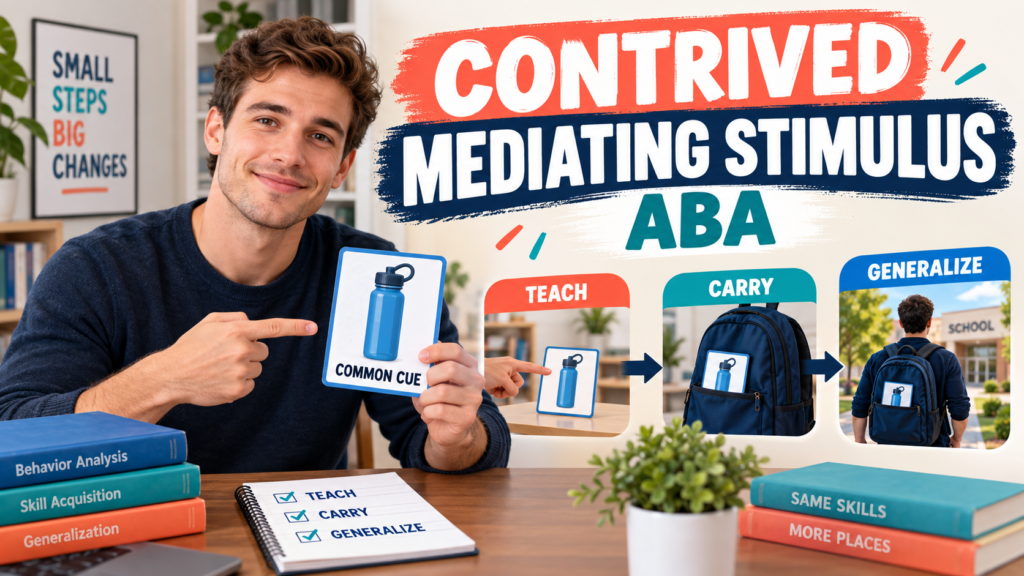
A contrived mediating stimulus ABA procedure uses a cue that is made functional for a target behavior during instruction and then transported or reintroduced to support performance in a new setting. The two-part test is important: the item must help evoke or support the target response, and it must be usable where generalization is expected.
Table of Contents
- What Is a Contrived Mediating Stimulus in ABA?
- What Two Criteria Define It?
- What Is a Contrived Mediating Stimulus ABA Example?
- How Do You Make the Stimulus Functional?
- How Does Portability Support Generalization?
- How Do You Test Generalization?
- How Is It Different From a Prompt or Reinforcer?
- What Data Should You Collect?
- How Is It Tested on the BCBA Exam?
- What Mistakes Should You Avoid?
- What Ethical Boundaries Matter?
- Contrived Mediating Stimulus ABA FAQ
- Quick Review Checklist
- Take the Free BCBA Mock Exam
A card, timer, object, person, or visual reminder is not automatically a mediating stimulus simply because it is present. The analyst must show that the stimulus matters for the target response and that it can bridge the instructional setting and the generalization setting. This page explains the definition, gives a worked example, and separates the concept from a generic prompt or a contrived reinforcer. The current BCBA Test Content Outline provides the study context. Examples below are simplified learning illustrations, not a universal program or individualized clinical advice. Table of Contents
What Is a Contrived Mediating Stimulus in ABA?
A contrived mediating stimulus is a stimulus intentionally arranged so it helps evoke or support a target behavior during instruction and then helps that behavior occur in a generalization setting. “Contrived” means that the practitioner arranges its use for a teaching or generalization purpose. “Mediating” means that the stimulus helps bridge the original teaching arrangement and the later context. It is not simply an object that happens to be nearby.
For example, a small visual card might be taught to cue a learner to use a hand-washing sequence. If the card is functional during instruction and can be carried to the bathroom at school or placed in a new bathroom, it may mediate generalization. The card is useful because it participates in the learner’s behavior—not because the analyst labels it a “visual.”
What Two Criteria Define It?
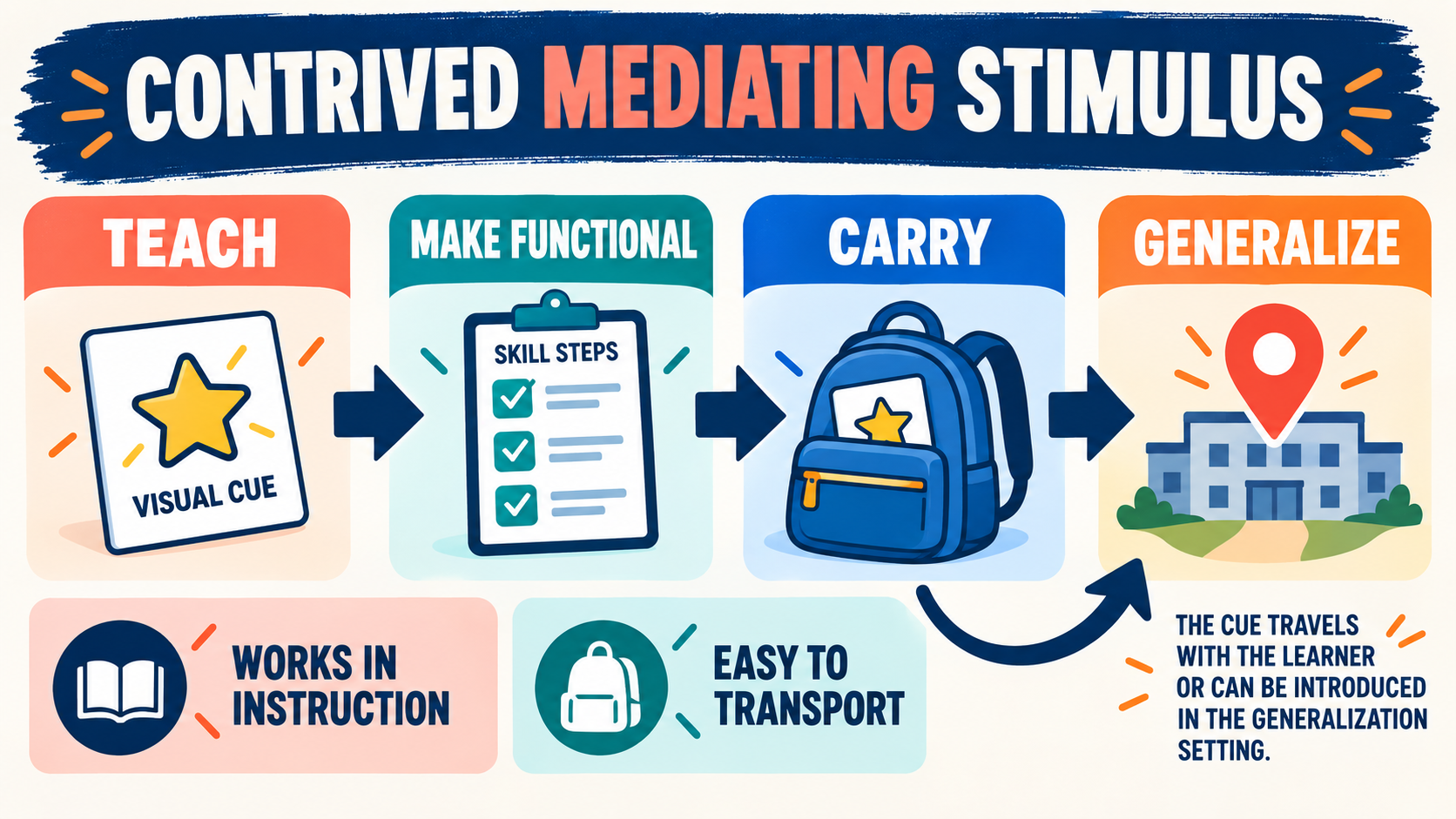
Most BCBA study explanations emphasize two practical criteria:
- Functional during instruction: the stimulus is made relevant to the target behavior and actually helps evoke, prompt, organize, or support that response.
- Portable or reintroducible: the stimulus can be moved with the learner or reproduced in the setting where generalization is expected.
Both criteria matter. A laminated card that never affects responding is not functional merely because it is attached to a binder. A powerful cue that is fixed to one classroom wall may support instruction but fail the portability requirement for a new setting. The analyst must design and measure the bridge rather than assume it exists.
What Is a Contrived Mediating Stimulus ABA Example?
Suppose a learner is learning to request help before leaving a difficult task. During instruction, the team introduces a small “HELP” card on a ring. The card is taught as part of a communication response: the learner selects or hands over the card, the adult responds promptly, and the learner experiences the relevant outcome. The card is not merely placed on the table; its relation to the target response is established.
Later, the same kind of card is attached to the learner’s school binder and made available during a different activity with a different adult. A generalization probe checks whether the learner can use the card to request help in the new context. If the response occurs only after the original instructor gives extra verbal prompts, the team has not yet shown that the card alone mediates the skill. This example contains several separate decisions:
- Target behavior: an observable help request using the learner’s available communication mode.
- Arranged stimulus: a portable help card that is available before the response is needed.
- Functional history: the card has been correlated with an effective, plan-consistent response to the request.
- Generalization test: the card is used with a different activity, person, or setting, and performance is measured.
How Do You Make the Stimulus Functional?
Start with the target response and the barrier to generalization. If the learner knows the response in a clinic but not during a classroom transition, identify what changes: materials, people, distance, time pressure, instructions, reinforcement, or the natural cues available. Then choose a stimulus that can be relevant in both contexts.
During instruction, the stimulus may be paired with the target opportunity, modeled, prompted, or embedded in a response routine that is meaningful to the learner. The exact procedure depends on the plan and the learner’s skills. What matters for the concept is that the stimulus acquires a functional relation with the response. A visual cue may help organize a chain, signal a communication option, or remind the learner of a self-management step.
Plan for fading and choice from the beginning. A cue that becomes so controlling that the learner cannot respond without it may create prompt dependence. On the other hand, fading too quickly can remove a support before the learner has a reasonable way to contact reinforcement or complete the skill. The BCBA should use data to decide when, where, and how to vary the cue.
How Does Portability Support Generalization?
Portability matters because the instructional setting rarely contains every stimulus that will be present in the learner’s daily life. A cue that can move, be recreated, or be arranged by natural support people gives the learner a stable bridge while other features of the environment change.
Portability does not mean the stimulus should be used forever. The eventual goal may be for naturally occurring cues and consequences to control the behavior. A mediating stimulus can be a bridge, not a permanent condition. Measure whether the learner can respond with less assistance, across people and settings, while preserving meaningful communication and independence.
How Do You Test Generalization?
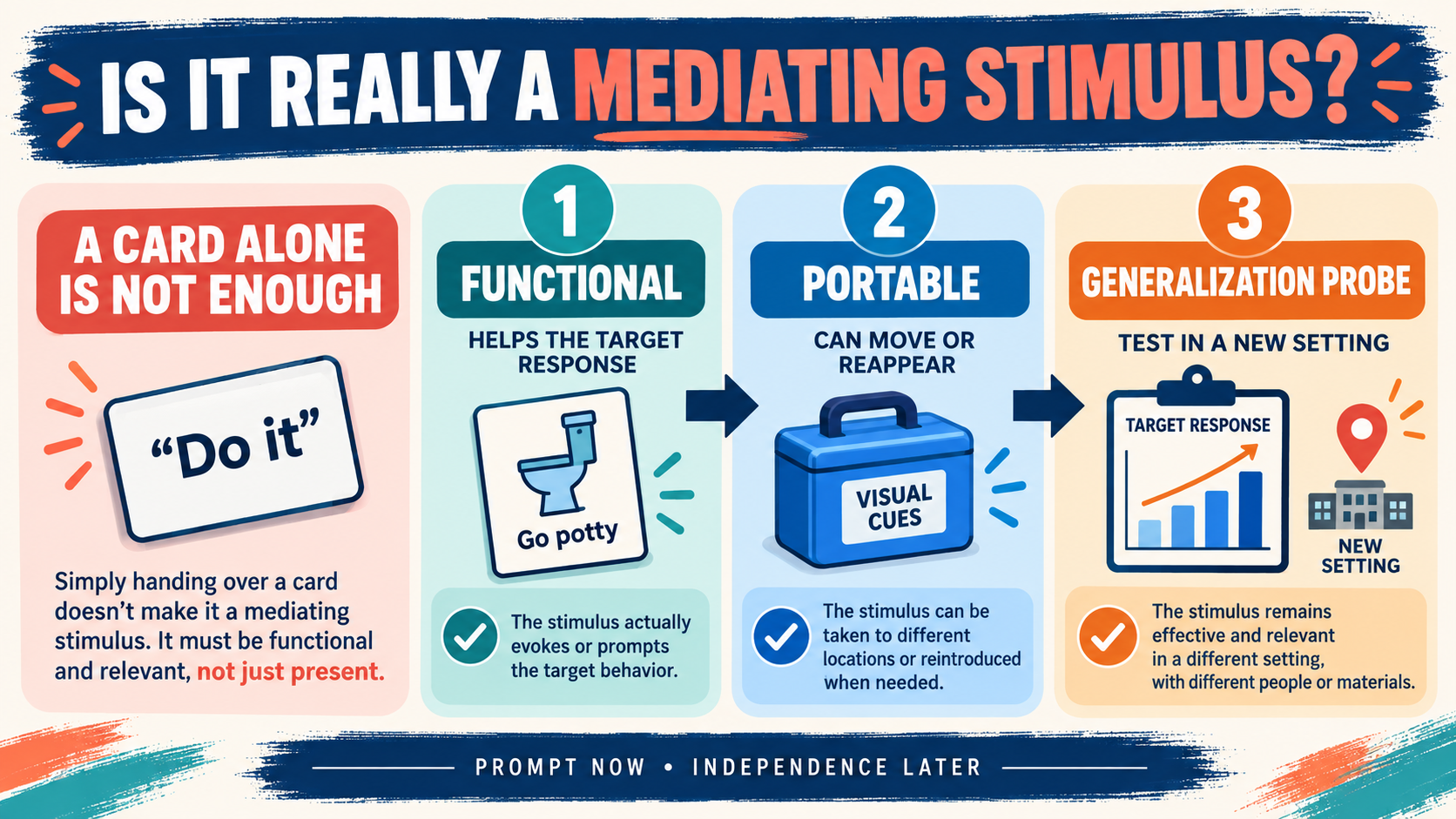
A generalization probe asks whether the target response occurs under a new, relevant condition without adding unplanned teaching prompts. Before the probe, define what will change and what will remain constant. A useful probe may vary the setting while keeping the cue available, vary the adult while keeping the activity similar, or vary materials while preserving the target relation.
Record the response, prompt level, latency when relevant, and the exact context. If the learner succeeds only after the original instructor says “remember your card,” the result is not equivalent to independent use of the mediating stimulus. That may indicate a need for additional teaching, a different cue, or a more gradual transfer—not a failure by the learner.
How Is It Different From a Prompt or Reinforcer?
The terms can overlap in an intervention, but they answer different questions. A prompt is an extra stimulus arranged to increase the probability of a response. A contrived reinforcer is a consequence arranged to strengthen behavior. A contrived mediating stimulus is defined by its role in supporting transfer or generalization across contexts.
| Concept | Main role | Key exam clue |
|---|---|---|
| Prompt | Increases the chance of a response in the current opportunity. | Extra help is delivered close to the SD and should be faded as appropriate. |
| Contrived reinforcer | Strengthens behavior by following it with an arranged consequence. | The focus is the consequence and future response probability. |
| Contrived mediating stimulus | Bridges instruction and generalization when made functional and portable. | Ask whether the cue works in instruction and can support the target response in a new setting. |
What Data Should You Collect?
Collect data that answer the generalization question. Depending on the target, that might include independent percentage, prompted percentage, latency, duration, frequency, or successful steps in a chain. Record the setting, person, materials, cue availability, and prompt level so a result is interpretable.
How Is It Tested on the BCBA Exam?
For contrived mediating stimulus ABA, look for the bridge between settings. The scenario usually says that a stimulus is taught to support a target response in instruction and then carried, recreated, or introduced in the generalization environment.
- Functional during teaching: the cue actually helps evoke or organize the target behavior.
- Portable or reintroducible: the cue can be available where transfer is expected.
- Generalization evidence: the response is checked with a new person, material, setting, or activity.
Common distractors include a generic verbal prompt that is never used outside instruction, a preferred item delivered after the response, and a visual that is present but has no demonstrated relation to the behavior. If the question emphasizes a consequence, think reinforcement. If it emphasizes extra assistance immediately before a response, think prompt. If it emphasizes a cue that bridges environments, think mediating stimulus.
What Mistakes Should You Avoid?
Do not assume that every visual support is a mediating stimulus. Presence is not function. Do not assume that one successful trial proves generalization. A probe should be planned, measured, and interpreted in relation to the learner’s actual contexts.
Finally, do not make the cue harder to use than the target behavior. If the learner must find a tiny icon, ask an adult for the card, and navigate three screens before communicating, the arrangement may add response effort. Revise it with the responsible BCBA and the learner’s support team.
What Ethical Boundaries Matter?
A mediating stimulus should support meaningful independence, not conceal a restrictive procedure or force a person to communicate in one narrow way. Consider assent, consent, cultural and contextual fit, privacy, dignity, and access to the learner’s preferred communication system. Do not withhold necessities or create distress simply to manufacture a dramatic generalization test.
Use the free BCBA mock exam as a study checkpoint for stimulus control and generalization concepts. It is a study aid, not an official BACB product and not a substitute for supervision or individualized assessment.
Contrived Mediating Stimulus ABA FAQ
What is a contrived mediating stimulus?: It is a deliberately arranged stimulus made functional for a target behavior during instruction and then transported or reintroduced to help that behavior occur in a generalization setting. What is a simple example?: A portable help card can be taught to support a help request during instruction and then made available during a new activity or with a new adult. The team must measure whether the learner uses it in the new context.
Does a visual prompt automatically count?: No. A visual prompt may help a response in the current trial, but it is a contrived mediating stimulus only when it is functional for the target response and relevant or portable for the generalization setting.
How is it different from a contrived reinforcer?: A contrived reinforcer is an arranged consequence intended to strengthen behavior. A mediating stimulus is an antecedent or contextual bridge that supports transfer of the behavior across settings. What is the fastest exam clue?: Look for the cue being made functional during teaching and then carried or recreated in a new environment. That two-setting bridge is the strongest clue.
A contrived mediating stimulus ABA arrangement is successful only when the cue does real functional work and supports a meaningful transfer. Teach the relation, make the cue practical, test it in a new context, and use data to decide whether to fade, adapt, or keep the support.
Quick Review Checklist
Use this final checklist to turn contrived mediating stimulus ABA into exam-ready reasoning. The goal is not to memorize a label in isolation; it is to identify the relevant evidence and explain why the best answer fits the scenario. Key ideas to review:
- State the central definition or decision point for contrived mediating stimulus ABA in your own words.
- Identify the detail that makes contrived mediating stimulus ABA different from its closest related ABA term.
- Separate the observable facts in a scenario from assumptions that are not supported by the facts.
- Write one example and one nonexample so you can recognize the concept in a new setting.
Exam application checks:
- Ask what the question is actually requesting before comparing the answer choices.
- Mark the antecedent, response, consequence, or other evidence that supports the selected answer.
- Look for a distractor that describes a related process but does not answer the specific question.
Final self-check:
- Explain how you would verify the interpretation with clear observations or data.
- Change one detail in the scenario and decide whether your answer should change.
- Give a one-sentence rationale that a supervisor or study partner could evaluate.
Take the Free BCBA Mock Exam
If you want a low-pressure way to check your recall, use the free practice resource below. Take the Free BCBA Mock Exam



