
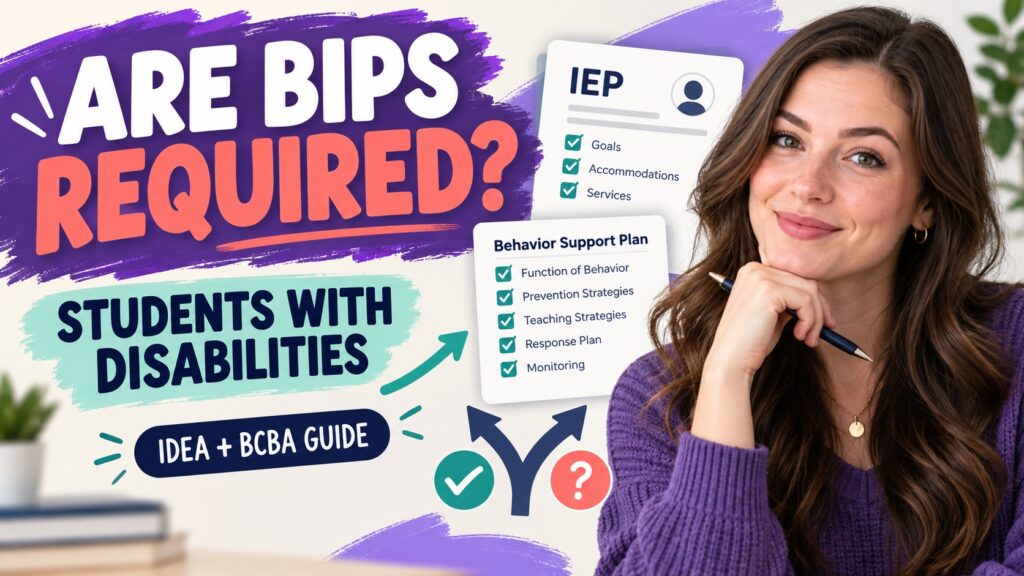
Short answer: No—not every student with a disability automatically needs behavior intervention plans (BIPs). Under IDEA, when a child’s behavior impedes the child’s learning or the learning of others, the IEP Team must consider positive behavioral interventions and supports and other strategies. A BIP may be the appropriate way to document and implement those supports, but the federal rule is not a blanket requirement that every student with a disability have a BIP.
Table of Contents
- Are behavior intervention plans required for every student?
- What does IDEA require?
- When may a BIP be required or appropriate?
- Who decides whether a BIP is needed?
- What should a function-based BIP include?
- How do discipline rules change the analysis?
- How does the BCBA exam test this question?
- What mistakes should you avoid?
- Behavior intervention plans requirements FAQ
- Take the Free BCBA Mock Exam
This distinction is important for the search question behavior intervention plans are required for students with disabilities. A simplified exam answer often points to students whose behavior interferes with learning, but a careful answer separates three ideas: what IDEA requires the IEP Team to consider, when a BIP is appropriate, and when discipline provisions create additional FBA/BIP duties. State law, district policy, and the student’s individual IEP can add requirements.
The current IDEA rule for behavior intervention plans says the IEP Team must consider positive behavioral interventions and supports when behavior impedes learning. U.S. Department of Education guidance also explains that IDEA does not define BIP as a standalone federal term, while describing a BIP as a component of an educational program that addresses behavior interfering with learning. This article is an exam-prep and general-information guide, not legal advice for a specific student or school. Table of Contents
Are behavior intervention plans required for every student?
The most accurate answer is conditional: a BIP is considered when a student’s behavior interferes with the student’s learning or the learning of others, and it becomes part of the student’s educational program when the IEP Team determines that individualized behavioral supports are needed. Disability status alone does not answer the question. The team must consider the behavior, educational impact, assessment information, supports already attempted, and the student’s individual needs.
For a multiple-choice item, the best option may be worded as “students whose behavior adversely affects their learning or the learning of others.” Treat that as a shorthand for the IDEA consideration requirement—not as proof that every such student automatically receives an identical document called a BIP in every state. A strong BCBA candidate knows the exam-friendly rule and the legal nuance behind it.
- Not automatic: a disability label by itself does not trigger a universal BIP.
- Behavioral impact matters: the team considers supports when behavior impedes learning.
- Individualization matters: the plan and supports must match the student and context.
- Team decision matters: the IEP Team determines what is needed in the educational program.
- Local rules matter: state and district requirements may be more specific than the federal baseline.
What does IDEA require?
IDEA uses the IEP as the vehicle for providing a free appropriate public education (FAPE). In the federal special-factors rule, the IEP Team must consider positive behavioral interventions and supports, and other strategies, when a child’s behavior impedes the child’s learning or the learning of others. The rule is about the team’s consideration of appropriate supports; it does not say that every eligible child must have a separately titled BIP.
The U.S. Department of Education’s Positive, Proactive Approaches guide explains that if behavior interferes with learning, the IEP Team must consider positive behavioral interventions and supports. The Department’s 2024 FBA guidance describes BIP or behavioral-support-plan components such as defining the interfering behavior, examining environmental factors, identifying function, teaching replacement skills, assigning implementation responsibilities, and evaluating effectiveness.
For exam purposes, keep “must consider” separate from “must use a BIP in every case.” The team may determine that general classroom supports, an IEP goal, environmental changes, communication instruction, counseling, or another individualized support is appropriate. A BIP is a tool for organizing behavioral supports; it is not a substitute for an FBA, an IEP Team decision, or an individualized educational program.
When may a BIP be required or appropriate?
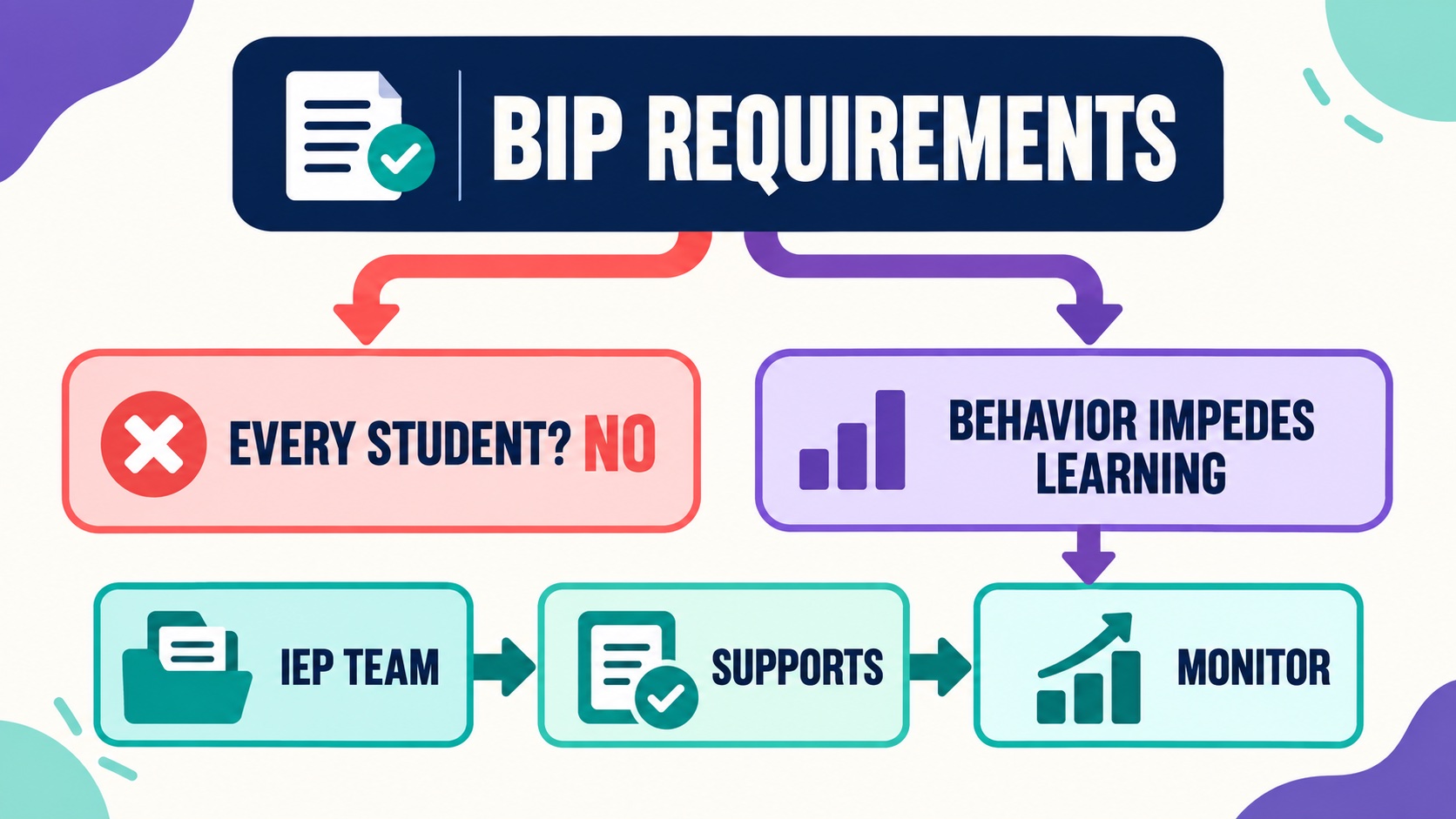
A BIP is more likely to be appropriate when behavior has a meaningful effect on educational access, safety, participation, or the learning of others and the team needs a coordinated, function-based plan. The exact trigger depends on the circumstances and governing rules. The following situations are useful study categories, not a universal legal checklist.
| Scenario | What the team should ask | BIP implication |
|---|---|---|
| Behavior impedes learning | What behavior is occurring, in which contexts, and how does it affect access or progress? | The IEP Team must consider positive behavioral supports; a BIP may organize individualized strategies. |
| Repeated or serious problem behavior | What does the data suggest about antecedents, consequences, and function? | An FBA-informed plan may be needed to coordinate prevention, teaching, response, and measurement. |
| Disciplinary change in placement | Do IDEA discipline provisions require an FBA, a BIP, or modifications as appropriate? | The team must apply the specific discipline rule and manifestation-determination facts, not a generic shortcut. |
| Existing plan is ineffective | Was the plan implemented with fidelity, and does new data change the hypothesis? | Review and revise through the authorized team process; do not simply add punishment or rewrite the plan informally. |
A BIP can be useful even when a specific federal provision does not force the label. It gives educators a shared description of the target behavior, prevention steps, replacement skills, reinforcement, response procedures, data system, and responsibilities. The plan should reduce ambiguity—not create a second, disconnected treatment system beside the IEP.
Who decides whether a BIP is needed?
The IEP Team makes educational-program decisions within the applicable law and school procedures. The team typically includes the parents, a regular education teacher when appropriate, a special education teacher or provider, a public-agency representative, a person who can interpret evaluation results, and others with relevant knowledge or expertise as invited. A BCBA or behavior specialist may contribute assessment and intervention expertise, but the acronym of one professional does not replace the team’s legal decision-making process.
The student and family perspective is also important. The team should ask how the behavior affects communication, participation, relationships, dignity, and access to instruction. A plan that looks technically complete but is impossible for staff to use, culturally mismatched, or disconnected from the student’s goals is not a strong implementation plan. The team should specify who will implement each step and how staff will be trained and supported.
- Define the target behavior in observable and measurable terms.
- Review FBA information or other data that supports the behavioral hypothesis.
- Identify prevention and antecedent supports that fit the setting.
- Teach a replacement behavior that serves the relevant function.
- Specify reinforcement and response procedures without vague language.
- Assign implementation, data-collection, consultation, and review responsibilities.
- Set a schedule for evaluating progress and revising the plan.
What should a function-based BIP include?
A useful BIP connects assessment to action. It does not merely list a problem behavior and a consequence. The plan should explain what the student is likely to gain, avoid, communicate, or regulate through the behavior, then teach an efficient alternative and arrange the environment so the alternative can work.
| Component | What it clarifies | Example of measurable wording |
|---|---|---|
| Operational definition | What counts and does not count as the target behavior. | “Leaves the assigned area by more than three feet for at least five seconds.” |
| Function or hypothesis | What variables may evoke and maintain the behavior. | “Most likely during difficult writing tasks when adult help is delayed.” |
| Replacement skill | What the student can do instead to access the same outcome. | “Uses a help card or spoken request within 10 seconds of the task cue.” |
| Measurement and review | How the team will know whether implementation and outcomes are improving. | “Record opportunities, independent requests, prompts, and area-leaving per class.” |
How do discipline rules change the analysis?
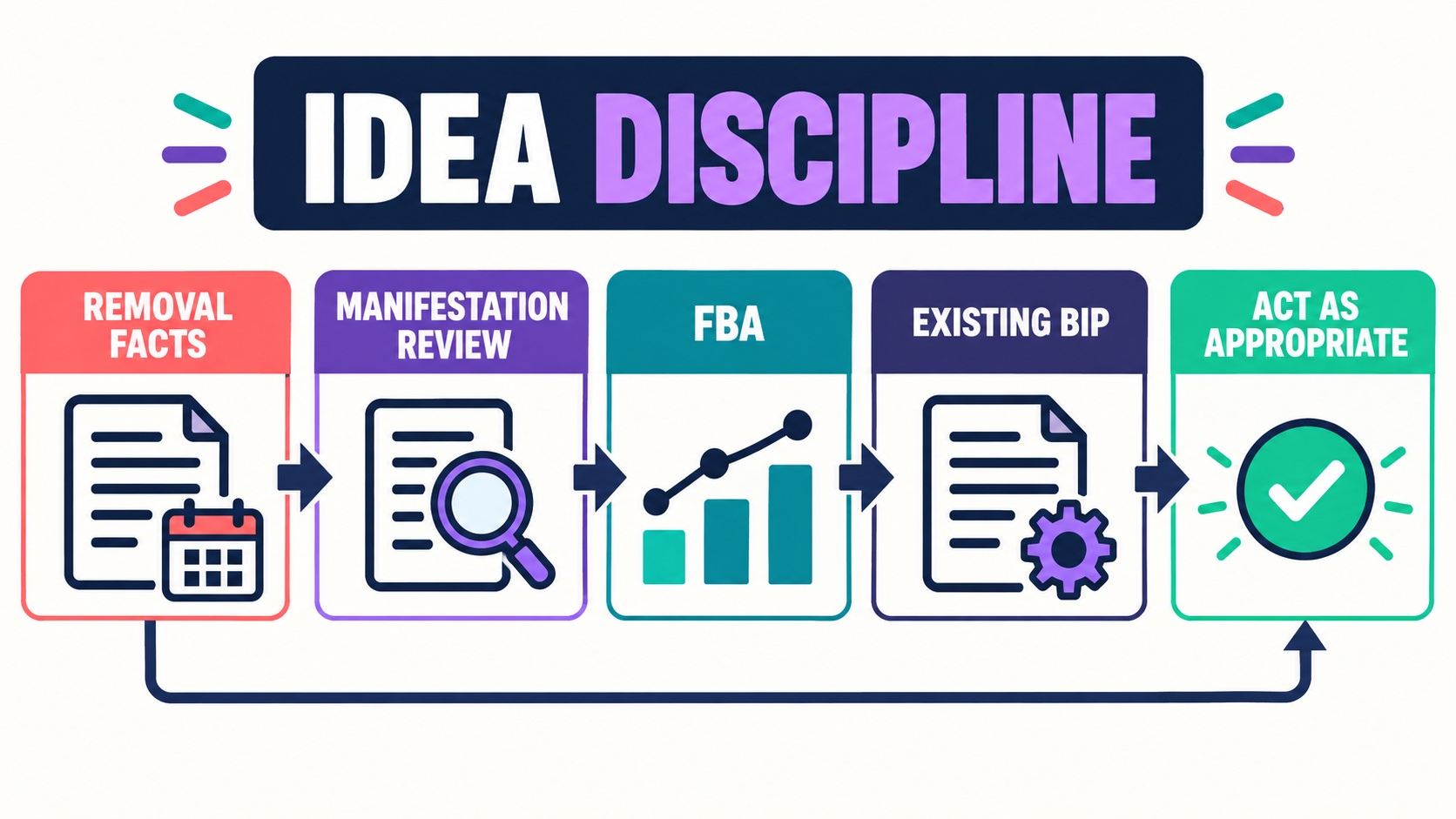
Discipline questions require extra precision. IDEA includes provisions addressing removals from the current placement, manifestation determinations, and behavior supports. In certain disciplinary circumstances, the school must provide an FBA and behavioral intervention services or modify an existing BIP as appropriate. The exact requirement depends on the length and pattern of removal, the manifestation determination, whether a BIP already exists, and other facts in the regulation.
The U.S. Department of Education’s IDEA discipline Q&A explains that a BIP is generally understood as part of an educational program addressing behavior that interferes with learning or school expectations. It also clarifies that, in the discipline context, an IEP Team may need to include, review, or modify a BIP when the applicable conditions are met. Read the fact pattern instead of applying “all students with disabilities” as the trigger.
- Identify whether the student has an IEP or is treated as a child with a disability under the relevant provision.
- Determine whether the removal is a disciplinary change in placement or a shorter removal.
- Check whether a manifestation determination is required and what it concluded.
- Ask whether an FBA has already been conducted and whether a BIP already exists.
- Apply the “as appropriate” language and the team’s individualized decision.
- Separate federal baseline rules from state, district, and IEP-specific requirements.
How does the BCBA exam test this question?
The BCBA exam is more likely to test the behavioral and educational logic than to ask you for legal advice about a particular district. When a stem says a student’s behavior interferes with learning, recognize the need to consider positive behavioral supports. When it asks who decides or what happens next, choose a response that uses assessment data, involves the appropriate team, and protects educational access.
For the current exam-domain frame, consult the BACB BCBA Test Content Outline. This article translates the topic into study logic; it does not reproduce official questions or imply that this exact wording will appear on an exam.
| Question clue | Best reasoning direction | Avoid |
|---|---|---|
| Behavior interferes with learning | Consider positive behavioral supports and gather data about context and function. | Assuming a diagnosis alone requires one identical plan. |
| Existing intervention is not effective | Check fidelity, measurement, function, and team review before changing procedures. | Adding an unapproved consequence after one difficult session. |
| Disciplinary removal is described | Apply the specific IDEA discipline facts and ask what is required as appropriate. | Choosing “BIP for every student with a disability” without reading the conditions. |
A useful exam sentence is: When behavior impedes learning, the IEP Team must consider positive behavioral interventions and supports; a function-based BIP may be included when the individualized facts show it is appropriate. That sentence preserves the high-yield rule without overstating the federal requirement.
What mistakes should you avoid?
- Overgeneralizing the requirement: not every student with a disability automatically receives a BIP.
- Ignoring educational impact: the key federal trigger is behavior that impedes learning or the learning of others.
- Confusing consideration with implementation: the team may need to consider supports before selecting a specific plan.
- Skipping function: a BIP should be linked to assessment information and replacement skills.
- Forgetting fidelity: an ineffective outcome may reflect inconsistent implementation rather than an ineffective intervention.
- Giving legal advice from a study page: state rules, district procedures, and the current facts must be checked for an individual case.
Behavior intervention plans requirements FAQ
Are behavior intervention plans required for all students with disabilities?: No. Federal IDEA rules require the IEP Team to consider positive behavioral interventions and supports when behavior impedes learning. Whether a separate or incorporated BIP is needed depends on the student’s behavior, data, educational impact, team decision, discipline facts, and applicable state or district rules.
What is the common BCBA exam answer?: The high-yield answer is students whose behavior interferes with their own learning or the learning of others. Read the wording carefully: this points to the requirement to consider positive behavioral supports and may support a BIP, but it should not be read as a blanket federal requirement for every student with a disability.
Does a BIP have to be part of the IEP?: A BIP may be incorporated into an IEP when the IEP Team determines that it is appropriate. The exact document format and state requirements vary. The important concept is that behavioral supports should be coordinated with the student’s educational program and implemented by the responsible team.
Is an FBA always required before a BIP?: An FBA is a strong foundation for a function-based plan, but the exact legal requirement depends on the circumstances. IDEA discipline provisions can require an FBA and behavioral intervention services as appropriate in specified situations, while IEP teams may also use FBA proactively when needed to understand behavior and design supports.
Quick review: disability status alone is not the complete answer. Identify whether behavior impedes learning, what the IEP Team must consider, whether a BIP is appropriate for the individual facts, and whether discipline provisions add a specific duty. For more scenario practice, use the free BCBA mock exam as a practice and feedback resource. It is not an official BACB exam and does not guarantee certification or a passing result.
Take the Free BCBA Mock Exam
When you are ready to apply the idea, use the free practice resource below for additional feedback. Take the Free BCBA Mock Exam



