
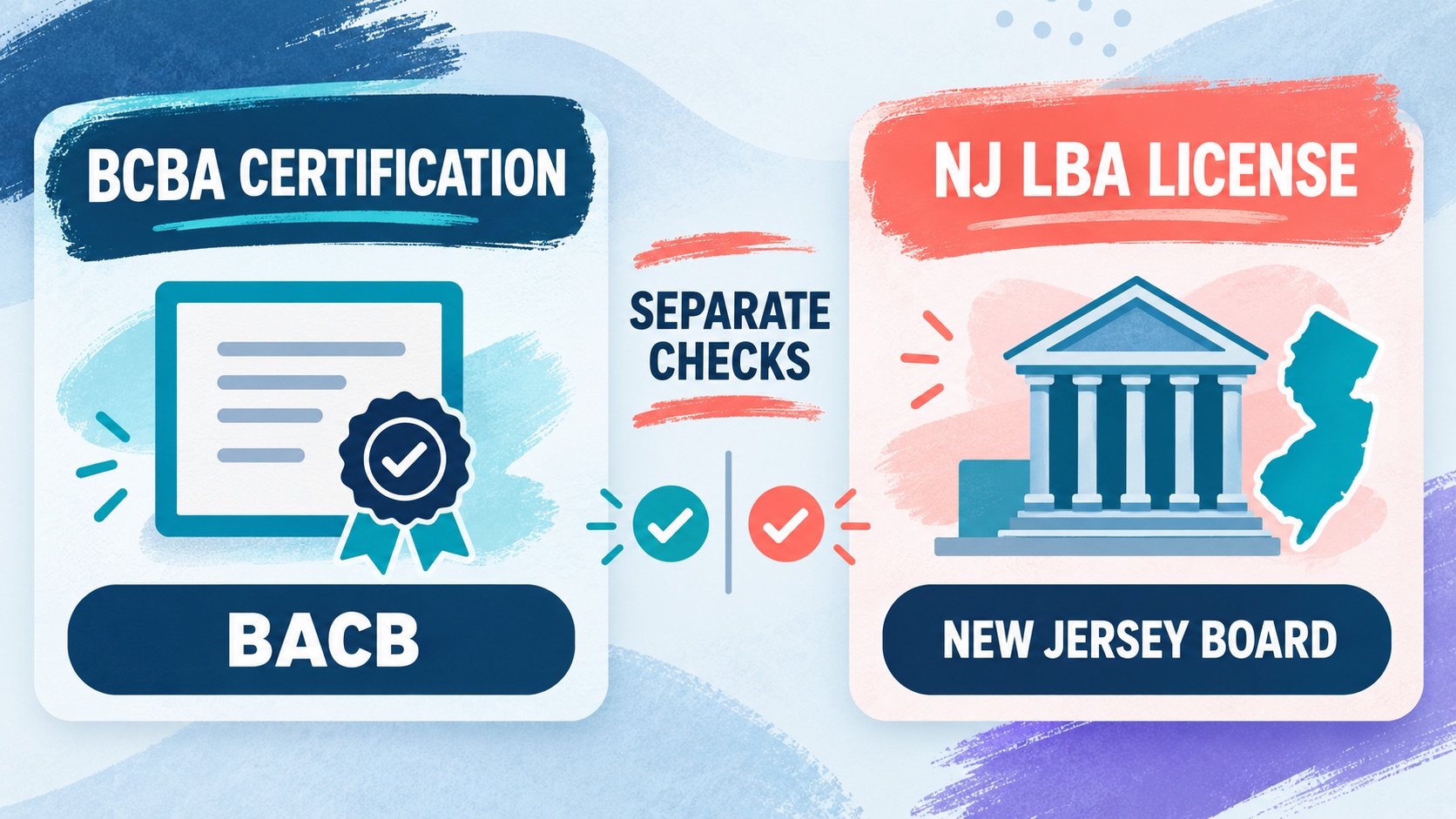
If you are searching for an NJ BCBA licensure application, start with one important distinction: BCBA certification and New Jersey state licensure are separate credentials. The Behavior Analyst Certification Board (BACB) controls the national BCBA certification, while the New Jersey State Board of Applied Behavior Analyst Examiners controls the state license to practice in New Jersey. A current BCBA credential may be required for a New Jersey Licensed Applied Behavior Analyst (LBA) application, but it does not replace the state application.
Table of Contents
- NJ BCBA licensure application: what is the short answer?
- What license does a BCBA apply for in New Jersey?
- What are the New Jersey LBA requirements?
- How do you start the online application?
- Which documents should you prepare?
- What is the jurisprudence orientation?
- How is NJ licensure different from BCBA certification?
- Does another state license transfer automatically?
- How long does New Jersey approval take?
- What application mistakes should you avoid?
- When should you prepare for the BCBA exam?
- NJ BCBA licensure application FAQ
- Quick Review Checklist
- Take the Free BCBA Mock Exam
New Jersey’s official application page says applications are online through the state’s MyLicense portal. The Board’s FAQ lists the LBA qualifications as a completed application, proof of a qualifying master’s or doctoral degree, current BCBA or BCBA-D certification, and completion of the online jurisprudence orientation. The Board also says approval timing depends on the criminal-history background check and whether the application requirements are complete. This guide maps the process without treating general information as legal advice. Table of Contents
NJ BCBA licensure application: what is the short answer?
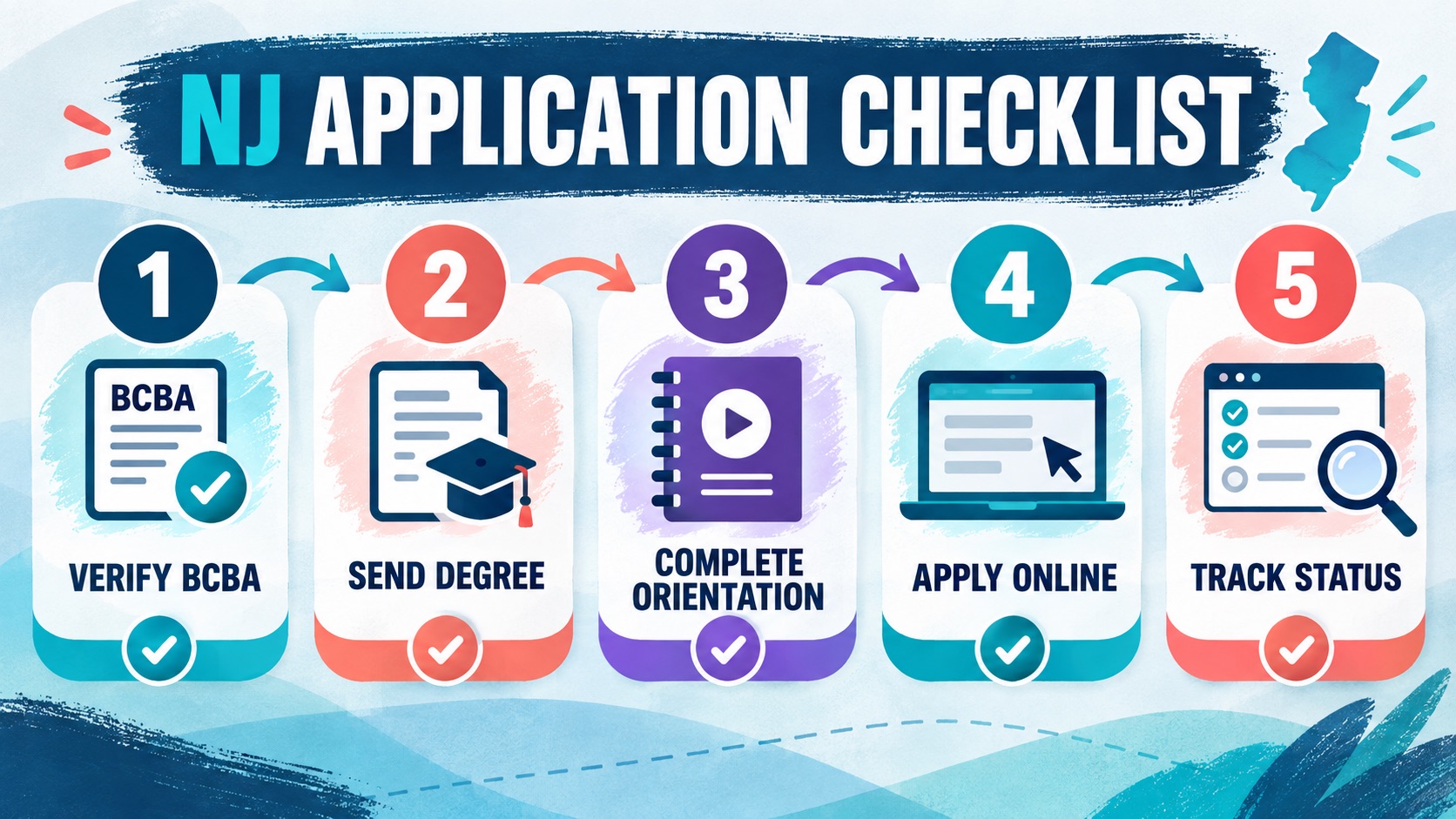
For a New Jersey LBA application, you generally need both a qualifying national credential and a state application. The official New Jersey FAQ identifies current BCBA or BCBA-D certification, a qualifying graduate degree, a completed application, and the online jurisprudence orientation as part of the LBA qualification list. It also directs applicants to the State Board’s online application process. The practical order is:
- Confirm that the New Jersey LBA license is the credential you need for your role and setting.
- Verify that your BACB certification is current and that your graduate degree documentation is available.
- Open the application through the official New Jersey portal and follow the Board’s current instructions.
- Arrange required documents and background-check information exactly as requested.
- Complete the jurisprudence orientation or examination step when the Board makes it available to you.
- Track the application and respond to any deficiency notice instead of assuming submission equals approval.
Do not use a private checklist as a substitute for the Board’s live application instructions. The Board can change forms, portal steps, fees, and document delivery instructions. Save the page date and the confirmation number for your own records.
What license does a BCBA apply for in New Jersey?
New Jersey uses the title Licensed Applied Behavior Analyst, commonly shortened to LBA. The state license is not the same as the BCBA certification. The BCBA is a graduate-level national certification issued by the BACB; the LBA is a New Jersey authorization governed by state law and the State Board of Applied Behavior Analyst Examiners.
The New Jersey Board’s application page also lists a Licensed Assistant Applied Behavior Analyst (LaBA) application. That is a different pathway for someone holding BCaBA certification and a bachelor’s degree. A person searching for an NJ BCBA licensure application should not accidentally select the LaBA form simply because both applications appear on the same state website.
If your job title, employer, payer, or service setting uses a different term, confirm with the Board and the employer which license is required. A school, clinic, insurance plan, or state program may have additional credentialing requirements even after the state license is issued.
What are the New Jersey LBA requirements?
The official New Jersey Board FAQ provides the clearest high-level checklist. It lists the following for an LBA applicant:
| Item | What it means for an LBA applicant | What to verify |
|---|---|---|
| Completed application | Submit the New Jersey LBA application through the official process and answer every required field. | Current portal, fee, signature, disclosure, and submission instructions. |
| Graduate degree proof | Provide evidence of a master’s or doctoral degree from an institution accredited by a regional accrediting body recognized by the U.S. Department of Education’s Office of Postsecondary Education. | Whether the transcript must be sent directly and whether the degree record matches your legal name. |
| Current BCBA or BCBA-D certification | The state application relies on current national certification evidence for the LBA route. | Credential status, certification number, expiration or recertification status, and verification method. |
| Jurisprudence orientation | Complete the New Jersey law and rules orientation required by the Board before issuance. | When the orientation becomes available in the application flow and how completion is recorded. |
This table is a planning aid, not a complete legal checklist. Read the current portal and the Board’s statutes and regulations page before submitting. If the state asks for background information, license verification, or a good-moral-character form, provide it in the format and delivery channel the Board specifies.
How do you start the online application?
Begin at the New Jersey State Board of Applied Behavior Analyst Examiners Applications and Forms page. The page states that applications are online and provides a link to the state MyLicense portal. Use the Board’s page rather than a saved third-party link if you are unsure whether the portal address or application version has changed.
Before creating or opening an application, prepare a small document folder with your legal name exactly as it appears on your BACB account, school records, and identification. Use a consistent email address that you will monitor after submission. Record the date you started, the portal confirmation number, the application type, and any instructions displayed after payment or submission.
Which documents should you prepare?
The exact upload and delivery instructions belong to the live application, but an applicant can reduce delays by preparing the likely evidence in advance:
- Degree evidence: request an official graduate transcript or other degree proof in the form the Board accepts. Confirm that the school can send it directly if required.
- BCBA verification: keep your current BACB certification details available and use the Board’s requested verification route. A screenshot may not replace official verification.
- Identity and name history: prepare documents explaining a legal-name difference between your identification, transcript, and BACB record if one exists.
- License history: if the application asks about licenses held in other jurisdictions, list them accurately and arrange verification as instructed.
- Background information: follow the New Jersey background-check instructions and disclose requested events completely rather than relying on a private interpretation.
- Orientation record: save confirmation that you completed the jurisprudence orientation or examination step.
- Payment and submission record: retain receipts, confirmation pages, emails, and copies of the submitted application.
What is the jurisprudence orientation?
New Jersey requires applicants to learn the state’s laws and rules for applied behavior analysis through a jurisprudence orientation or examination process. The state’s applicant orientation page explains that the Board requires applicants to complete the jurisprudence examination before a license is issued. It describes a 25-question test covering laws and regulations governing the profession in New Jersey.
This is not the BCBA examination. The BACB exam tests national behavior-analytic knowledge for BCBA certification. The New Jersey jurisprudence step tests knowledge of New Jersey statutes, regulations, and professional practice boundaries. Prepare for the two assessments separately and use the version of the state material linked from the official New Jersey site.
Read the state orientation after gathering your application facts. Pay particular attention to scope of practice, exemptions, supervision, professional conduct, reporting, and the distinction between a national credential and a state license. Keep a note of the date you completed the step because the portal may display completion separately from the application status.
How is NJ licensure different from BCBA certification?
The two systems connect, but they answer different questions. BACB certification asks whether you meet national eligibility requirements, have an approvable application, and pass the BCBA exam. New Jersey licensure asks whether you may practice under the state’s applied behavior analyst licensing law and rules. A person can be BCBA-certified but still have a pending New Jersey license application.
The reverse is also why the application sequence matters: a state application that asks for current BCBA certification cannot create the national credential for you. You must satisfy the BACB route first or otherwise meet the specific state exception or rule that applies to your situation. Never assume that a university, employer, or payer enrollment decision is proof of either credential.
The BACB’s BCBA application resource and current BCBA Handbook explain national certification. New Jersey’s statutes and regulations page points applicants to the state licensing law and administrative code. Keep both sources in your application folder.
Does another state license transfer automatically?
No. The New Jersey FAQ explicitly says that holding a license in another state does not automatically qualify you for a New Jersey license. You still need to review the New Jersey requirements and submit the current application. The Board may require license verification or other evidence, so collect details for every jurisdiction where you have held a professional license.
Remote practice makes this distinction more important. The location of the client, the service, the supervisor, and the practitioner may create different legal questions. An employer’s statement that “the BCBA credential is enough” is not a substitute for the New Jersey Board’s answer. Confirm the rules for your setting, including school, clinic, telehealth, home-based, and payer-funded work.
How long does New Jersey approval take?
New Jersey does not promise one universal approval time for every applicant. The Board FAQ says processing depends on the results of the criminal-history background check and completion of the application requirements. That means a complete application with promptly delivered documents can move differently from an application waiting on transcript delivery, license verification, a disclosure review, or a background-check issue. Use a status tracker with these columns:
- application type and portal confirmation number;
- submission date and payment receipt;
- degree transcript requested, sent, and received;
- BCBA verification requested and received;
- background-check step and status;
- jurisprudence orientation or examination completed;
- deficiency notices and response deadlines; and
- final approval, license number, and renewal date.
If your application appears stalled, check the portal and your email first, then contact the Board using the current contact information. Do not submit a second application merely because the first one is under review unless the Board tells you to do so.
What application mistakes should you avoid?
- Searching for a New Jersey “BCBA license” and selecting the LaBA application by mistake.
- Assuming a current BCBA certificate automatically creates an LBA license.
- Using an old application PDF or third-party checklist instead of the current Board portal.
- Uploading a transcript that does not clearly show the qualifying degree.
- Leaving out a prior license, legal name, or background disclosure because it seems unrelated.
- Assuming another state’s license transfers without a New Jersey review.
- Confusing the New Jersey jurisprudence step with the national BCBA exam.
- Starting work that requires a state license before confirming the license status and any exemption.
- Failing to save the submitted application, payment receipt, and portal confirmation.
When should you prepare for the BCBA exam?
If you still need the national BCBA certification, study for that exam as a separate project. New Jersey licensure cannot substitute for BACB eligibility, supervised fieldwork, an approvable national application, or a passing score. At the same time, passing the BCBA exam does not mean the New Jersey LBA application is complete. Use a diagnostic study loop:
- Take a timed practice set aligned with the current BCBA Test Content Outline.
- Sort missed items into concept, application, ethics, calculation, and pacing errors.
- Review the underlying behavior-analytic principle rather than memorizing one answer.
- Retest the skill in a new scenario and record the change in accuracy.
Our free BCBA mock exam can be used as a study checkpoint while you organize the New Jersey application. It is not state licensing advice, BACB approval, legal advice, or a guarantee of a passing result.
NJ BCBA licensure application FAQ
Does New Jersey require a BCBA to apply for an LBA license?: The New Jersey FAQ lists current BCBA or BCBA-D certification as an LBA qualification. Confirm the current Board instructions for your situation, because the state license and national credential are separate.
Where is the NJ BCBA licensure application submitted?: The State Board’s Applications and Forms page directs applicants to the online New Jersey MyLicense portal. Start from the official Board page so you receive the current application type and instructions.
Is the New Jersey jurisprudence test the BCBA exam?: No. The jurisprudence step covers New Jersey laws and regulations for applied behavior analysis. The BCBA exam is the national BACB examination. Prepare for and document them separately. Does an out-of-state BCBA license transfer to New Jersey?: No automatic transfer is promised by the New Jersey FAQ. Review the state requirements, arrange any requested verification, and submit the current application.
How long does an NJ LBA application take?: The Board says processing depends on the criminal-history background check and completion of application requirements. A complete application and prompt document delivery reduce avoidable delay, but the Board controls the final timeline.
The central rule is simple: treat BACB certification and New Jersey licensure as two connected but separate checklists. Verify the LBA route, use the current state portal, submit the required degree and BCBA evidence, complete jurisprudence requirements, track deficiencies, and confirm approval before representing yourself as licensed in New Jersey.
Quick Review Checklist
Use this final checklist to turn nj bcba licensure application into exam-ready reasoning. The goal is not to memorize a label in isolation; it is to identify the relevant evidence and explain why the best answer fits the scenario. Key ideas to review:
- State the central definition or decision point for nj bcba licensure application in your own words.
- Identify the detail that makes nj bcba licensure application different from its closest related ABA term.
- Separate the observable facts in a scenario from assumptions that are not supported by the facts.
- Write one example and one nonexample so you can recognize the concept in a new setting.
Exam application checks:
- Ask what the question is actually requesting before comparing the answer choices.
- Mark the antecedent, response, consequence, or other evidence that supports the selected answer.
- Look for a distractor that describes a related process but does not answer the specific question.
Final self-check:
- Explain how you would verify the interpretation with clear observations or data.
- Change one detail in the scenario and decide whether your answer should change.
- Give a one-sentence rationale that a supervisor or study partner could evaluate.
Take the Free BCBA Mock Exam
When you are ready to apply the idea, use the free practice resource below for additional feedback. Take the Free BCBA Mock Exam



