
Short answer: Useful BCBA supervision topics are not random lecture subjects. They are observable, role-appropriate skills or decisions that connect a current case, trainee performance, ethical responsibility, or fieldwork requirement to practice, feedback, and a measurable next step.
Table of Contents
- BCBA Supervision Topics: What Counts as a Useful Topic?
- What are the five core BCBA supervision topic groups?
- How should topics change by supervision role?
- What should a BCBA supervision meeting agenda include?
- How do you choose the next topic?
- What mistakes make supervision topics ineffective?
- What should you review after the meeting?
- BCBA supervision topics FAQ
- Take the Free BCBA Mock Exam
If you are looking for BCBA supervision topics for a trainee meeting, start with evidence: What decision is difficult? What skill is missing? What client or supervisee outcome needs attention? The best topic is usually narrow enough to practice today and important enough to review again next meeting. Table of Contents
BCBA Supervision Topics: What Counts as a Useful Topic?
A supervision topic is a defined area of performance that the supervisor and trainee can discuss, model, practice, observe, or evaluate. “Assessment” is a broad domain. “Select an indirect assessment, explain its limits, and compare the result with direct observation for this case” is a supervision topic that can produce observable work.
The current BACB supervision resources distinguish several relationships, including supervision of trainees pursuing certification and supervision of ongoing services for BCaBAs or RBTs. That distinction matters. A trainee preparing for independent behavior-analytic practice may need opportunities to analyze data, write goals, and defend an intervention decision. An RBT supervisee may need competency-based feedback on implementation fidelity, communication, and client procedures. The same label does not create the same learning objective.
The BCBA supervision topics curriculum source is the current BACB Supervisor Training Curriculum Outline (2.0). It is a source to consult, not a script to copy. A strong meeting translates a relevant objective into an applied task, defines what competent performance looks like, and records feedback and follow-up.
What are the five core BCBA supervision topic groups?
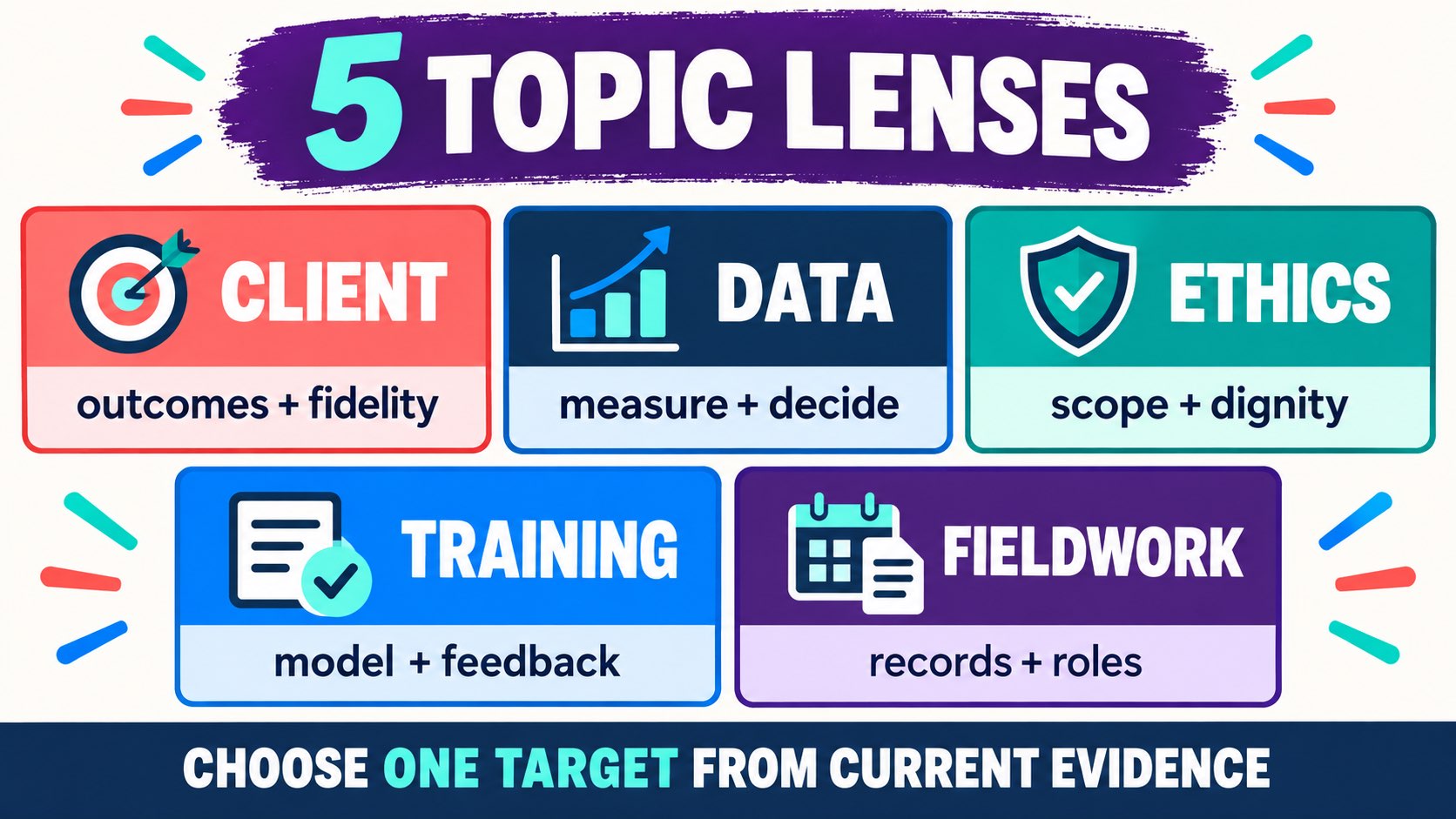
Use these five groups as a map. They are broad enough to cover a real supervision relationship but specific enough to help you select one target for the next meeting.
| Topic group | Examples | Evidence to review | Useful output |
|---|---|---|---|
| Client outcomes and service quality | Progress monitoring, treatment integrity, generalization, maintenance, communication, and barriers to benefit. | Graphs, fidelity checks, session notes, caregiver or team feedback, and decision history. | A defensible next clinical or training decision. |
| Measurement, assessment, and intervention | Operational definitions, measurement selection, functional assessment, skill acquisition, behavior reduction, and data interpretation. | Raw data, graphs, assessment results, written goals, procedures, and observed implementation. | A practiced analysis, corrected procedure, or measurable mastery target. |
| Ethics, scope, and professional judgment | Consent, confidentiality, cultural responsiveness, conflicts, competence, dual relationships, and referral or consultation decisions. | The relevant ethics code section, policy, communication record, and risk facts. | A documented decision boundary and escalation or consultation plan. |
| Training and performance feedback | Behavioral skills training, feedback delivery, modeling, prompting, performance assessment, and assistance-seeking. | A task analysis, role-play, direct observation, work sample, or performance checklist. | A demonstrated skill with a criterion and a plan for maintenance. |
| Fieldwork and documentation | Activity classification, supervision contacts, records, contracts, version control, and application preparation. | Current handbook, forms, supervision log, contract, and evidence system. | A corrected record and a clear next documentation deadline. |
These groups are a planning map, not five mandatory agenda items for every meeting. A short meeting might focus only on data interpretation and feedback. A monthly review may need to add documentation, ethics, and a fieldwork reconciliation check.
How should topics change by supervision role?
Role is the first filter. The BACB’s official supervision and training resource separates supervising future behavior analysts from supervising ongoing services. Use the applicable handbook and agreement to confirm the exact requirements.
- BCBA trainee: prioritize conceptual understanding, measurement and assessment, intervention design, data-based decisions, ethics, written and verbal communication, and independent professional judgment. Each topic should connect to the current task list and to an observable work sample or performance.
- BCaBA supervisee: prioritize implementation quality, data review, decision-making within scope, communication with the supervising BCBA, and the specific ongoing-supervision expectations that apply to the credential.
- RBT supervisee: prioritize competency-based performance, accurate implementation, measurement, client dignity, communication, and timely assistance-seeking. The topic should match the RBT role and the procedures the person is authorized and trained to implement.
- New BCBA or developing supervisor: prioritize scope, consultation, feedback, documentation, ethical decision-making, and how to create effective learning opportunities for another person.
Do not let a topic list erase the supervision relationship. A trainee may ask for “functional analysis” every week, but the supervisor still needs to decide whether the next useful target is interpreting an existing analysis, explaining design logic, practicing safety planning, or recognizing when consultation is necessary.
What should a BCBA supervision meeting agenda include?
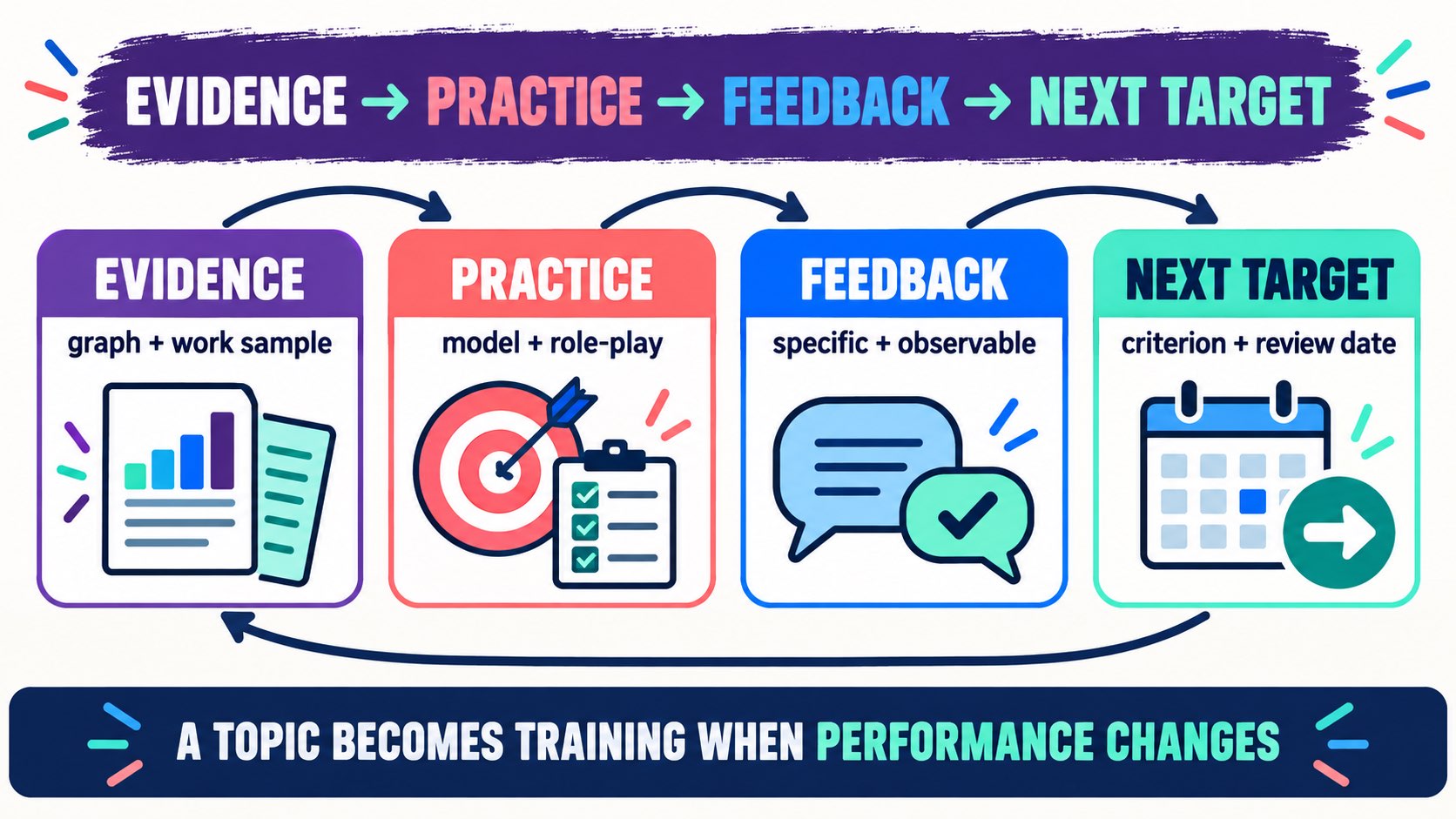
A useful agenda moves from evidence to action. It does not require a long lecture or a fixed number of topics.
- Open with the target: state the one or two skills or decisions the meeting will address and why they matter now.
- Review evidence: inspect a graph, work sample, role-play, observation, case note, or documentation record. Separate facts from assumptions.
- Teach or model: explain the decision rule, demonstrate the skill, and name the relevant ethical, clinical, or task-list boundary.
- Practice under conditions: ask the trainee or supervisee to analyze a new scenario, role-play a conversation, revise a procedure, or complete the next step.
- Give behavior-specific feedback: identify what was correct, what needs change, and what observable criterion will show improvement.
- Assign the next action: record the task, owner, evidence expected, deadline, and next review date.
For example, a meeting topic can be “choose a measurement system for a behavior that varies in duration and frequency.” The evidence might be a short case description and sample observations. The practice might require the trainee to defend a choice and identify a limitation. The output is not simply “discussed measurement”; it is a completed decision with feedback and a follow-up observation.
How do you choose the next topic?
When several topics compete for time, prioritize the one with the highest combination of client or service risk, learner impact, and evidence of a skill gap. A topic that is interesting but unrelated to the current performance problem can wait.
- Find the signal: look for an error pattern, stalled client progress, uncertain decision, missed documentation, or repeated assistance request.
- Define the behavior: describe what the learner must say, write, select, implement, or analyze. Avoid “understand ethics” as the objective.
- Choose the evidence: select a graph, written product, direct observation, role-play, or scenario that can show the current level.
- Set a criterion: define what acceptable performance looks like and when the skill will be checked again.
- Connect it forward: link the topic to the client outcome, supervision role, current task list, or next responsibility.
The topic should be narrow enough to finish a meaningful practice loop. “Ethics” is a curriculum area. “Respond to a request for confidential information by identifying the authorization issue, protecting the record, and naming the consultation step” is a workable supervision target.
What mistakes make supervision topics ineffective?
- Using a random list: a long catalogue does not show which skill matters next.
- Teaching without observing: a conversation about a skill does not demonstrate competent performance.
- Confusing roles: a topic suitable for a BCBA trainee may be outside the role, training, or scope of an RBT.
- Ignoring the case: abstract definitions are less useful when the learner has a current data or implementation problem to solve.
- Turning supervision into signatures: a form records a required event; it does not replace teaching, feedback, or evaluation.
- Overpromising fieldwork credit: a topic or assignment does not automatically count as qualifying fieldwork; classify it under the current requirements and supervisor review.
- Skipping follow-up: without a next criterion, the same topic returns as a discussion instead of a learning loop.
The official curriculum and handbook should control the requirements. This article provides planning language, not a substitute for supervisor judgment, current BACB instructions, an employment policy, or a state licensing rule.
What should you review after the meeting?
End with a short record that another qualified reviewer can understand:
- What topic and role were addressed?
- What evidence was reviewed?
- What was taught, modeled, practiced, or observed?
- What feedback did the learner receive?
- What decision, assignment, or behavior will be checked next?
- What documentation, privacy, ethics, or scope boundary needs follow-up?
For exam preparation, practice recognizing the same structure in a scenario: identify the learner’s role, the observable performance gap, the evidence, the appropriate teaching or feedback strategy, and the next measure. The free BCBA mock exam can help you practice supervision and personnel-management decisions. It is a study resource and does not reproduce official BACB questions.
BCBA supervision topics FAQ
What are the best BCBA supervision topics? Start with topics that improve client or service quality, data-based decisions, ethical and professional judgment, role-specific performance, and documentation. Choose one target from current evidence rather than trying to cover every domain in every meeting.
How many topics should be discussed in one supervision meeting? There is no universal number that makes a meeting effective. One well-practiced target with feedback may be more valuable than ten definitions. Use the available time, learner performance, role, and current requirements to set the scope.
Should BCBA supervision topics follow the task list? For a BCBA trainee, supervision objectives should be connected to the applicable task list and fieldwork expectations. The task list is a map, not a reason to ignore current client needs, ethical decisions, or demonstrated skill gaps.
Can a supervision topic count as unrestricted fieldwork? Not automatically. The activity must meet the current fieldwork requirements, be appropriate to the role and setting, and be documented and reviewed under the applicable supervision arrangement. Ask the responsible supervisor to classify it before counting it.
Take the Free BCBA Mock Exam
When you are ready to apply the idea, use the free practice resource below for additional feedback. Take the Free BCBA Mock Exam



