
What Are Independent and Dependent Variabl
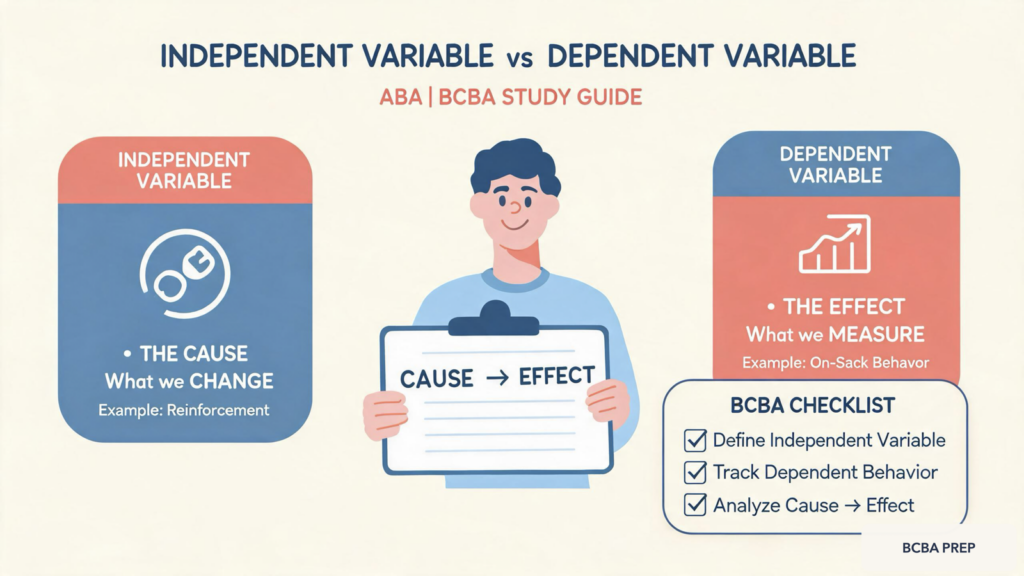
In Applied Behavior Analysis, every intervention revolves around two core concepts: the independent variable and dependent variable. Understanding the independent variable versus dependent variable is essential for designing experiments, interpreting data, and passing the BCBA exam. The independent variable (IV) is the intervention or condition you manipulate to change behavior. The dependent variable (DV) is the target behavior you measure to see if the intervention worked.
Table of Contents
- What Are Independent and Dependent Variabl
- How to Identify the Independent Variable vs Dependent Variable in ABA Scenarios
- Worked Examples: Independent and Dependent Variables in Action
- Exam Relevance and Common Traps for BCBA Candidates
- Quick Reference Checklist for Independent vs Dependent Variable
- Test Your Knowledge: Practice Prompts
- Final Summary
Independent Variable (IV) Definition and Role
The IV is what the practitioner controls. It could be a token system, a prompting strategy, or a schedule of reinforcement. In a functional analysis, the IV includes conditions like attention, demand, or alone. The key is that the IV is deliberately changed to observe its effect on behavior.
Dependent Variable (DV) Definition and Role
The DV is the behavior you track. It must be observable and measurable. Examples include frequency of aggression, duration of tantrums, or percentage of correct responses. Changes in the DV are attributed to the IV if the experiment is well-controlled.
How to Identify the Independent Variable vs Dependent Variable in ABA Scenarios
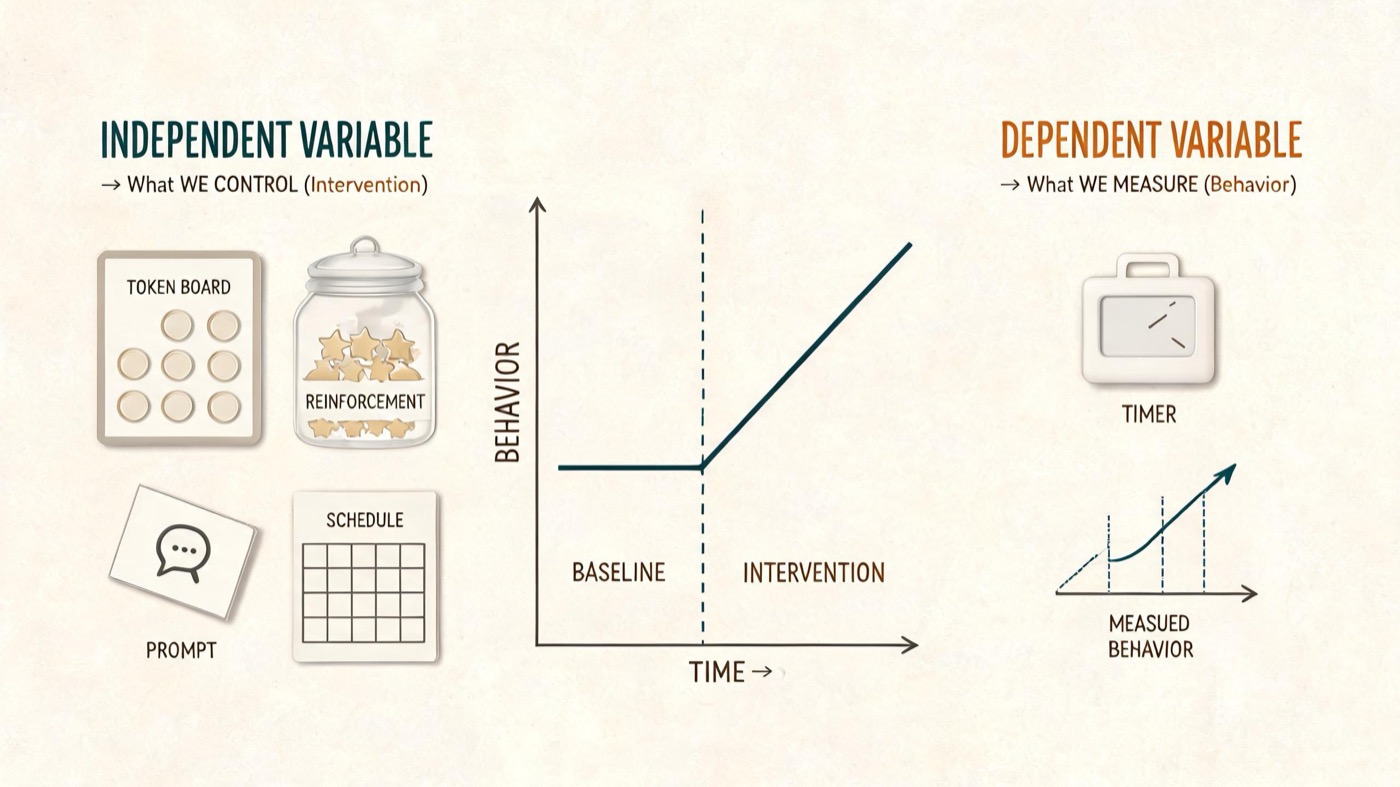
When reading a study description or a BCBA exam scenario, use two simple questions: “What is being manipulated?” and “What is being measured?” The manipulated element is the IV; the measured outcome is the DV. Here are practical steps:
- Manipulation: The IV is whatever the practitioner changes across phases (e.g., baseline vs. intervention). If a teacher provides a break after every third correct response, the break schedule is the IV.
- Measurement: The DV is the primary outcome (e.g., on-task behavior, self-injury). It is graphed on the y-axis.
- AB Design: In an A-B design, the change from A to B is the IV; the data collected is the DV.
- ABC Data: In functional behavior assessment, antecedents and consequences manipulated are IVs, while the behavior recorded is the DV.
For hypothesis testing, remember: the IV is the intervention, and the DV is the target behavior. This mapping is tested frequently on the exam.
Worked Examples: Independent and Dependent Variables in Action
Let’s apply the concepts to three realistic ABA examples. Each shows how to identify the IV and DV clearly.
Example 1: Differential Reinforcement of Alternative Behavior (DRA)
A child engages in aggression to access tangibles. The team implements DRA by reinforcing mands while withholding reinforcement for aggression. The IV is the DRA procedure (reinforcing mands, extinction for aggression). The DV includes the frequency of aggression and frequency of mands. The hypothesized function is access to tangibles.
Example 2: Token Economy for On-Task Behavior
A classroom uses a token system to increase on-task behavior. Students earn tokens for staying on task and exchange them for backup reinforcers. The IV is the token economy (number of tokens, exchange rate). The DV is the percentage of intervals on-task. The function here is positive reinforcement.
Example 3: Noncontingent Reinforcement (NCR) for Attention-Maintained Behavior
A student with attention-maintained disruptive behavior receives fixed-time attention every 2 minutes regardless of behavior. The IV is the fixed-time delivery of attention. The DV is the rate of disruptive behavior. The function is attention.
Exam Relevance and Common Traps for BCBA Candidates
BCBA exam questions often present complex scenarios where the IV and DV are not immediately obvious. Watch for these common traps:
- Trap 1: Confusing Extraneous Variables with the Independent Variable. Extraneous variables (e.g., time of day, setting events) are not planned IVs. The IV is only what you systematically change. For example, if a student’s medication changes during an intervention, that is an extraneous variable, not part of the IV.
- Trap 2: Mistaking the Measurement System as the Dependent Variable. The DV is the behavior itself, not how you measure it. For instance, “frequency of hitting” is the DV; “using a frequency count” is the measurement method.
- Trap 3: Forgetting Intervention Integrity. If the IV is implemented inconsistently, you cannot attribute changes in the DV to the intervention. The exam may ask you to identify whether poor integrity is a threat to internal validity.
Quick Reference Checklist for Independent vs Dependent Variable
Use this checklist when reviewing a scenario:
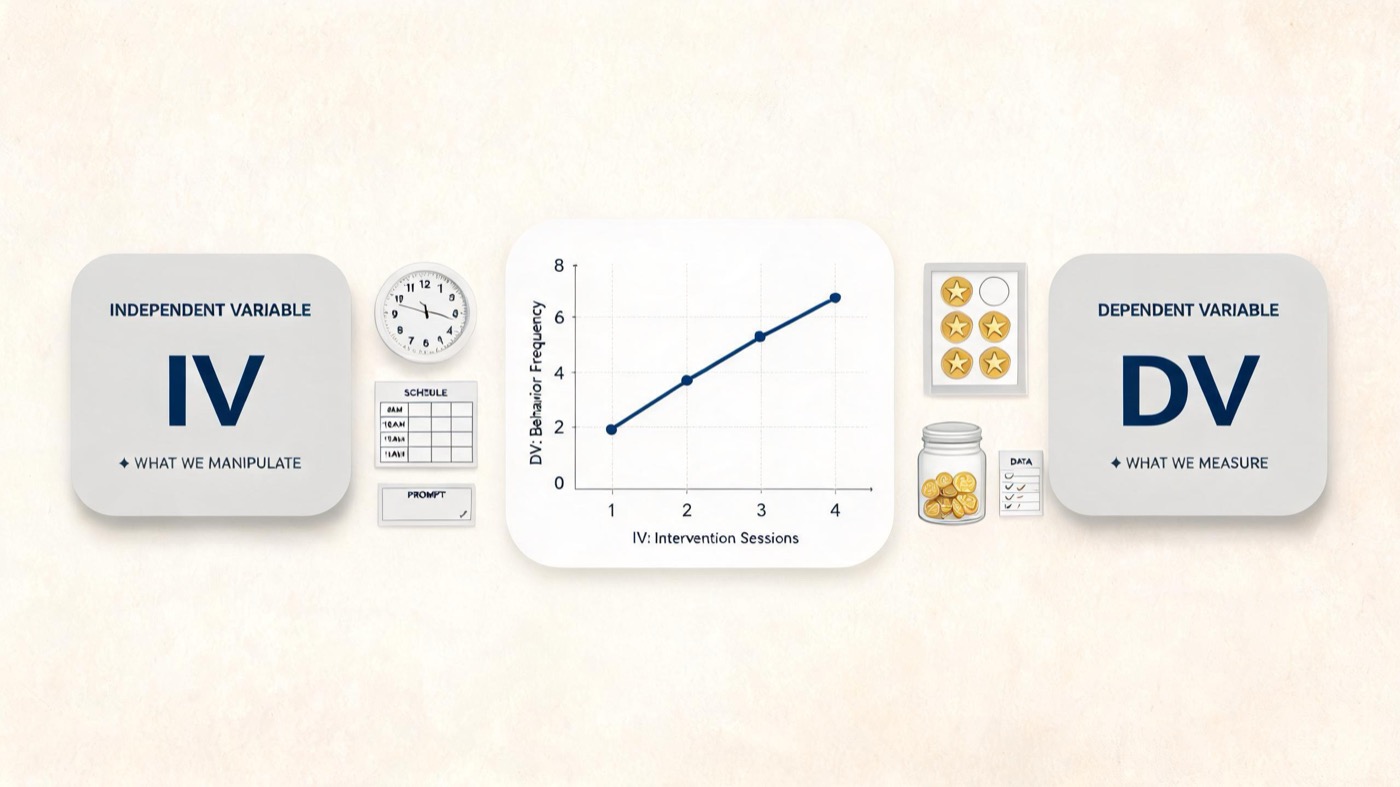
- Identify manipulation: Look for what the practitioner changes (e.g., prompts, reinforcement, environment). That is likely the IV.
- Identify measurement: Look for the behavior being tracked and graphed. That is the DV.
- Check for control: Ensure extraneous variables are controlled so the IV is the only thing changing.
- Verify operational definitions: Both IV and DV should be clearly defined and measurable.
Test Your Knowledge: Practice Prompts
Try these brief scenarios. Identify the IV and DV, then check your answers below.
Prompt 1: A behavior analyst uses a token system to increase compliance. Compliance percentage is recorded daily. IV: token system; DV: compliance percentage.
Prompt 2: During a functional analysis, the therapist provides attention after each occurrence of screaming in the attention condition. IV: attention condition; DV: screaming rate.
Prompt 3: A teacher implements a self-monitoring checklist to reduce off-task behavior. Off-task intervals are measured. IV: self-monitoring checklist; DV: off-task intervals.
For more practice, check out our detailed guide on independent and dependent variables and explore how variable dependency affects experimental control.
Final Summary
Mastering the independent variable versus dependent variable is fundamental for BCBA exam success. The IV is the intervention you manipulate; the DV is the behavior you measure. Use the two-question method (What is manipulated? vs. What is measured?) to quickly identify them in any scenario. Avoid common traps like confusing extraneous variables or mistaking the measurement system for the DV. With practice and the checklist above, you will be ready for exam questions. For authoritative context, see the BACB website for task list updates and ethical guidelines.
Complete BCBA Exam Prep
Turn this topic into exam-day practice
Practice concepts in context with five full-length 6th Edition mock exams, two bonus practice exams, a 6th Edition study guide, and key-term flashcards—all in one $120 USD package.
Get the $120 All-in-One Prep Pack
Review everything included on the product page before ordering. No pass guarantee is implied.



