
In applied behavior analysis, reliability refers to the consistency and dependability of measurement and implementation. When reliability in ABA is demonstrated through systematic procedures, practitioners can trust their data and confidently attribute behavior change to interventions rather than measurement error or inconsistent implementation.
Table of Contents
- Reliability in ABA: What Reliability Means in ABA Measurement
- How Reliability is Demonstrated: Worked Examples
- Exam Relevance, Common Traps, and Your Reliability Checklist
- Summary: Why Mastering Reliability Demonstration Matters
- References
This concept forms the foundation of scientific rigor in our field and is heavily emphasized on the BCBA exam. Without proper reliability demonstration, even well-designed interventions may produce misleading results.
Reliability in ABA: What Reliability Means in ABA Measurement
Reliability in ABA specifically addresses measurement consistency across observers and implementation consistency across sessions. It differs from validity, which concerns whether you’re measuring what you intend to measure.
Two primary methods demonstrate reliability: Interobserver Agreement for data collection and Procedural Fidelity for intervention implementation.
Interobserver Agreement: The Cornerstone of Data Reliability
Interobserver Agreement measures how consistently two or more observers record the same behavior under the same conditions. This ensures that data reflects actual behavior rather than observer bias or inconsistency.
Common IOA calculation methods include:
- Total Count IOA: (Smaller count ÷ Larger count) × 100
- Mean Count-Per-Interval IOA: Average agreement across intervals
- Exact Agreement IOA: Percentage of intervals with identical scores
- Trial-by-Trial IOA: Agreement on each discrete trial
Procedural Fidelity: Reliability of Implementation
Procedural fidelity (also called treatment integrity) assesses whether interventions are implemented as designed. Without this reliability check, you cannot determine whether behavior change resulted from the intervention or from inconsistent implementation.
High procedural fidelity ensures that the independent variable is actually being manipulated as intended, which is essential for establishing experimental control.
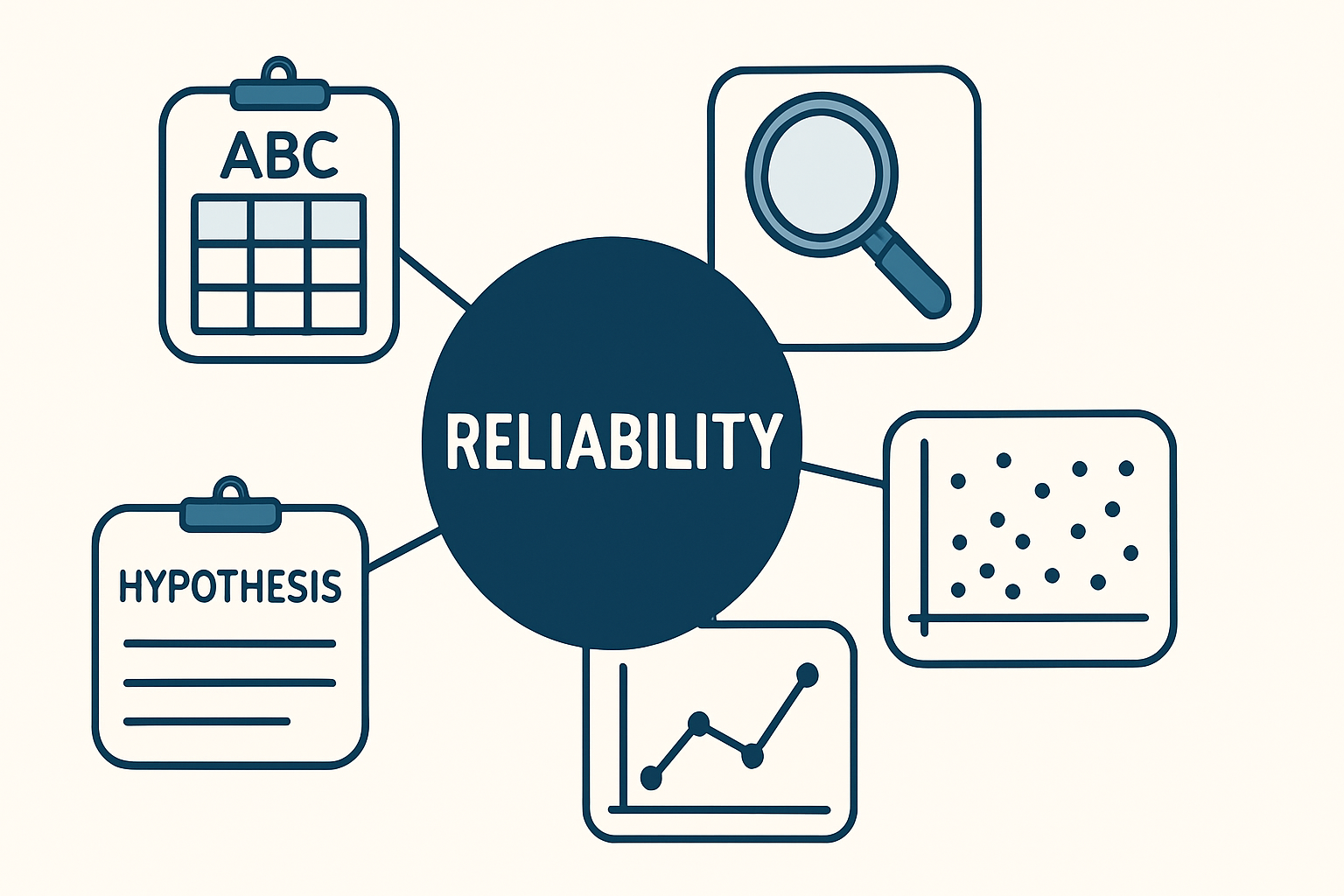
How Reliability is Demonstrated: Worked Examples
Let’s examine concrete examples of calculating reliability using common ABA scenarios. These practical applications will help you recognize how reliability is demonstrated in actual practice.
Example 1: Calculating Total Count IOA for Vocal Stereotypy
Two observers record instances of vocal stereotypy during a 30-minute session:
- Observer A: 42 occurrences
- Observer B: 38 occurrences
Using the Total Count IOA formula:
Smaller count (38) ÷ Larger count (42) = 0.905
0.905 × 100 = 90.5% agreement
This 90.5% IOA score demonstrates strong reliability between observers. The BACB generally recommends minimum IOA standards of 80-90% depending on behavior complexity.
Example 2: Assessing Procedural Fidelity for a DRA Procedure
Consider a Differential Reinforcement of Alternative Behavior intervention with these critical steps:
- 1. Present the discriminative stimulus clearly
- 2. Wait 5 seconds for independent response
- 3. Provide prompt if no response occurs
- 4. Reinforce appropriate alternative behavior immediately
- 5. Record data on both target and alternative behaviors
A fidelity checklist reveals the implementer completed steps 1, 2, 4, and 5 correctly but forgot step 3 (prompting).
Fidelity score: 4 correct steps ÷ 5 total steps = 80%
This 80% fidelity indicates generally reliable implementation but identifies a specific area needing improvement. Without this assessment, decreased effectiveness might be incorrectly attributed to the intervention rather than implementation error.
Exam Relevance, Common Traps, and Your Reliability Checklist
Reliability concepts appear frequently on the BCBA exam, often in scenario-based questions requiring application rather than simple recall. Understanding common pitfalls can significantly improve your exam performance.

Common BCBA Exam Traps on Reliability Questions
Several recurring patterns trip up candidates:
- Confusing reliability with validity: Reliability concerns consistency; validity concerns accuracy of measurement
- Assuming IOA is a one-time check: Reliability must be assessed continuously (minimum 20% of sessions)
- Selecting inappropriate IOA formulas: Different measurement systems require different calculation methods
- Overlooking procedural fidelity as a reliability measure: Both data collection AND implementation require reliability checks
- Misinterpreting acceptable standards: 90% IOA is ideal, but 80% may be acceptable for complex behaviors
Quick Checklist: Demonstrating Reliability in Practice
Use this actionable checklist to ensure you’re properly demonstrating reliability:
- Collect IOA data for minimum 20% of sessions across all conditions
- Aim for ≥90% IOA (80% acceptable for complex behaviors or new observers)
- Use standardized fidelity checklists for all critical procedures
- Re-calibrate observers immediately when IOA drops below standards
- Report reliability data alongside primary data in graphs and reports
- Train staff using Behavior Skills Training to ensure consistent implementation
- Regularly review and update operational definitions to maintain clarity
Summary: Why Mastering Reliability Demonstration Matters
Demonstrating reliability is non-negotiable for ethical, scientifically valid ABA practice. It ensures that data accurately reflects behavior change and that interventions are implemented consistently.
On the BCBA exam, these concepts test your understanding of measurement systems and experimental design. More importantly, in practice, proper reliability demonstration protects clients by ensuring interventions are evaluated based on accurate data.
Remember that reliability forms one pillar of the 7 dimensions of ABA. When combined with other dimensions like technological and conceptually systematic approaches, reliability ensures our science produces meaningful, replicable outcomes that genuinely benefit clients.
For further study on related measurement concepts, explore our guide on data collection methods in ABA.
References
Complete BCBA Exam Prep
Turn this topic into exam-day practice
Practice concepts in context with five full-length 6th Edition mock exams, two bonus practice exams, a 6th Edition study guide, and key-term flashcards—all in one $120 USD package.
Get the $120 All-in-One Prep Pack
Review everything included on the product page before ordering. No pass guarantee is implied.



