

What Is Validity in Behavioral Measurement?
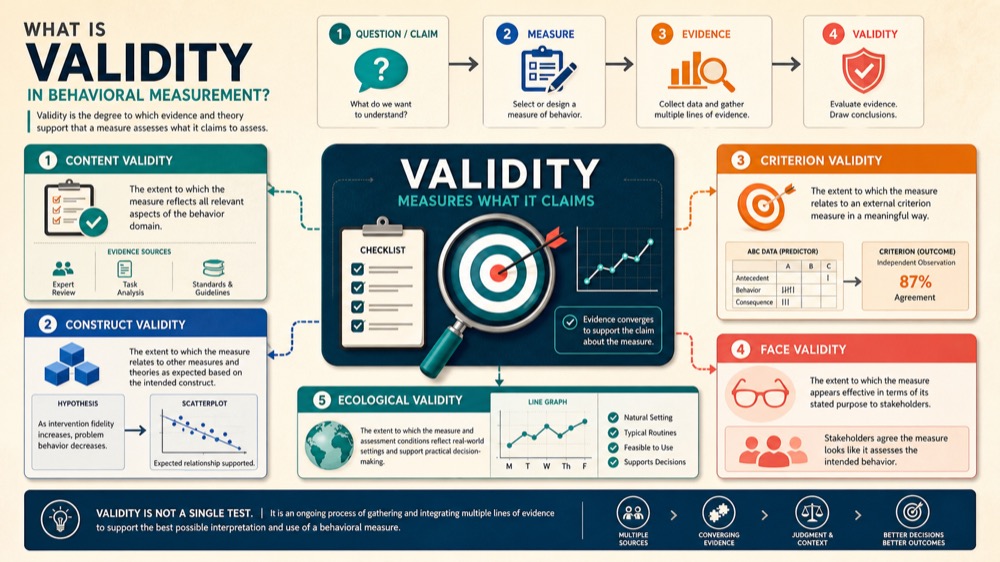
Validity is a fundamental concept in applied behavior analysis (ABA) that refers to the degree to which a measurement tool or experimental design measures what it claims to measure. In the context of the BCBA exam, understanding validity and types of validity is essential for interpreting data, evaluating interventions, and making ethical decisions. Without validity, the data you collect may lead to incorrect conclusions and ineffective treatment plans.
Table of Contents
- What Is Validity in Behavioral Measurement?
- Internal Validity: Did the Intervention Cause the Change?
- External Validity: Can Results Be Generalized?
- Content and Face Validity: What’s Being Measured?
- Social Validity: Is the Intervention Acceptable?
- Criterion Validity: How Does It Compare?
- Avoiding Common Exam Traps: Validity vs. Reliability and More
- Quick Checklist for BCBA Candidates
- Summary: Validity and Types of Validity for Your Exam
For BCBAs, validity ensures that assessment results accurately reflect the target behavior and that intervention effects are real, not artifacts of extraneous variables. The BACB task list emphasizes validity under measurement and experimental design. On the exam, expect questions that ask you to identify threats to validity or choose the most appropriate type of validity for a given scenario. Mastering this topic will boost your confidence in both test questions and real-world practice.
Why Validity Matters for BCBAs: Valid measurement directly impacts client outcomes. If you use a preference assessment that lacks validity, you may incorrectly identify reinforcers, leading to weak intervention effects. Similarly, an experiment with poor internal validity cannot demonstrate that the intervention caused behavior change, which undermines the scientific basis of ABA. Ethical practice requires that interventions are evidence-based, and evidence depends on valid methods. On the exam, you will be asked to evaluate research scenarios and identify validity concerns, so it is critical to distinguish between the different types and their applications.
Internal Validity: Did the Intervention Cause the Change?
Internal validity refers to the extent to which an experimental design allows you to conclude that the independent variable (the intervention) caused changes in the dependent variable (the target behavior). In single-subject designs common in ABA, internal validity is paramount. Without it, you cannot claim that your treatment was effective.
Threats to internal validity include history events (e.g., a new medication started during the study), maturation (natural developmental changes), testing effects (repeated measurement altering behavior), instrumentation changes (observer drift), and regression to the mean. For example, if you implement a differential reinforcement of alternative behavior (DRA) intervention using a reversal design (ABAB), a sudden improvement might be due to a concurrent change in the child’s sleep schedule rather than the DRA. The reversal phase helps rule this out by demonstrating that behavior returns to baseline levels when the intervention is removed.
Threats to Internal Validity in Single-Subject Designs: Classic threats include:
- History: External events that coincide with the intervention (e.g., parent started a new routine).
- Maturation: Physical or psychological changes over time (e.g., a child becomes more tolerant of demands).
- Testing: Repeated exposure to measurement changes behavior (e.g., practice effects on a fluency measure).
- Instrumentation: Changes in how data are collected (e.g., observer becomes more lenient).
- Attrition: Participants dropping out, which may bias results.
For the exam, be prepared to identify these threats in vignettes. A common trap is confusing history with maturation; remember that history involves specific events, while maturation is a gradual process.
ABA Example: Functional Analysis and Internal Validity: A functional analysis (FA) is designed to maximize internal validity by systematically manipulating antecedents and consequences while controlling for extraneous variables. For instance, in a standard FA, you test each condition (e.g., attention, escape, alone) in a controlled environment like a therapy room. By replicating conditions across sessions, you can confidently conclude that the behavior is maintained by a specific function. ABC data collection in natural settings has lower internal validity because you cannot control for all confounds, but it provides ecologically valid information. On the exam, an FA scenario will test your ability to recognize high internal validity versus descriptive assessments.
External Validity: Can Results Be Generalized?
External validity is the extent to which findings from a study can be generalized across individuals, settings, behaviors, or time. Even if a treatment works in a clinic, it may not work at school or home. For BCBAs, generalization is a key goal of intervention. External validity is often sacrificed for internal validity in tightly controlled experiments, but both are important for real-world impact.
Factors That Enhance External Validity: Key factors include:
- Replication: Direct, systematic, and clinical replications across different participants and settings increase generalizability.
- Multiple baseline designs: These demonstrate that the intervention works across different behaviors, subjects, or settings, which strengthens external validity.
- Participant characteristics: Including diverse participants (age, diagnosis, culture) improves the ability to generalize findings.
- Naturalistic settings: Conducting research in real-world environments (e.g., classrooms, homes) enhances external validity.
ABA Example: Social Skills Training Across Settings: Imagine you teach a child with autism to initiate conversations using a social skills training program in a clinic. If the skill does not generalize to the school playground or home dinner table, the intervention lacks external validity. To improve it, you might program common stimuli (e.g., training with peers from school), teach multiple exemplars (e.g., different conversation topics), and train in natural settings. On the exam, a question might ask you to recommend a strategy to increase external validity, such as using a multiple baseline across settings design.
Content and Face Validity: What’s Being Measured?
Content validity refers to how well a measurement tool covers all aspects of the construct it intends to measure. Face validity is the superficial appearance that a test measures what it claims. While content validity is essential for accurate assessment, face validity is more about social acceptance but can influence stakeholder buy-in.
Ensuring Content Validity in Skill Assessments: For example, the VB-MAPP (Verbal Behavior Milestones Assessment and Placement Program) has strong content validity because it includes items across all verbal operants (mand, tact, echoic, intraverbal, etc.) and developmental levels. If an assessment omitted tacts, it would have poor content validity for language skills. As a BCBA, you should review assessment items to ensure they represent the full range of relevant skills. On the exam, you may be asked to evaluate whether a measurement tool has adequate content validity.
The Role of Face Validity in Stakeholder Acceptance: Face validity matters for parents and teachers who may judge an assessment by its appearance. A behavior rating scale that looks like it measures aggression (e.g., items about hitting, yelling) will have high face validity for that construct. However, face validity can be misleading; a test can look valid but still fail to measure the target behavior accurately. On the exam, remember that face validity is not a technical form of validity and does not replace content, criterion, or construct validity. It simply helps with social acceptability.
Social Validity: Is the Intervention Acceptable?
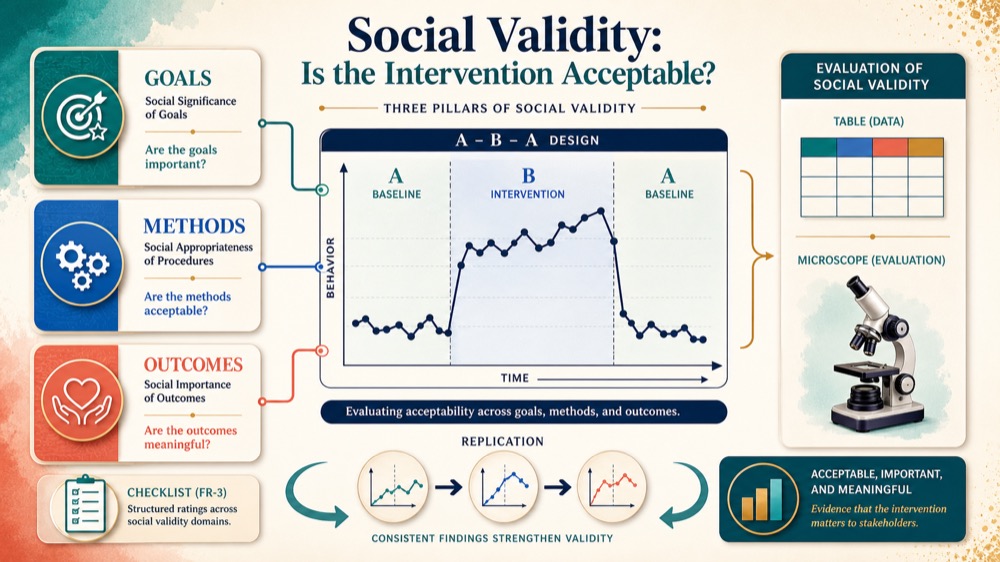
Social validity is a unique concept in ABA that evaluates the social significance of goals, the social appropriateness of procedures, and the social importance of outcomes. It answers: Are the goals important? Are the methods acceptable to clients and families? Are the results meaningful?
Measuring Social Validity in Practice: You can measure social validity through surveys, interviews, and Likert scales. For example, after implementing a behavior intervention to reduce self-injurious behavior, you might ask parents to rate their satisfaction with the procedures (e.g., ease of implementation) and outcomes (e.g., reduction in injury). A high social validity rating indicates that the intervention is likely to be maintained in the natural environment. On the exam, expect questions about how to assess social validity and why it matters for ethical practice. The BACB ethics code requires that clients have input into the goals and procedures.
Criterion Validity: How Does It Compare?
Criterion validity assesses how well one measure predicts or correlates with an outcome (criterion) measured at the same time (concurrent validity) or in the future (predictive validity). It is often used when validating new assessment tools against established standards.
Concurrent Validity Example: Comparing Two Functional Assessment Methods: Suppose you develop a brief indirect functional assessment (e.g., a questionnaire) and want to know if it yields the same function as a full experimental FA. You administer both to the same client and compare the results. If they agree on the function (e.g., escape-maintained), the indirect assessment has strong concurrent validity. On the exam, you might need to identify that a new assessment tool should be correlated with a gold standard to establish concurrent validity.
Predictive Validity Example: Screening for Academic Readiness: An example of predictive validity is using the Assessment of Basic Language and Learning Skills (ABLLS-R) scores at age 4 to predict academic performance at age 7. If the ABLLS-R accurately predicts future success, it has high predictive validity. For the exam, remember that predictive validity involves a time lag between the measure and the criterion, while concurrent validity involves simultaneous measurement.
Avoiding Common Exam Traps: Validity vs. Reliability and More
The BCBA exam often tests your ability to distinguish between validity and reliability, and to recognize threats that seem similar but require different answers.
Trap: Confusing Validity with Reliability: A classic trap is equating reliability with validity. Reliability means consistency (e.g., test-retest, interobserver agreement), while validity means accuracy. A measure can be reliable but not valid, like a scale that consistently reads 5 pounds too heavy. On the exam, if a question describes a measurement that yields stable but incorrect data, the answer is a validity problem, not a reliability issue. To avoid this trap, always ask: Does the measure capture the true behavior?
Trap: Overlooking Threats in Experimental Designs: Another common mistake is failing to identify threats like maturation or history in a multiple baseline design. For example, if a student improves across all baselines simultaneously, the change might be due to an external event (history) rather than the intervention. On the exam, carefully read vignettes for cues like ‘all participants improved at the same time’ (history) or ‘the participant grew older’ (maturation). Practice with mock questions to sharpen your detection.
Quick Checklist for BCBA Candidates
- Internal validity: Can I say the intervention caused the change? Check for confounds like history, maturation, and testing effects.
- External validity: Will the results generalize? Look for replication across participants, settings, and behaviors.
- Content validity: Does the assessment cover all relevant aspects? Review item coverage for the target construct.
- Social validity: Are the goals, procedures, and outcomes acceptable to stakeholders? Use surveys or interviews.
- Criterion validity: Does the measure correlate with a gold standard or predict future outcomes? Distinguish concurrent vs. predictive.
- Face validity: Does it appear to measure what it should? Remember: not a technical validity type.
Summary: Validity and Types of Validity for Your Exam
Validity is a cornerstone of ABA science and practice. Each type of validity serves a different purpose: internal validity ensures causal claims, external validity supports generalization, content validity guarantees comprehensive measurement, social validity ensures real-world relevance, and criterion validity benchmarks against standards. On the BCBA exam, you will encounter scenarios that require you to identify threats, select appropriate designs, or evaluate measurement tools. By mastering these concepts and practicing with mock questions, you will build the analytical skills needed to pass and, more importantly, to serve your clients effectively. Use our free BCBA mock exam practice questions to test your knowledge. For deeper study, review resources from the BACB and peer-reviewed journals like the Journal of Applied Behavior Analysis.
Next step for BCBA exam prep
Turn this topic into exam-day practice
Use this topic as a focused review, then test it in exam-style conditions with a free mock before deciding whether five full-length mocks are the right next step.
Start the Free BCBA Mock ExamContinue with Five Full-Length Mocks — $99
Review the included materials and access details before ordering. No pass guarantee is implied.



