

MSWO preference assessment: What is MSWO in Applied Behavior Analysis?
The Multiple Stimulus Without Replacement (MSWO) assessment is a systematic method for identifying a hierarchy of preferred items or activities. This preference assessment efficiently ranks potential reinforcers by presenting multiple stimuli simultaneously and removing selected items from subsequent trials.
Table of Contents
- MSWO preference assessment: What is MSWO in Applied Behavior Analysis?
- Conducting an MSWO Assessment: A Step-by-Step Guide
- MSWO in Practice: Worked Examples and Hypothesized Functions
- MSWO on the BCBA Exam: Relevance and Common Traps
- MSWO Quick-Reference Checklist and Summary
Unlike its counterpart MSW (with replacement), MSWO provides clearer preference hierarchies by preventing immediate reselection of the same item. This approach is particularly valuable when you need to identify multiple potential reinforcers for varied programming needs.
MSWO Definition and Core Purpose
MSWO stands for Multiple Stimulus Without Replacement, a formal assessment procedure within the broader category of stimulus preference assessments. The core purpose is to efficiently establish a ranked preference hierarchy among several items. This differs from paired stimulus assessments, which compare items in pairs, and free operant assessments, which measure duration of engagement.
The primary advantage of MSWO is its efficiency in identifying multiple potential reinforcers in a single session. This makes it particularly useful when working with clients who can scan arrays and make selections from multiple options.
When to Choose MSWO Over Other Assessments
Selecting the appropriate preference assessment depends on several clinical considerations. MSWO is ideal when you need to test 5-7 items efficiently and establish a clear preference hierarchy. This aligns with BACB Task List item F-8, which requires identification of appropriate preference assessment methods.
- Client skill level: The client must be able to scan an array and make selections
- Number of items: Typically 5-7 items to test simultaneously
- Need for hierarchy: When ranked preferences are clinically valuable
- Time efficiency: Faster than paired stimulus for multiple items
Conducting an MSWO Assessment: A Step-by-Step Guide
Proper implementation of MSWO requires careful preparation and systematic execution. Following a standardized procedure ensures reliable results that can inform treatment planning and reinforcer selection.
Preparation and Stimulus Selection
Begin by selecting 5-7 items that have been pre-screened for safety and appropriateness. Include a mix of known preferred items and potentially neutral items to ensure valid assessment. Always obtain client assent and consider ethical presentation factors.
- Select items based on caregiver report or previous assessments
- Include at least one neutral item to validate preference patterns
- Ensure items are clean, safe, and age-appropriate
- Set up a distraction-free environment with consistent lighting
- Position items in a semi-circle or straight line with equal spacing
The MSWO Procedure and Data Collection
The assessment begins with a clear instruction, such as “Pick one.” After the client makes a selection, immediately remove the chosen item from the array for the remainder of the session. Reposition the remaining items to maintain equal spacing and prevent positional biases.
- Record the selected item and the order of selection
- Note selection latency if clinically relevant
- Continue trials until all items are selected or 5+ trials complete
- Maintain consistent presentation and removal procedures
- Calculate preference hierarchy based on selection order and frequency
MSWO in Practice: Worked Examples and Hypothesized Functions
Understanding MSWO application through concrete scenarios helps bridge theory to practice. These examples demonstrate how selection patterns can inform hypotheses about behavioral function and guide intervention planning.
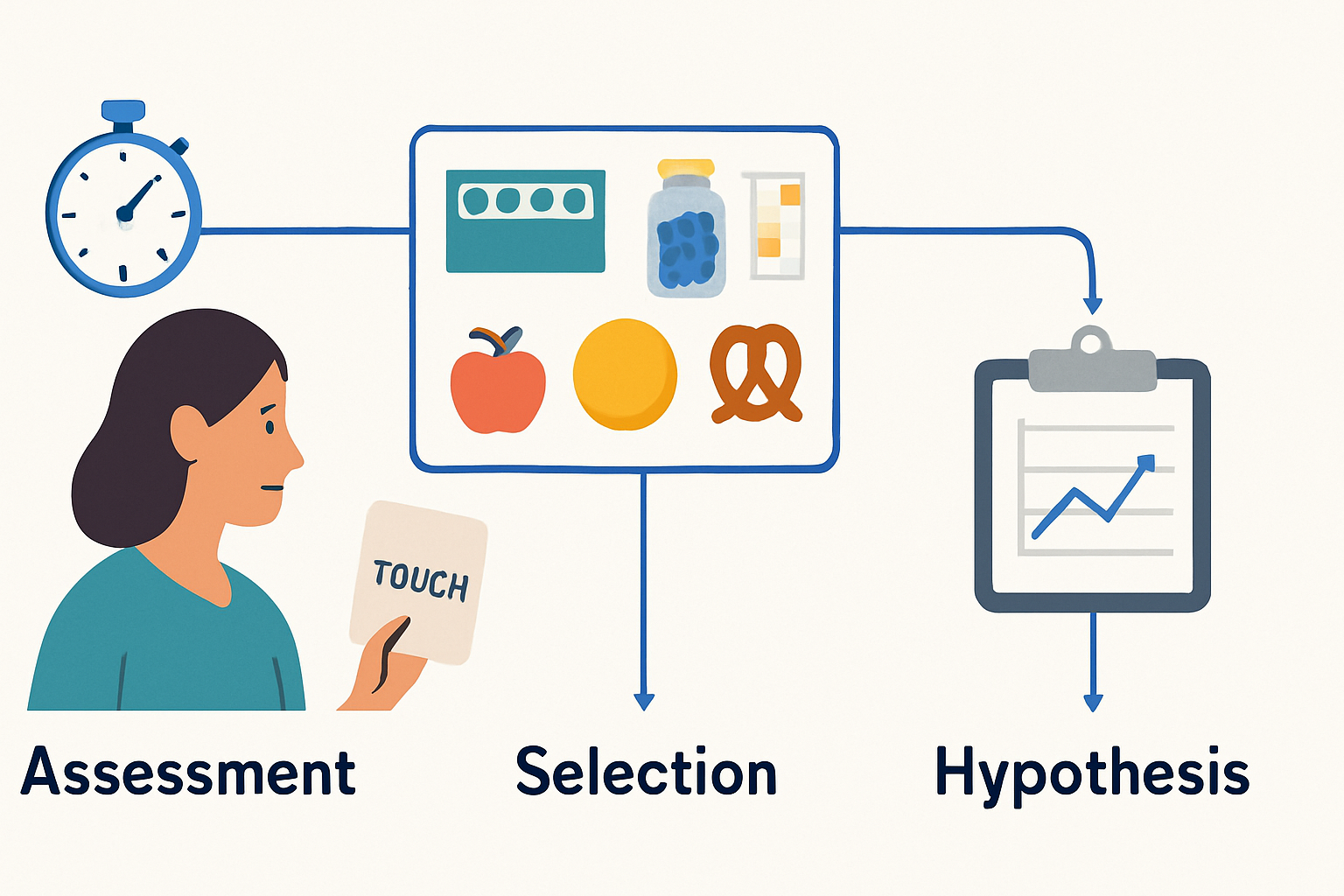
Example 1: Identifying Edible Reinforcers for a Learning Task
In this scenario, a practitioner presents an array of 6 food items before a matching task. The antecedent includes the verbal instruction “Pick one snack” with the array visible. The client consistently selects gummy bears first across multiple sessions.
The behavior of selecting gummy bears results in their removal from future trials in that session. This pattern suggests gummy bears may serve as positive reinforcement for learning tasks. The resulting hierarchy informs which edibles to use during discrete trial training sessions.
Example 2: Assessing Preferred Sensory Items for Break Time
A therapist offers an array of 5 sensory toys after work completion. The antecedent is the presentation of stress balls, fidget spinners, textured fabrics, vibrating toys, and weighted lap pads. The client consistently selects the weighted lap pad first across assessment trials.
The consequence involves removing the lap pad after selection. This consistent preference pattern suggests the item may provide automatic reinforcement through sensory input. The assessment results guide break time activities and sensory diet planning.
MSWO on the BCBA Exam: Relevance and Common Traps
MSWO questions frequently appear on the BCBA exam, testing both procedural knowledge and clinical decision-making. Understanding common pitfalls can help you avoid costly errors on test day.
Key Exam Topics and Task List Alignment
The BACB Task List explicitly addresses preference assessments in Section F (Behavior Assessment). MSWO specifically relates to items requiring identification of appropriate assessment methods and interpretation of results. Questions may ask about procedural steps, data interpretation, or when to choose MSWO versus other assessment types.
For comprehensive exam preparation, review our guide on preference assessments which covers all major assessment types and their clinical applications.
Frequently Missed Questions and How to Avoid Them
Several common traps can trip up even well-prepared candidates. Being aware of these pitfalls improves your exam performance and clinical practice.
- Confusing MSWO with MSW: Remember “without replacement” means items are removed after selection
- Misinterpreting data: Selection frequency indicates preference, not necessarily reinforcement efficacy
- Overlooking ethical considerations: Always obtain assent and consider client dignity
- Forgetting verification: Preference doesn’t guarantee reinforcement – always verify through reinforcer assessment
- Ignoring variety: Rotate items regularly to prevent satiation and maintain effectiveness
MSWO Quick-Reference Checklist and Summary
This concise reference consolidates the most critical information for clinical implementation and exam preparation. Keep these key points in mind for efficient MSWO administration.
Your MSWO Implementation Checklist
-
- Select 5-7 pre-screened items including known and neutral options
>Obtain client assent and ensure comfortable positioning
- Present array evenly with consistent item spacing
- Record selected item and selection order immediately
- Remove chosen item for remainder of assessment session
- Reposition remaining items to eliminate positional bias
- Continue trials until all items selected or minimum trials completed
- Calculate preference hierarchy based on selection patterns
Core Takeaways for Clinical Practice and Exam
MSWO efficiently establishes ranked preferences among multiple items through systematic removal of selected stimuli. This assessment is particularly valuable when you need to identify multiple potential reinforcers quickly. Remember that identified preferences require verification through reinforcer assessment before clinical application.
For additional study resources, explore our comprehensive BCBA exam preparation guide and the official BACB Ethics Code for guidance on ethical assessment practices.
Key distinctions to remember: MSWO removes items after selection (without replacement), while MSW returns them to the array (with replacement). Paired stimulus assessments compare items in pairs, and free operant assessments measure engagement duration rather than selection.
Complete BCBA Exam Prep
Turn this topic into exam-day practice
Practice concepts in context with five full-length 6th Edition mock exams, two bonus practice exams, a 6th Edition study guide, and key-term flashcards—all in one $120 USD package.
Get the $120 All-in-One Prep Pack
Review everything included on the product page before ordering. No pass guarantee is implied.



