

A generalized conditioned reinforcer in ABA is a learned reinforcer paired with multiple other reinforcers. Tokens, points, money, or broad social approval may qualify only if contingent delivery increases future behavior.
A token is not automatically a reinforcer. Identify the response that produces it, the exchange system, and later behavior change. Value can weaken when backup choices, rules, delivery, or pairing are poor.
What Is a Generalized Conditioned Reinforcer in ABA?
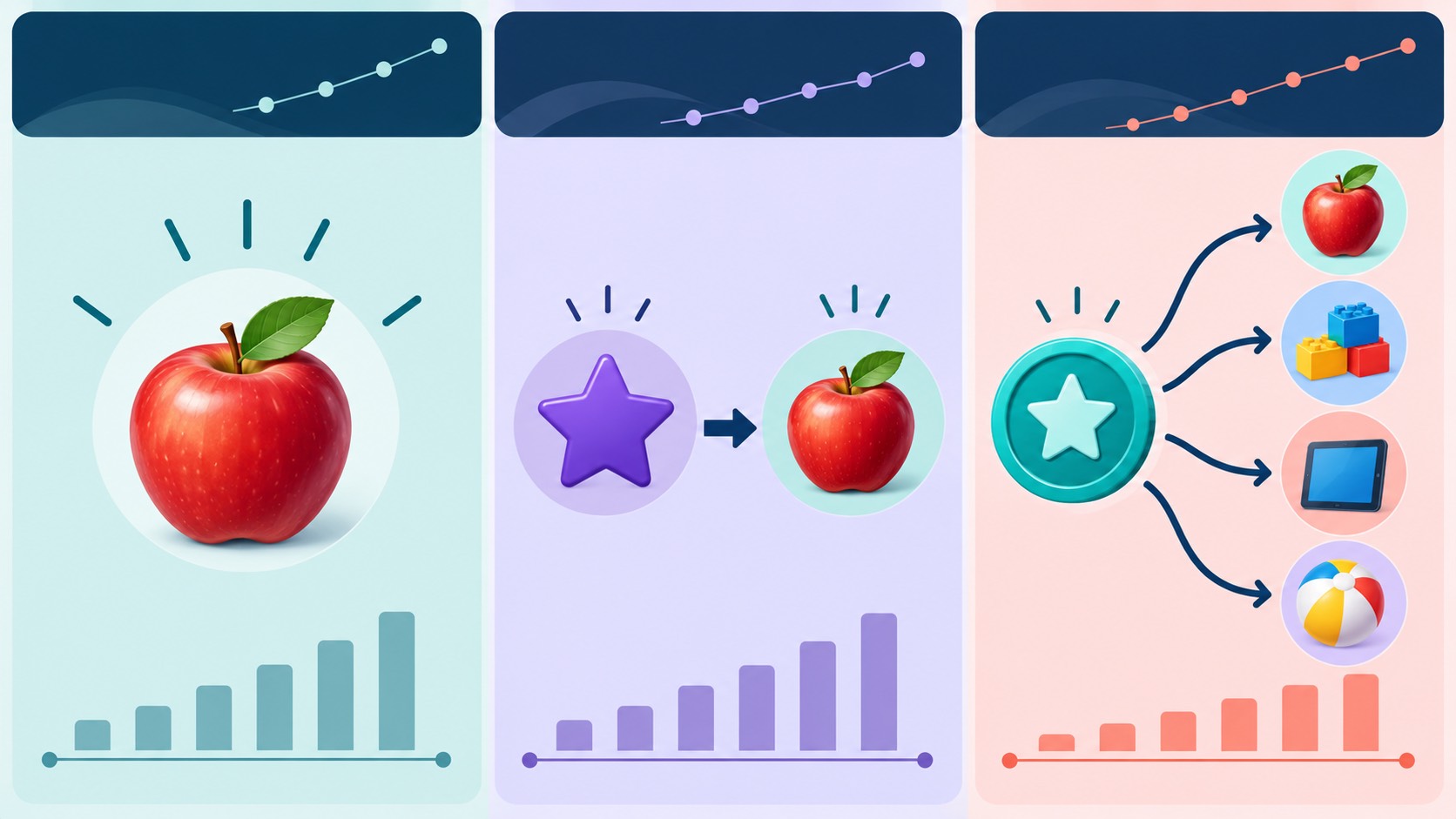
A generalized conditioned reinforcer acquired value through pairing with multiple reinforcers. “Conditioned” means learning history; “generalized” means effectiveness is not tied to one backup.
Function still depends on behavior change. If a point does not increase future responding, it has not demonstrated reinforcement in that arrangement.
| Part of the term | Meaning | Example |
|---|---|---|
| Reinforcer | A consequence whose delivery increases future responding under similar conditions. | More independent requests occur after a point is delivered. |
| Conditioned | The stimulus acquired its function through learning rather than being effective without that history. | A token becomes valuable after repeated exchange for preferred outcomes. |
| Generalized | The stimulus was paired with multiple reinforcers rather than only one. | Points can be exchanged for music, games, snacks, or social activities. |
| Contingent delivery | The reinforcer follows a defined response according to a program. | A token is delivered after completing the specified step. |
| Behavioral effect | Future responding changes in the direction predicted by reinforcement. | Independent task completion increases across later opportunities. |
The BACB BCBA Test Content Outline, 6th edition covers unconditioned, conditioned, and generalized reinforcers in B.7 and establishing conditioned reinforcers in G.4. Classify by history and behavioral effect, not appearance.
How Generalized Conditioned Reinforcement Works
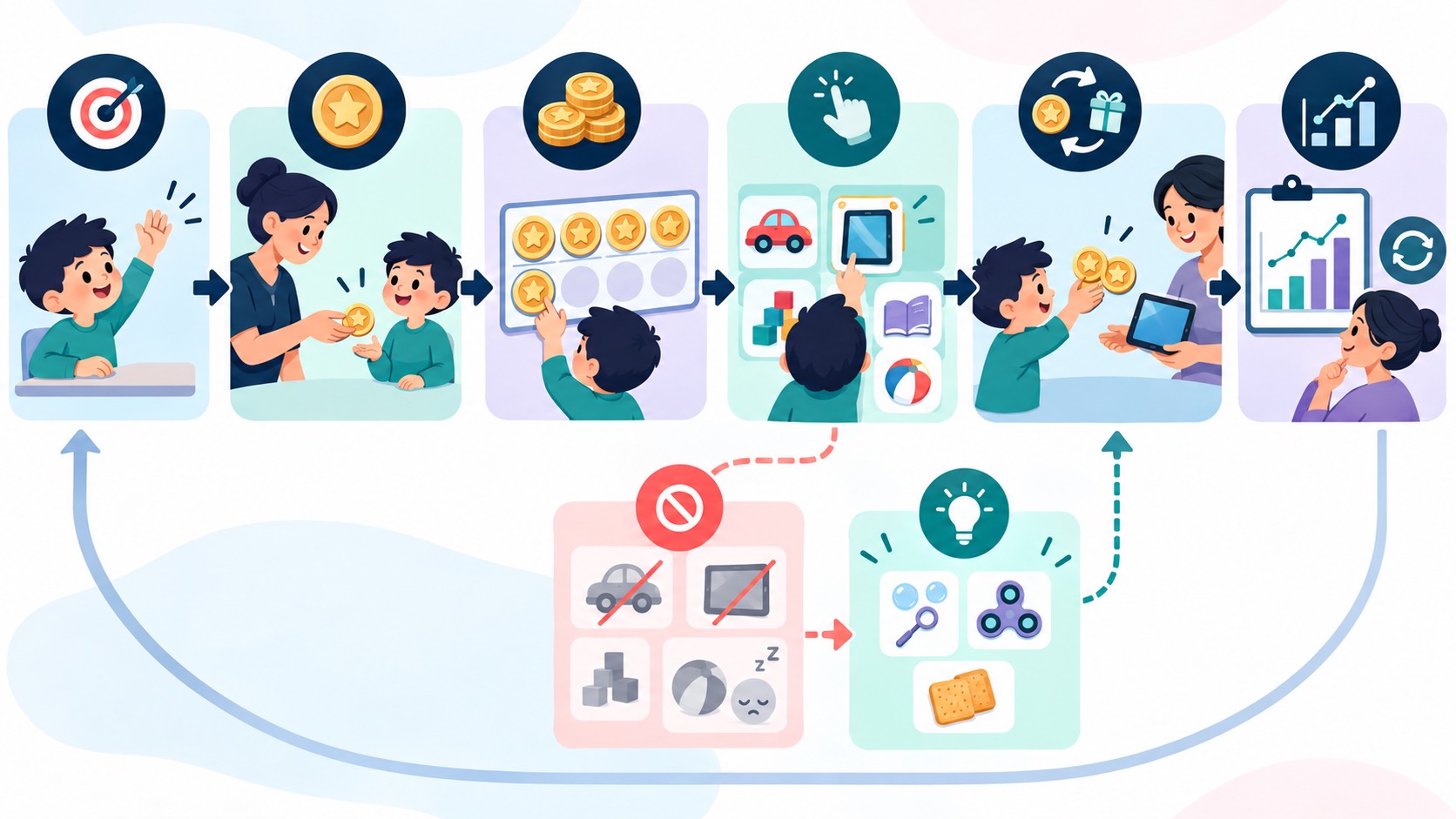
The sequence is response → immediate token or point → accumulation or exchange → backup reinforcer → future responding. Pairing with varied outcomes can also give the token social value; verify praise rather than assuming it works.
Multiple backups can make a token more resilient when one outcome loses value. Availability, choice, delay, effort, and current motivation still matter.
| Sequence component | What the analyst arranges | What to measure |
|---|---|---|
| Target response | Define the behavior that can contact the token or point. | Independent occurrence, quality, and prompt level. |
| Immediate token delivery | Deliver the token promptly after the response. | Latency and procedural integrity. |
| Accumulation | Make the token visible or otherwise trackable. | Tokens earned, lost, saved, and exchanged. |
| Backup choice | Offer multiple meaningful outcomes at a defined exchange cost. | Selections and actual engagement with backups. |
| Behavioral effect | Review whether target responding changes over time. | Rate, percentage, duration, or other fit-for-purpose measurement. |
A token may reinforce immediately through conditioned value and later mediate access to a backup. Check whether long exchange delays weaken its effect.
Generalized Versus Unconditioned and Simple Conditioned Reinforcers
Unconditioned reinforcers can work without a specific pairing history; conditioned reinforcers acquire value through pairing; generalized conditioned reinforcers are paired with multiple outcomes. These are functional histories, not appearances.
A simple conditioned reinforcer can be useful but depends on one pairing. A generalized label requires multiple effective outcomes plus a current behavior-increasing effect.
| Type | Learning history | ABA example |
|---|---|---|
| Unconditioned reinforcer | Effective without a specific pairing history, though value varies by context. | Access to water when thirst is relevant. |
| Conditioned reinforcer | Paired with or exchanged for another reinforcer. | A sound paired with a preferred video. |
| Generalized conditioned reinforcer | Paired with or exchangeable for multiple reinforcers. | Money, points, or tokens exchangeable for varied outcomes. |
| Potential reinforcer | Appears desirable but has not yet demonstrated a behavior-increasing effect. | A sticker offered without data showing increased responding. |
| Punisher | A consequence that decreases future behavior; it is not defined by being unpleasant. | A separate consequence that reliably reduces a response. |
Use the site’s conditioned-versus-unconditioned reinforcer guide and unconditioned reinforcer guide for B.7. Classify by history and behavioral effect.
Tokens, Points, Money, and Social Reinforcement
Tokens, points, money, and broad social approval may be generalized when paired with varied outcomes and shown to increase behavior. Do not assume praise works for every learner.
A point, checkmark, sticker, or chip is only a potential reinforcer. Its function depends on establishment and consequences; a token board may also provide prompts or visual feedback.
| Stimulus form | Why it may be generalized | Verification question |
|---|---|---|
| Token | Exchangeable for several preferred outcomes. | Does earning the token increase the target response before exchange? |
| Points | Can represent progress toward a menu of activities or privileges. | Are points consistently delivered and exchangeable as described? |
| Money | Can purchase many outcomes across settings. | Does the learner’s behavior change when payment is contingent? |
| Social praise | May be paired with varied social and activity outcomes. | Does specific praise increase the target response for this learner? |
| Digital badge | May connect to multiple privileges, access, or social outcomes. | Is the badge meaningful, accessible, and exchangeable rather than decorative? |
Use the least artificial arrangement that fits, and transfer to natural consequences when appropriate. Tokens must not replace communication, choice, or needed support.
Token Economy Design and Backup Reinforcers
A token economy delivers tokens for defined responses and later exchanges them for backup reinforcers. Define earning, price, exchange time, choices, and unavailable backups.
Vary backups enough to support generalized value, but keep the menu usable. Use preference or reinforcer assessments and review the menu as preferences and access change.
| Design feature | Recommended practice | Risk if missing |
|---|---|---|
| Target definition | Specify the response, quality, and opportunity. | Tokens are delivered inconsistently or for unrelated behavior. |
| Exchange menu | Offer several meaningful, accessible backup choices. | One unavailable or satiating item collapses the system. |
| Exchange cost | Set a feasible price and explain the rule clearly. | The learner experiences delay or effort as unpredictable. |
| Delivery timing | Deliver the token promptly and pair it with clear feedback. | The token loses immediate conditioned value. |
| Choice and assent | Allow reasonable choice and preserve refusal or help-seeking. | The system becomes coercive or socially invalid. |
| Review plan | Predefine when data will trigger changes or fading. | The team continues an ineffective or unnecessary system. |
Make exchange easy to observe and access. Unclear prices, adult negotiation, or inaccessible communication can make the token unreliable.
Establishing and Maintaining Generalized Conditioned Value
Establish the token by pairing it with varied effective reinforcers and delivering it contingently and promptly. Continue exchanges and monitor the target behavior.
Maintenance fails when tokens are free, backups unavailable, delays long, or outcomes lose value. Generalized means less dependent on one backup, not independent of motivation.
| Establishment or maintenance step | Example | Data question |
|---|---|---|
| Pair with varied outcomes | Exchange points for activities, items, attention, and choices. | Which outcomes are selected and engaged with? |
| Deliver promptly | Give the point immediately after the defined response. | What is the latency from response to token delivery? |
| Keep exchange reliable | Honor prices, menus, and schedules as stated. | How often does the learner receive the promised backup? |
| Rotate backups | Update the menu as preferences change. | Does the token remain effective when one item loses value? |
| Transfer to natural outcomes | Thin tokens while direct activity or social consequences maintain behavior. | Does responding persist with less programmed mediation? |
Fade gradually when data show stable behavior and access to natural reinforcement. Preserve communication about needs and preferences.
Using Generalized Conditioned Reinforcers in Natural Contexts
Program use across people, activities, and routines, then test whether natural outcomes maintain behavior. Dependence on one staff member or board signals weak generalization.
Allow varied backups, saving, scheduled exchange, and requests for alternatives. Explain changes and let the learner report unavailable or unwanted outcomes.
| Context goal | Programming example | Review question |
|---|---|---|
| Across people | Different trained partners deliver the same token for the same defined response. | Does the learner respond when the original trainer is absent? |
| Across settings | Use the system in classroom, home, and community routines when appropriate. | Is the board portable, accessible, and socially acceptable? |
| Across backups | Offer multiple choices with different prices or exchange times. | Does one backup’s satiation eliminate all responding? |
| Natural maintenance | Gradually transfer control to the activity, feedback, or outcome itself. | Does behavior persist as token density decreases? |
| Learner choice | Teach saving, requesting a menu change, and declining an option. | Can the learner influence the system and communicate concerns? |
Link the token to meaningful communication, participation, independence, safety, and quality of life.
Measuring Whether the Token Is a Reinforcer
Measure target behavior before and after delivery across opportunities and contexts. Record responses, tokens, exchanges, backups, and later performance; a full board is not enough.
Use reversal or multiple-condition comparisons only when appropriate and ethical. Routine data and integrity checks may suffice; evaluate behavior, not board fullness.
| Measure | What it tells you | Interpretation caution |
|---|---|---|
| Target response rate | Whether responding increases when the token contingency is present. | Consider task changes, prompts, and competing consequences. |
| Independent percentage | Whether behavior occurs without unnecessary adult assistance. | Do not count prompted responses as independent gains. |
| Token delivery integrity | Whether staff deliver tokens after the defined response. | Inconsistent delivery can mimic a weak reinforcer. |
| Exchange selection | Whether the learner chooses and engages with backups. | Choice may reflect access or preference, not token function alone. |
| Maintenance probe | Whether responding persists as tokens are thinned. | Do not remove support before natural reinforcement is available. |
| Generalization probe | Whether the behavior occurs with other people and settings. | A token may work only in the original training context. |
Use the site’s preference assessment guide when building the backup menu; preference is not identical to reinforcement, so verify behavior change.
Common Failures and Ethical Boundaries
Systems fail when responses are vague, delivery delayed, tokens unexchangeable, or backups unavailable. Review the contingency before calling a learner “not motivated.”
Keep the system transparent, individualized, culturally responsive, and assent-compatible. Never make food, medication, sleep, communication, or basic care a token cost; preserve refusal and help-seeking.
| Failure or concern | What may be happening | Safer response |
|---|---|---|
| Token has no effect | It has not been paired, delivered promptly, or exchanged reliably. | Reestablish pairing and check the backup menu. |
| One backup item dominates | The token may function as a simple conditioned reinforcer tied to one outcome. | Add meaningful choices and test varied exchanges. |
| Behavior drops when one item is unavailable | Generalized value is weak or the menu lacks alternatives. | Plan substitutes before removing an option. |
| Staff deliver tokens for compliance | The target is broad, subjective, or not socially meaningful. | Define observable alternative behavior and collect integrity data. |
| Learner cannot refuse | The system is overriding assent or communication rights. | Preserve refusal, help-seeking, accessibility, and choice. |
| Token economy persists indefinitely | There is no review or transfer plan. | Set data-based fading and maintenance criteria. |
A board that works one-to-one may not fit community routines. Choose an accessible form with the learner and supporters.
BCBA Exam Traps, Checklist, and FAQ
Do not define a generalized conditioned reinforcer by its form. Support requires multiple reinforcer history plus increased behavior; generalized value is not motivation-free.
| Exam clue | Likely concept | Reasoning move |
|---|---|---|
| A token is exchanged for music, games, snacks, and attention. | Generalized conditioned reinforcer. | Identify multiple backup reinforcers and a learning history. |
| A sound is paired only with one specific activity. | Simple conditioned reinforcer. | Do not add “generalized” without multiple reinforcer history. |
| Food increases behavior without prior pairing. | Unconditioned reinforcer. | Consider biological history and current value. |
| A sticker is offered but behavior does not change. | Potential stimulus, not demonstrated reinforcer. | Use the behavioral effect, not the label. |
| Token value disappears when one backup is unavailable. | Weak exchange history or narrow conditioned value. | Review menu, pairing, delay, and procedure integrity. |
| A token is delivered for any behavior staff like. | Unclear contingency and possible implementation drift. | Define the target and check social validity. |
See the token economy guide and free BCBA mock exam. Checklist:
- Identify the behavior that produces the stimulus.
- Confirm a learning history.
- Count supporting reinforcers.
- Check contingent behavior increase.
- Separate generalized, simple conditioned, and unconditioned reinforcement.
- Review exchange reliability.
- Review choice and delay.
- Check current motivation.
- Protect assent and communication.
- Preserve dignity and needed support.
What is a generalized conditioned reinforcer? A learned reinforcer paired with multiple outcomes.
Is every token a generalized conditioned reinforcer? No; its history and behavioral effect must support the label.
How is it different from a conditioned reinforcer? Both are learned; generalized has multiple reinforcer pairings.
Does it work without motivation? Not entirely; preferences, delay, context, and backup availability still matter.
How should a token economy be evaluated? Measure target behavior, prompts, delivery, exchange, backups, maintenance, and generalization.
A generalized conditioned reinforcer is a learned consequence supported by multiple outcomes and increased behavior.



