
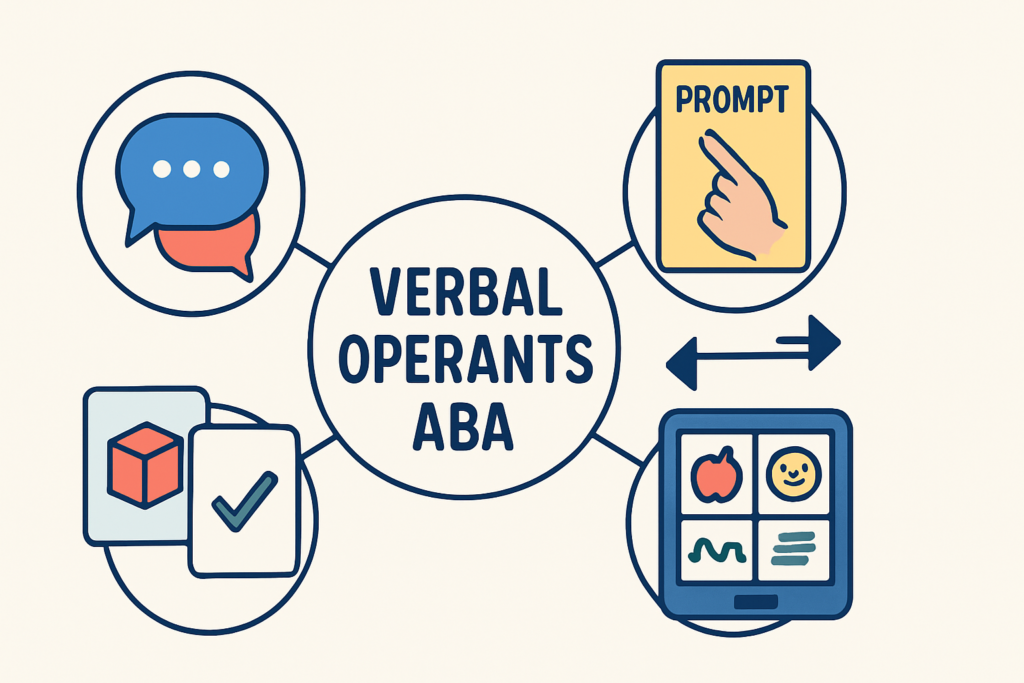
Understanding verbal operants is essential for behavior analysts working with language development and communication skills. B.F. Skinner’s analysis of verbal behavior provides a functional framework that goes beyond traditional linguistic categories. This approach examines why verbal behavior occurs rather than just its form. For BCBA candidates, mastering verbal operants is crucial for Section B of the Task List, which covers conceptual analysis.
Table of Contents
- Verbal Operants ABA: Introduction to Verbal Behavior and Operants
- Defining the Six Verbal Operants
- Applied Examples and Functional Analysis
- Exam Relevance and Common Traps
- Quick-Study Checklist and Summary
Verbal Operants ABA: Introduction to Verbal Behavior and Operants
Skinner’s 1957 book Verbal Behavior revolutionized how we analyze language. Unlike structural linguistics, Skinner focused on the functional relationships between verbal responses and environmental variables. This approach allows behavior analysts to teach language more effectively by targeting specific functions.
The six primary verbal operants include: mand, tact, echoic, intraverbal, textual, and transcription. Each operant has distinct controlling variables that determine when and why specific verbal responses occur. Understanding these differences is fundamental to effective functional communication training and language programming.
Defining the Six Verbal Operants
Each verbal operant is defined by its unique antecedent conditions and reinforcing consequences. The same word can function as different operants depending on these variables.
The Mand: Requesting Reinforcers
The mand is under the control of motivating operations and reinforced by specific consequences. When a child says “juice” because they’re thirsty and receives juice, this is a mand. The antecedent is an establishing operation (thirst), and the consequence is access to the requested item.
The Tact: Naming or Labeling
A tact is controlled by a non-verbal stimulus and reinforced by generalized conditioned reinforcement. When a child sees a dog and says “dog,” receiving praise, this is a tact. The antecedent is the presence of the stimulus, and the consequence is social reinforcement.
The Echoic, Textual, and Transcription: Duplicative Operants
These three operants involve duplication of verbal stimuli. The echoic requires a vocal model leading to a vocal response with formal similarity. The textual involves reading written words aloud. The transcription requires writing or typing from dictation or copy.
The Intraverbal: Conversation and Fill-Ins
Intraverbals are controlled by verbal stimuli without formal similarity. When someone asks “What’s your name?” and you respond “Alex,” this is an intraverbal. The antecedent is the verbal question, and the consequence is social interaction.
Video Study: Verbal Operants
Watch: BCBA Exam Prep Podcast | B19 Verbal Operants Explained | 6th edition
Use this lesson as a visual study companion, then return to the definitions and examples below to apply the same concept to BCBA® exam questions.
Prefer a second pass? Open this lesson on YouTube.
Applied Examples and Functional Analysis
Real-world application requires careful analysis of antecedent conditions and reinforcing consequences. Let’s examine two common scenarios.
Example 1: Distinguishing Mand from Tact in a Session
A client points to a cookie on a shelf and says “cookie.” To determine if this is a mand or tact, analyze the motivating operation. If the child is hungry and receives the cookie, it’s a mand. If they’re simply labeling and receive praise, it’s a tact. The same topography has different functions.
Example 2: Intraverbal vs. Echoic in Social Play
During a game, a therapist says “Ready, set…” and the child says “go!” This is likely an intraverbal to a partial verbal stimulus, not an echoic. There’s no formal similarity between “set” and “go,” and the response completes a familiar sequence.
Exam Relevance and Common Traps
Verbal operants appear frequently on the BCBA exam, particularly in questions about functional analysis and language programming. Understanding these common traps can improve your exam performance.
Trap 1: Confusing Form with Function
The same word can serve different functions. Exam questions test your ability to analyze controlling variables rather than just topography. Always examine the antecedent and consequence before classifying an operant.
Trap 2: Overlooking the Duplicative Operants
Echoic, textual, and transcription are often condensed in study materials but appear on exams. Remember that formal similarity is required for echoics but not for intraverbals. Textual involves reading, while transcription involves writing.
Trap 3: Misidentifying Intraverbal Antecedents
Intraverbal antecedents must be verbal but lack formal similarity. A common mistake is classifying responses to questions about absent items as tacts. These are actually intraverbals since the stimulus is verbal, not the actual item.
Quick-Study Checklist and Summary
Use this checklist to review key concepts and prepare for exam questions:
- Identify controlling variables for each operant (antecedent, behavior, consequence)
- Distinguish mands from tacts based on presence of motivating operations
- Recognize duplicative operants and their formal similarity requirements
- Analyze intraverbals as responses to verbal stimuli without echoic similarity
- Apply functional analysis to real-world language examples
- Review common exam traps and practice with varied scenarios
Mastering verbal operants enhances both exam performance and clinical practice. This functional approach to language allows for more precise assessment and intervention planning. For additional study resources, explore our guide on motivating operations and stimulus control concepts that interact with verbal behavior.
For authoritative references on verbal behavior theory, consult the Behavior Analyst Certification Board resources and Skinner’s original work. Understanding these concepts deeply will serve you well in both certification exams and practical applications with clients.
Complete BCBA Exam Prep
Turn this topic into exam-day practice
Practice concepts in context with five full-length 6th Edition mock exams, two bonus practice exams, a 6th Edition study guide, and key-term flashcards—all in one $120 USD package.
Get the $120 All-in-One Prep Pack
Review everything included on the product page before ordering. No pass guarantee is implied.



