
Introduction
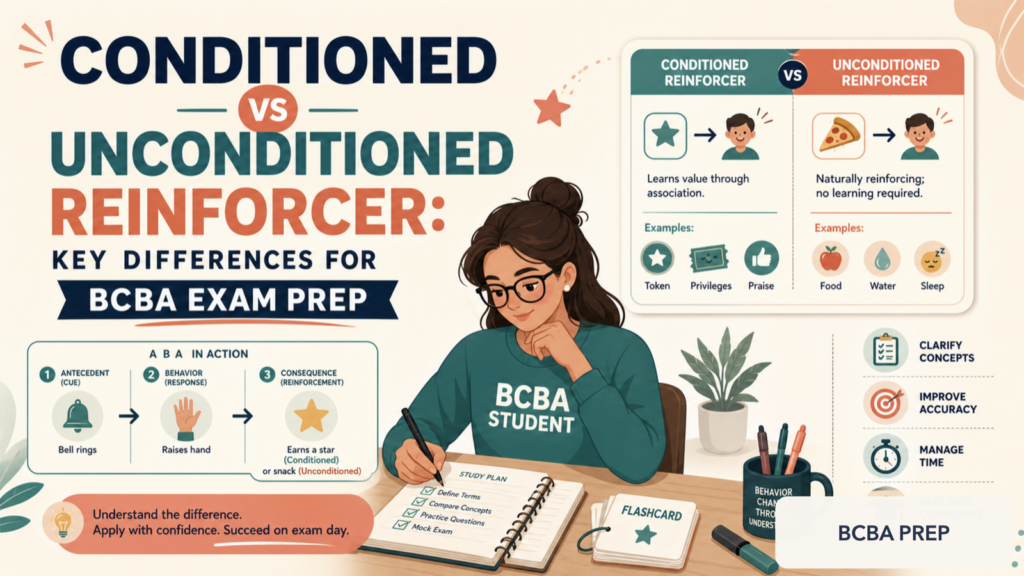
Understanding the difference between a conditioned vs unconditioned reinforcer is essential for the BCBA exam. This distinction appears frequently on the task list and in scenario-based questions. An unconditioned reinforcer is innately reinforcing, while a conditioned reinforcer acquires its value through learning history. This guide breaks down both types with practical ABA examples, highlights common exam traps, and provides a quick checklist to solidify your understanding.
Table of Contents
- Introduction
- What Is an Unconditioned Reinforcer?
- What Is a Conditioned Reinforcer?
- Conditioned vs Unconditioned Reinforcer: Side-by-Side Comparison
- Why This Distinction Matters for the BCBA Exam
- Quick Checklist: Conditioned vs Unconditioned Reinforcer
- Summary
- References
What Is an Unconditioned Reinforcer?
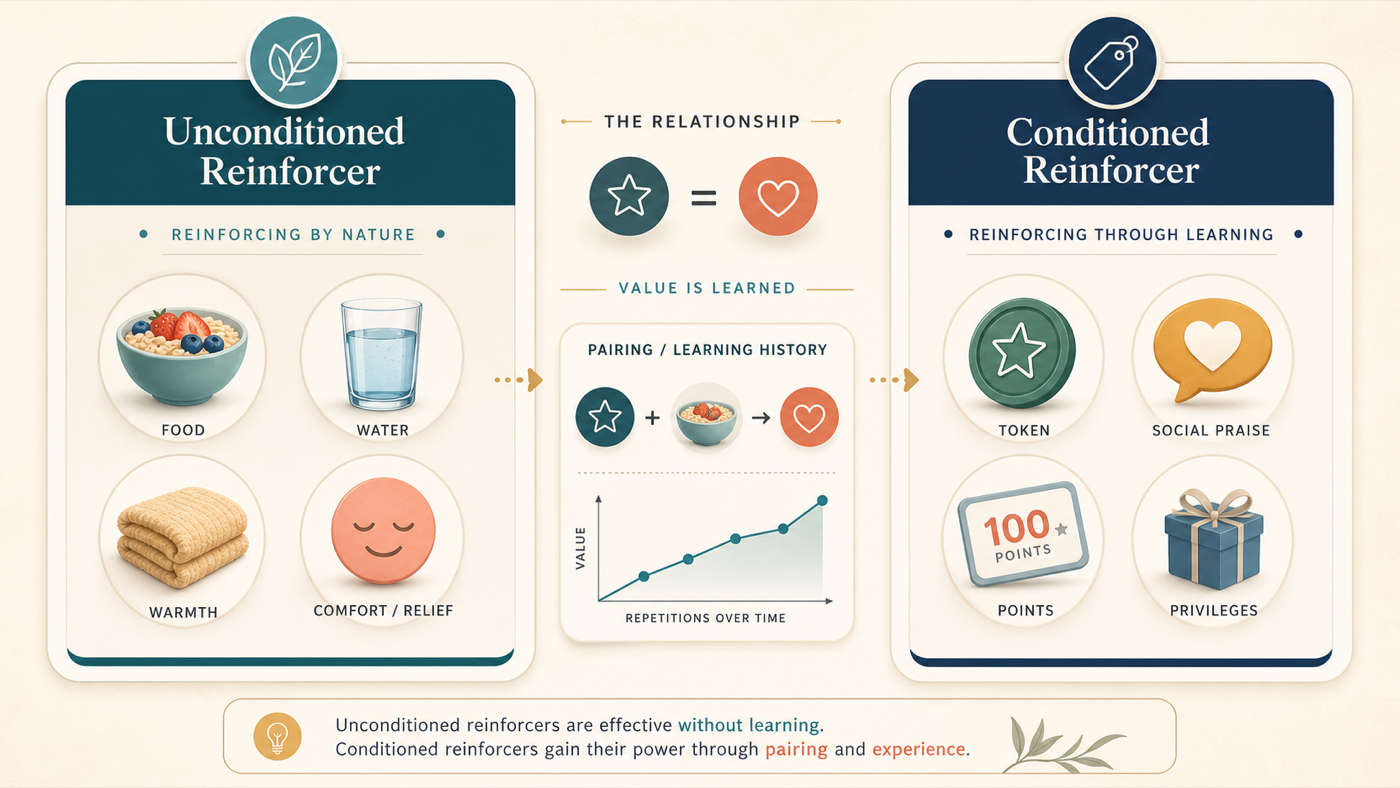
An unconditioned reinforcer (also called a primary reinforcer) is a stimulus that is reinforcing without any prior learning. Its value is biologically determined. Examples include food, water, warmth, sleep, and sexual stimulation. These reinforcers are essential for survival and work for most individuals without needing to be paired with anything else.
Definition and Biological Basis
Unconditioned reinforcers are innate because they satisfy fundamental biological needs. They are not learned; their reinforcing effect is universal across species. For instance, a hungry infant will find food reinforcing from birth. No pairing or conditioning is required. This characteristic makes them powerful but often satiate quickly.
Example in ABA: Teaching Requesting with a Hungry Child
Consider a child who is hungry and learning to request a snack. The ABC contingency might look like this:
- Antecedent: Child sees a preferred cookie and is hungry (establishing operation).
- Behavior: Child says ‘cookie’.
- Consequence: Therapist provides the cookie.
The cookie serves as an unconditioned reinforcer because food is innately reinforcing when the child is food-deprived. The hypothesized function is access to tangible, but the reinforcer itself is unconditioned.
What Is a Conditioned Reinforcer?
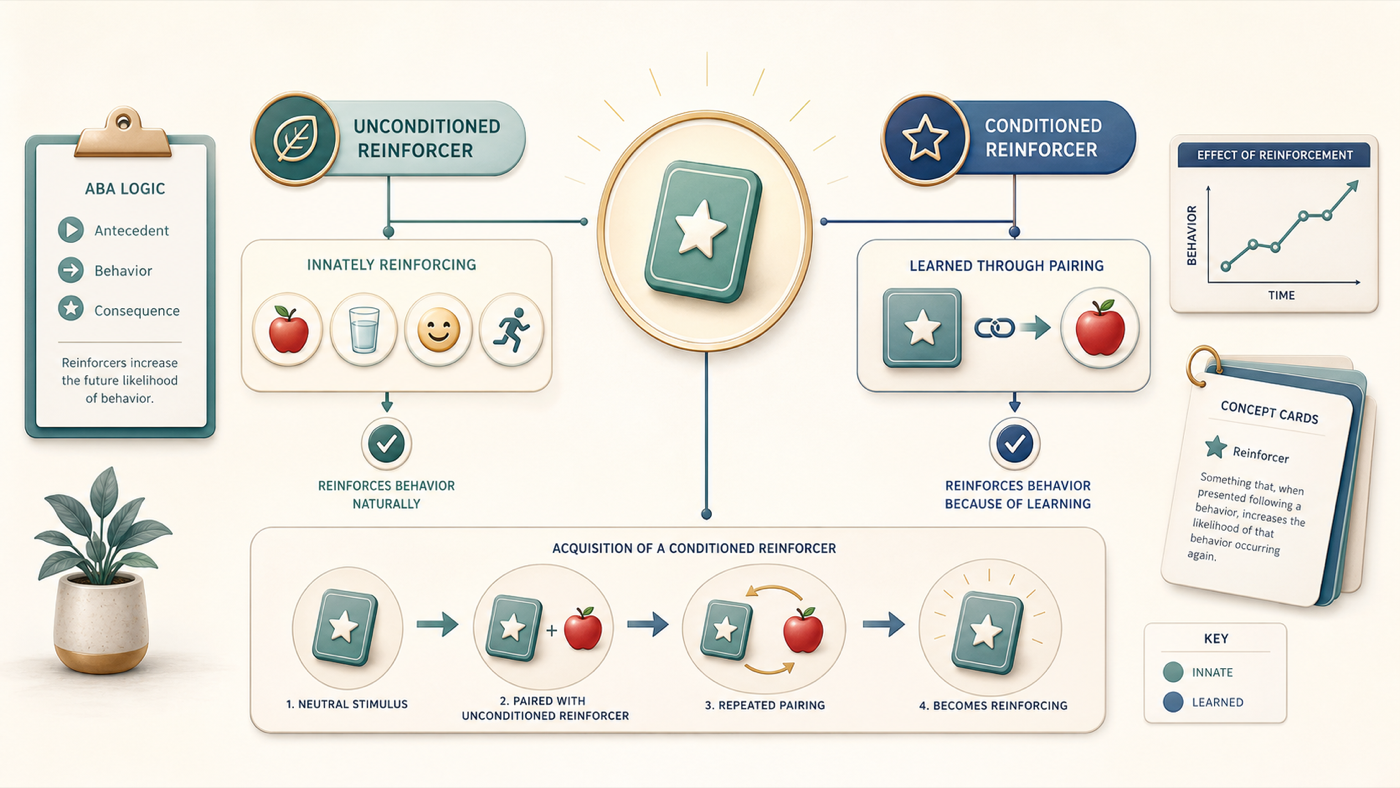
A conditioned reinforcer (secondary reinforcer) is a stimulus that becomes reinforcing through repeated pairing with an unconditioned reinforcer or another conditioned reinforcer. It has no intrinsic value initially but acquires reinforcing power via learning history. Examples include tokens, praise, money, grades, and points.
Conditioned Reinforcer Definition: Learned Through Pairing
A neutral stimulus, like a token, becomes a conditioned reinforcer when it is consistently paired with a backup reinforcer (e.g., food, play time). For example, a token that can be exchanged for a snack becomes reinforcing because of its association with the snack. This process is based on respondent conditioning and is fundamental to token economies.
Example in ABA: Token Economy in a Classroom
In a classroom, a teacher implements a token system to increase on-task behavior. Students earn tokens for completing work. The tokens themselves are not inherently reinforcing; they gain value because they can later be exchanged for a backup reinforcer, such as extra play time or a small prize. Over time, the token becomes a generalized conditioned reinforcer if it can be exchanged for multiple backup reinforcers.
- Antecedent: Teacher instructs students to start independent work.
- Behavior: Student completes a worksheet.
- Consequence: Student receives a token (conditioned reinforcer).
- Ultimate consequence: Token exchanged for 5 minutes of iPad time (backup reinforcer).
Conditioned vs Unconditioned Reinforcer: Side-by-Side Comparison
The table below summarizes the key differences between these two types of reinforcers.
| Feature | Unconditioned Reinforcer | Conditioned Reinforcer |
|---|---|---|
| Reinforcing value | Innate, no learning needed | Learned via pairing |
| Examples | Food, water, warmth | Tokens, praise, money |
| Saturation | Satiation occurs quickly | Less subject to satiation |
| Generality | Similar across individuals | Depends on learning history |
| Exam tip | Often identified by biological relevance | Often involves a token or social reward |
Why This Distinction Matters for the BCBA Exam
BCBA exam questions often ask you to identify whether a reinforcer is conditioned or unconditioned. Understanding the distinction helps in selecting appropriate reinforcers for interventions and predicting how reinforcement will function.
Exam Relevance
Questions may present a scenario and ask which type of reinforcer is being used. For example: ‘A therapist gives a child a sticker for every correct response; the sticker can be traded for a toy. What type of reinforcer is the sticker?’ The answer is a conditioned reinforcer. Other questions might ask about the implications of using one type over the other, such as potential satiation effects.
Common Traps
One frequent mistake is confusing a generalized conditioned reinforcer (e.g., money) with an unconditioned reinforcer. Money is not innately reinforcing; it is conditioned through pairing with many backup reinforcers. Another trap is thinking that all social praise is unconditioned. While praise can be conditioned, it often acquires its value through pairing with primary reinforcers early in development.
- Trap 1: Assuming money is a primary reinforcer. Money is a generalized conditioned reinforcer.
- Trap 2: Believing that all reinforcers that reduce a biological need are conditioned. They are unconditioned.
- Trap 3: Overlooking that conditioned reinforcers can lose value if not occasionally paired with backup reinforcers.
Quick Checklist: Conditioned vs Unconditioned Reinforcer
Use this checklist for last-minute review before the exam.
- Is the reinforcer innately reinforcing? (Yes = Unconditioned, No = Conditioned)
- Does it satisfy a biological need? (Yes = Unconditioned)
- Did the reinforcer require a pairing history? (Yes = Conditioned)
- Can the reinforcer be exchanged for other reinforcers? (Yes = Generalized conditioned reinforcer)
- Is satiation a rapid concern? (Yes = More likely unconditioned)
Summary
Mastering the conditioned vs unconditioned reinforcer distinction is vital for exam success. Unconditioned reinforcers are innate and biologically based, while conditioned reinforcers are learned through pairing. Remember key examples, avoid common traps like mislabeling money as unconditioned, and use the checklist to reinforce your understanding. For more practice, explore our free BCBA mock exam questions to test your knowledge. Good luck with your preparation!
References
Ready to test what you just learned?
Put it into practice with a free, full-length BCBA mock exam — real exam-style questions, instant scoring, and answer explanations.
Complete BCBA Exam Prep
Turn this topic into exam-day practice
Practice concepts in context with five full-length 6th Edition mock exams, two bonus practice exams, a 6th Edition study guide, and key-term flashcards—all in one $120 USD package.
Get the $120 All-in-One Prep Pack
Review everything included on the product page before ordering. No pass guarantee is implied.



