
What is Whole Interval Recording?
Whole interval recording is a discontinuous measurement procedure where an observer records whether a target behavior occurs throughout an entire predetermined interval. This method provides a conservative estimate of behavior duration by only counting intervals where the behavior is present for the complete time period.
Table of Contents
- What is Whole Interval Recording?
- Whole Interval Recording in Practice: ABA Examples
- Whole Interval Recording on the BCBA Exam
- Quick-Reference Checklist and Summary
The procedure requires careful timing and continuous observation throughout each interval. Unlike other measurement methods, whole interval recording systematically underestimates actual occurrence, making it particularly useful for specific clinical applications.
The Formal Definition and Procedure
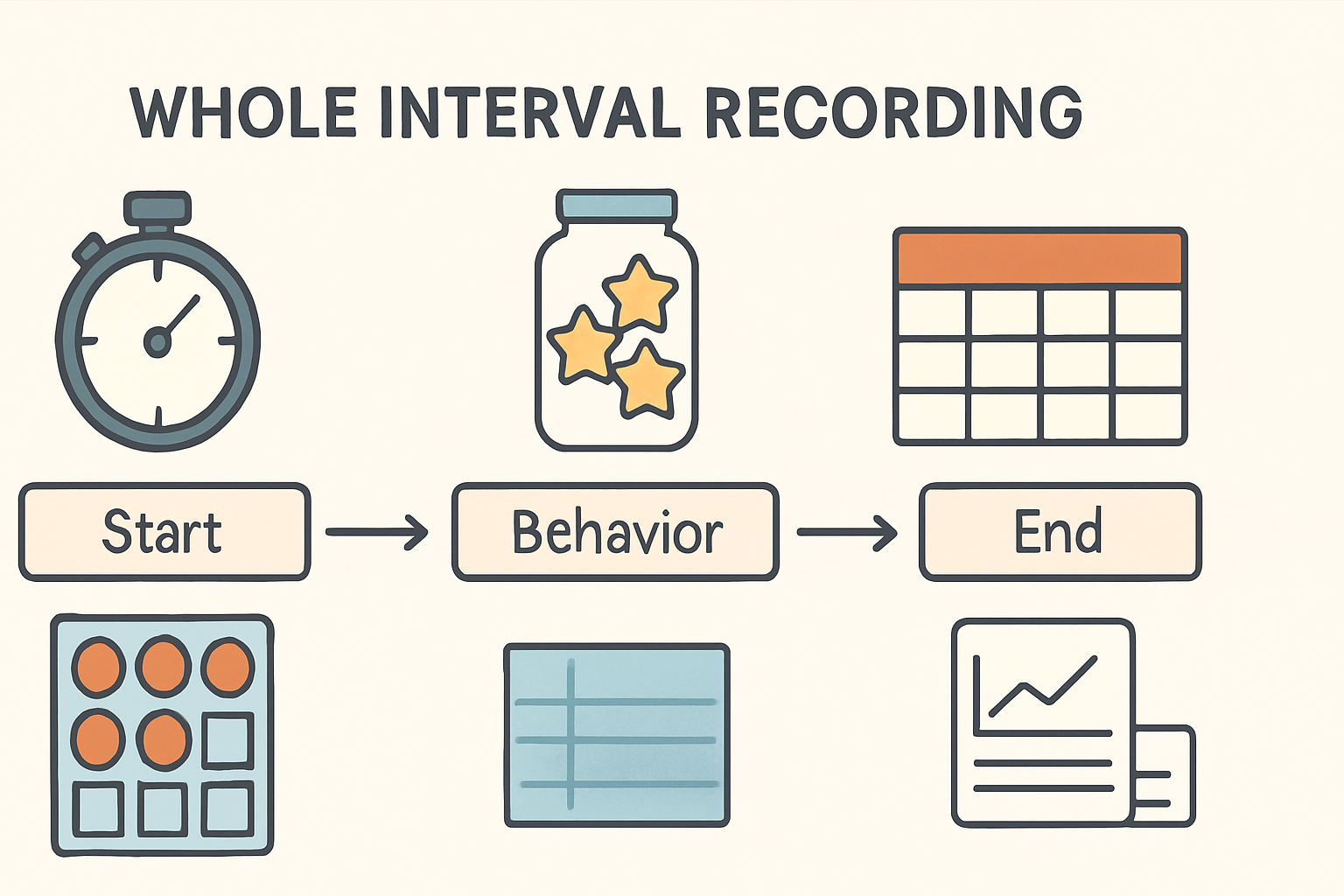
In whole interval recording, you divide observation sessions into equal time intervals. The observer must watch continuously throughout each interval and record a yes/no response based on whether the behavior occurred for the entire duration. Here’s the step-by-step process:
- Divide the observation period into equal intervals (e.g., 5-minute intervals for a 30-minute session)
- Start the timer and observe the client continuously throughout the first interval
- Record a plus (+) or checkmark if the behavior occurs throughout the entire interval
- Record a minus (-) or leave blank if the behavior stops at any point during the interval
- Reset and repeat for each subsequent interval
- Calculate percentage of intervals with behavior occurrence
This method contrasts sharply with partial interval recording (which overestimates by recording behavior if it occurs at any point) and momentary time sampling (which records behavior only at specific moments).
When to Use It (and When Not To)
Whole interval recording is ideal for measuring continuous, longer-duration behaviors where you want to track sustained engagement or participation. It’s particularly effective for behaviors like on-task work, social engagement, or compliance with multi-step instructions.
However, this method is inappropriate for brief, high-frequency behaviors like hand flapping, vocalizations, or aggression. For these behaviors, whole interval recording would severely underestimate occurrence. Instead, consider continuous measurement methods or partial interval recording for more accurate data.
Whole Interval Recording in Practice: ABA Examples
Understanding theoretical definitions is important, but practical application is crucial for BCBA exam success. These examples demonstrate how whole interval recording works in real clinical scenarios.
Example 1: Measuring On-Task Behavior During Independent Work
Scenario: A 9-year-old student with escape-motivated off-task behavior during independent math work. The target behavior is defined as “eyes on worksheet or materials, hands appropriately manipulating materials, and no vocalizations unrelated to the task.”
- Session duration: 30 minutes
- Interval length: 5 minutes (6 intervals total)
- Data: +, +, -, +, -, + (4 out of 6 intervals)
- Percentage: 67% of intervals with on-task behavior
Clinical interpretation: The student demonstrates moderate engagement but shows variability. The escape function suggests breaks in behavior may relate to task difficulty. This data helps identify when antecedent interventions might be needed.
Example 2: Tracking Social Engagement During Group Play
Scenario: A 6-year-old child with attention-motivated solitary play. Target behavior: “engaged in reciprocal play with at least one peer, including sharing materials, taking turns, or responding to peer initiations.”
Using shorter 1-minute intervals for a 15-minute play session provides more granular data. Sample ABC data shows low engagement specifically when a new peer joins the group (antecedent) and the peer moves away (consequence), confirming the attention function.
This example demonstrates how whole interval recording captures sustained social behavior better than methods that would count brief interactions. The data supports implementing differential reinforcement procedures to increase social engagement.
Whole Interval Recording on the BCBA Exam
Measurement procedures are heavily tested on the BCBA exam, and understanding the nuances of whole interval recording can make the difference between passing and failing. This section covers common question formats and critical connections to the BACB Task List.
Common Exam Question Formats and Traps
Exam questions typically test your ability to select appropriate measurement procedures and interpret collected data. Watch for these common traps:
- Confusing whole with partial interval: Remember whole underestimates, partial overestimates
- Misapplying to brief behaviors: Whole interval is inappropriate for behaviors like vocal tics or hand flapping
- Misinterpreting data charts: Practice identifying which method produced given data patterns
- Overlooking measurement limitations: Always consider reactivity and observer drift
Typical question stems include: “Which measurement procedure would be most appropriate for…” or “Based on this data, what can you conclude about…” Mastery requires understanding both procedural details and clinical implications.
Linking to the BCBA Task List (5th Ed.)
Whole interval recording directly connects to Section C: Measurement, Data Display, and Interpretation. Specifically:
- C-1: Establish operational definitions of behavior
- C-2: Distinguish among direct, indirect, and product measures of behavior
- C-3: Measure occurrence (count, rate/frequency)
- C-4: Measure temporal dimensions (duration, latency, interresponse time)
Understanding discontinuous measurement procedures like whole interval recording is non-negotiable for certification. These skills form the foundation of effective behavior analysis practice and data-driven decision making.
Quick-Reference Checklist and Summary
Use this checklist to ensure you’ve mastered whole interval recording concepts for both clinical practice and exam preparation.
- Define target behavior operationally before data collection begins
- Select appropriate interval length based on behavior duration and session time
- Observe continuously throughout each entire interval
- Record occurrence only if behavior happens throughout the complete interval
- Calculate percentage of intervals with behavior occurrence
- Interpret data conservatively knowing this method underestimates
- Choose alternative methods for brief or high-frequency behaviors
- Consider measurement limitations including reactivity and observer drift
Whole interval recording provides valuable data for sustained behaviors but requires careful implementation. Remember that this method systematically underestimates actual occurrence, making it ideal for behaviors where you want to measure continuous engagement. For comprehensive measurement strategies, review the BACB Task List requirements and practice applying different procedures to various clinical scenarios.
For authoritative guidance on measurement procedures, consult the BACB Task List and peer-reviewed resources on discontinuous measurement in applied behavior analysis.
Complete BCBA Exam Prep
Turn this topic into exam-day practice
Practice concepts in context with five full-length 6th Edition mock exams, two bonus practice exams, a 6th Edition study guide, and key-term flashcards—all in one $120 USD package.
Get the $120 All-in-One Prep Pack
Review everything included on the product page before ordering. No pass guarantee is implied.



