
In applied behavior analysis, understanding what constitutes a reinforcer is fundamental to both effective practice and exam success. The ABA definition of a reinforcer differs significantly from everyday understanding, requiring careful analysis of behavior-consequence relationships.
Table of Contents
- Reinforcer ABA Definition: The Operational Definition: What Makes a Reinforcer a Reinforce
- Reinforcers in Action: Worked Examples from ABC Data
- Reinforcer Concepts on the BCBA Exam: Traps and Tips
- Quick Checklist: Is It a Reinforcer?
- Summary: From Concept to Application
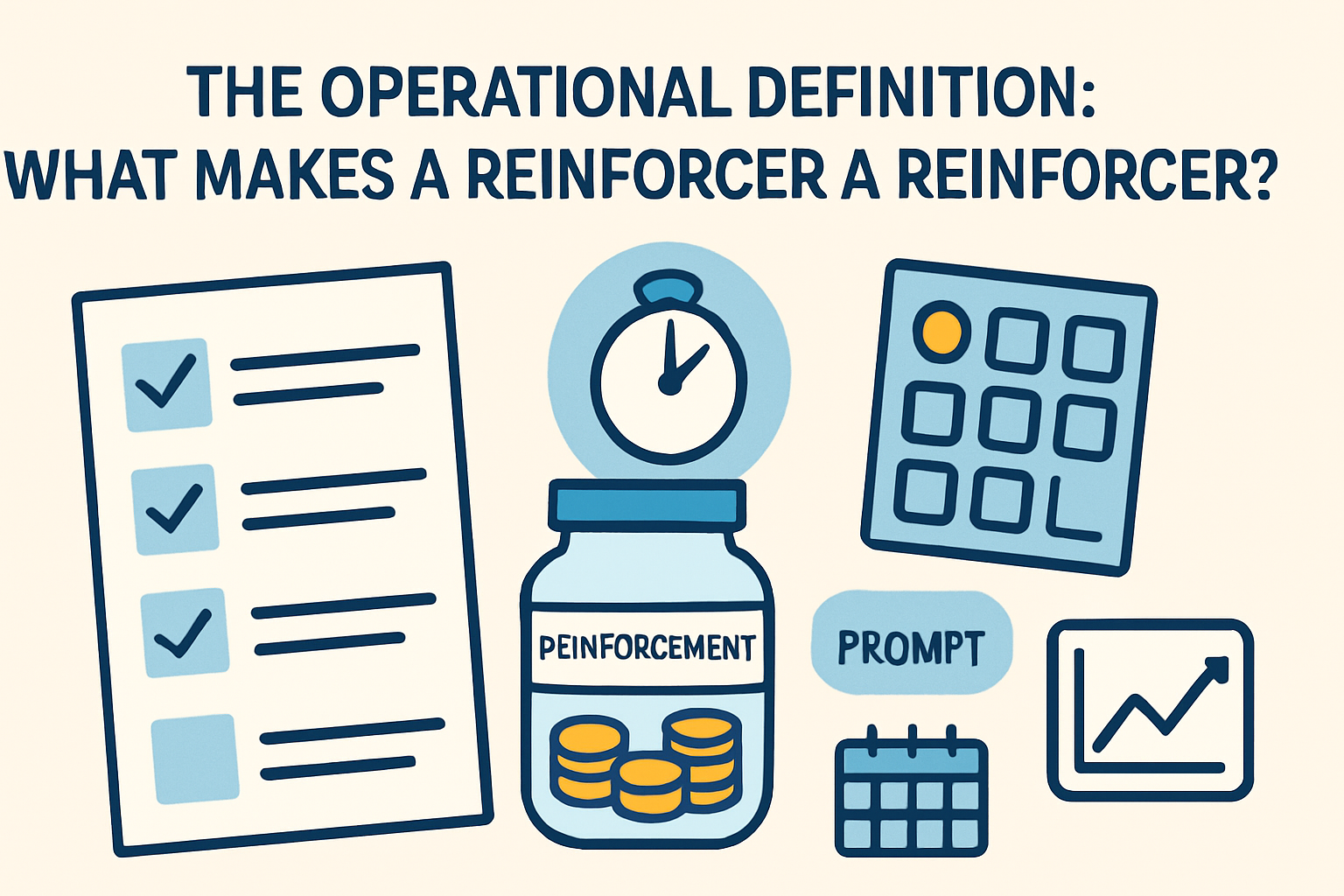
Reinforcer ABA Definition: The Operational Definition: What Makes a Reinforcer a Reinforce
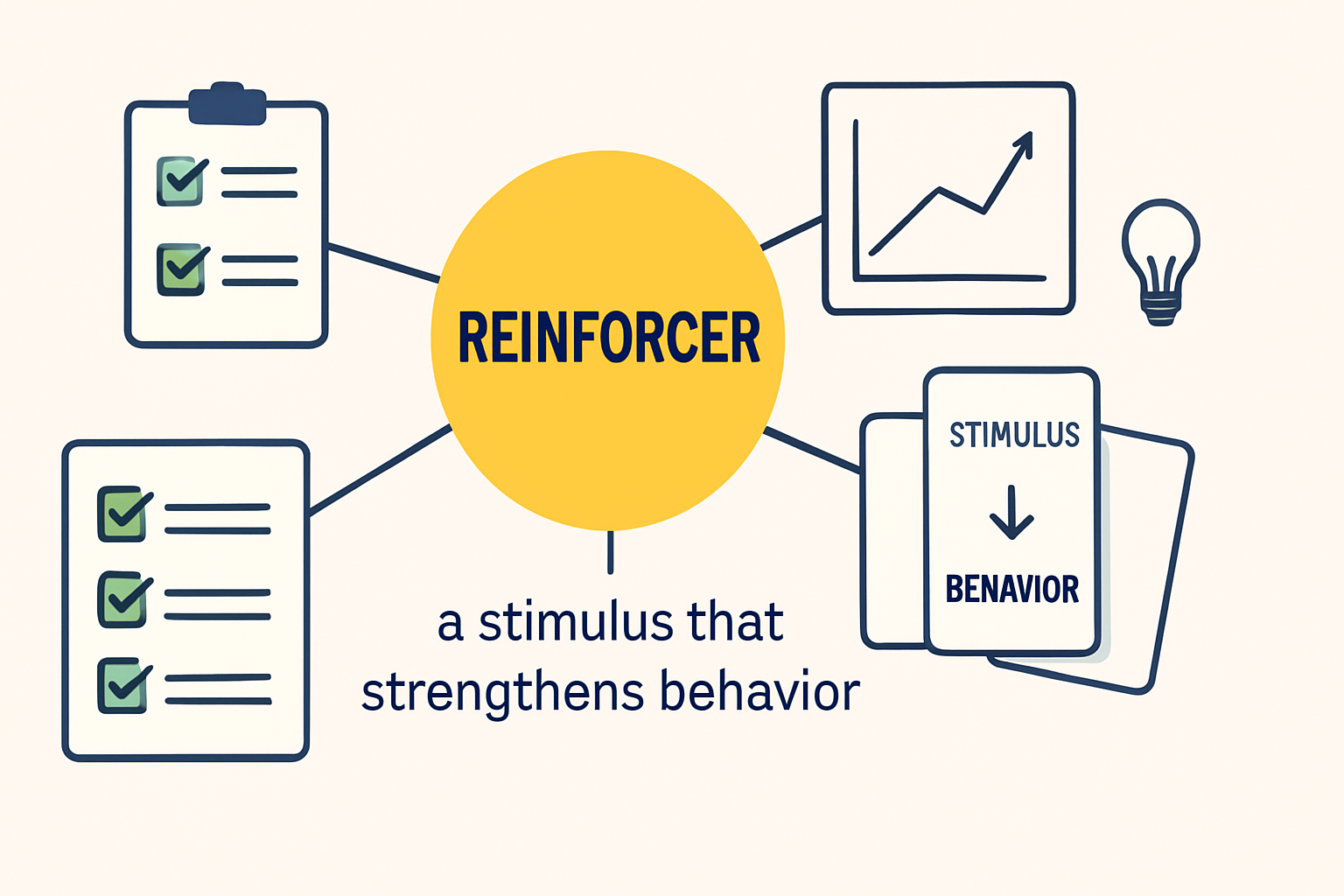
A reinforcer is defined by its effect on behavior, not by its assumed value. In behavior analysis, a stimulus only qualifies as a reinforcer if it demonstrably increases the future frequency of the behavior it follows.
Reinforcer vs. Reward: The Critical Distinction
The term ‘reward’ is colloquial and often based on assumed value, while ‘reinforcer’ is an empirical, functional term. A stimulus becomes a reinforcer only when data shows it increases behavior frequency.
The Two Key Questions for Identification
To identify a reinforcer, ask two questions: 1) Did a stimulus follow a behavior? 2) Did the future frequency of that behavior increase? Both must be ‘yes’ for functional classification.
Reinforcers in Action: Worked Examples from ABC Data
Applying the definition to real scenarios helps clarify how to analyze Antecedent-Behavior-Consequence sequences. Each example demonstrates different reinforcement functions.
Example 1: The Homework Token (Tangible/Access)
Antecedent: Instruction to start math. Behavior: Completes 5 problems. Consequence: Receives token for game time. Function: Access to tangible (game time) as a positive reinforcer. The token serves as a conditioned reinforcer paired with the backup reinforcer.
Example 2: The Elopement in the Store (Escape)
Antecedent: Parent says ‘no’ to candy. Behavior: Child runs down aisle. Consequence: Parent stops lecture. Function: Escape from demands as a negative reinforcer. The behavior increases to remove an aversive stimulus.
Example 3: The Classroom Hand-Raise (Attention)
Antecedent: Teacher asks question. Behavior: Student raises hand and shouts. Consequence: Teacher gives corrective attention. Function: Access to teacher attention as a positive reinforcer, even when corrective.
Reinforcer Concepts on the BCBA Exam: Traps and Tips
Understanding how the BACB tests this knowledge is crucial for exam success. Common errors stem from misunderstanding fundamental concepts.
Common Exam Traps to Avoid
- Confusing reinforcing stimulus with preferred stimulus without data
- Mislabeling negative reinforcement as punishment
- Assuming a consequence is a reinforcer without future frequency data
- Over-relying on typographical categories instead of functional analysis
- Forgetting that conditioned reinforcers require pairing history
Key Terms You Must Define
- Positive Reinforcement: Adding a stimulus that increases behavior
- Negative Reinforcement: Removing a stimulus that increases behavior
- Unconditioned Reinforcer: Biologically significant without learning history
- Conditioned Reinforcer: Gains value through pairing with other reinforcers
- Generalized Conditioned Reinforcer: Paired with multiple reinforcers (e.g., money, tokens)
Quick Checklist: Is It a Reinforcer?
Use this practical guide to analyze potential reinforcers systematically. Each step corresponds to the operational definition.
- Identify the specific behavior that occurred
- Note the immediate consequence following the behavior
- Collect data on future frequency of the behavior
- Compare baseline to post-consequence behavior rates
- Determine if the consequence increased behavior frequency
- Classify the function: positive or negative reinforcement
- Consider if the stimulus is conditioned or unconditioned
Summary: From Concept to Application
A reinforcer is defined functionally by its effect, not topographically by its form. Mastering this distinction is essential for both the BCBA exam and ethical practice. Remember that reinforcement always increases behavior frequency, whether through stimulus addition (positive) or removal (negative).
For more on related concepts, see our guide to positive reinforcement examples and negative reinforcement applications. Understanding these principles is crucial for effective functional behavior assessment.



