
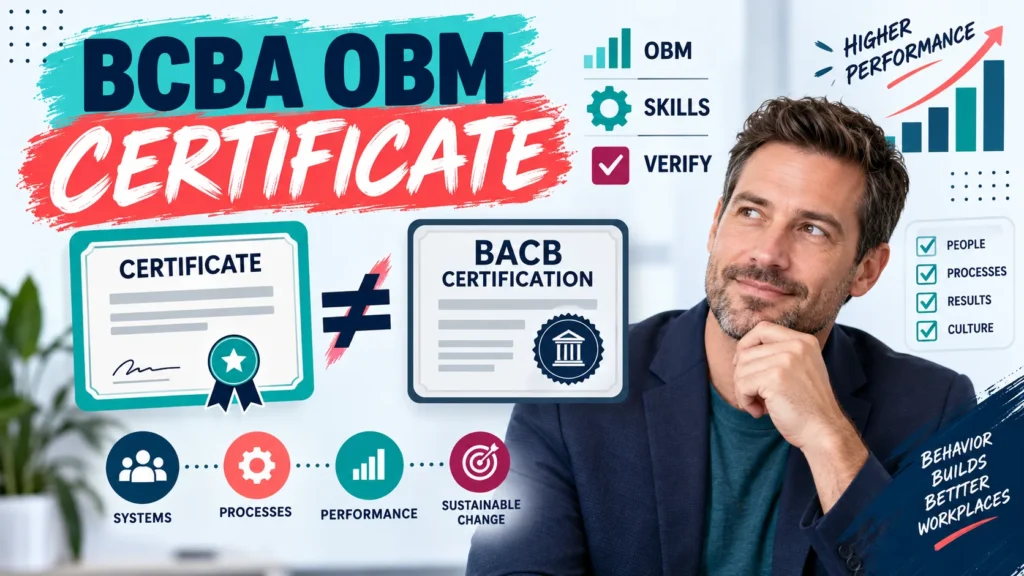
Quick answer: A bcba obm certificate usually means a course, graduate certificate, or professional-development program focused on Organizational Behavior Management (OBM). It does not automatically mean that the BACB has issued an additional OBM certification, and it does not automatically replace the BCBA certification pathway. The BACB describes OBM as an ABA subspecialty; the BCBA is the separate graduate-level certification with its own education, fieldwork, application, and examination requirements.
Table of Contents
- bcba obm certificate: what is it?
- Is an OBM certificate the same as BCBA certification?
- What does OBM cover?
- Can an OBM certificate satisfy 2027 BCBA coursework?
- How should you evaluate an OBM certificate program?
- How are certificates different from OBM CEUs?
- Is an OBM certificate useful for a BCBA?
- Which mistakes should candidates avoid?
- BCBA OBM certificate FAQ
- Official and provider sources for verification
- Take the Free BCBA Mock Exam
That distinction matters even more as the 2027 BCBA requirements take effect. The current BACB handbook includes Organizational Behavior Management as a 2027 coursework content area, but a certificate’s title alone does not prove that it is the required academic coursework, that it includes the required instructional hours, or that a program can submit the applicable Pathway 2 attestation. Before paying for any OBM program, identify what it awards, who recognizes it, and what evidence it provides.
This guide is a credential-boundary and program-screening guide. It does not rank providers, declare that a commercial certificate is BACB-approved, or make an individual eligibility determination. Requirements, provider offerings, prices, and course documentation can change, so check the current BACB handbook and the provider’s current terms before enrolling. Table of Contents
bcba obm certificate: what is it?
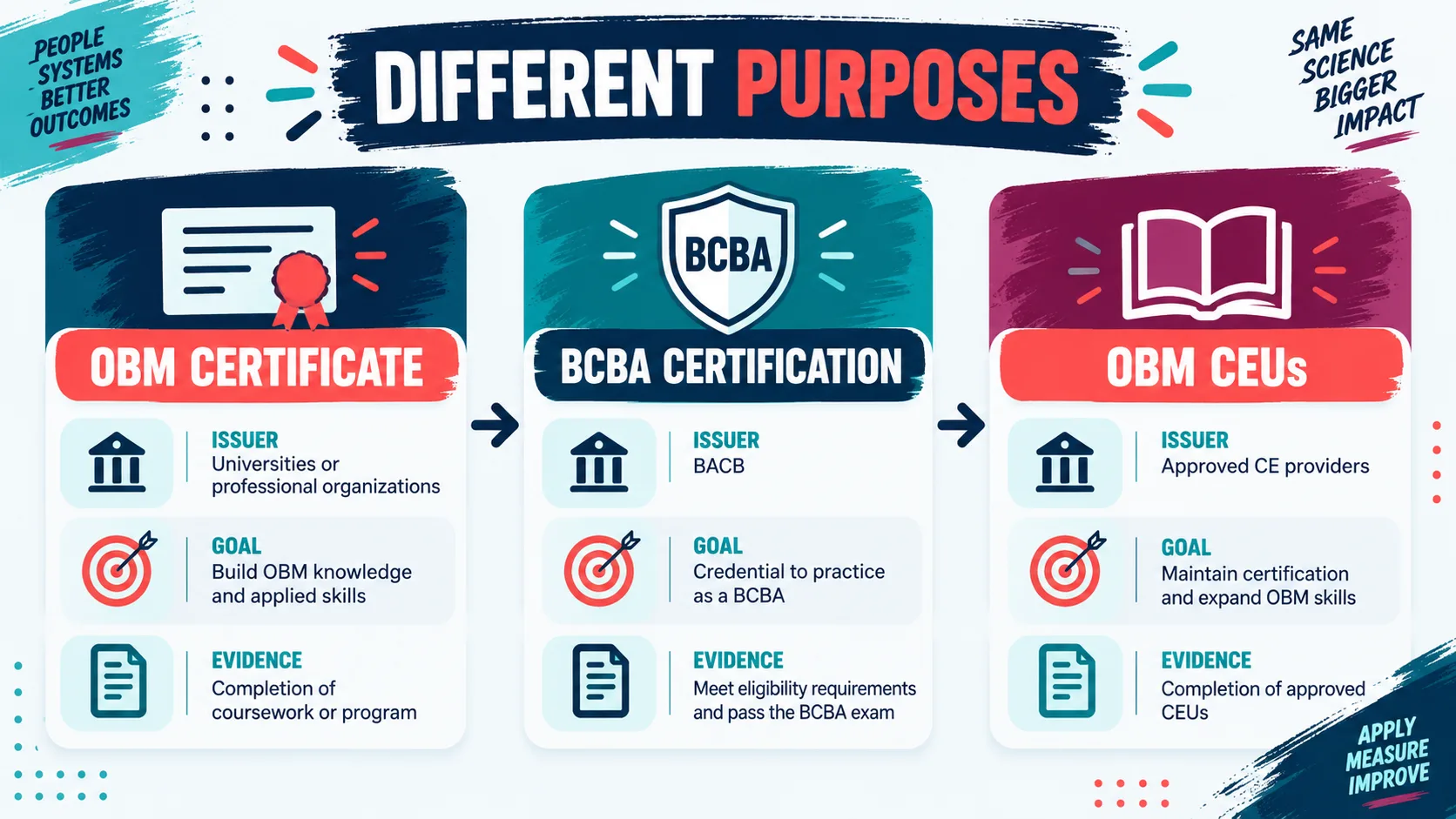
The phrase can refer to several different products. A university may award a graduate certificate. A training company may issue a certificate of completion for a professional-development series. An organization may issue a badge or third-party credential after an assessment. Those outcomes can all be useful, but they are not interchangeable.
Start by reading the exact award language rather than the headline. Does the provider say “certificate,” “certificate of completion,” “graduate certificate,” “badge,” or “certification”? Who is the issuer? Is there a transcript? Is there an assessment? Is it a BACB continuing-education event, an academic course, or neither? A careful answer is more valuable than a confident label.
| Term | What it may mean | What it does not prove by itself |
|---|---|---|
| OBM certificate | Completion of a provider’s OBM learning program or an academic certificate in an OBM-related subject. | That the BACB issued a new credential or that the certificate satisfies a particular BCBA eligibility rule. |
| BCBA certification | The national graduate-level certification awarded through the BACB after the applicable requirements and examination. | That the holder has a separate OBM specialty certificate or a state license. |
| OBM CEUs | Continuing-education credit that may be usable for a certificant’s maintenance cycle if the event, provider, category, and documentation qualify. | That the activity is initial-certification coursework or a graduate course transcript. |
For broader credential context, see our bcba obm certificate: broader BCBA credential context guide, then use this page for the narrower OBM decision. The two pages should work together rather than repeat the same certification checklist.
Is an OBM certificate the same as BCBA certification?
No. The BACB’s official materials describe the BCBA as a graduate-level certification in behavior analysis. The BACB’s OBM page describes OBM as a subspecialty that applies behavior analysis to workplace performance and culture. Those descriptions create an important boundary: OBM can be an area of education or professional emphasis within behavior analysis, while BCBA certification is the credential issued through the BACB’s certification process.
A provider may use the word “certification” in a commercial title, but the issuer and scope still matter. An OBM provider’s certificate may demonstrate that you completed its program. It does not, without more evidence, allow you to represent yourself as a BCBA, change an inactive BACB status, or satisfy a state’s licensure rule.
- Issuer: Is the award from the BACB, a university, a training company, or another organization?
- Purpose: Is it initial certification, continuing education, academic coursework, or workplace skill development?
- Evidence: Will you receive a transcript, certificate, learning objectives, assessment result, or CEU record?
- Authority: Which organization decides whether the evidence counts for your goal?
- Representation: What exact wording can you use on a résumé without implying a credential you do not hold?
If a sales page says “become an OBM-certified BCBA” without explaining the issuing body and the limits of the award, pause. Ask for the official name of the credential and the rule or registry that recognizes it. Clear programs can answer that question without asking you to infer status from a badge or marketing slogan.
What does OBM cover?
According to the BACB, Organizational Behavior Management focuses on assessing and changing the work environment to improve employee performance and workplace culture. In the current 2027 BCBA handbook, the OBM content area includes topics such as performance analysis and management, supervision, staff training, behavioral systems analysis, organizational culture, and leadership. That scope can serve several learners:
- a BCBA who wants to improve staff training and implementation fidelity;
- a clinical director who wants to analyze team performance and systems;
- a behavior analyst moving toward organizational development or performance consulting;
- a student comparing ABA subspecialties before choosing a graduate or certificate program;
- a workplace professional who wants behavior-analytic tools without pursuing BCBA certification.
The goal determines what evidence you need. A working BCBA may need high-quality continuing education and practical tools. A 2027 applicant may need a qualifying academic course and a program attestation. A business professional may care most about applied projects and workplace outcomes. Calling all three goals “BCBA certification” creates confusion.
Can an OBM certificate satisfy 2027 BCBA coursework?
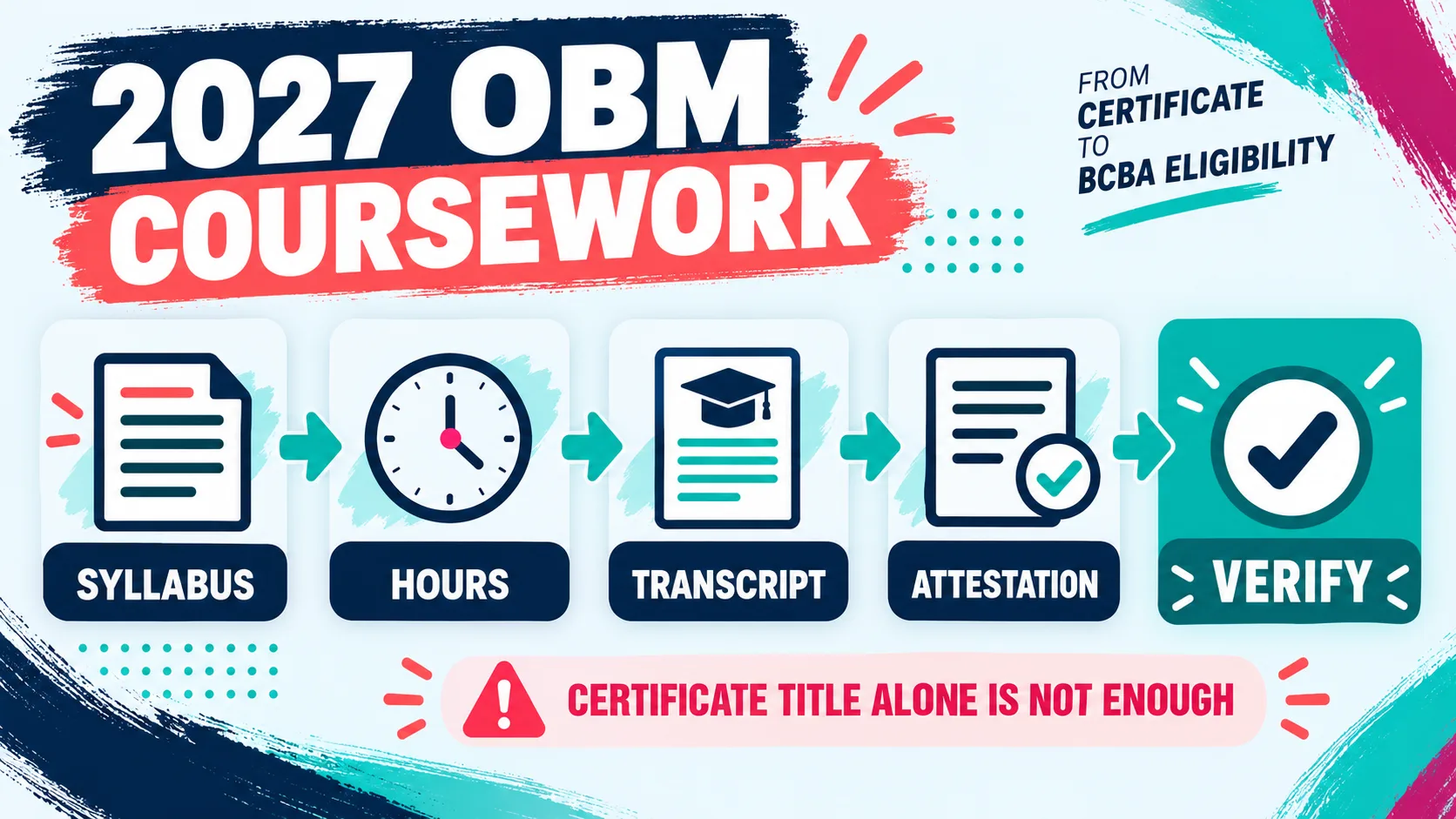
Not automatically. The 2027 BCBA requirements identify Organizational Behavior Management as a content area within the behavior-analytic coursework framework. The BACB handbook describes 45 instructional hours within one freestanding course for this area, subject to the full pathway, course-content, degree, and attestation requirements. A private OBM certificate may contain relevant material, but its title is not enough to establish that it meets those requirements. Before counting an OBM program toward initial BCBA eligibility, verify all of the following:
- Pathway: identify whether you are applying through the 2027 accredited or recognized program pathway or the behavior-analytic coursework pathway.
- Course identity: confirm whether the OBM content is a freestanding academic course, part of a larger certificate, a noncredit workshop, or continuing education.
- Instructional hours: compare the documented instructional hours with the applicable BACB content-area requirement.
- Content majority: read the syllabus to see whether OBM is the majority of the course content rather than a short module in a general program.
- Program contact: ask whether the university has the appropriate BACB Pathway 2 contact and can submit the required attestation when applicable.
- Transcript: confirm that an official transcript or other required record will show the course in the format the application requires.
- Application date: check which requirements govern when you expect to submit a complete application, especially during the 2027 transition.
The BACB’s current BCBA Handbook and 2027 BCBA Requirements page control this decision. A provider may explain how its course is designed, but the provider cannot replace the BACB’s application determination.
How should you evaluate an OBM certificate program?
Use a document-first screen before comparing price or marketing claims. A program that fits your goal should be able to show what you will learn, how you will be assessed, what award you will receive, and whether any CEU or academic record is issued.
| Check | Question to ask | Evidence to save |
|---|---|---|
| Credential wording | What exactly will appear on the certificate and résumé? | Sample certificate, issuer name, award policy, and completion criteria. |
| Curriculum | Which OBM topics, practice activities, and assessments are included? | Syllabus, learning objectives, schedule, and assessment description. |
| Recognition | Is the program academic, ACE-related, employer-facing, or a private training award? | Transcript policy, CEU policy, provider status, and the organization that recognizes it. |
| Fit | Does it serve your career goal or a specific BCBA application requirement? | A written mapping from the program to your goal, not a generic “BCBA-ready” claim. |
Do not make “BACB approved” do more work than it can. A course can be approved or recognized for one purpose—such as continuing education—without satisfying a different purpose, such as initial-certification coursework. Ask what the approval covers and for which learner status.
How are certificates different from OBM CEUs?
A certificate can be evidence that you completed a program. A CEU record is evidence of continuing education that may be counted during an active certificant’s maintenance cycle if the activity and category qualify. They can appear together, but they answer different questions.
For a BCBA who is already certified, record the provider, event title, date, learning category, number of credits, and certificate or completion record. Check whether the activity is learning or supervision credit and whether it fits your current recertification cycle. Our separate OBM CEUs BCBA guide covers the CEU-versus-2027-coursework distinction in more detail.
For a new applicant, do not assume that an OBM CEU certificate is an academic transcript. The words “certificate” and “CEU” do not erase the difference between maintenance credit and initial eligibility evidence. If a program advertises both, request separate documentation for each purpose.
Is an OBM certificate useful for a BCBA?
It can be useful when it matches a real work problem. OBM training may help a BCBA analyze staff performance, improve feedback systems, design training, measure implementation, or communicate behavioral principles in organizational settings. The value is practical and professional; it is not automatically a new BACB title. Use a simple fit test:
- Role fit: will you work with teams, supervisors, organizations, or performance systems?
- Skill fit: does the program teach performance analysis, measurement, feedback, systems, and implementation—not only general motivation?
- Evidence fit: will you produce a work sample or assessment that demonstrates what you learned?
- Time fit: can you complete the program without neglecting current certification, supervision, or client responsibilities?
- Boundary fit: can you describe the award accurately without calling it BACB certification?
If your immediate goal is to pass the BCBA exam, an OBM certificate may be an optional specialization rather than the next required step. Use the current Test Content Outline and handbook to identify the exam or eligibility task first. When exam preparation is the bottleneck, the free BCBA mock exam can provide optional practice and feedback; it is not an OBM certificate, CEU event, BACB form, or guarantee of a passing score.
Which mistakes should candidates avoid?
- Assuming every OBM certificate is a BACB credential: check the issuer and the exact award language.
- Counting a CEU as a graduate course: keep maintenance records and initial-eligibility records separate.
- Trusting a 2027 marketing phrase: compare the syllabus and attestation process with the current BACB handbook.
- Choosing by badge design: judge the learning objectives, assessment, evidence, and career fit.
- Using “certified” on a résumé without a qualifier: say who issued the certificate and what was completed.
- Assuming a university certificate automatically satisfies a pathway: verify the specific degree, course, transcript, and program-contact requirements.
BCBA OBM certificate FAQ
Is there an official BACB OBM certification?: The BACB’s official materials describe OBM as a subspecialty and describe the BCBA as the certification credential. They do not present a separate OBM certificate as an additional BACB certification in the materials used for this guide. Treat a third-party OBM award as its issuer’s credential unless the BACB explicitly says otherwise.
Can a BCBA get an OBM certificate without taking another master’s degree?: Some professional-development or graduate-certificate programs may be designed for people who already hold a graduate degree, but admission and completion rules vary. A certificate can build OBM skills without being another master’s degree. Check the provider’s current admission requirements and award language.
Does an OBM certificate count as BACB CEUs?: Only the qualifying portion of a program, if any, can be counted for a particular maintenance purpose. Verify the provider, learning category, credit amount, and documentation. A completion certificate alone is not a universal CEU approval.
Can an OBM certificate satisfy the 2027 OBM coursework area?: Not merely because it uses the word OBM or certificate. Compare the course format, instructional hours, content, pathway, transcript, program-contact attestation, and application date with the current BACB requirements. Ask the university or program contact for evidence before counting it.
Is OBM training useful if I do not want to work in autism services?: It may be. OBM applies behavior-analytic methods to workplace performance and organizational culture, so the work can include training, performance improvement, leadership, safety, or operational systems. The relevant qualification may be a university award, professional certificate, employer experience, or another credential—not necessarily a BCBA.
Official and provider sources for verification
- BACB Organizational Behavior Management overview
- BACB BCBA Handbook
- BACB 2027 BCBA Requirements
- BACB OBM Fact Sheet
- Example provider FAQ: OBM Specialist Certificate
Bottom line: A BCBA OBM certificate can be a useful learning or career credential, but it is not automatically BACB certification, a state license, a CEU record, or 2027 Pathway 2 coursework. Start with the issuer, purpose, evidence, and authority. Then choose the program that solves your actual OBM or BCBA planning problem and describe the result accurately.
Take the Free BCBA Mock Exam
When you are ready to apply the idea, use the free practice resource below for additional feedback. Take the Free BCBA Mock Exam



