
If you are looking for the BACB supervisor training curriculum outline, you probably need more than a list of supervision topics. You need to know what the outline is for, who must complete the related training, what the current 8-hour requirement means, what a valid completion record should contain, and when a supervisor may begin providing supervision.
Table of Contents
- What is the BACB Supervisor Training Curriculum Outline?
- Who needs the 8-hour supervision training?
- What topics does the outline cover?
- What should the 8-hour training include?
- What documentation should the learner receive?
- When can a supervisor begin providing supervision?
- How is the outline different from a supervision contract?
- What mistakes should BCBA candidates avoid?
- What is the quick review checklist?
- Frequently asked questions
- Take the Free BCBA Mock Exam
Short answer: the BACB Supervisor Training Curriculum Outline (2.0) describes learning objectives, tasks, and considerations for building an effective supervisory relationship. Supervisors who oversee BCBA or BCaBA fieldwork, or who supervise current BCaBA or RBT certificants who require ongoing supervision, must complete at least 8 hours of supervision training based on this outline before providing that supervision. The training is offered independently by an eligible provider; the outline itself is not a BACB course or an endorsement of a provider.
The current BACB source checked for this guide is the May 2026 version of the outline. Always open the live BACB Supervision, Assessment, Training, and Oversight page and the current PDF before enrolling or signing a supervision contract. Table of Contents
What is the BACB Supervisor Training Curriculum Outline?
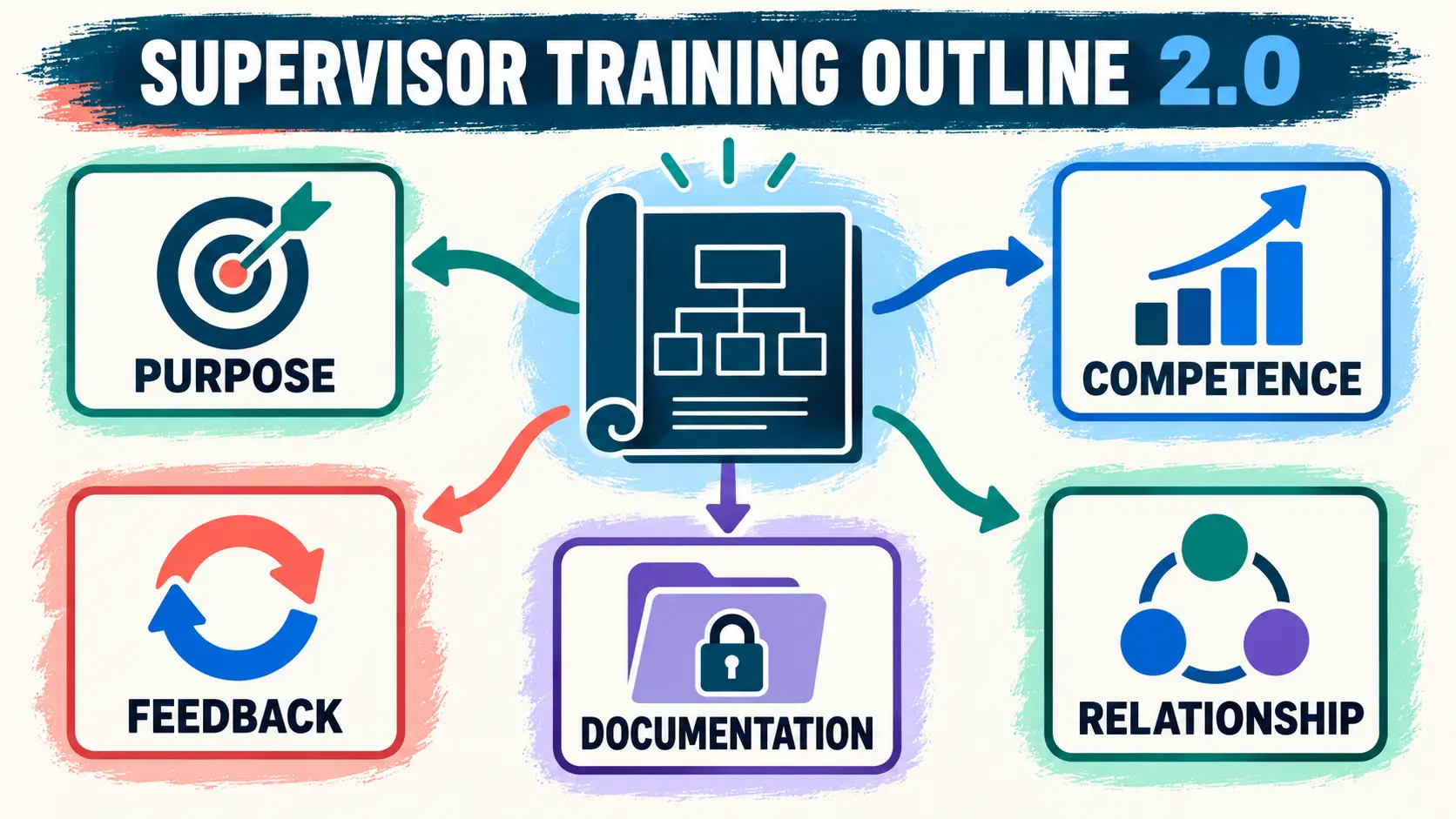
The Supervisor Training Curriculum Outline (2.0) is a BACB-published framework for supervision training. It organizes learning objectives and practical tasks that matter when a supervisor develops another person’s behavior-analytic, professional, and ethical repertoire. It is not a replacement for the BCBA Handbook, the BCaBA Handbook, the RBT Handbook, the Ethics Code, or the supervision forms that apply to a specific relationship.
The outline is best understood as a training blueprint. It tells an eligible training provider what competencies and considerations the course should address; it does not turn every course that mentions “supervision” into qualifying training. A course should be based on the current Outline 2.0, meet the duration and competence requirements, and provide the documentation the BACB requires.
One wording trap is especially important: the training is independent of the BACB. A provider may offer training based on the outline, but that does not mean the BACB sponsors, approves, or endorses that provider’s commercial program. Read the course description and completion document carefully.
Who needs the 8-hour supervision training?
The current BACB supervision page identifies two broad situations. First, the supervisor oversees individuals acquiring fieldwork for BCBA or BCaBA certification. Second, the supervisor oversees current BCaBA or RBT certificants who are required to receive ongoing supervision. In those situations, the supervisor must complete the 8-hour supervision training based on the outline before providing the supervision.
| Role or situation | Why the outline matters | What to verify |
|---|---|---|
| BCBA fieldwork supervisor | The supervisor is training a person acquiring BCBA fieldwork. | Current supervisor eligibility, training completion, contract, and fieldwork forms |
| BCaBA fieldwork supervisor | The supervisor is training a person acquiring BCaBA fieldwork. | The BCaBA Handbook and the responsible supervisor’s qualifications |
| BCaBA or RBT supervisor | The certificant requires ongoing supervision under the applicable credential rules. | The current credential handbook, role-specific requirements, and documentation |
| Trainer or course purchaser | The outline helps screen whether a course is structured around the required objectives. | Provider eligibility, full duration, competence opportunities, and completion record |
A person who is merely reading the outline for exam preparation does not automatically become a supervisor. Likewise, completing a course does not by itself satisfy every other supervisor qualification. The outline training is one gate in a larger system of credential, role, ethics, contract, client access, observation, and documentation requirements.
What topics does the outline cover?
The outline is organized around effective supervision of ongoing behavior-analytic services and supervision of trainees. Its learning objectives are practical rather than purely definitional. A well-designed training should help a learner explain the purpose of supervision, establish a structured relationship, teach and evaluate competencies, monitor effectiveness, and end the relationship responsibly.
- Purpose and outcomes: high-quality client services and development of behavior-analytic, professional, and ethical repertoires.
- Supervision systems: expectations, communication, records, access to sites, time management, and available organizational resources.
- Assessment and feedback: baseline skill assessment, observation, behavioral skills training, performance feedback, and progress monitoring.
- Competency evaluation: objective measures of client performance, supervisee or trainee performance, professionalism, and intervention fidelity.
- Relationships and boundaries: regular communication, response-time expectations, multiple relationships, and conditions for ending supervision.
- Professional development: literature review, peer feedback, consultation, mentorship, and ongoing learning for supervisors.
For a BCBA candidate, the exam connection is the reasoning pattern: supervision should be observable, competency-based, ethical, and responsive to performance data. A supervisor who only lectures about concepts but never observes behavior, sets a mastery criterion, or gives usable feedback is not demonstrating the full training logic.
What should the 8-hour training include?
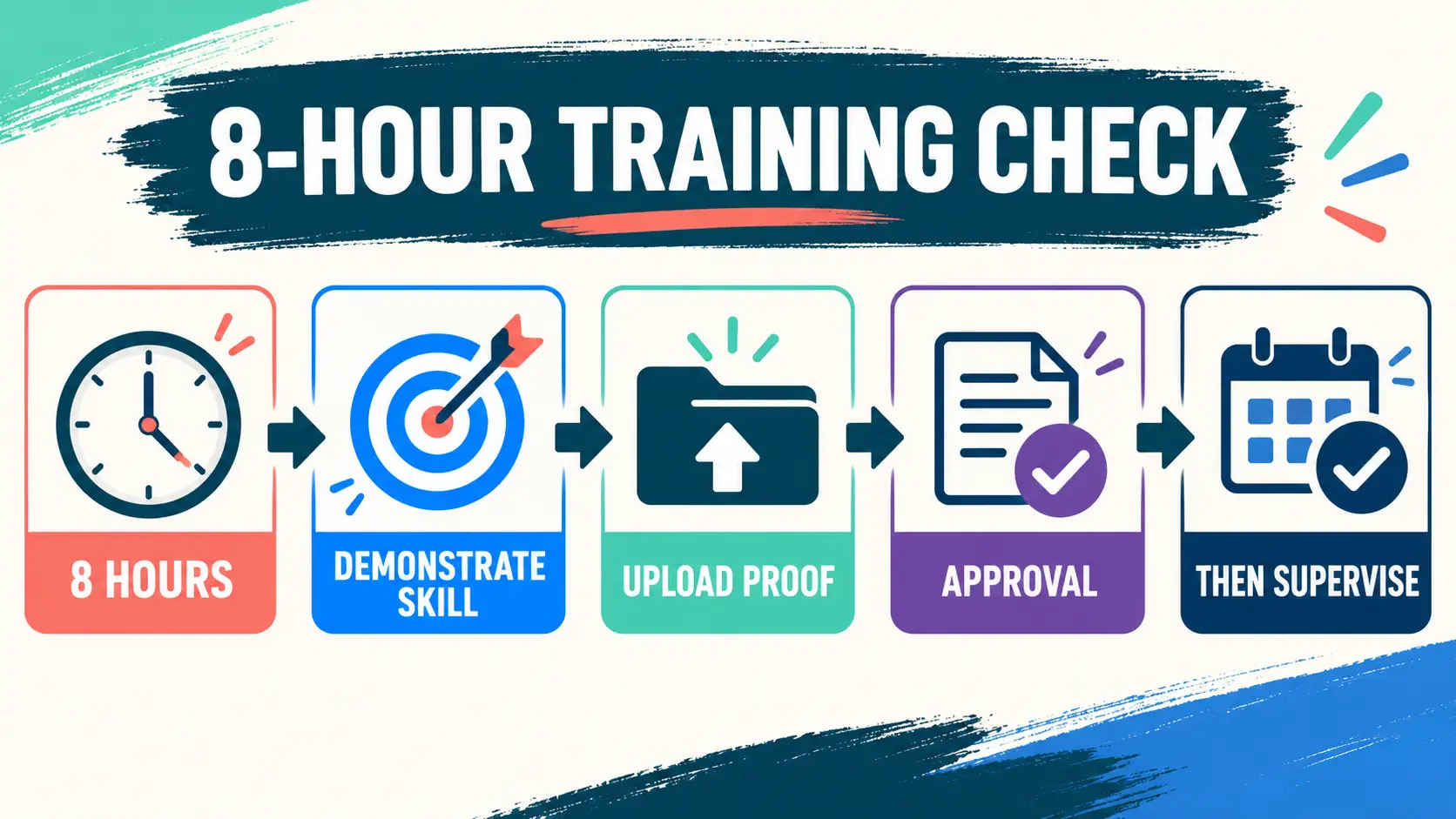
The current outline says the cumulative duration must be at least 8 hours, although the training may be delivered in units as brief as one hour. It may be offered online or in person. Duration alone is not enough: the activities must include opportunities for learners to demonstrate verbal or practical competence in the curricular areas.
That competence requirement is the difference between watching eight hours of generic management content and completing supervision training based on the outline. Ask how the course checks understanding. Examples might include applied case analysis, practice feedback, structured role-play, written performance criteria, or another method that requires the learner to demonstrate the relevant skill. The provider should explain its method clearly. Use this screening table before paying for a course:
| Course question | A reassuring answer | Red flag |
|---|---|---|
| Is the curriculum source identified? | The provider names the current Supervisor Training Curriculum Outline (2.0) and links it. | The page says only “BACB supervision approved” without a document or version. |
| Is the duration cumulative? | The course documents at least 8 total hours and explains the modules. | The course advertises a short certificate without a clear hour total. |
| Can learners demonstrate competence? | The course includes applied demonstrations, practice, or documented evaluation. | It is only passive video viewing with no meaningful opportunity to demonstrate skill. |
| Is the training independent? | Materials state that the program is based on the outline but offered independently of the BACB. | Marketing implies that the BACB endorses the provider or guarantees eligibility. |
What documentation should the learner receive?
The current outline says an ACE Provider must give the learner a one-page document showing completion of the full training, consistent with the ACE Provider Handbook documentation requirements. The training materials and completion document must include the required independent-provider wording. The learner must upload the required documentation to the BACB account.
Save more than the certificate image. Keep the provider name, course title, version of the outline, module dates, total hours, competence-evaluation information, and the one-page completion record in a secure folder. If an audit or application review asks how you met the training requirement, a complete record is easier to defend than a single screenshot with no course context.
- Confirm the provider is eligible to offer the supervision training.
- Record the course title, completion date, total hours, and outline version.
- Save the completion document and the provider’s required wording.
- Keep evidence of the competence activities if the provider supplies it.
- Upload the documentation to the BACB account as instructed.
- Wait for approval and confirm the remaining supervisor qualifications before beginning supervision.
When can a supervisor begin providing supervision?
Completing the eight hours is not the same as receiving permission to supervise anyone in any context. The outline states that the learner must upload the required documentation, and that once the documentation has been approved and all other relevant supervision eligibility requirements are met, the learner may begin providing supervision.
The timing rule also matters. The current PDF says the training may be completed up to 180 days before the learner’s original BACB certification date. That is a timing window, not a reason to skip the other requirements. If you are a new BCBA, check the current handbook and the current supervision page for consulting-supervisor or other role-specific conditions that may apply to your situation.
Before the first supervision meeting, confirm the contract, roles, client access, observation plan, feedback schedule, record system, and applicable forms. A training certificate cannot fix a relationship that has no clear responsibilities or no way to measure whether supervision is effective.
How is the outline different from a supervision contract?
The curriculum outline describes what a supervisor should learn and be able to do. A supervision contract describes how a specific supervisory relationship will operate. The contract should identify responsibilities, meeting structure, observation and feedback expectations, documentation, fees or employment boundaries when relevant, and conditions for changing or ending the relationship.
They work together but cannot substitute for one another. A signed contract does not prove that the supervisor completed the required training. A training certificate does not define the supervisee’s fieldwork plan or prove that the parties are following it. Keep the outline-based training record and the relationship-specific documents in the same secure system.
What mistakes should BCBA candidates avoid?
The most common errors are scope and version errors. Avoid the following:
- Using an old outline or a copied course handout without checking the current BACB PDF.
- Assuming a course is BACB-endorsed because it says it is based on the outline.
- Counting a generic leadership course as the required 8-hour supervision training.
- Ignoring the requirement to demonstrate verbal or practical competence.
- Starting supervision before the documentation is uploaded, approved, and paired with all other eligibility requirements.
- Confusing the training requirement with supervision CEUs, fieldwork hours, or the RBT 40-hour training.
- Signing a contract before clarifying who observes, gives feedback, and stores records.
What is the quick review checklist?
Before relying on a supervisor-training certificate, confirm:
- The provider names the current Supervisor Training Curriculum Outline (2.0).
- The cumulative training time is at least 8 hours.
- The training is online or in person in a format the current source permits.
- Learners have opportunities to demonstrate verbal or practical competence.
- The independent-provider wording appears in the required materials.
- You received a one-page completion record and saved the course evidence.
- The documentation was uploaded to the BACB account.
- All other role, credential, contract, ethics, and documentation requirements are satisfied.
For exam preparation, use the outline to practice recognizing a good supervision decision: define observable performance, collect relevant data, use behavioral skills training when appropriate, provide feedback, and protect the supervisee and client. After reviewing the concept, the free BCBA mock exam can provide exam-style practice and feedback. It is not official BACB training or an official BACB question bank.
Frequently asked questions
Is the Supervisor Training Curriculum Outline a BACB course?: No. It is a BACB-published curriculum framework. A qualifying provider offers training based on it, but the training is independent of the BACB and should not be marketed as BACB endorsement.
How many hours is the required supervisor training?: The current outline requires a cumulative minimum of 8 hours for the relevant supervision training. The course may be divided into shorter units, but the provider should document the complete total and the competence activities.
Can the training be completed online?: The current outline permits training online or in person. Check the live BACB source and the provider’s documentation because the format does not remove the duration, competence, documentation, or other supervisor-eligibility requirements.
Can I supervise immediately after finishing the course?: Not automatically. Upload the required documentation, wait for the applicable approval, and confirm all other relevant qualifications before beginning supervision. The certificate is one requirement in a larger supervision system.
Is the outline the same as the BCBA Task List?: No. The outline focuses on supervision training objectives and tasks. The BCBA Task List or Test Content Outline serves a different purpose: organizing certification or examination content. Do not use one document as a substitute for the other.
Take the Free BCBA Mock Exam
When you are ready to apply the idea, use the free practice resource below for additional feedback. Take the Free BCBA Mock Exam



