

If you searched for BACB certificant data, you may be trying to answer one of several different questions: How many people currently hold a BCBA, BCaBA, or RBT credential? How many certificants are in a state? Is the number growing? Or do you need to verify one person’s current status? The BACB publishes different tools for those tasks, and they should not be treated as interchangeable.
Table of Contents
- What is BACB certificant data?
- What are the latest BACB certificant numbers?
- What does the data page include?
- How is BACB data different from the registry and annual report?
- How should you read regional certificant data?
- What can the numbers tell you about growth?
- What can the data not prove?
- What is the quick data-check checklist?
- Frequently asked questions
- Take the Free BCBA Mock Exam
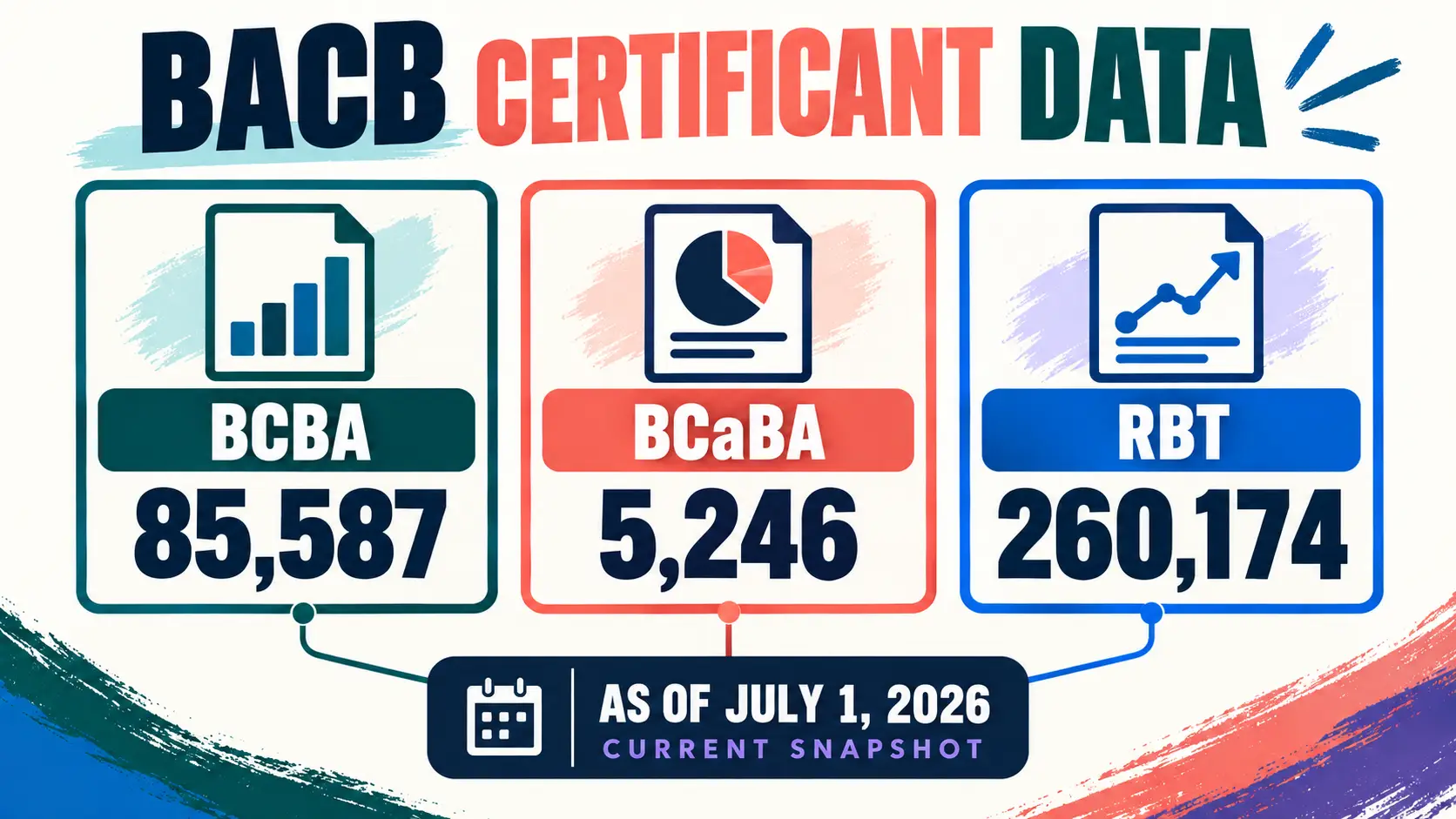
Short answer: the official BACB Certificant Data page is the best starting point for current, organization-level counts and demographic snapshots. On the official page checked for this guide, the numbers listed as of July 1, 2026 were 85,587 BCBAs, 5,246 BCaBAs, and 260,174 RBTs. Because the page is date-sensitive, record the “as of” date whenever you quote a number.
Use the annual data report for historical testing and certification trends, the region-specific tool for geographic questions, and the BACB Certificant Registry for an individual’s credential status. A study candidate can use the numbers to understand the profession, but the data page does not replace the BCBA Handbook, an eligibility decision, or a practice question. Table of Contents
What is BACB certificant data?
BACB certificant data is the board’s public reporting about people who hold BACB credentials and the patterns associated with those credentials. The public data page includes overall counts by certification level, annual trend views, and demographic displays based on information reported in certificants’ BACB accounts. It is a population-level resource, not a page for looking up one person’s name.
The word certificant matters. It refers to an individual who holds a BACB certification or designation in the dataset. A count of certificants is not the same thing as the number of job openings, the number of active clinical providers in a city, or the number of people who passed the exam in one month. Before using a number, identify what is being counted and the date of the snapshot.
For BCBA candidates, the practical value is context. The data can help you understand the size and geographic distribution of the profession, interpret a report used in a class or article, and distinguish certification-level trends from individual credential verification. It cannot tell you whether you personally meet the current BCBA eligibility pathway.
What are the latest BACB certificant numbers?
On the official BACB Certificant Data page checked on October 4, 2026, the headline table reported the following counts as of July 1, 2026:
| Credential | Individuals reported | How to read the figure |
|---|---|---|
| BCBA | 85,587 | People holding BCBA certification in the cited snapshot |
| BCaBA | 5,246 | People holding BCaBA certification in the cited snapshot |
| RBT | 260,174 | People holding RBT certification in the cited snapshot |
These are not permanent facts. A later page visit may show a new snapshot, and a report may use a different end date. If you include the figures in a blog post, presentation, or school assignment, write the source name, URL, access date, and “as of” date. That simple habit prevents a current count from being mistaken for a timeless total.
What does the data page include?
The official page is useful because it combines several views that answer different questions. Read each section as a separate measurement rather than combining every number into one grand total. The live page’s notes and update labels should control if they differ from a saved screenshot or an older article.
- Overall counts: a snapshot of individuals holding BCBA, BCaBA, and RBT credentials.
- Overall counts by year: a trend view that helps you see how the population has changed over time.
- Demographic displays: summaries based on information certificants reported in their BACB accounts.
- Geographic views: region-specific tools that allow a reader to examine locations, credential levels, and time ranges.
- Definitions and access notes: context explaining when the data were updated and how the page may be cited.
One useful reading rule is to keep the numerator and denominator visible. “The number of BCBAs increased” is a statement about counts over time. “BCBAs are becoming a larger share of all certificants” requires a denominator and a clearly defined population. Do not infer a pass rate, employment rate, or service-need rate from a count table that was not designed to measure that outcome.
How is BACB data different from the registry and annual report?
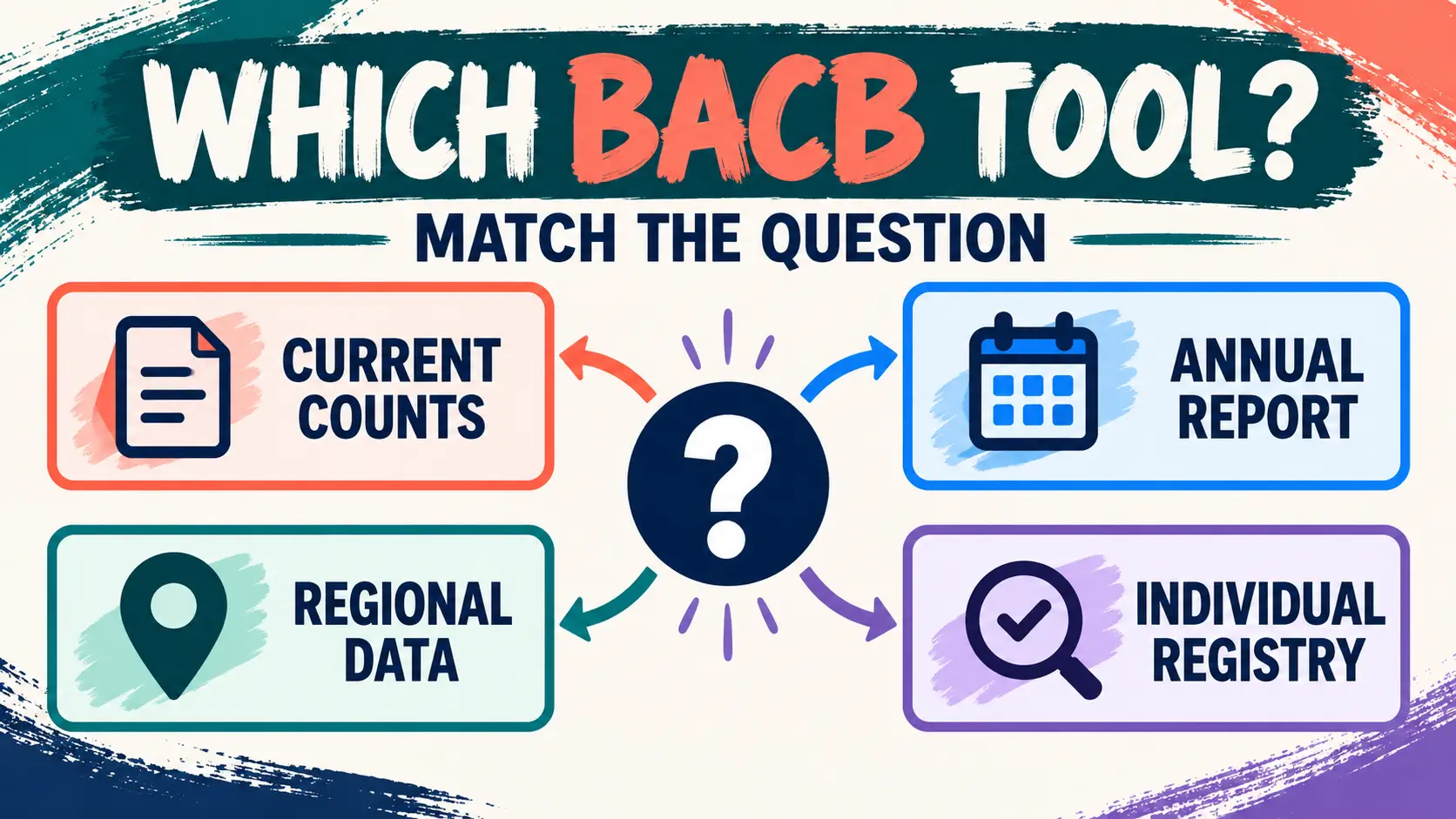
The BACB publishes related resources under similar language, which is why users often land on the wrong page. Choose the tool by the question you are trying to answer. For example, the BACB Annual Data Report is designed for named-year testing and certification figures, while the BACB certification-verification page routes individual status questions to the Registry:
| Resource | Best question | Do not use it as |
|---|---|---|
| BACB Certificant Data | How many people hold each credential, and what broad trends or demographic views are reported? | A personal status lookup or a pass-rate table |
| Annual Data Report | How many candidates tested, passed, or became certified in a named year? | A current count for today or a prediction of future pass rates |
| Region-Specific Certificant Data | How are credentials distributed by state, country, or time range? | Proof that every listed person is available for a particular job |
| Certificant Registry | Is a named person’s certification current, and are reportable disciplinary actions shown? | An estimate of statewide workforce size |
The difference between the data page and the Registry is especially important. A population count answers “how many,” while the Registry answers “which individual and what status.” If you are checking a potential supervisor, employee, or provider, use the BACB’s official verification resource and review the exact credential and status. Do not infer a person’s current status from an old chart or from the number of BCBAs in that person’s state.
How should you read regional certificant data?
Region-specific certificant data can show how many BCBA, BCaBA, RBT, or other listed credential holders appear in a selected location. It is useful for describing distribution, comparing a region over time, or exploring where a credential is concentrated. It is not a directory of available clinicians, a measure of clinical quality, or a guarantee that a provider accepts a particular insurance plan. When you read a regional table, check four details before drawing a conclusion:
- Location definition: Is the table grouped by current location, country, state, or another region?
- Credential filter: Does it include BCBA, BCaBA, RBT, BCBA-D, or more than one level?
- Date range: Is the displayed count a current snapshot, a monthly view, or an annual total?
- Purpose: Are you describing a population, verifying a person, or choosing a service provider?
For example, a candidate comparing graduate programs might use regional data as background context, while an employer verifying a credential should use the Registry. Both actions are reasonable, but they need different evidence.
What can the numbers tell you about growth?
Yearly counts can help you describe the expansion or contraction of the BACB credential population. A careful comparison names the two dates, uses the same credential definition, and avoids treating a change in the count as proof of one specific cause. Certification counts can be affected by new certifications, expirations, voluntary inactive status, recertification timing, geographic movement, and changes in reporting or eligibility rules.
Use a simple trend sentence: “The official annual series reports a different number of BCBA certificants at the end of Year A and Year B.” If you calculate a percentage change, show the formula and label it as a calculation from the source counts. Do not convert the trend into a promise that a student will find a job, pass the exam, or earn a particular salary.
- Compare like with like: BCBA with BCBA, not BCBA with all certificants.
- Use the report’s stated endpoint, not an assumed calendar-year endpoint.
- Separate the number of candidates tested from the number newly certified.
- Keep current snapshots separate from historical annual reports.
- Explain that correlation in a graph does not identify the cause of a trend.
What can the data not prove?
Public statistics are valuable, but they are not a complete picture of behavior-analytic practice. A credential count does not show whether a certificant is actively accepting clients, works full time, practices independently, supervises trainees, or lives in the same state where a service is delivered. It also does not tell you whether a specific program is a good fit.
Demographic displays require the same caution. They reflect information reported in BACB accounts and may have their own update date. Avoid assigning a characteristic to every certificant, identifying individuals from a small group, or treating missing data as evidence that a group is absent. Use the official page’s notes and definitions before making a public claim.
What is the quick data-check checklist?
Before quoting or using BACB certificant data, ask:
- Did I open the official BACB page rather than rely on a copied graphic?
- Did I record the page’s “as of” date and my access date?
- Am I using the overall data page, annual report, regional tool, or Registry for the correct task?
- Did I keep BCBA, BCaBA, RBT, and BCBA-D categories separate?
- Did I avoid treating a population count as proof of an individual’s current status?
- Did I avoid turning a trend into a pass-rate, salary, employment, or quality claim?
- Can another reader open the official URL and reproduce the number?
If you are preparing for the BCBA examination, use credential statistics as context, not as a substitute for studying the current content outline. After you identify the domain or concept you need to practice, the free BCBA mock exam can give you exam-style practice and feedback. It is a study resource, not an official BACB dataset or a guarantee of a particular result.
Frequently asked questions
What is the difference between BACB certificant data and the BACB Registry?: BACB certificant data describes population-level counts and trends. The Certificant Registry is used to search for an individual’s credential and status. Use the Registry when the question is about a named person.
How many BCBAs are there?: The official page checked for this guide reported 85,587 BCBAs as of July 1, 2026. The number is date-sensitive, so quote the source and snapshot date rather than presenting it as a permanent total.
Does BACB certificant data show who passed the exam?: Not by itself. The overall data page is about certificant counts and related displays. Use the BACB Annual Data Report for named-year testing and pass-rate information, and keep those figures separate from the current population snapshot.
Can I use regional data to find a BCBA near me?: Regional data can provide background about credential distribution, but it is not a provider-availability directory. For an individual credential check, use the official Registry and then separately confirm licensure, service availability, payer participation, and fit. Why can two BACB pages show different numbers?: They may use different snapshot dates, filters, credential categories, or measurement purposes. Compare the date, definition, and source before deciding that one page is wrong.
Take the Free BCBA Mock Exam
When you are ready to apply the idea, use the free practice resource below for additional feedback. Take the Free BCBA Mock Exam



