

Quick answer: pediatric ABA is applied behavior analysis delivered to children in a coordinated care context. It may help a child build communication, play, social participation, adaptive, school-readiness, or daily-living skills while the team studies what supports learning and safety. The useful question is not whether every child should receive the same program. It is whether the goals, setting, teaching approach, data, family role, and supervision fit this child and family.
Table of Contents
- What Does Pediatric ABA Mean?
- What Goals Can Pediatric ABA Address?
- How Does a Pediatric ABA Plan Develop?
- What Does the Pediatric ABA Care Cycle Include?
- Which Pediatric ABA Setting Might Fit?
- Who Is on a Pediatric ABA Team?
- How Is Progress Measured in Pediatric ABA?
- How Should Pediatric ABA Respect the Child?
- What Should Families Ask About Cost and Coverage?
- What Questions Should Families Ask a Pediatric ABA Provider?
- How Do Pediatric ABA Settings and Teams Compare?
- What Are Signs of a Good Fit?
- Pediatric ABA FAQ
- Is pediatric ABA only for toddlers?
- How many hours of pediatric ABA does a child need?
- Does a child need an autism diagnosis before families ask about ABA?
- Key Takeaway
- Take the Free BCBA Mock Exam
Pediatric ABA is a service description, not a diagnosis and not a promise of a particular outcome. A clinic, home-based team, school partner, or community provider may use the phrase differently. Before enrolling, ask who assesses the child, who designs and supervises the plan, who delivers direct care, how progress is measured, and how the team responds when the child communicates discomfort or needs a different kind of support.
What Does Pediatric ABA Mean?
Pediatric ABA applies behavior-analytic principles to goals that matter in a child’s real life. A team may look at what happens before and after a response, how the environment affects participation, which skills are missing or emerging, and what teaching arrangement makes practice more successful. The plan should be individualized rather than copied from a standard package.
The BACB describes behavioral pediatrics as an application of behavior analysis to behavior problems in pediatric medical settings, but pediatric ABA services can also occur in homes, clinics, schools, and community routines. The label alone does not tell you the setting, credential, intensity, or clinical quality. It is a starting point for questions, not a complete description of care.
Families may encounter RBTs, behavior technicians, BCaBAs, BCBAs, educators, speech-language pathologists, occupational therapists, physicians, and other professionals. Their responsibilities are not interchangeable. The person implementing a teaching plan may be the person who sees the most day-to-day detail, while the qualified clinician remains responsible for assessment, plan design, supervision, and clinical decisions within the applicable rules.
What Goals Can Pediatric ABA Address?
Goals should be observable, meaningful, and connected to the child’s daily participation. Depending on the assessment and family priorities, a plan might address:
- Functional communication, such as requesting help, rejecting safely, answering, or using an augmentative communication system.
- Play, shared attention, turn-taking, imitation, and participation with siblings or peers.
- Daily routines such as dressing, eating, toileting, handwashing, sleep preparation, or leaving the house.
- Transitions, waiting, tolerating changes, and using a break or coping response.
- Early learning and school-readiness skills that are relevant to the child’s educational environment.
- Reducing behavior that interferes with communication, learning, health, or safety while teaching a functional alternative.
A useful goal does not merely say “be more compliant” or “reduce behaviors.” It explains what the child will do, in which situation, with what level of support, and why the change matters. A family should be able to recognize the goal in ordinary life. If a target does not make sense to the people who live with the child, ask the team to explain its practical purpose and how the child’s preferences were considered.
How Does a Pediatric ABA Plan Develop?
Strong planning is a loop rather than a one-time label. The team gathers information from caregivers and relevant professionals, observes the child in appropriate contexts, defines the skills or behaviors clearly, selects teaching procedures, and decides what data will answer the clinical question. The family should know which decisions are preliminary, which are documented in the plan, and when the team will review the results.
Assessment does not mean a BCBA is diagnosing every developmental or medical condition. It means the behavior-analytic team is gathering information within its scope to decide what services it can provide and how to measure them. Concerns about hearing, language, sleep, pain, nutrition, medication, or other health factors may require coordination with the child’s medical team.
What Does the Pediatric ABA Care Cycle Include?
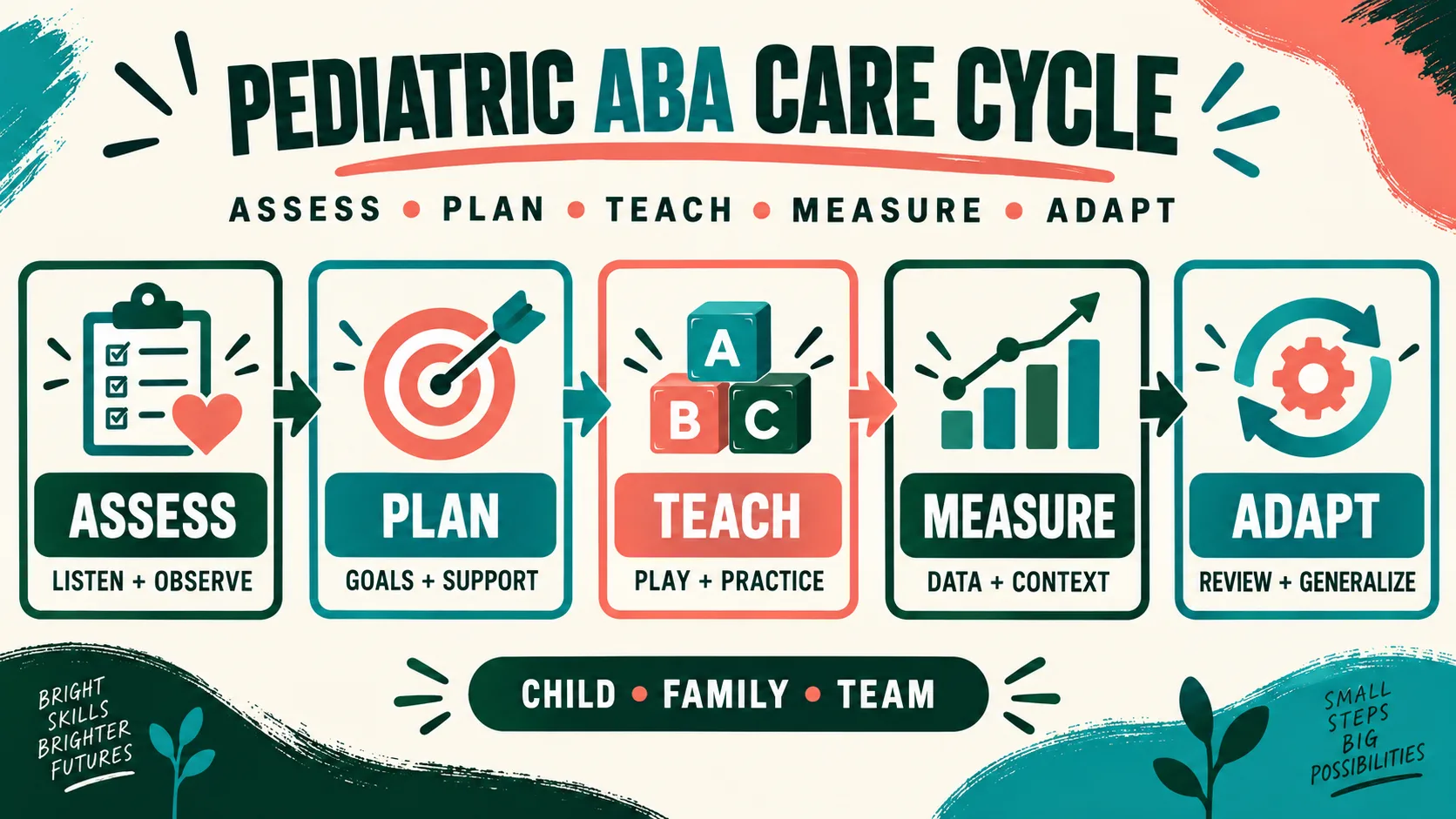
The care cycle can be remembered as assess, plan, teach, measure, and adapt. The order is simple; the clinical reasoning is not. A therapist may teach a target through play, a routine, structured practice, or a carefully arranged opportunity. The team then looks at the response and decides whether the teaching arrangement, prompt, reinforcement, goal, or setting needs review.
Progress should not be reduced to a single score. A child may acquire a response in a clinic but need more support to use it at home, at school, or with another communication partner. Generalization and maintenance matter. A plan that improves a graph but makes daily life harder deserves a careful conversation about whether the target and procedure are actually useful.
Which Pediatric ABA Setting Might Fit?
There is no universally best setting. The right choice depends on the child’s goals, safety, tolerance, family capacity, school schedule, transportation, available providers, and payer rules. A setting can be clinically sound and still be a poor practical fit if the family cannot sustain the schedule or the team cannot coordinate with other supports.
| Setting | Potential strength | Questions to ask |
|---|---|---|
| Clinic or center | Consistent materials, multiple teaching spaces, and access to a wider team | How will skills transfer to home, school, and community routines? |
| Home | Practice can be connected to family routines and the child’s own materials | How are privacy, siblings, caregiver choice, and boundaries handled? |
| School or early learning | Goals can be coordinated with participation, learning, and classroom routines | Who has educational authority, and how will consent and communication work? |
| Community | Skills can be practiced where the child actually needs them | How will safety, public privacy, transportation, and data collection be managed? |
Read the site’s separate guides on in-home ABA therapy and school-based ABA therapy when one of those settings is the main decision. This article is the broader map; the setting-specific pages can answer the narrower workflow questions.
Who Is on a Pediatric ABA Team?
A team may include a BCBA or another qualified clinical supervisor, a BCaBA where permitted, an RBT or behavior technician, caregivers, teachers, and related professionals. The title “therapist” is not enough to identify scope. Ask who can change the plan, who reviews data, who communicates with the payer or school, and who is available when a safety or ethical concern appears.
Family participation can range from sharing priorities and routines to practicing agreed strategies, observing sessions, or reviewing data. Participation should be collaborative, not a transfer of clinical responsibility to a caregiver without training or support. A family can ask for plain-language explanations and can raise a concern about a goal, procedure, schedule, or fit.
How Is Progress Measured in Pediatric ABA?
Measurement should answer a useful question. Depending on the goal, the team may track frequency, duration, latency, percentage of independent responses, prompt level, opportunities completed, or another defined dimension. The data system should tell the team what happened and help it decide whether to continue, modify, generalize, or fade support.
Ask to see an example of how the provider explains progress to families. A graph without context can be confusing. The team should explain the target, the observation conditions, the level of help, meaningful changes in the child’s daily life, and any limitations in the data. If a child is distressed, refusing, or communicating a need for a break, the team should treat that information as clinically relevant rather than simply as a failure to comply.
How Should Pediatric ABA Respect the Child?
Ethical care includes attention to dignity, assent, privacy, communication, and the least intrusive effective support within the applicable professional and legal framework. A child may communicate willingness or discomfort through words, gestures, movement, body language, or behavior. Assent is not the same as asking a child to make every clinical decision, but it is a reason to observe, listen, adjust, and escalate concerns appropriately.
Ask how the team responds when the child says no, moves away, shows distress, or needs a break. Ask how the provider distinguishes a safety emergency from ordinary refusal, how replacement communication is taught, and who reviews a procedure that is not working. A provider should be able to answer without reducing the child to a behavior score.
What Should Families Ask About Cost and Coverage?
Coverage depends on the health plan, state, diagnosis or authorization rules, service codes, provider network, deductibles, and the setting. A provider may help with benefits verification, but the family should confirm the details with the plan and request written information about authorization, expected out-of-pocket costs, cancellations, transportation, and what happens if the plan changes.
- Which services are being requested, and which clinician writes or signs the required documentation?
- Is the provider in network, and what does the plan say about deductibles, copays, coinsurance, and limits?
- Are caregiver training, assessment, coordination, and direct services handled under separate rules?
- What happens during an authorization gap, waitlist, denial, or change in the child’s needs?
- Which state early-intervention, school, or community resources should the family contact separately?
The CDC access-to-services guidance explains that early-intervention pathways can help young children and that families may need to contact their state system directly. Do not assume that a referral, diagnosis, or insurance approval works the same way in every state.
What Questions Should Families Ask a Pediatric ABA Provider?
Before choosing a program, ask for concrete answers rather than broad promises:
- What are the first goals, and how do they connect to our child’s communication, safety, independence, or participation?
- Which credentialed professional assesses and supervises the program?
- Where will services happen, and how will skills generalize across people and settings?
- What data will you collect, how will you review them, and how will we see the results?
- How will you respond to distress, refusal, breaks, communication differences, and safety concerns?
- How will you coordinate with school, speech, occupational therapy, medical care, and other supports?
- What training and supervision does each person delivering direct care receive?
- How do you decide when to change a goal, fade support, pause a procedure, or discharge?
How Do Pediatric ABA Settings and Teams Compare?
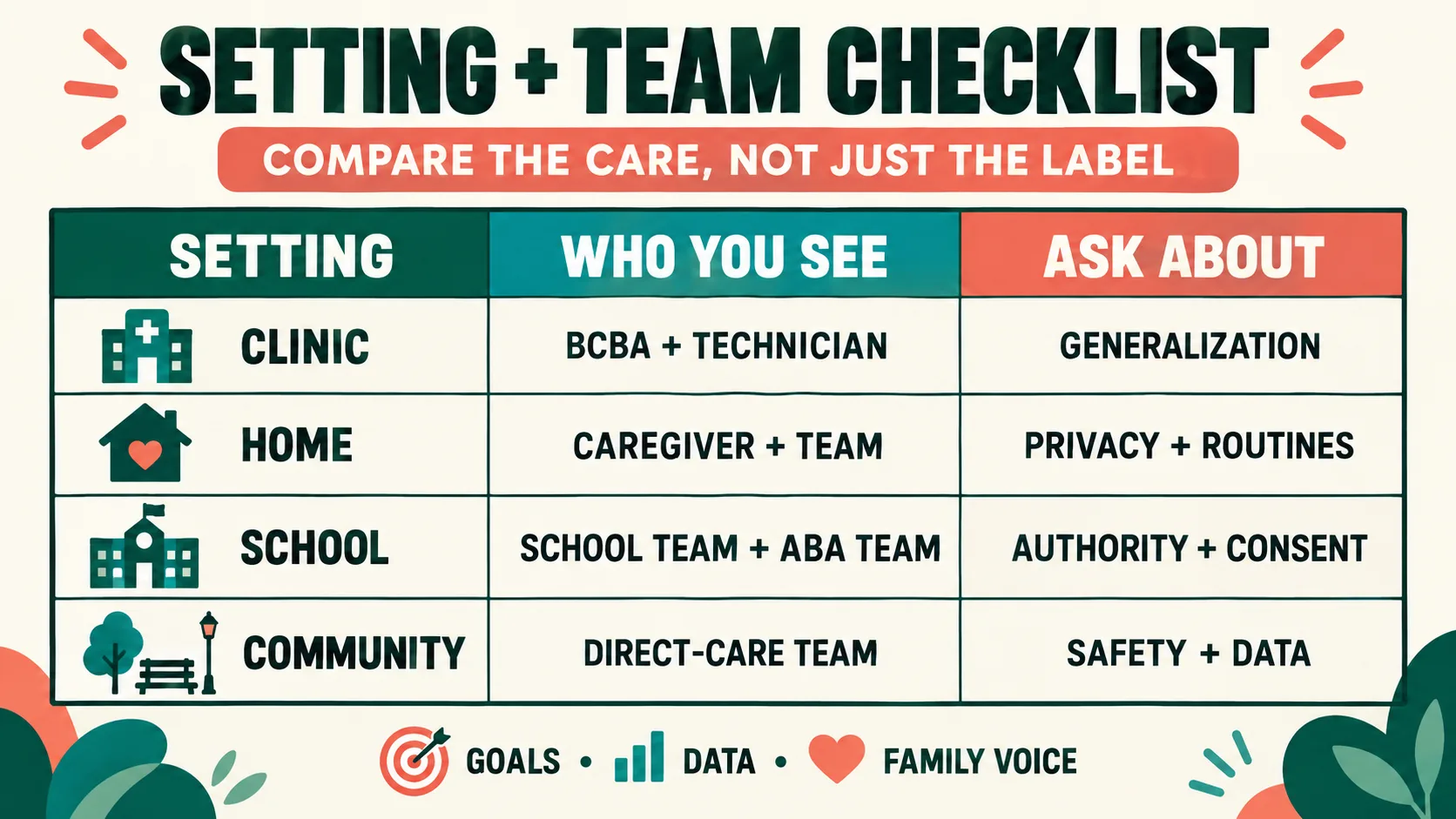
Use the matrix as a conversation starter, not as a ranking. The best answer is the one that makes the service’s responsibilities, communication path, and review process visible. If a provider cannot explain who is responsible for a decision or how the family can raise a concern, keep asking before signing up.
What Are Signs of a Good Fit?
A good fit is not defined by a polished brochure. It is reflected in specific, respectful answers. The team can explain goals in plain language, identify the supervisor, show how data influence decisions, adapt to the child’s communication, coordinate with other supports, and discuss limits without promising a guaranteed result. The family understands the schedule and cost questions, and the child’s dignity is treated as part of quality rather than an optional extra.
Be cautious when a provider guarantees a result, treats one setting or number of hours as correct for every child, refuses to explain who makes clinical decisions, discourages questions, or presents a generic curriculum as an individualized plan. A disagreement does not automatically prove poor care, but a team should be willing to explain its reasoning and listen to family concerns.
Pediatric ABA FAQ
Is pediatric ABA only for toddlers?
No. Pediatric usually means care for children, but the age range and service definition vary by provider, state, payer, and program. A toddler-focused page, a school-age clinic, and a hospital behavioral-pediatrics service may all use different goals and workflows. Ask the provider to define the ages, settings, and needs it actually serves.
How many hours of pediatric ABA does a child need?
There is no universal schedule that can be responsibly prescribed from a search phrase. The appropriate service pattern depends on individualized goals, assessment, health and safety needs, family capacity, school or childcare, clinical reasoning, and authorization rules. Ask the team to explain the recommendation and how it will be reviewed rather than accepting a fixed number as a guarantee.
Does a child need an autism diagnosis before families ask about ABA?
Eligibility and referral rules vary. Families can discuss developmental or behavioral concerns with a pediatrician, state early-intervention program, school system, health plan, or qualified provider. ABA is not a substitute for a medical or developmental evaluation, and families should not delay appropriate health or communication support while waiting for one pathway to finish.
Key Takeaway
Pediatric ABA should be understandable, individualized, measurable, and connected to real participation. Compare the setting, team roles, goals, data, family support, consent, and coverage—not just the brand name or promised schedule. If you are learning the analyst-level concepts behind measurement, reinforcement, ethics, and supervision, you can also use the site’s free BCBA mock exam for structured practice. For targeted review, use our pediatric aba practice questions to apply the concept in exam-style scenarios.
Take the Free BCBA Mock Exam
If you want a low-pressure way to check your recall, use the free practice resource below. Take the Free BCBA Mock Exam



