
OBM CEUs BCBA searches usually come from one of two decisions: a BCBA wants continuing education about organizational behavior management, or a 2027 applicant wants to know whether an OBM CEU can satisfy the new coursework requirement. The short answer is important: an OBM topic can be useful Learning CE, but a CEU certificate does not automatically replace graduate-level academic credit or the 2027 Pathway 2 freestanding course requirement.
Table of Contents
- What Does OBM CEUs BCBA Mean?
- OBM CEUs and 2027 Coursework
- What Changes for OBM in 2027?
- How to Choose and Verify OBM CEUs
- How to Document the Credit
- Common OBM CEU Mistakes
- BCBA Study and Career Lens
- FAQ
- Take the Free BCBA Mock Exam
Organizational behavior management can cover performance analysis, staff training, supervision, behavioral systems, organizational culture, and leadership. The BACB includes OBM as a 2027 Pathway 2 coursework area, while continuing education is a separate maintenance activity. A course title that contains “OBM” is not enough to tell you which requirement it satisfies.
This guide separates OBM CEUs from 2027 eligibility coursework, shows how to verify a provider and certificate, and gives a recordkeeping workflow. Requirements can change, so use the current BACB 2027 BCBA Requirements document and your current handbook before relying on any specific course. Table of Contents
What Does OBM CEUs BCBA Mean?
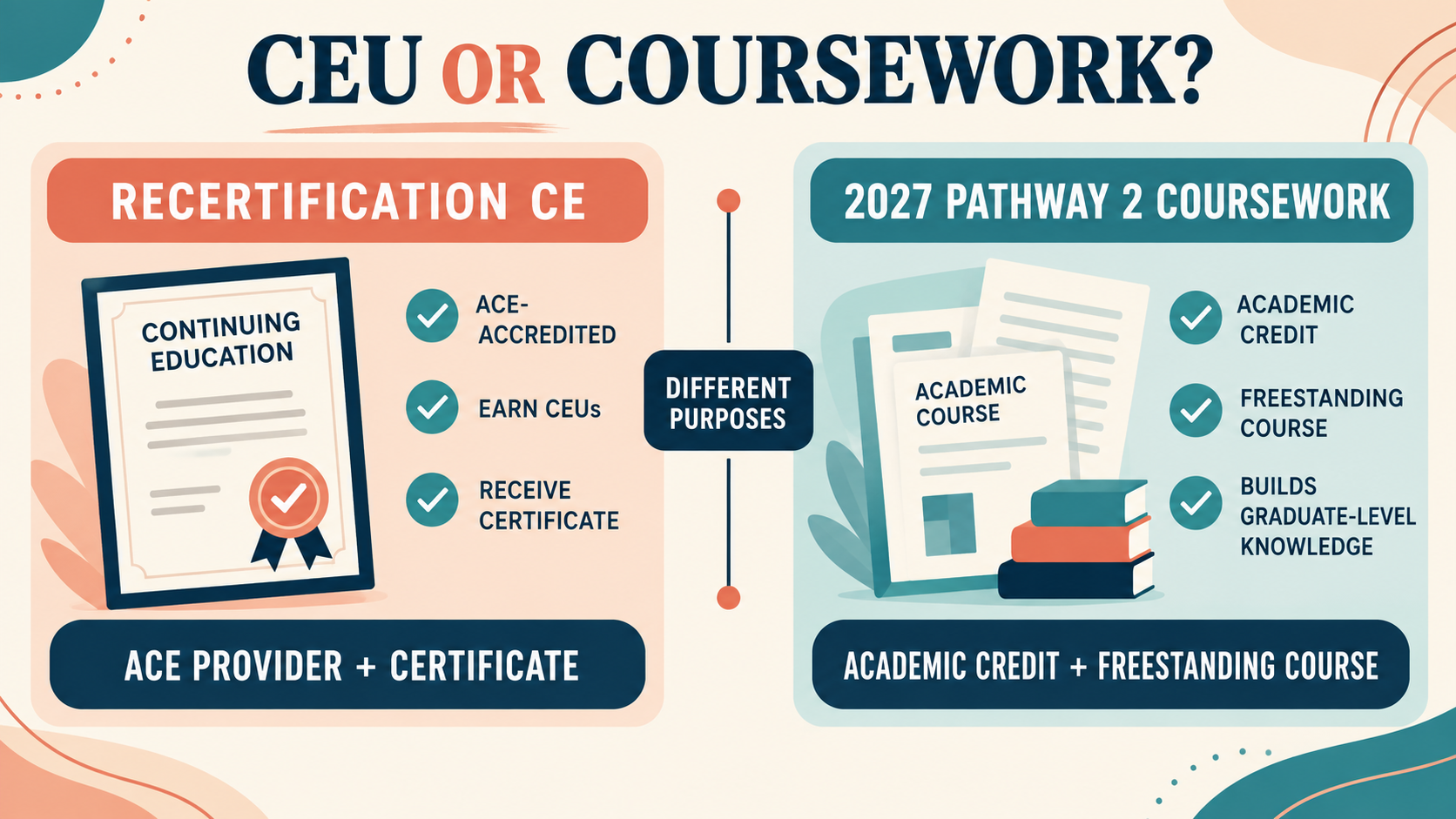
OBM CEUs are continuing-education learning opportunities about applying behavior-analytic principles to organizational performance and workplace systems. Depending on the event, a provider may discuss performance measurement, feedback, training, leadership, systems analysis, culture, or staff support. The subject can be professionally valuable even when it is not part of an initial certification coursework transcript.
For a currently certified BCBA, an OBM event may be recorded as Learning CE when the provider, event, audience, content, completion evidence, and certification-cycle timing meet the applicable BACB requirements. OBM is a topic; it is not an automatic approval label. A provider’s marketing page cannot, by itself, decide whether the credit counts.
For someone pursuing certification through the 2027 Pathway 2 coursework route, the question is different. The 2027 requirements describe Organizational Behavior Management as 45 instructional hours within one freestanding course, as part of 315 total behavior-analytic coursework hours. The requirement involves academic coursework and credit, not simply a certificate for attending a continuing-education event. Start by identifying which job the activity is supposed to do:
- Maintenance: build professional knowledge and potentially count qualifying CE toward a current certification cycle.
- Initial eligibility: satisfy a defined coursework area in an approved or qualifying academic pathway.
- Exam preparation: understand OBM concepts that may appear within the current exam content, without treating a CE certificate as exam credit.
- Career development: practice organizational analysis or leadership skills that support a role, portfolio, or consulting plan.
OBM CEUs and 2027 Coursework
The safest way to avoid an expensive misunderstanding is to compare the evidence required for each purpose. A course can be excellent professional development and still fail to satisfy an academic eligibility requirement.
| Question | OBM continuing education | 2027 Pathway 2 OBM coursework |
|---|---|---|
| Purpose | Ongoing professional development and possible CE credit during a certification cycle. | Initial BCBA eligibility through the behavior-analytic coursework pathway. |
| Evidence | ACE-provider or other applicable completion record, certificate, event details, and cycle documentation. | Academic credit, transcript, passing grade, qualifying program contact, and the required freestanding course structure. |
| Time label | CE amount or event duration stated by the provider. | 45 instructional hours in one freestanding OBM course under the 2027 content table. |
| Can one automatically replace the other? | No. A CEU certificate does not automatically establish academic coursework. | No. An academic course should not be treated as a CEU event without checking the applicable provider and record rules. |
Ask a program contact or advisor before enrolling if your purpose is Pathway 2 eligibility. The 2027 requirements say Pathway 2 coursework must be completed in a program with a qualified Pathway 2 Program Contact, at the master’s or doctoral level at the qualifying institution where you are enrolled, for academic credit, and with a passing grade. Those are different signals from an ACE certificate.
What Changes for OBM in 2027?
The 2027 transition is why this query deserves its own page. Under the transition guidance, the prior “Personnel Supervision and Management” area is reorganized as Organizational Behavior Management. The high-level comparison changes the OBM allocation from 30 hours to 45 hours and specifies one freestanding course for the 2027 area. The total behavior-analytic coursework remains 315 hours, but the content grouping and freestanding-course rules change.
| Coursework view | Earlier 2022 grouping | 2027 Pathway 2 grouping |
|---|---|---|
| Name | Personnel Supervision and Management | Organizational Behavior Management |
| Instructional hours | 30 hours | 45 hours in one freestanding course |
| What the content can include | Personnel supervision and management within the earlier content structure. | Performance analysis and management, supervision, staff training, systems analysis, organizational culture, and leadership. |
The transition guidance says applicants who completed some coursework under the 2022 requirements should compare their previous course content with the 2027 areas. If a previous course combined OBM-related content with other areas, the course title alone may not answer whether it maps cleanly. Review the syllabus, credit, content hours, and freestanding-course status with the program contact.
Do not confuse this eligibility change with a promise that the BCBA examination itself changed in the same way. The BACB’s transition guidance states that the BCBA exam is based on the BCBA Test Content Outline, 6th edition, and that exam/TCO updates occur independently of certification-requirement changes.
How to Choose and Verify OBM CEUs
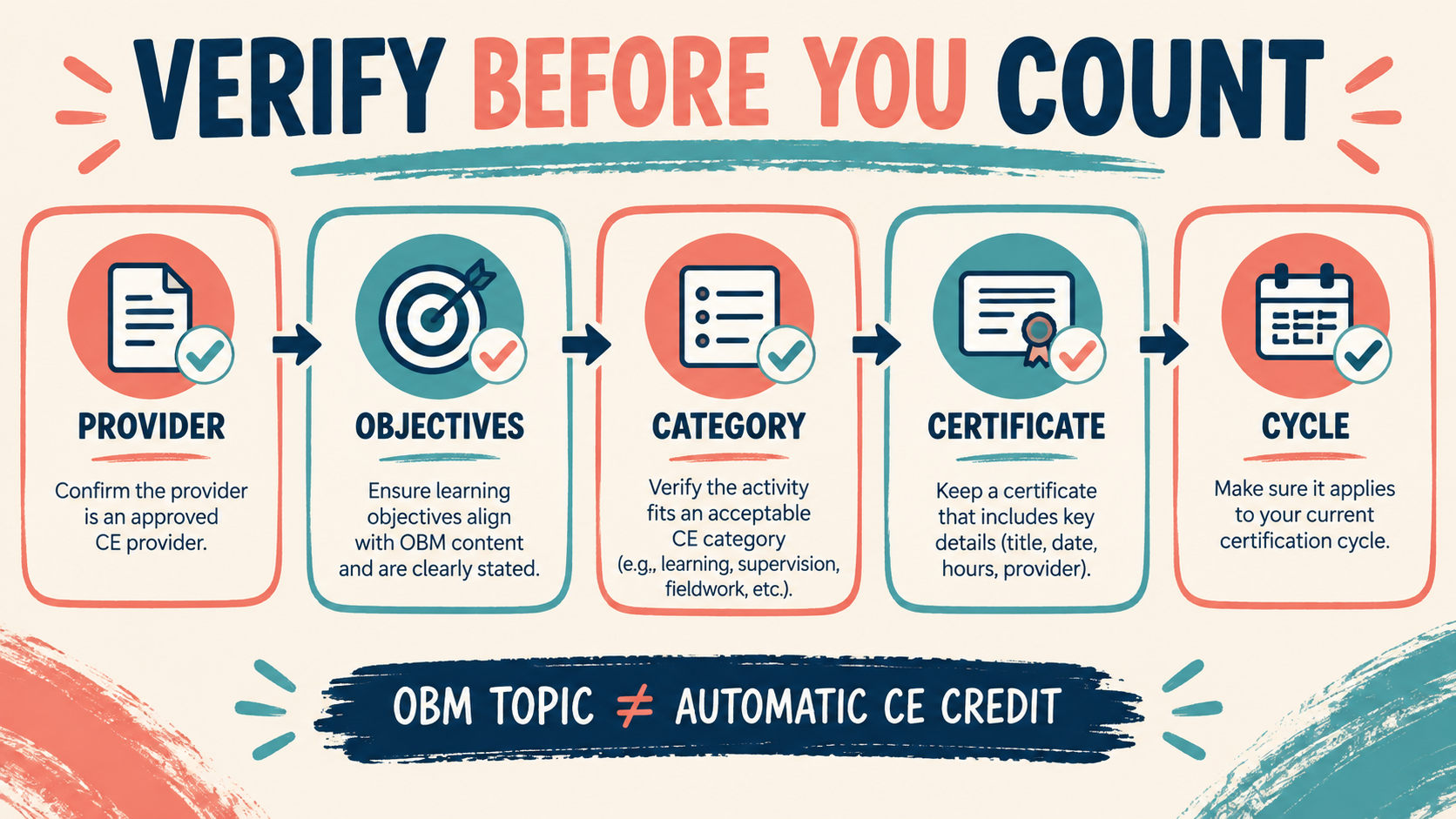
If your goal is professional development or renewal credit, evaluate the event as a CE activity rather than assuming the OBM label does the work. Use the current BACB Authorized Continuing Education Providers page and the ACE Provider Verification Registry when the event claims ACE authorization.
- Verify the provider. Search the provider’s name in the current registry and make sure the legal or public name matches the course page.
- Read the learning objectives. Look for specific OBM content such as performance analysis, feedback, training, systems, leadership, or organizational culture—not only a career promise.
- Confirm the audience. Check that the event is offered for BCBA or BCaBA Learning CE when that is the credit you need.
- Check the category. OBM is not automatically Ethics or Supervision CE. A category requires content that meets the applicable definition.
- Check the evidence. Confirm the event supplies a certificate or record showing your name, title, provider, date, amount, and any category designation.
- Check your cycle. Make sure the completion date fits your current certification cycle and that the credit fills a real gap rather than duplicating an activity.
A useful decision sentence is: “I am taking this event for Learning CE about OBM, and I can verify the provider, audience, completion record, and cycle.” If your sentence instead says, “This certificate should count as my 45-hour graduate OBM course,” stop and speak with the qualifying program before purchasing.
How to Document the Credit
Keep an OBM CE record that a reviewer can understand without opening the provider’s dashboard. Save the course page or syllabus, registration receipt, completion screen, certificate, and the provider’s category or audience statement. Record the completion date, CE amount, and certification cycle in your own tracker.
- Provider: exact provider name and ACE status when applicable.
- Course: exact title, instructor, learning objectives, and OBM topics.
- Completion: date, duration or credit amount, assessment or attendance evidence, and certificate location.
- Category: Learning, plus Ethics or Supervision only when the provider and content support that designation.
- Cycle: the two-year certification cycle or other applicable period.
- Purpose: renewal learning, career development, exam study, or a separate academic requirement.
For 2027 Pathway 2 coursework, keep a different file set: institution and program information, syllabus, transcript, passing grade, content-hour mapping, and evidence that the course is freestanding. If you store both records in one folder, name them clearly so a CE certificate is not accidentally offered as academic evidence.
Common OBM CEU Mistakes
- Using an OBM title as proof of eligibility: topic similarity does not establish academic credit or freestanding-course status.
- Calling an event “BACB approved” without checking the provider: verify current ACE status and use precise language.
- Assuming OBM is automatically Supervision CE: organizational leadership and supervision can be related without satisfying the category definition.
- Counting a certificate toward the 45-hour requirement: a CE amount and academic instructional hours are not interchangeable labels.
- Ignoring the current cycle: useful OBM learning may not solve a category or timing gap in the present renewal period.
- Trusting a 2022 course title: compare the syllabus and content hours with the 2027 Pathway 2 requirements.
- Assuming the exam changed because coursework changed: certification requirements and the exam/TCO are separate update tracks.
BCBA Study and Career Lens
For the BCBA exam, OBM sits inside a larger behavior-analytic framework that includes measurement, performance analysis, supervision, training, and systems-level decision-making. For certification planning, the 2027 requirements document is the higher-priority source because it tells you what Pathway 2 coursework must look like. For maintenance, the current BCBA Handbook and ACE resources govern continuing education documentation.
OBM CEUs can be a smart professional-development choice even when they do not solve an initial eligibility requirement. Choose them because the objectives help you analyze performance, design feedback, train staff, or evaluate organizational systems—not because the word “OBM” promises a credential.
Once you have separated CE documentation from exam preparation, the free BCBA mock exam can be used as optional scenario practice. It is not a CEU event, an academic course, a BACB form, or a guarantee of certification.
FAQ
Can OBM CEUs count toward BCBA renewal?: They may, when the event and provider meet the applicable requirements and you retain appropriate completion evidence. Verify the provider, audience, content, amount, category, and certification-cycle timing before counting the credit.
Can OBM CEUs replace the 2027 OBM coursework requirement?: Do not assume they can. The 2027 Pathway 2 requirement describes 45 instructional hours in one freestanding Organizational Behavior Management course with academic credit and other pathway conditions. A CEU certificate is different evidence.
Is OBM automatically Supervision CE?: No. OBM may discuss supervision, leadership, or staff training, but the event must meet the applicable Supervision CE content definition to receive that designation. Check the provider’s documentation and current BACB guidance.
What should I verify before buying an OBM CEU course?: Verify the provider’s current status, course objectives, audience, CE category, duration, certificate fields, completion rules, and fit with your certification cycle. Save the evidence before access to the course expires.
Bottom line: OBM CEUs can support a BCBA’s continuing education and career development, but they are not automatically 2027 Pathway 2 coursework. Match the activity to its purpose, verify the provider and evidence, and keep CE records separate from academic eligibility records.
Take the Free BCBA Mock Exam
If you want a low-pressure way to check your recall, use the free practice resource below. Take the Free BCBA Mock Exam



