

If you are researching an ABA franchise, the most important question is not whether the brand looks polished. It is whether the franchise system gives you a workable combination of clinical quality, local compliance, payer access, staffing support, and financial control. A recognizable name can reduce some startup friction, but it cannot make an unsuitable territory, weak clinical model, or unfavorable contract disappear.
Table of Contents
- What Is an ABA Franchise?
- Is an ABA Franchise a Fit for a BCBA?
- How to Read the Franchise Disclosure Document
- ABA Franchise Clinical and Compliance Due Diligence
- State, Payer, and Staffing Checks
- How to Test the ABA Franchise Business Model
- ABA Franchise Red Flags
- A Practical Decision Workflow
- ABA Franchise FAQ
- Take the Free BCBA Mock Exam
This guide is for BCBAs, clinical directors, and operators comparing a franchise with an independent ABA practice. It is an educational due-diligence framework, not legal, tax, investment, or clinical advice. Before you sign, pay, or rely on an earnings claim, review the current disclosure documents with qualified professionals and confirm local requirements.
What Is an ABA Franchise?
An ABA franchise is a business arrangement in which a franchisor licenses its brand, operating system, training, and support model to a local franchisee. The franchisee typically pays an initial fee and ongoing royalties or other charges, then operates a location under a contract that defines approved services, territory, marketing, technology, purchasing, reporting, and exit rules.
The clinical work is still delivered to real clients in a real jurisdiction. That means a franchise decision has two layers. The first is the commercial relationship: fees, territory, required vendors, renewal, transfer, and termination. The second is the clinical and regulatory operation: supervision, documentation, treatment quality, staff competence, privacy, payer rules, and the professional judgment of the BCBA team. A strong brand does not transfer responsibility for local care.
- Franchisor: supplies the licensed system, brand standards, training, and contractual support.
- Franchisee: funds and operates the local business within the contract and local law.
- Clinical leadership: protects treatment quality, ethical practice, supervision, and client-centered decisions.
- Payors and regulators: determine whether services can be enrolled, authorized, documented, billed, and audited.
The FTC Franchise Rule requires covered franchisors to provide a Franchise Disclosure Document (FDD) containing 23 categories of information. The FDD is a starting point for verification, not a guarantee that a particular ABA location will be profitable or clinically successful.
Is an ABA Franchise a Fit for a BCBA?
A franchise can be attractive when you value a defined launch playbook, centralized tools, brand recognition, recruiting resources, or a peer network. It may be a poor fit when you need unrestricted control over clinical operations, want to build a highly local identity, or cannot tolerate recurring fees while a caseload develops.
Separate the question “Can I become a franchise owner?” from “Can I be the right clinical leader for this system?” A BCBA may own, manage, or clinically lead a location, but the contract and state rules may assign those roles differently. Ask who has authority over clinical decisions, who can alter treatment protocols, who reviews incidents, and what happens when a business target conflicts with client needs.
| Fit question | Evidence to request | Warning sign |
|---|---|---|
| Clinical authority | Role descriptions, escalation process, sample quality policies | Revenue targets appear to override clinical judgment |
| Local support | Launch timeline, credentialing support, staffing plan, named contacts | Promises are verbal and no owner is accountable |
| Economic fit | All-in fee schedule, realistic ramp assumptions, unit economics | Model depends on an unverified utilization or hiring assumption |
| Exit flexibility | Transfer, renewal, termination, and post-termination clauses | A sale or transfer requires broad approval with unclear fees |
How to Read the Franchise Disclosure Document
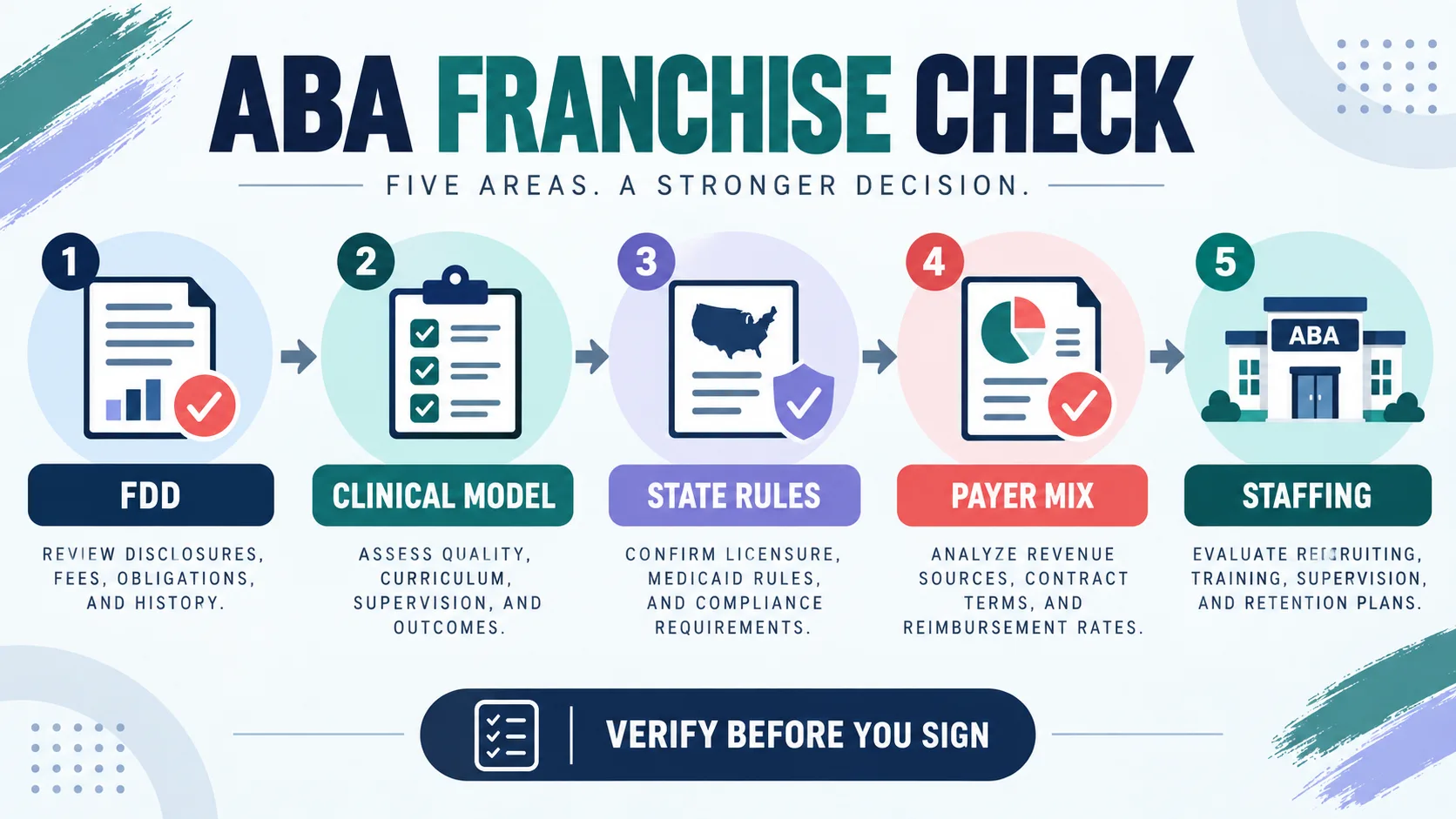
Do not treat the FDD as a brochure. Read it as a list of claims, obligations, and risks that must be matched to evidence. The FTC consumer guide to buying a franchise advises prospective franchisees to review the disclosure information carefully and obtain professional advice before committing.
Start with the franchisor and management history. Look for litigation, bankruptcy, regulatory disputes, ownership changes, and relevant experience. Then study the initial and ongoing investment categories. For an ABA operation, the headline franchise fee is only one line: leasehold work, clinical equipment, software, insurance, payroll before collections, recruiting, credentialing, marketing, legal review, and working capital can determine whether the launch survives a slow ramp.
- Compare Items 5–7: identify initial fees, recurring fees, required purchases, technology charges, marketing contributions, and assumptions that are not included.
- Read Item 12: confirm the territory, protected area, online referrals, competing locations, and whether the franchisor can serve nearby clients through another channel.
- Study Item 17: understand renewal, termination, transfer, dispute resolution, post-termination restrictions, and the practical consequences of a breach.
- Use Item 19 carefully: if financial performance representations are made, tie each claim to the stated population, period, costs, geography, and exclusions. Do not convert a top-quartile example into your forecast.
- Check Item 20: review openings, closures, transfers, and owner contact information. Ask why locations left the system and interview current and former operators.
Ask the franchisor to identify every document that controls the relationship, including the franchise agreement, operating manual, software terms, lease requirements, vendor agreements, and clinical policies. A helpful presentation does not change the contract. Give yourself enough time to review the FDD before signing or paying; the FTC rule generally requires delivery at least 14 days before those events for covered franchises, but you should confirm the rule and your situation with counsel.
ABA Franchise Clinical and Compliance Due Diligence
The distinctive risk in an ABA franchise is that operational standardization can be useful while clinical decisions must remain individualized. Ask how the system monitors treatment quality without turning a child’s care into a production quota. The BACB Ethics Codes should be part of the reference set for discussions about competence, documentation, conflicts, client welfare, supervision, and professional boundaries.
- Clinical governance: Who supervises BCBAs and RBTs? Who reviews clinical incidents, complaints, restrictive procedures, and changes in treatment?
- Documentation: Are notes, data, parent training, reassessments, authorizations, and discharge decisions audited consistently?
- Staff competence: What is the training sequence, who observes performance, and how are staff supported when the caseload is complex?
- Client fit: Does the model explain how services are individualized, culturally responsive, family-centered, and adjusted when progress is limited?
- Privacy and technology: Who owns the records, controls access, handles a breach, and exports information if the franchise ends?
Request a sample quality dashboard without accepting only a single success metric. Ask to see how the system tracks authorization denials, missed supervision, caregiver participation, reassessments, staff turnover, incident follow-up, and client transitions. A franchise may have polished training materials and still lack a credible escalation path when local capacity is inadequate.
Also clarify whether the franchisor provides clinical policies as guidance or attempts to make clinical decisions centrally. Professional judgment, scope of competence, and applicable law remain important even when an operating manual is mandatory. If the answer to a clinical question is always “the brand decides,” ask the attorney and qualified clinical advisor to examine that allocation of responsibility.
State, Payer, and Staffing Checks
Before modeling revenue, verify that the proposed location can legally and operationally deliver the services described. State licensure, Medicaid enrollment, commercial payer contracts, telehealth rules, supervision requirements, background checks, facility rules, privacy, and business registration can differ by jurisdiction. The franchisor’s experience in one state is not proof that a new territory has the same pathway.
Build a payer map for the exact county or service area. Ask which payers are contracted, which are accepting new providers, what credentialing timeline is realistic, which services require prior authorization, and how denials or recoupments are handled. A projected rate is not the same as collected cash. Your model should separate billed, allowed, paid, and delayed amounts.
Staffing deserves the same level of scrutiny. Ask for local time-to-fill data for BCBAs, RBTs, technicians, intake staff, and billers. Test the caseload assumptions against supervision capacity, commute time, cancellations, training hours, sick leave, and the possibility that a client needs a higher level of support. If the system depends on hiring several qualified employees immediately, create a slower-ramp scenario before signing a lease.
How to Test the ABA Franchise Business Model
Convert the sales presentation into a monthly model. Include the initial fee, royalties, marketing fees, software, rent, payroll taxes, benefits, insurance, clinical supervision, training, credentialing, billing, legal and accounting costs, supplies, and working capital. Then model collections rather than simply revenue. A profitable-looking spreadsheet can fail if authorization or payer cash arrives months later.
- Build a conservative case with slower hiring, lower utilization, higher turnover, and delayed payer collections.
- Build a base case using evidence from comparable locations, not a national average with no local adjustment.
- Build an upside case only to understand capacity; do not use it to justify the purchase price.
- Identify the break-even client count after royalties and required vendor fees.
- Run a sensitivity test for one lost payer, a vacant BCBA role, a delayed credentialing approval, and a 20% reduction in scheduled hours.
Ask whether the franchisor’s financial performance representation includes owner labor, clinical director compensation, debt service, taxes, recruiting costs, and failed starts. Compare current and former franchisee experiences with the written assumptions. If you cannot explain how the model works in a slow first year, you are not ready to choose a territory.
ABA Franchise Red Flags
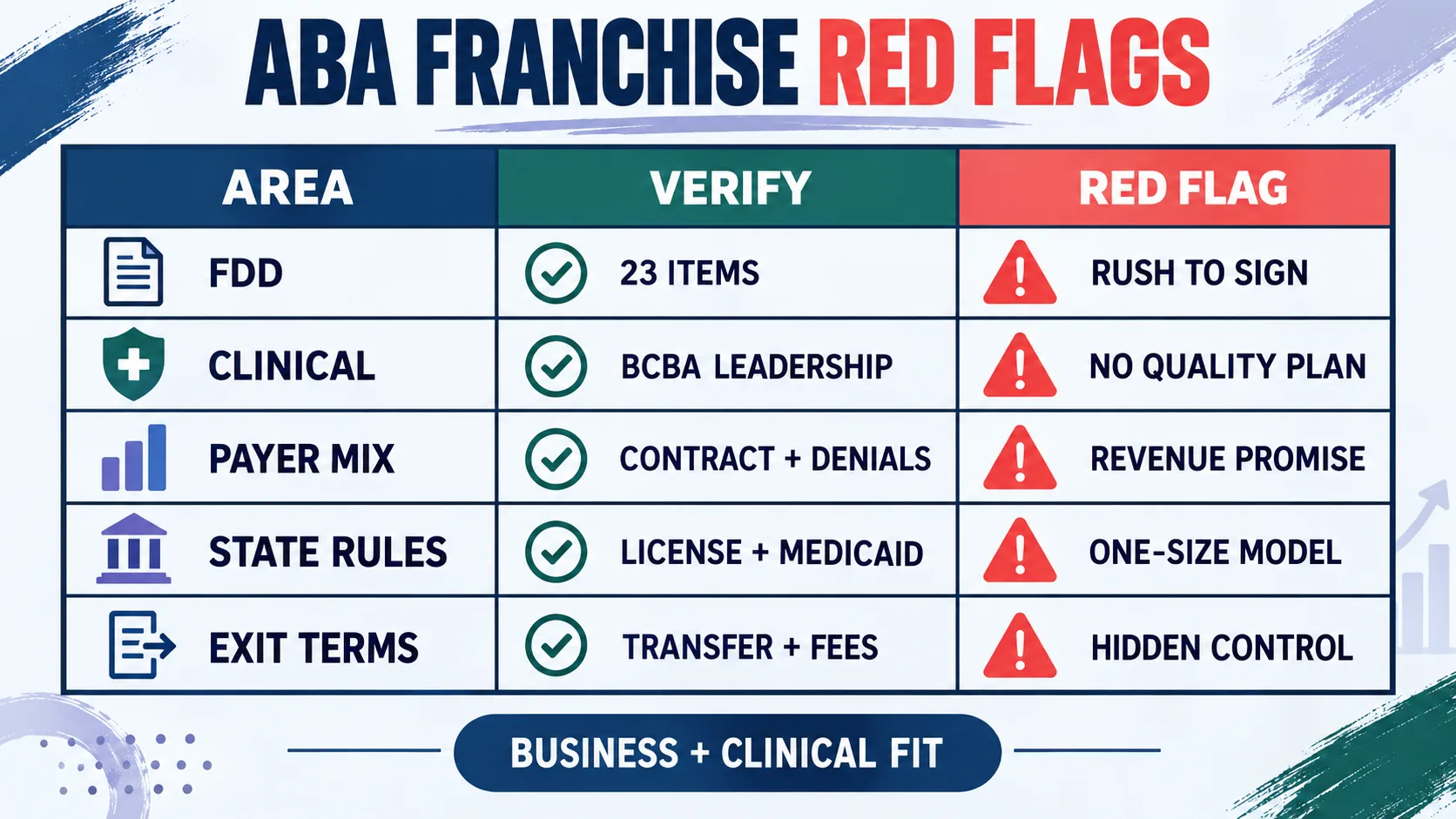
One red flag is not always a deal-breaker, but a pattern of vague answers is meaningful. Pause when the sales process creates urgency before you have the FDD, when the financial story relies on selected locations, or when current franchisees are difficult to contact independently.
- Pressure to sign or pay before the disclosure review period is complete.
- Promises of guaranteed referrals, staffing, payer approval, or earnings without written boundaries.
- Large differences between the operating manual, franchise agreement, and sales presentation.
- No clear answer about client-record ownership, clinical escalation, or who bears responsibility for a quality event.
- Required vendors whose pricing, renewal terms, or referral relationships are not transparent.
- High closure, transfer, or litigation activity that is explained only as “normal business.”
- Territory language that sounds protected but allows competing channels or nearby locations.
- Exit terms that make a transfer expensive, slow, or dependent on discretionary approval.
A Practical Decision Workflow
Use a staged decision so enthusiasm does not outrun evidence:
- Define your role: owner, clinical leader, manager, or a combination. Write down which decisions you must control to protect clients and staff.
- Request the full document set: FDD, agreement, manuals, fee schedule, software terms, sample policies, and any written performance representation.
- Verify the market: map payer access, state rules, staffing supply, competitors, referral sources, facility costs, and local demand.
- Interview operators: speak with current and former franchisees, ask the same questions, and compare the answers with the written documents.
- Stress-test the model: use conservative collections and staffing assumptions; decide how much working capital is needed if the launch is slow.
- Use independent review: have a franchise attorney, accountant, and qualified clinical advisor review the parts that affect their expertise.
- Make a documented decision: proceed, renegotiate, or walk away based on evidence rather than the brand’s visual polish.
The BACB employer resources can help frame questions about qualified staff and professional expectations, but they do not replace state or payer-specific verification. Keep a dated evidence folder so that every important promise has a written source, owner, and follow-up date.
ABA Franchise FAQ
Is an ABA franchise automatically better than an independent practice?: No. A franchise may provide a system and support, while an independent practice may provide more control and flexibility. The better option depends on the local market, the contract, your management capacity, clinical governance, and the economics after all fees.
Does being a BCBA guarantee that I can operate an ABA franchise?: No. BCBA certification does not by itself resolve business registration, state licensure, payer enrollment, staffing, facility, privacy, employment, or franchise-contract requirements. Confirm the role you will hold and the rules in the jurisdiction where services will be delivered.
What should I ask current franchisees?: Ask how long it took to open, how long credentialing took, how recruiting actually performed, which fees surprised them, how much working capital they needed, whether clinical support was useful, and what they would negotiate differently. Speak with both current and former operators where possible.
Can the franchisor promise referrals or insurance revenue?: Treat referral and revenue statements as claims that require written scope, assumptions, and verification. A franchisor cannot make a local payer, client, or referral source guarantee your results. Have professionals review any financial performance representation before you rely on it.
Once your business decision is separated from your exam preparation, you can keep building the clinical knowledge that supports responsible practice. Use the free BCBA mock exam as a low-friction way to check your readiness while you work through the franchise documents. A careful due-diligence file protects the quality of the decision; it does not replace professional advice or a current review of the rules. For targeted review, use our aba franchise practice questions to apply the concept in exam-style scenarios.
Take the Free BCBA Mock Exam
If you want a low-pressure way to check your recall, use the free practice resource below. Take the Free BCBA Mock Exam



