
What Is the BCBA Certificate?
The BCBA certificate is a professional credential awarded by the Behavior Analyst Certification Board (BACB). It signifies that the holder has met rigorous standards in behavior analysis education, supervised fieldwork, and examination. Many professionals pursue the BCBA certificate to demonstrate competence and advance their careers in applied behavior analysis.
Table of Contents
- What Is the BCBA Certificate?
- How to Meet BCBA Certificate Requirements
- BCBA Exam Study Strategies with ABA Examples
- BCBA Certification Quick Checklist
- Summary: Your Path to the BCBA Certificate
It’s important to distinguish the BCBA certificate from a state license. The BACB issues the certificate, while individual states issue licenses to practice. Candidates must hold a current BCBA certificate to apply for a license in most states.
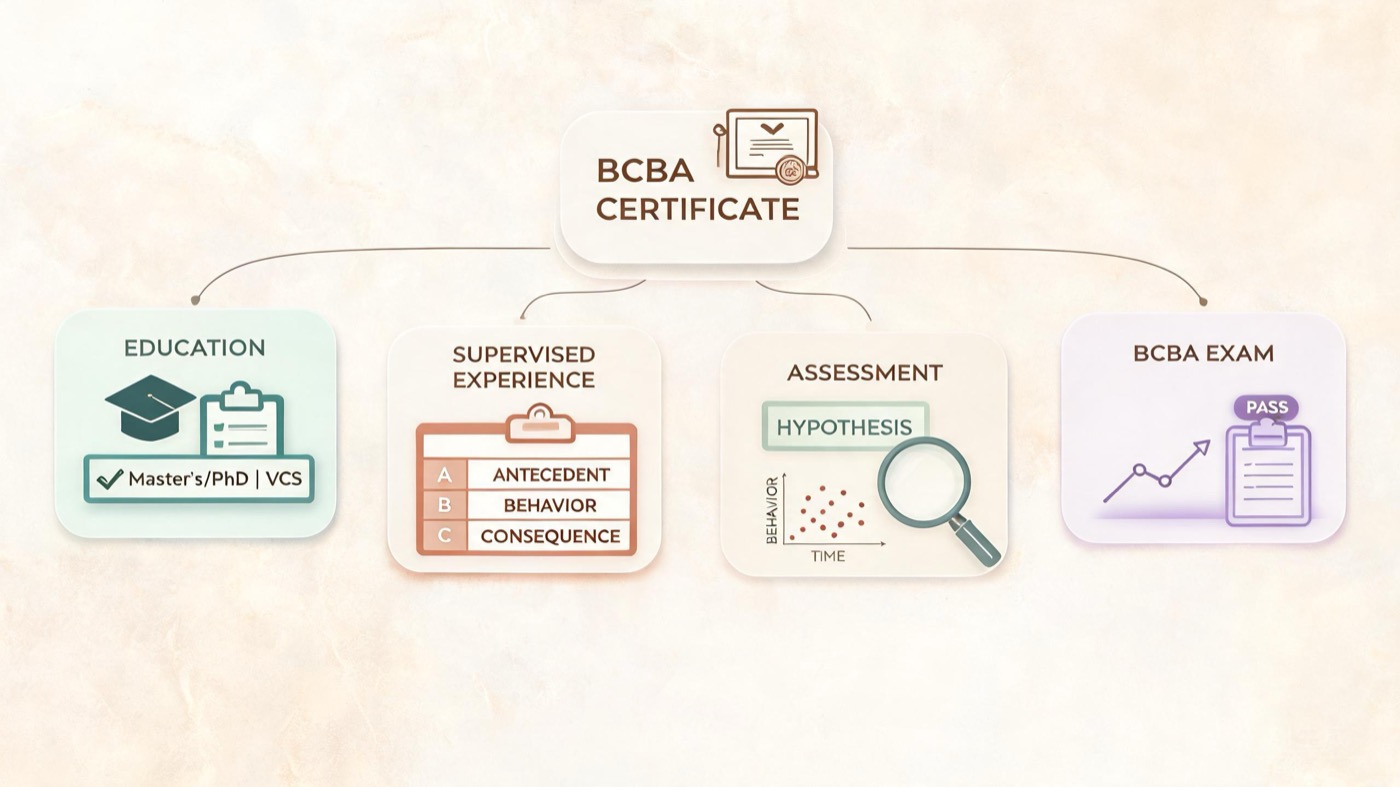
BCBA Certificate vs. BCBA License: Key Differences
The BCBA certificate is a national credential, whereas a license is state-specific. The BACB sets the certification standards (education, experience, exam), and states may add additional requirements. For exam preparation, focus on the BACB’s Task List – that’s what the test measures.
Who Needs a BCBA Certificate?
This credential is designed for individuals who want to work as Board Certified Behavior Analysts. Typical candidates include graduate students in ABA, psychology, or education; practicing behavior analysts seeking credentialing; and professionals transitioning from related fields. If you plan to supervise RBTs or design behavior intervention plans, the BCBA certificate is essential.
How to Meet BCBA Certificate Requirements
To earn the BCBA certificate, you must satisfy three main components: education, supervised experience, and passing the exam. Let’s break each one down.
Educational Requirements: ABA Coursework & Verified Course Sequences
You need a graduate degree (master’s or higher) from an accredited institution that includes a Verified Course Sequence (VCS) approved by the BACB. Typical courses include Ethical and Professional Conduct, Behavior Assessment, and Behavior-Change Procedures. Your degree can be in behavior analysis, education, psychology, or a related field.
Supervised Experience: Fieldwork Hours & Supervision Types
You must complete supervised fieldwork hours. There are two options:
- Supervised Fieldwork: 2,000 total hours, with at least 4 supervision contacts per month (minimum 5% of total hours).
- Concentrated Supervised Fieldwork: 1,500 total hours, with at least 6 supervision contacts per month (minimum 10% of total hours).
Supervision must be provided by a BCBA supervisor who meets BACB requirements. Document your hours carefully using the BACB’s fieldwork tracker.
The BCBA Exam: Structure, Content Areas & Scoring
The BCBA exam is a computer-based test with 150 multiple-choice questions (10 of which are unscored pilot items). You have 4 hours to complete it. The exam covers content from the BCBA Task List (5th or 6th edition, check current). The passing score is typically around 400 out of 500 scaled points. You’ll see questions on measurement, experimental design, behavior change procedures, and ethics.
BCBA Exam Study Strategies with ABA Examples
Applying ABA concepts to real-world scenarios is key to passing. Here are three worked examples with common exam traps you must avoid.
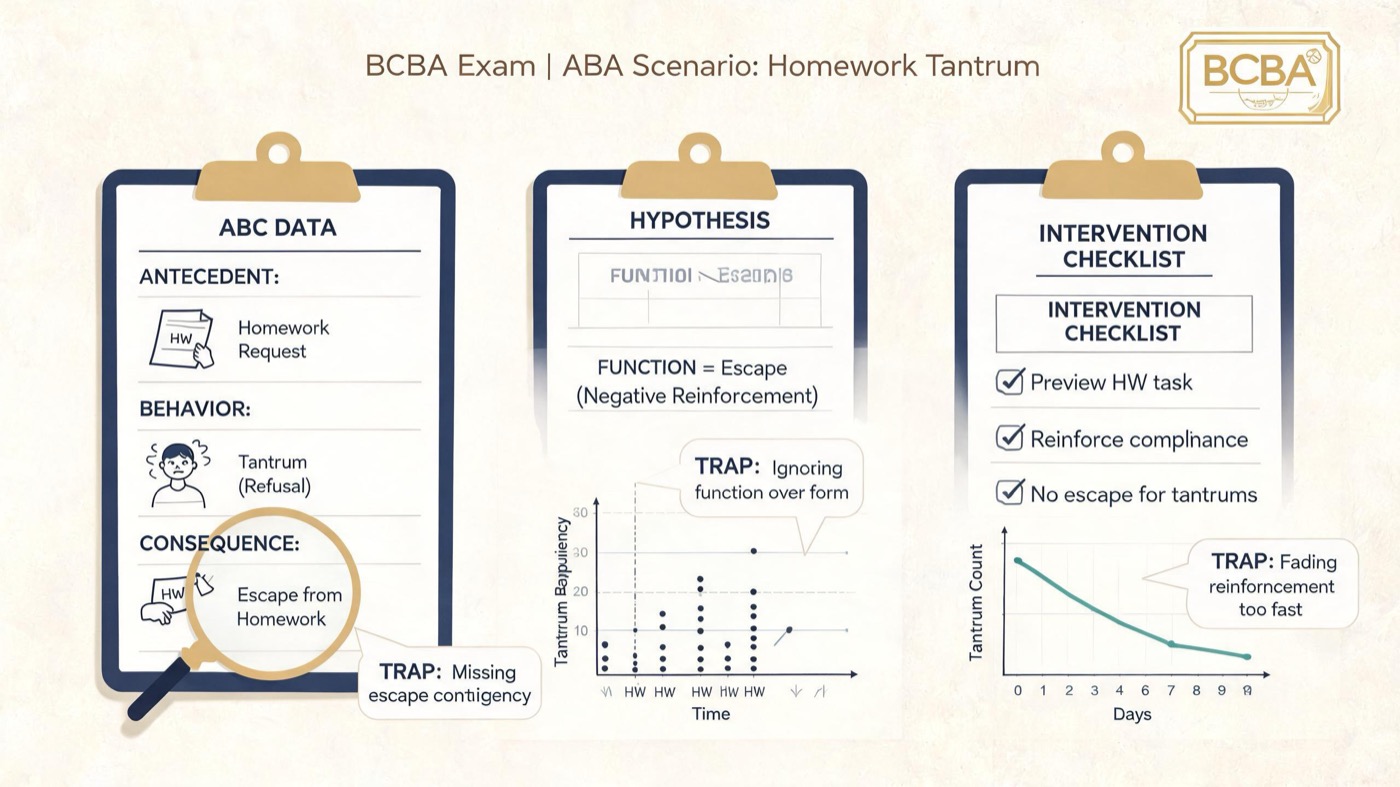
Mastering ABC Data: Example with Escape Function
Consider a child who tantrums when asked to do homework. The antecedent is the demand (homework), the behavior is the tantrum, and the consequence is the demand being removed. The function is escape from demands. On the exam, you might see similar scenarios. A common trap is assuming every tantrum is escape-motivated; you must consider other possibilities like attention or access to tangibles. Always look for the consequence that follows the behavior.
Identifying Function in the Exam: Example with Attention
A student calls out in class, and the teacher immediately scolds her. The behavior (calling out) is followed by attention (scolding). The function is access to attention. Exam traps include confusing automatic reinforcement (where the behavior itself produces sensory stimulation) with social functions. In this example, the consequence is delivered by another person, ruling out automaticity. Also, be careful not to confuse the function with the form (e.g., disruption) – focus on the consequence.
Common Exam Traps and How to Avoid Them
Here are three frequent pitfalls:
- Overgeneralizing functions: Assuming one behavior’s function applies to all behaviors. Always conduct a functional behavior assessment (FBA).
- Ignoring multiple functions: A behavior can be maintained by more than one consequence. For example, a child might scream to escape a task and also get attention from the teacher.
- Misreading MO vs. SD: A motivating operation (MO) alters the value of a reinforcer, while a discriminative stimulus (SD) signals availability. An exam question might describe deprivation (MO) as an SD. Study the difference carefully.
To avoid traps, always ask: What is the immediate consequence? Does the behavior increase or decrease? Is the reinforcer social or automatic?
Additional Worked Example: Tangible Function
A child whines until given a tablet. The antecedent is the tablet being visible but out of reach; the behavior is whining; the consequence is receiving the tablet. Function: access to tangibles. A trap here is confusing access to tangibles with attention – check if the child wants the item or the person’s reaction. In this case, the tablet is the reinforcer, not the caregiver’s response.
BCBA Certification Quick Checklist
Track your progress with this actionable checklist. Each step moves you closer to your BCBA certificate.
- Confirm your degree program includes a BACB-approved VCS.
- Complete all ABA coursework with a grade of C or better (or pass, depending on your program).
- Accumulate required fieldwork hours (2,000 or 1,500) under qualified supervision.
- Submit your certification application to the BACB along with transcripts and verification forms.
- Schedule your BCBA exam through Pearson VUE once your application is approved.
- Create a study plan focusing on the Task List areas where you’re weakest.
- Take a BCBA mock exam to assess readiness. Use BCBA mock exam resources to simulate the real test.
- Review ethics thoroughly – ethics questions appear throughout the exam.
Summary: Your Path to the BCBA Certificate
The BCBA certificate is achievable with careful planning and dedicated study. Begin by ensuring your education meets BACB standards and begin tracking your fieldwork hours early. Use practice questions and focus on areas like functional assessment and behavior change procedures. Avoid common exam traps by practicing with real-life scenarios and reviewing the four functions of behavior. Remember to stay current with BACB updates, as requirements may change. For authoritative information, visit the BACB official website. Good luck on your journey!



