
If you searched for BCBA Bureau of Labor Statistics, you may be expecting to find one official BLS salary line labeled “BCBA.” That expectation is the problem. The Bureau of Labor Statistics organizes its data around occupations and the work people perform, while BCBA is a professional certification. At the time of this review, BLS does not publish a clean, standalone wage series that isolates every Board Certified Behavior Analyst.
Table of Contents
- In This Guide
- What Does “BCBA Bureau of Labor Statistics” Actually Mean?
- Why BLS Does Not Publish a Simple BCBA Line
- What BLS Occupation Data Can Tell You
- How Should You Use a Broader Occupation as a BCBA Proxy?
- BLS, BACB Lightcast, and Salary Sites Compared
- A Practical BCBA Bureau of Labor Statistics Research Workflow
- How Do You Cite the Data Without Overstating It?
- What This Limitation Means for Career and Exam Planning
- BCBA Bureau of Labor Statistics FAQ
- Quick Review Checklist
- Take the Free BCBA Mock Exam
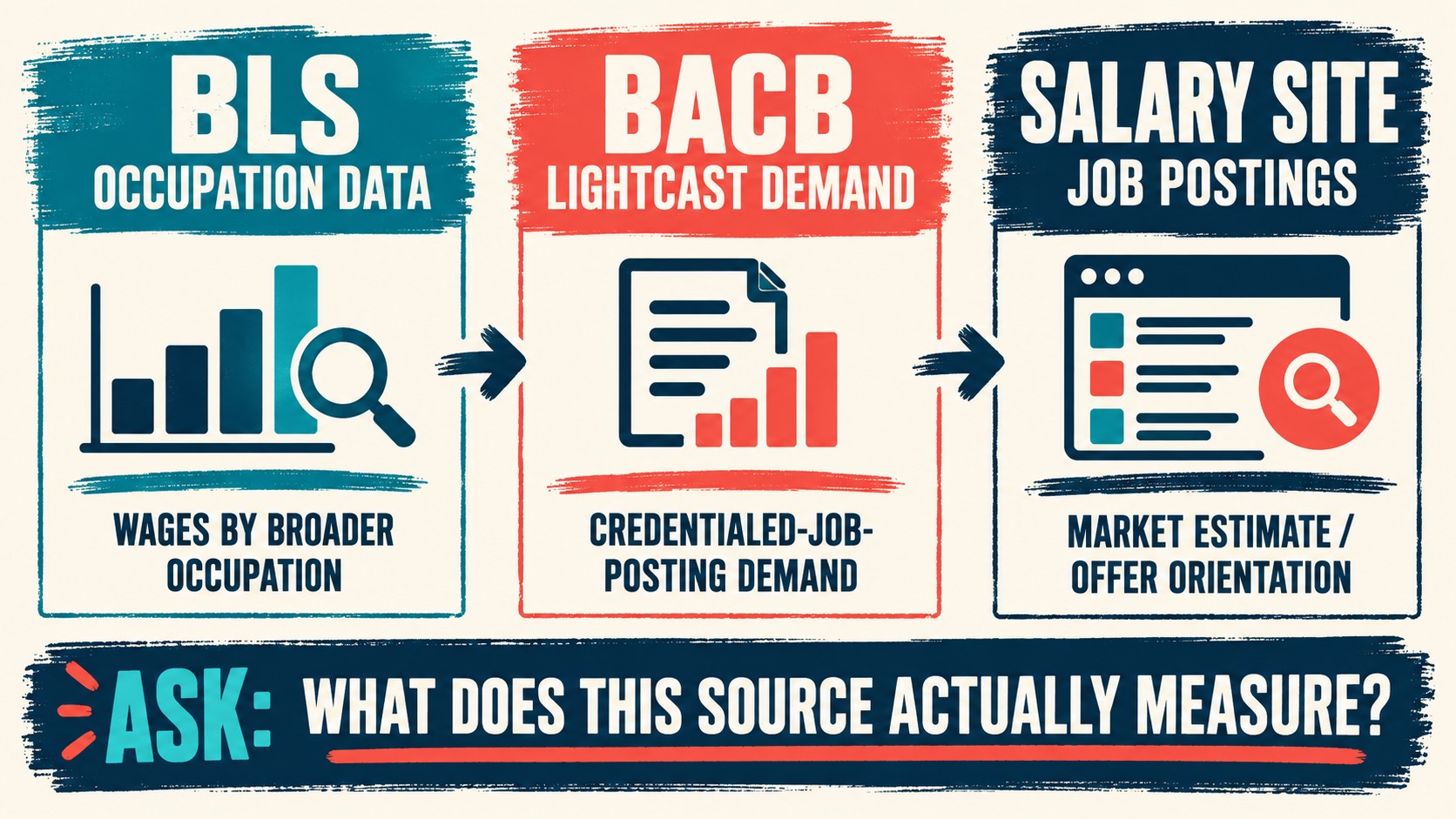
That does not make labor data useless. It means you have to label the source correctly. BLS can explain how occupation data is built and can provide information for broader occupational groups. BACB’s Lightcast report can describe demand for job postings that require or prefer BCBA or BCBA-D certification. Salary websites can provide market estimates. Those sources answer different questions, so they should not be blended into one false-precision “BCBA salary.”
In This Guide
What Does “BCBA Bureau of Labor Statistics” Actually Mean?
Most people using this search phrase want one of three things: a trustworthy annual wage, a state-by-state comparison, or an official answer about whether BLS recognizes BCBA as its own occupation. The third question should come first because it determines how you interpret every number that follows.
BLS explains that workers are classified into occupational categories based on the work they perform and their skills, education, training, and credentials. The classification system is not a certification directory. A person can hold a BCBA credential while working in a role whose employer uses a broader job title, a different occupational code, or a blended set of duties. That is why a BLS figure connected to one occupation may include people who are not BCBAs and may omit BCBAs whose work is classified elsewhere.
The accurate short answer is therefore: BLS provides occupation-level labor statistics, not a guaranteed BCBA-specific salary database. You can use BLS to understand a comparison occupation or the limits of federal wage data, but you should not copy a broader occupation’s median wage and label it “the BCBA salary.”
Why BLS Does Not Publish a Simple BCBA Line
A certification and an occupation overlap, but they are not the same measurement unit. The BCBA credential describes professional training and certification through the Behavior Analyst Certification Board. An occupation describes the job duties, employer setting, and classification used by a labor survey. One credential can appear across clinics, schools, hospitals, consulting practices, community programs, and private practices.
This creates a classification problem. A survey built around occupations needs to place workers into categories that can be measured consistently across employers. It does not automatically create a new federal wage category every time a profession uses a credential. When the credential does not have a dedicated series, analysts sometimes compare BCBAs with broader groups such as mental health counselors or certain psychology-related occupations. That comparison may be useful as context, but it is not a BCBA-only observation.
Use the BLS Standard Occupational Classification search to understand the occupation system, but do not treat a nearby title as proof that the category measures BCBAs specifically. The classification is the beginning of the research, not the conclusion.
What BLS Occupation Data Can Tell You
BLS still offers valuable information when the question is framed correctly. Its occupation statistics overview explains that the agency publishes employment, earnings, working-condition, and projection information by occupation. Its Occupational Employment and Wage Statistics program publishes wage estimates by occupation, industry, geography, and related dimensions.
| BLS question | What the data can support | What it cannot prove |
|---|---|---|
| How are workers grouped? | The occupational classification and the duties represented by a category. | That everyone in the category holds BCBA certification. |
| What do workers in a category earn? | A wage estimate for the broader measured occupation and geography. | A guaranteed BCBA offer or a credential-specific wage. |
| Where is demand changing? | Employment and projection patterns for the selected occupation. | The number of BCBA openings unless the dataset identifies that credential directly. |
Before using a BLS number, record the occupation name, data program, reference year, geography, measure, and population. “Median annual wage” and “mean annual wage” are not interchangeable. Neither one tells you whether the sample includes benefits, contract work, overtime, productivity bonuses, or unpaid documentation time. The BLS OEWS data overview is useful because it shows how the agency presents profiles, tables, maps, and reference periods.
How Should You Use a Broader Occupation as a BCBA Proxy?
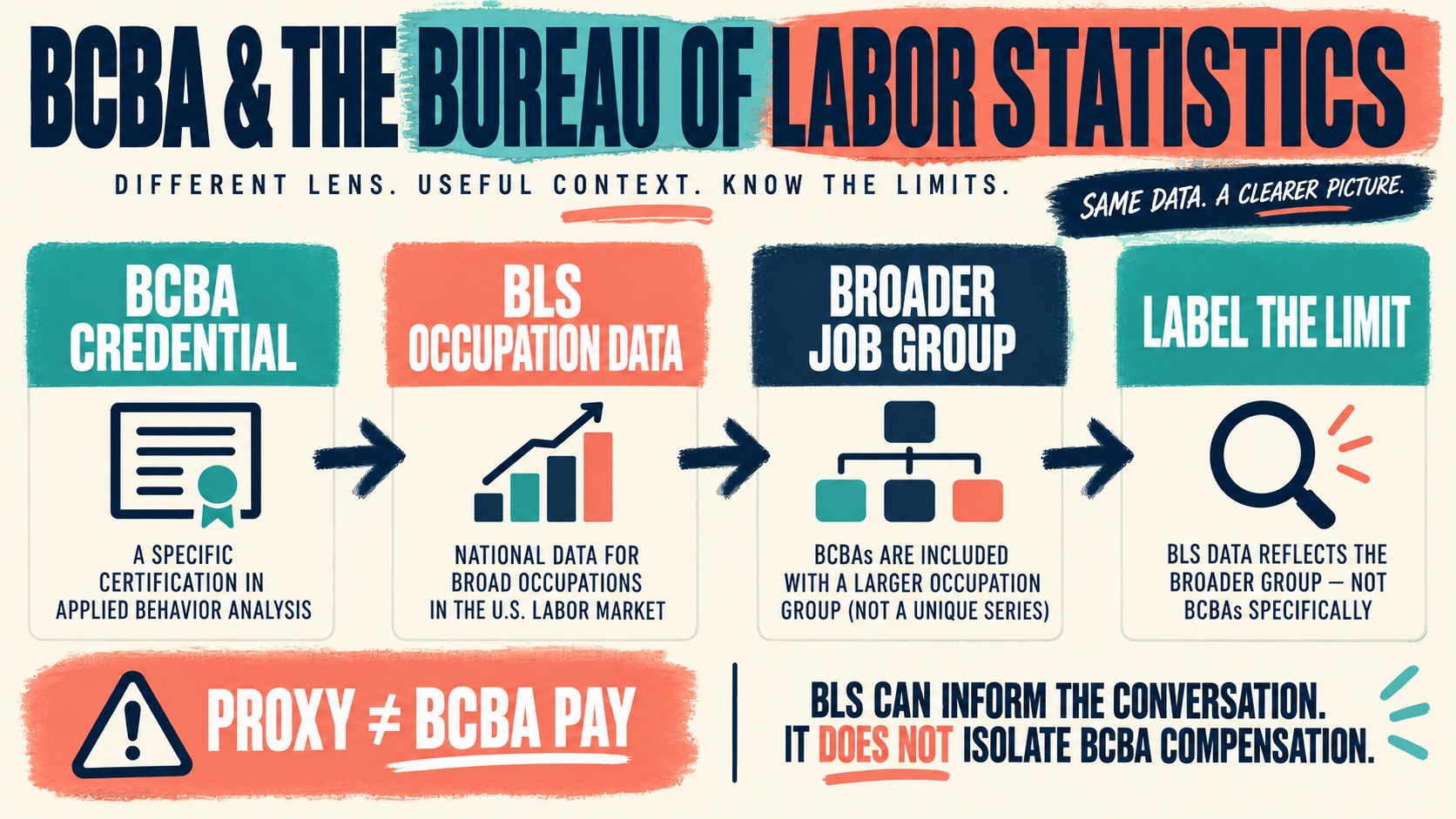
A proxy is a comparison, not a conversion. If you use a broader BLS occupation to add context to a BCBA career discussion, state the relationship in the first sentence. For example: “This BLS occupation includes a broader workforce and is shown only as context; it is not a BCBA-specific wage estimate.” That one sentence prevents readers from mistaking a population-level comparison for a credential-level fact.
Then ask whether the proxy has enough overlap to be useful. Compare duties, work setting, required education, client population, and supervision responsibilities. A proxy that shares only a job title is weak. A proxy that shares a meaningful portion of the work may still be imperfect, but the limitations can be explained.
- Use the proxy for direction: It can show how a broad labor market varies by state, region, or experience category.
- Do not use it for a promise: It should not become “BCBAs earn exactly this amount.”
- Keep the source label attached: Put the occupation name and reference year next to the number every time it appears.
- Pair it with BCBA-specific evidence: Current job postings, credential requirements, and a report that explicitly tracks BCBA or BCBA-D demand can make the career picture more relevant.
BLS, BACB Lightcast, and Salary Sites Compared
People often place these sources in one spreadsheet column called “salary.” That is how confusion begins. The source may be credible and still answer a different question.
| Source | Primary measure | Best use for a BCBA reader |
|---|---|---|
| BLS occupation data | Wages, employment, and projections for a broader occupational category. | Methodology, comparison context, and transparent limits. |
| BACB Lightcast report | Job-posting demand for roles requiring or preferring BCBA or BCBA-D certification. | Demand trends and state concentration; not a personal wage calculator. |
| Salary or job-posting site | An estimate based on its own postings, surveys, or compensation model. | A dated market snapshot to compare with actual local offers. |
The BACB’s current US Employment Demand for Behavior Analysts report is a good example of a source that explicitly follows BCBA or BCBA-D certification in job postings. It is useful for demand, not for saying that every certified analyst earns the same amount. The method is different from BLS OEWS, so the outputs should remain in separate columns.
A Practical BCBA Bureau of Labor Statistics Research Workflow
Use this workflow when you are researching a career page, evaluating a job offer, or checking an article that presents a confident BCBA salary number:
- Write the question first. Are you measuring occupation wages, certified-job demand, a posted offer, or a personal income target? Do not open a data table before deciding what you need it to answer.
- Identify the population. Record whether the source includes all workers in an occupation, people in a state, people responding to a survey, or job postings that mention BCBA credentials.
- Check the date. A reference year, publication date, and page-update date can all be different. Write down each one rather than treating “updated” as the data year.
- Check the measure. Mean, median, percentile, hourly wage, annual wage, advertised range, and total compensation are different fields.
- Check the job model. Ask whether the number assumes full-time hours, paid documentation, benefits, bonuses, travel, or billable productivity.
- Compare with current postings. Use several local offers to test whether the broad figure is relevant to the setting you would actually enter.
- Write the caveat next to the claim. The limitation is part of the result, not a footnote to hide after the number.
This process also helps when a page cites BLS without linking the exact table. If the author cannot name the occupation, reference year, and measure, the claim is not ready to guide a career decision. A citation should make the number easier to audit, not merely make the paragraph look authoritative.
How Do You Cite the Data Without Overstating It?
A responsible sentence has four parts: the source, the population, the measure, and the limitation. For example: “BLS reports the median wage for [named broader occupation] in [reference year]; the category is not limited to BCBAs, so the figure is context rather than a BCBA-specific salary.” This is more useful than writing “According to BLS, BCBAs earn…” when BLS did not isolate the credential.
Also avoid turning demand into salary. A state with many credentialed job postings may have strong opportunities, but demand does not establish what a new BCBA will take home. The offer still depends on role, experience, payer mix, caseload, supervision expectations, benefits, taxes, and whether the position is salaried, hourly, or contract-based.
What This Limitation Means for Career and Exam Planning
The lack of a dedicated BLS BCBA line does not mean the credential has no labor-market value. It means the career question needs more than one source. Use BACB requirements and current university or fieldwork information for the certification path, use credentialed job-posting demand for opportunity patterns, and use local offers for compensation decisions.
If you are deciding whether to pursue certification, compare the training cost, fieldwork, exam preparation, time, and fees with real roles in your target setting. A national proxy can frame the question, but it cannot decide whether a particular program or offer fits you.
For the exam-preparation part of the plan, use the BCBA pay and offer-comparison guide for compensation context, then practice the certification knowledge itself with the free BCBA mock exam. The mock exam is preparation material; it is not a BACB wage source, certification decision, or live examination form.
BCBA Bureau of Labor Statistics FAQ
Does the Bureau of Labor Statistics have a BCBA salary?: Not as a clean, standalone wage series that isolates every BCBA. BLS reports data by occupation, while BCBA is a certification that can appear across several work settings and job classifications. A broader BLS wage may be useful context, but it should not be renamed a BCBA salary.
Which BLS occupation should I use for a BCBA?: There is no universal proxy that is automatically correct. Compare the actual duties and employer classification first, then disclose the broader occupation and its limits. If a source does not match the work performed, do not use it merely because the number looks attractive.
Is the BACB Lightcast report a BLS report?: No. The BACB Lightcast report uses labor-market job-posting data to study demand for postings requiring or preferring BCBA or BCBA-D certification. It is valuable credential-specific demand context, but it is not the same program as BLS occupation wage data and it does not guarantee an individual salary.
Why do BCBA salary pages show different numbers?: They may use different years, job titles, regions, posting pools, survey respondents, occupation proxies, and definitions of annual pay. Some include bonuses or benefits while others report base salary. Read the method and date before comparing two figures.
What is the safest way to use BLS information?: Use BLS to explain the broader occupation, reference year, wage measure, and classification limits. Pair it with current BCBA-specific job postings and demand data, label every source, and avoid presenting a proxy as a guaranteed credential-level outcome.
Quick Review Checklist
Use this final checklist to turn bcba bureau of labor statistics into exam-ready reasoning. The goal is not to memorize a label in isolation; it is to identify the relevant evidence and explain why the best answer fits the scenario. Key ideas to review:
- State the central definition or decision point for bcba bureau of labor statistics in your own words.
- Identify the detail that makes bcba bureau of labor statistics different from its closest related ABA term.
- Separate the observable facts in a scenario from assumptions that are not supported by the facts.
- Write one example and one nonexample so you can recognize the concept in a new setting.
Exam application checks:
- Ask what the question is actually requesting before comparing the answer choices.
- Mark the antecedent, response, consequence, or other evidence that supports the selected answer.
- Look for a distractor that describes a related process but does not answer the specific question.
Final self-check:
- Explain how you would verify the interpretation with clear observations or data.
- Change one detail in the scenario and decide whether your answer should change.
- Give a one-sentence rationale that a supervisor or study partner could evaluate.
Take the Free BCBA Mock Exam
If you want a low-pressure way to check your recall, use the free practice resource below. Take the Free BCBA Mock Exam



