

Response variability ABA can mean two different things: scattered data on a graph or a change in the variety of responses. This guide separates those meanings, explains how variability can be measured, and shows the BCBA exam clues that matter.
Table of Contents
- What Does Response Variability ABA Mean?
- How Is Graph Variability Different?
- How Do You Measure Response Variability?
- Can Response Variability Be Reinforced?
- What Happens When Extinction Produces Variability?
- How Do You Read Variability on a Graph?
- What Does the BCBA Exam Test?
- What Is the Bottom Line?
- Quick Review Checklist
- Take the Free BCBA Mock Exam
Response variability ABA describes differences among responses or response patterns. A learner may use different response forms, vary the order of actions, or produce behavior that changes from trial to trial. In visual analysis, variability can also describe how far data points move around a graph. Those ideas are related, but they are not interchangeable.
The research literature on operant variability shows that variation itself can sometimes come under stimulus and reinforcement control. A response is not automatically random simply because it is hard to predict. The BCBA Test Content Outline also requires careful observation and interpretation, so the exam may ask whether the stem is describing a response property, a data pattern, or an experimental effect.
What Does Response Variability ABA Mean?
At the response level, variability means that responses differ along a defined dimension. The dimension could be topography, force, sequence, duration, location, word choice, or the order of actions. “The learner was inconsistent” is not a measurement definition. The team must say what varied, how it was scored, and under which conditions.
For example, a learner may request a break by speaking, signing, pointing to a card, or selecting an AAC button. If the question concerns communication-form flexibility, those forms can be counted separately and then examined as a functional class. If the question concerns whether a replacement response is occurring, the team may aggregate forms that serve the same defined function.
How Is Graph Variability Different?
Graph variability is the spread or inconsistency of data points within a phase. If aggression is 2, 3, 2, 4, and 3 across sessions, the data are relatively stable. If it is 0, 12, 1, 15, and 2, the phase is more variable. That pattern tells the analyst how consistent the measured behavior is; it does not by itself describe how many response forms the learner used.
| Meaning | What varies | How to measure |
|---|---|---|
| Response variability | A response property or sequence | Define and code forms, dimensions, or sequence differences |
| Graph variability | Session-to-session data values | Inspect spread around the phase level and trend |
| Response generalization | New but acceptable response forms | Probe planned forms across people, settings, and outcomes |
How Do You Measure Response Variability?
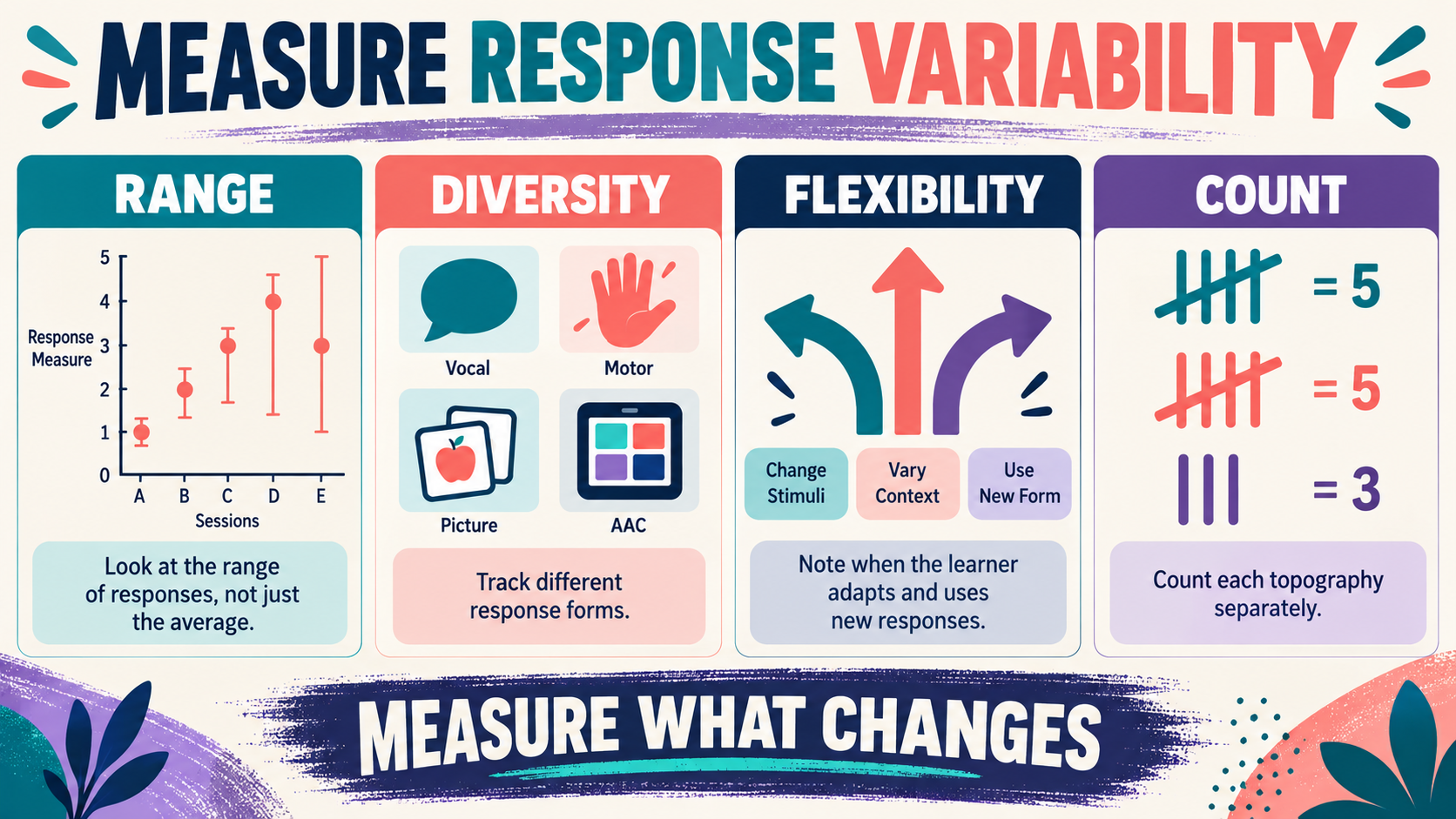
First, name the response property. A team studying varied play actions might code the number of unique toy actions per session. A team studying varied verbal responses might code unique words, sequence changes, or the number of repeated responses. A team studying problem behavior may need to distinguish topographies because different forms have different risks and functions.
Next, define the opportunity and comparison. “More variable” could mean more unique responses, a lower repetition ratio, a greater range, or a higher diversity index. The measure should match the clinical question. If the goal is flexible communication, count acceptable functional forms rather than rewarding unsafe or inefficient variation.
Can Response Variability Be Reinforced?
Yes, variability can be part of a contingency. A procedure may deliver reinforcement when a response differs from recent responses, meets a lag criterion, or falls within a defined range of alternatives. In that case, the reinforcer is contingent on a property of responding, not merely on one fixed topography.
That idea does not mean every changing response is being reinforced for variety. Check the contingency. If reinforcement follows any correct answer, changes in the answer may reflect learning, stimulus control, or ordinary response variation. If reinforcement follows a novel or different answer specifically, the design is targeting variability.
What Happens When Extinction Produces Variability?
When a previously reinforced response no longer produces its consequence, a learner may try different topographies or intensities. That change can be called response variability associated with extinction, but the function of the change is not “variability” merely because several forms appear. The analyst should monitor safety, identify the contingency change, and teach an effective alternative when needed. Do not treat new problem-behavior forms as creative skill acquisition. A more variable pattern may represent response substitution, escalation, or an unplanned contact with reinforcement. Measure the topographies separately when risk or function differs.
How Do You Read Variability on a Graph?
Inspect the phase level first, then the trend and spread. High variability weakens confidence in a simple phase comparison because the range of plausible values is wide. Look for setting events, opportunity differences, observer drift, changes in the operational definition, or inconsistent implementation. Sometimes the apparent variability is a measurement problem rather than a change in behavior.
Graphing does not require the analyst to eliminate all variation. Real behavior is variable. The task is to determine whether the pattern is meaningful, whether it changes with the intervention, and whether the decision should be delayed until data are more stable.
What Does the BCBA Exam Test?
- Variability is not trend: trend is direction; variability is spread around the pattern.
- Different forms are not automatically one class: define the shared topography or function.
- Unpredictable does not mean uncaused: examine reinforcement and stimulus control.
- Extinction-induced variation is not a treatment goal: identify the contingency change and safety implications.
- A high average can hide variation: inspect the raw forms, opportunities, and phase data.
- Measurement comes before interpretation: decide what “different” means before counting it.
What Is the Bottom Line?
Response variability ABA questions require you to identify the level of analysis. Are different response forms being counted, or are data points scattered across sessions? Define the varied property, inspect the contingency, and protect meaningful communication and safety. For more practice with visual analysis and response-class distinctions, use the free BCBA mock exam. It is study support, not a substitute for individualized clinical judgment.
For targeted review, use our response variability ABA practice questions to apply the concept in exam-style scenarios.
Quick Review Checklist
Use this final checklist to turn response variability ABA into exam-ready reasoning. The goal is not to memorize a label in isolation; it is to identify the relevant evidence and explain why the best answer fits the scenario. Key ideas to review:
- State the central definition or decision point for response variability ABA in your own words.
- Identify the detail that makes response variability ABA different from its closest related ABA term.
- Separate the observable facts in a scenario from assumptions that are not supported by the facts.
- Write one example and one nonexample so you can recognize the concept in a new setting.
Exam application checks:
- Ask what the question is actually requesting before comparing the answer choices.
- Mark the antecedent, response, consequence, or other evidence that supports the selected answer.
- Look for a distractor that describes a related process but does not answer the specific question.
Final self-check:
- Explain how you would verify the interpretation with clear observations or data.
- Change one detail in the scenario and decide whether your answer should change.
- Give a one-sentence rationale that a supervisor or study partner could evaluate.
Take the Free BCBA Mock Exam
When you are ready to apply the idea, use the free practice resource below for additional feedback. Take the Free BCBA Mock Exam



