
If you need a BCBA credential lookup, start with the Behavior Analyst Certification Board (BACB) Certificant Registry. It is the public tool designed to check whether a person holds a BACB certification and whether the record shows reportable disciplinary information. A registry result is useful, but it is not the same as a state license, a private BACB account record, or a formal verification letter.
Table of Contents
- What Does BCBA Credential Lookup Mean?
- Use the Official BACB Certificant Registry
- What a Registry Result Can and Cannot Prove
- When Do You Need a BACB Verification Letter?
- BCBA Certification Versus State Licensure
- Which Record Should You Use?
- How to Perform a BCBA Credential Lookup Step by Step
- What If You Cannot Find the Person?
- Do Not Confuse a BACB ID With a Certification Number
- BCBA Credential Lookup FAQs
- Quick Review Checklist
- Take the Free BCBA Mock Exam
That distinction matters when you are hiring a provider, checking a practitioner for a child or client, evaluating a potential supervisor, completing a payer request, or reviewing your own professional records. This guide shows which BACB source answers each question, what to record from the search, and when a quick public result is not enough.
What Does BCBA Credential Lookup Mean?
In most search contexts, BCBA credential lookup means checking a named person’s Board Certified Behavior Analyst certification through a current BACB source. The task is about the credential, not merely the person’s job title. Someone may describe themselves as a behavior analyst, therapist, consultant, or clinical director without that wording proving an active BCBA certification.
The cleanest question is: “Does this person have a current BACB certification, and what does the official record show?” The next questions are separate: “Is the person licensed in my state?” “Are they authorized for this payer or setting?” and “Are they qualified and available to supervise my fieldwork?” A good lookup answers the first question and directs you to the right authority for the others.
Use the Official BACB Certificant Registry
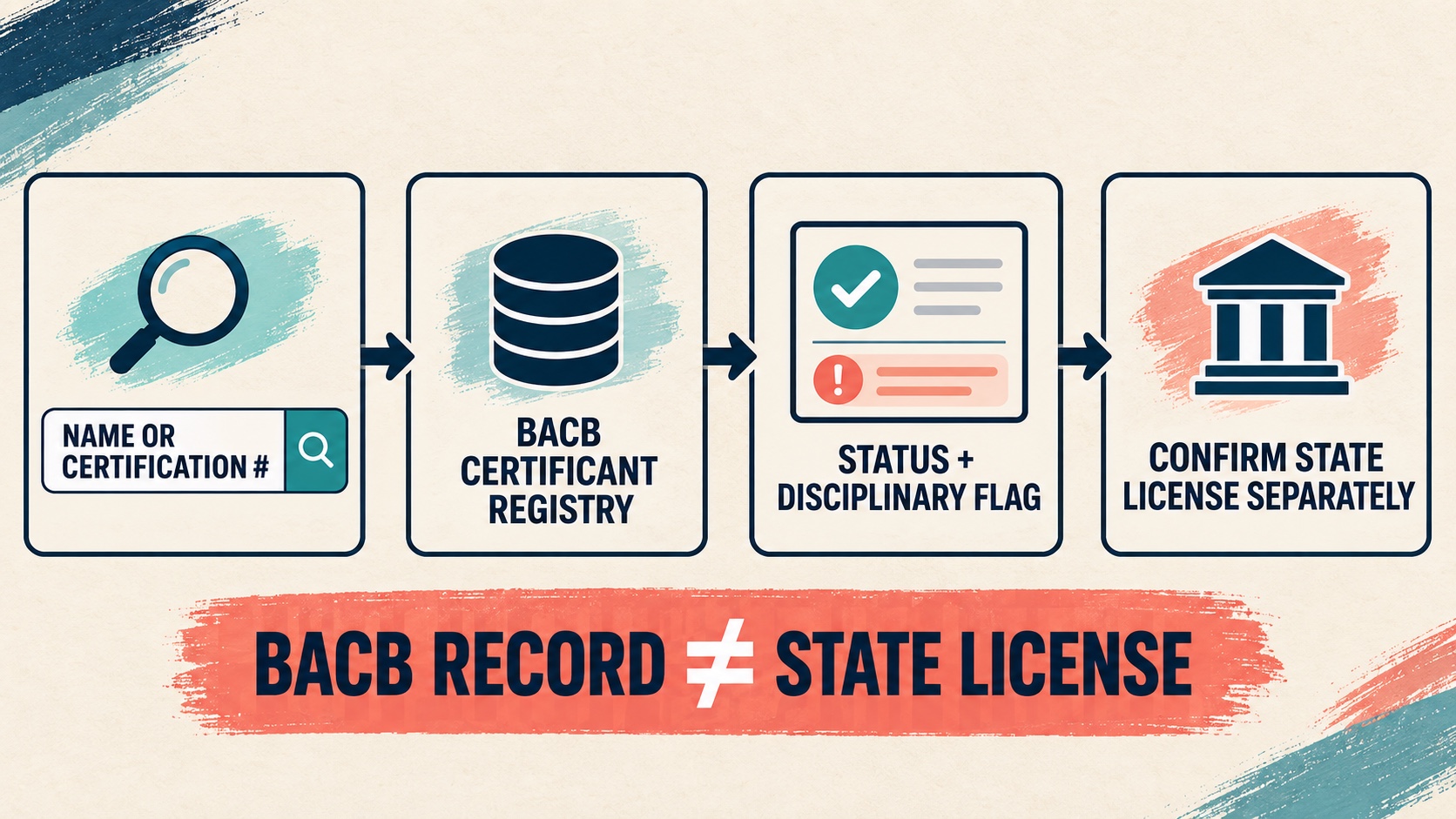
The BACB’s Verify BACB Certification page identifies the online Certificant Registry as the primary resource for quickly checking certification status and determining whether reportable disciplinary actions are associated with a certification. The BACB also says the Registry is updated daily, so a dated search is more useful than an old screenshot or an undated profile claim.
Open the Registry from the current BACB verification page rather than relying on a saved third-party link. The search interface can separate certification type, status, location, and other filters. It includes BCBA as a certification type and can show active, inactive, or expired records. Depending on the information you have, you may search by a person’s name or certification number and narrow the result by location.
When a name is common, do not select the first plausible result. Compare the name, location, certification type, certification number, and any other visible record details with the information supplied by the practitioner. A lookup should reduce identity uncertainty, not create a new assumption.
What a Registry Result Can and Cannot Prove
A public registry result is strong evidence about the BACB record displayed at the time you checked it. It does not automatically answer every employment, clinical, funding, or state-regulation question. Keep the boundaries visible in your notes.
| A lookup can help confirm | A lookup does not automatically confirm |
|---|---|
| Whether the matching record is listed as a BCBA or another BACB certification type. | Whether the person holds a license to practice in a particular state. |
| The status shown by the Registry at the time of the search. | Whether the person is available, competent for a specific case, or a good clinical fit. |
| Whether the public record indicates reportable disciplinary information. | Whether a payer, employer, school, or agency has completed its own credentialing process. |
| A starting point for a documented verification trail. | A guarantee about treatment quality, outcomes, or professional conduct outside the information published by the BACB. |
If the result shows a disciplinary indicator, read the information available through the Registry and follow the BACB’s instructions for obtaining more detail. Do not turn a flag into a conclusion that the public record does not state. Document what you saw, when you saw it, and which official page supplied the information.
When Do You Need a BACB Verification Letter?
A verification letter is different from a quick public lookup. The BACB explains that an active certificant may be able to view and print an on-demand verification report from the portal. It also provides a request route for written verification of a current certificant’s status. The current BACB page lists the verification-letter fee as $25 per letter and says letters are emailed within 3–5 business days after payment is received; confirm the current fee and timing before submitting a time-sensitive request.
A formal letter makes more sense when a licensing board, employer, funder, or another organization specifically requires written verification. The BACB page says the letter can include the certificant’s name and certification number, current status, applicable inactive reason, initial certification date, and expiration date. It is not a substitute for a state license check, and the BACB notes that verification letters are not provided for certifications that are expired.
For a quick “is this person listed and active?” question, the public Registry is usually the first step. For a documented submission with a receiving organization’s requirements, ask what format it accepts before paying for a letter.
BCBA Certification Versus State Licensure
BCBA certification and state licensure can overlap, but they are not the same record. The BACB’s consumer resources page says many, but not all, U.S. states require behavior analysts to be licensed and directs consumers to verify licensure separately. The state board or licensing authority controls the license record, scope of practice, renewal status, and any state-specific restrictions.
This matters because an active BACB record does not tell you, by itself, whether a person may practice under your state’s law or in a particular funded program. If your question is “Can this person legally practice here?”, go to the relevant state licensing board after checking the BACB credential. If your question is “Is this person a qualified supervisor for my fieldwork?”, use the Registry plus the current supervision requirements; the public result alone is not the complete eligibility review.
Which Record Should You Use?
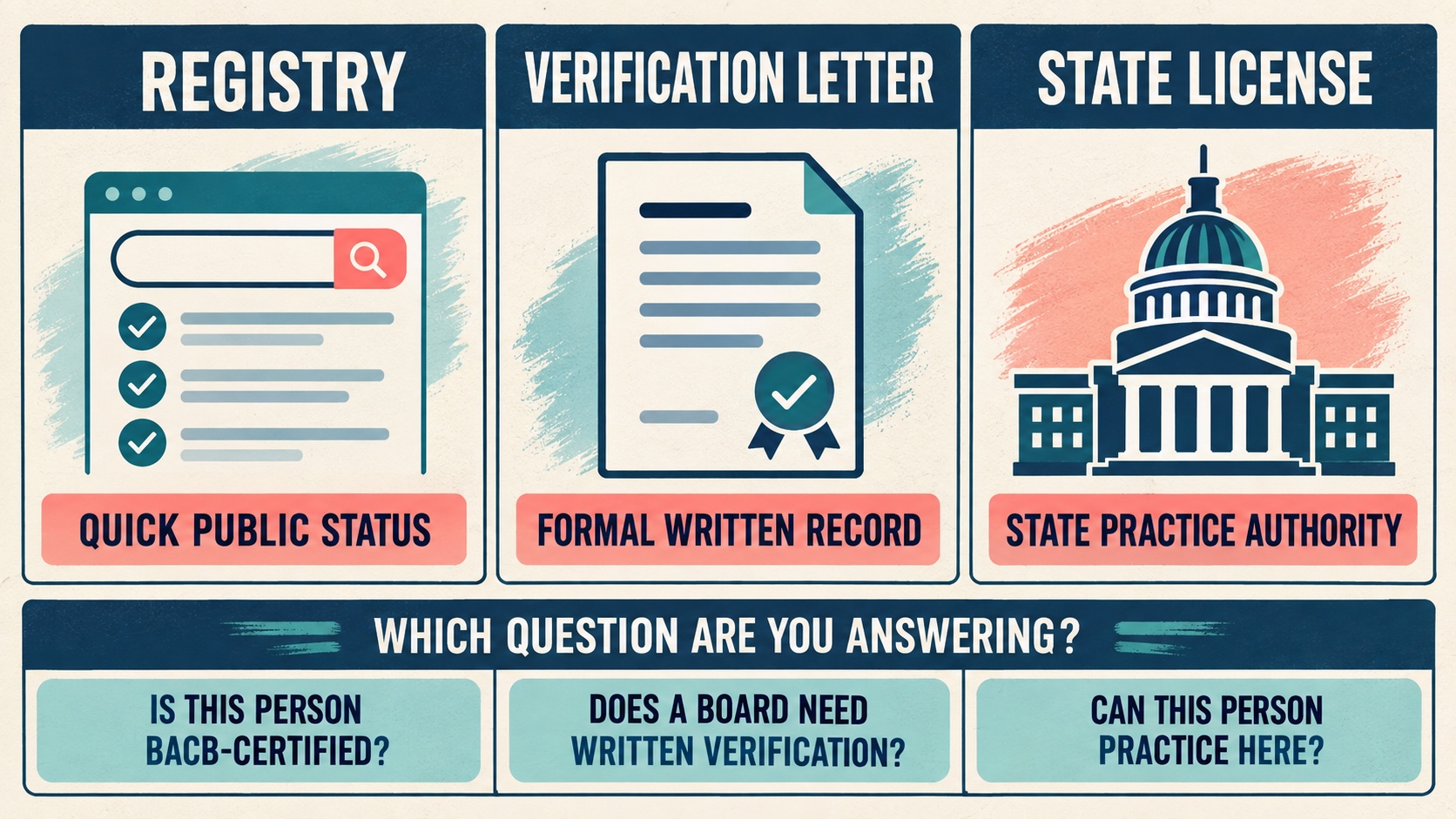
| Your question | Best first source | What to do next |
|---|---|---|
| Is this person currently listed as a BCBA? | BACB Certificant Registry | Match the identity and save the search date. |
| Does a board or employer need written proof? | BACB verification report or verification letter | Confirm the recipient’s required format, fee, and deadline. |
| Can the person practice in this state? | State behavior-analyst licensing board | Check the state record, scope, expiration, and setting rules. |
| What number belongs in my BACB account form? | Your private BACB portal account | Use the exact field label; an account ID is not automatically a certification number. |
How to Perform a BCBA Credential Lookup Step by Step
- Define the decision. Decide whether you are checking BACB certification, requesting written proof, checking a state license, or evaluating supervision eligibility.
- Collect the minimum matching information. Use the person’s full name, certification number if available, state, city, or employer context. Avoid collecting unrelated personal information.
- Open the current BACB verification page. Use the official Verify BACB Certification route and enter the Certificant Registry.
- Choose BCBA as the certification type. Narrow the search by status or location when the interface makes that option available.
- Match the record carefully. Compare the result with the practitioner’s supplied information. If multiple names appear, do not guess.
- Read the status and public disciplinary indication. Record the exact wording rather than paraphrasing it into a stronger conclusion.
- Check the second authority when necessary. Visit the state licensing board, payer, employer credentialing team, or current BACB supervision guidance for the part the Registry cannot answer.
- Save a dated note. Keep the URL, search date, matching details, and any next step in a secure work record. Do not publish private identifiers or use the Registry as a marketing list.
What If You Cannot Find the Person?
A missing result does not automatically prove that a person is unqualified. First check spelling, name order, hyphenation, location, certification type, and whether you accidentally searched a certification number in a name field. Ask the practitioner to confirm the exact name and certification number they want you to use, then repeat the search through the official route.
If the person says the record is active but the Registry does not match, pause the credentialing decision and contact the BACB through its current support route. Do not rely on a screenshot, social-media bio, clinic webpage, or an old certificate as a replacement for the current source. If the issue is state practice authority, contact the state board as well; the BACB cannot replace that state record.
Do Not Confuse a BACB ID With a Certification Number
A BACB account ID is connected to a private account or portal record. A certification number identifies a certification record. They can appear in the same workflow, but they answer different questions. If a form asks for your own BACB ID, retrieve it from your portal account. If a public verification screen asks for a certification number, use the credential number supplied for that purpose.
For the account-number distinction, see our guide to BACB ID meaning. For supervision-specific searches, see BACB supervisor search. If a board requests formal written status, use the workflow explained in BACB letter of good standing rather than treating a general lookup as a formal letter.
BCBA Credential Lookup FAQs
What is the official way to look up a BCBA credential?: Use the BACB’s current Verify BACB Certification page and open the BACB Certificant Registry. Search by the person’s name or certification number, select the appropriate certification type, and compare the result carefully.
Is the BACB Certificant Registry free?: The public Registry is presented by the BACB as a resource for consumers, employers, and licensing authorities to verify certification status. A formal verification letter is a separate service and may have a fee, so confirm the current request page before submitting. Does an active BCBA record prove a state license?: No. BACB certification and state licensure are separate records. Check the relevant state licensing authority when practice authorization, scope, or state renewal status matters.
Can I use a BACB ID for a public credential lookup?: Not automatically. A BACB ID is an account identifier, while a certification number identifies a credential. Use the number requested by the current form or verification tool; do not substitute one for the other.
How often should I repeat a credential check?: Repeat it close to the decision date and whenever a contract, payer, licensing board, or employer requires a current record. Keep the search date because certification status can change after an earlier check.
The safest answer to a BCBA credential lookup is source-specific: use the BACB Certificant Registry for a current public certification check, request written verification when a receiving organization requires it, and verify state licensure separately. If you are preparing for the BCBA exam, you can also use the free BCBA mock exam for practice. It does not access the BACB Registry, verify a practitioner, change eligibility, or guarantee certification.
Quick Review Checklist
Use this final checklist to turn bcba credential lookup into exam-ready reasoning. The goal is not to memorize a label in isolation; it is to identify the relevant evidence and explain why the best answer fits the scenario. Key ideas to review:
- State the central definition or decision point for bcba credential lookup in your own words.
- Identify the detail that makes bcba credential lookup different from its closest related ABA term.
- Separate the observable facts in a scenario from assumptions that are not supported by the facts.
- Write one example and one nonexample so you can recognize the concept in a new setting.
Exam application checks:
- Ask what the question is actually requesting before comparing the answer choices.
- Mark the antecedent, response, consequence, or other evidence that supports the selected answer.
- Look for a distractor that describes a related process but does not answer the specific question.
Final self-check:
- Explain how you would verify the interpretation with clear observations or data.
- Change one detail in the scenario and decide whether your answer should change.
- Give a one-sentence rationale that a supervisor or study partner could evaluate.
Take the Free BCBA Mock Exam
If you want a low-pressure way to check your recall, use the free practice resource below. Take the Free BCBA Mock Exam



