
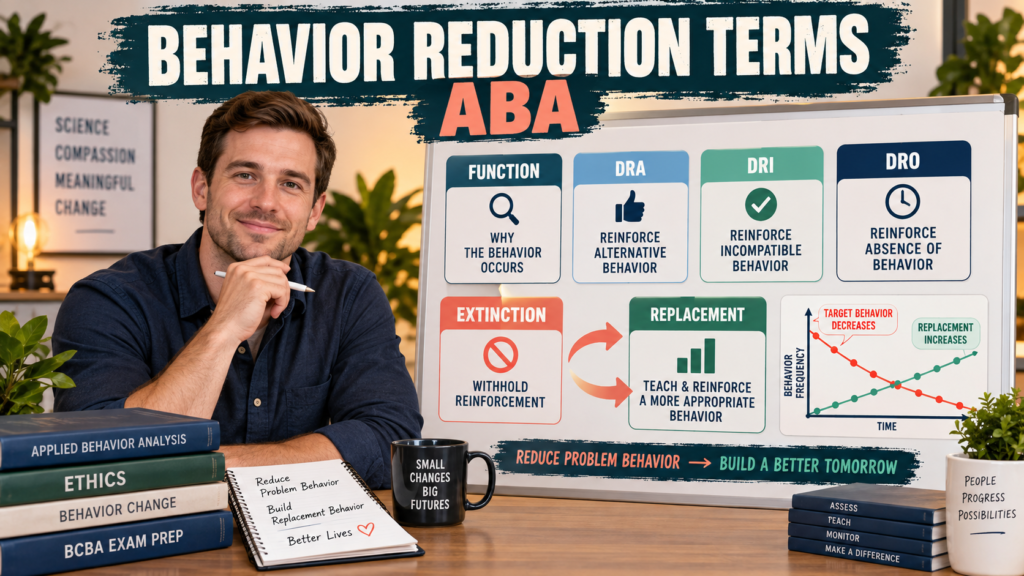
reduction of problem behavior terms ABA are the definitions and decision rules used to describe why behavior is occurring, what behavior is being reduced, and what functional skill should replace it. A useful behavior-reduction plan does not stop at “make the behavior go away.” It identifies an observable target, matches intervention to function, reinforces a safer replacement, and measures whether the learner is gaining meaningful access and independence.
Table of Contents
- What Are Reduction of Problem Behavior Terms ABA?
- Which Terms Describe the Target and Its Function?
- What Are DRA, DRI, and DRO?
- How Does Extinction Fit Into Behavior Reduction?
- What Is the Difference Between Antecedent and Consequence Strategies?
- How Do Replacement Skills Connect to Reduction?
- How Should You Read Behavior-Reduction Data?
- What Does the BCBA Exam Test?
- What Mistakes and Ethical Risks Should You Avoid?
- Reduction of Problem Behavior Terms ABA FAQ
- Take the Free BCBA Mock Exam
For BCBA exam questions, the fastest way to sort the vocabulary is to ask three questions: What is the target response? What consequence is maintaining it? What will the learner do instead? DRA, DRI, DRO, extinction, antecedent strategies, and replacement-skill teaching answer different parts of that sequence.
This guide organizes the most testable behavior-reduction terms without replacing an individualized functional assessment or clinical plan. The current BCBA Test Content Outline provides the exam context; a qualified BCBA must select, supervise, and evaluate procedures for a particular learner. Table of Contents
What Are Reduction of Problem Behavior Terms ABA?
Reduction of problem behavior terms ABA are the technical labels used to describe a behavior-change plan that decreases a response while teaching and strengthening a socially meaningful alternative. “Problem behavior” is not a complete operational definition. A plan should specify the observable response, the context in which it occurs, the measurement system, and the level of change that matters.
Behavior reduction is therefore a process, not a single procedure. A team may adjust antecedents, teach communication, arrange reinforcement, use extinction when it is appropriate and safe, or apply other behavior-change procedures supported by assessment. The terms describe the relation between those components; they do not authorize a generic recipe for every learner. Start by separating four ideas:
- Target behavior: the observable response to decrease, such as hitting, property destruction, elopement, or a precisely defined form of refusal.
- Function: the consequence or outcome that has historically maintained the response, such as attention, escape, access to tangibles, or automatic reinforcement.
- Replacement behavior: a safer, efficient response that produces the same or a more useful outcome, such as requesting a break.
- Behavior-change procedure: the planned arrangement of antecedents, prompts, consequences, and reinforcement used to change responding.
Which Terms Describe the Target and Its Function?
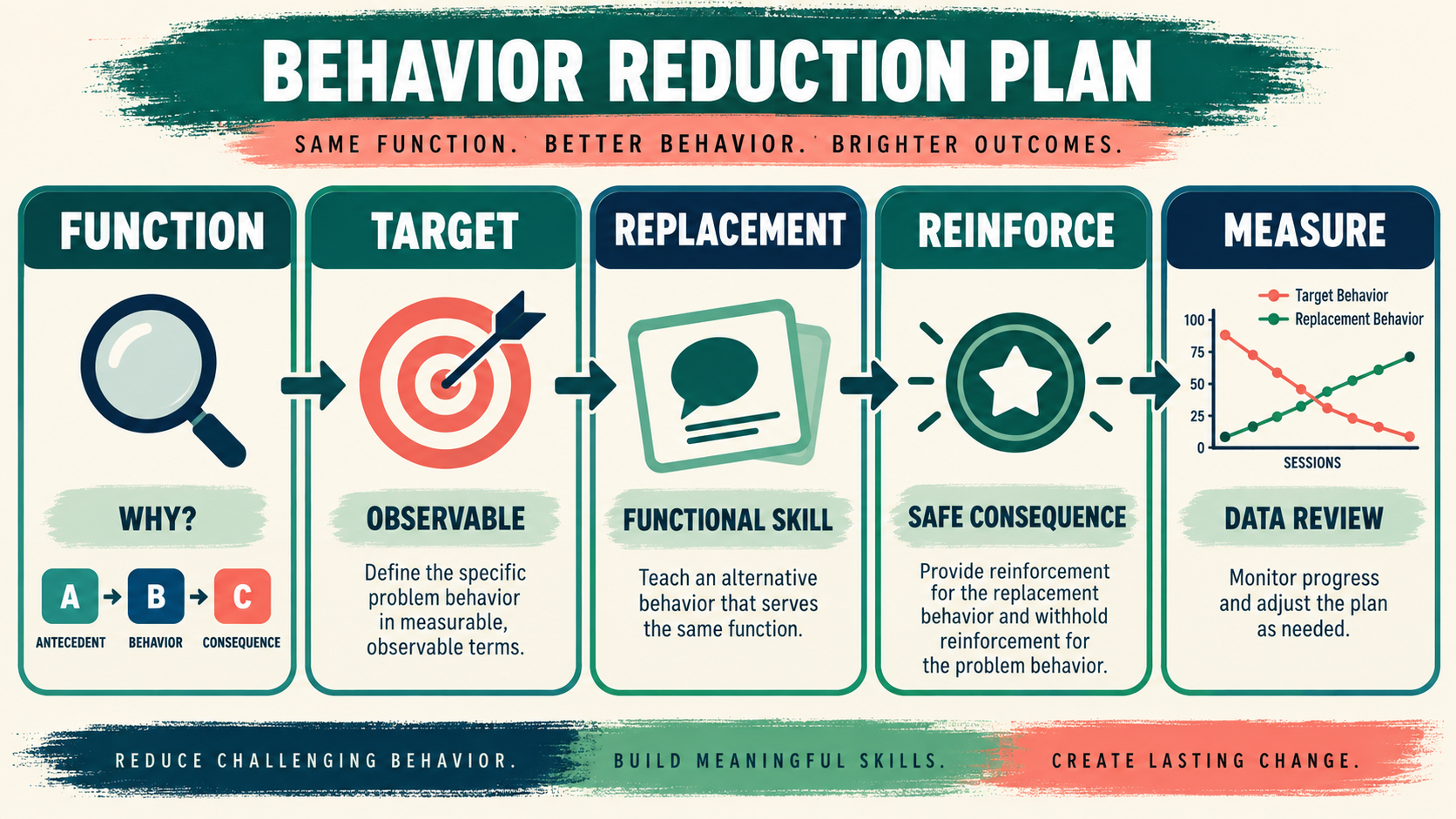
The target is the response the team intends to reduce, not a broad label such as “noncompliance” or “tantrum.” An operational definition should allow two trained observers to decide whether the behavior happened. It should include the response topography, beginning and ending criteria, examples, nonexamples, and the measurement method.
Function is a separate question. A behavior can look similar across learners while producing different outcomes. One learner may hit to end a difficult task; another may hit to obtain attention; a third may contact automatic sensory consequences. On an exam item, look for the maintaining consequence and for whether the proposed intervention gives the learner a functional way to obtain that outcome. Several terms help keep this logic clear:
- Function-based intervention: an intervention whose consequences and teaching arrangement address the behavior’s identified function.
- Function-matched replacement: a replacement response that is efficient enough to compete with the problem behavior and contacts a relevant outcome.
- Stimulus control: responding comes under the control of the relevant instruction, cue, or environmental event rather than an accidental prompt.
- Generalization: the skill occurs with different people, materials, settings, or examples beyond the teaching arrangement.
These terms prevent a common planning error: selecting a consequence simply because it suppresses a response in the short term while ignoring whether the learner can communicate, participate, or access reinforcement in a safer way.
What Are DRA, DRI, and DRO?
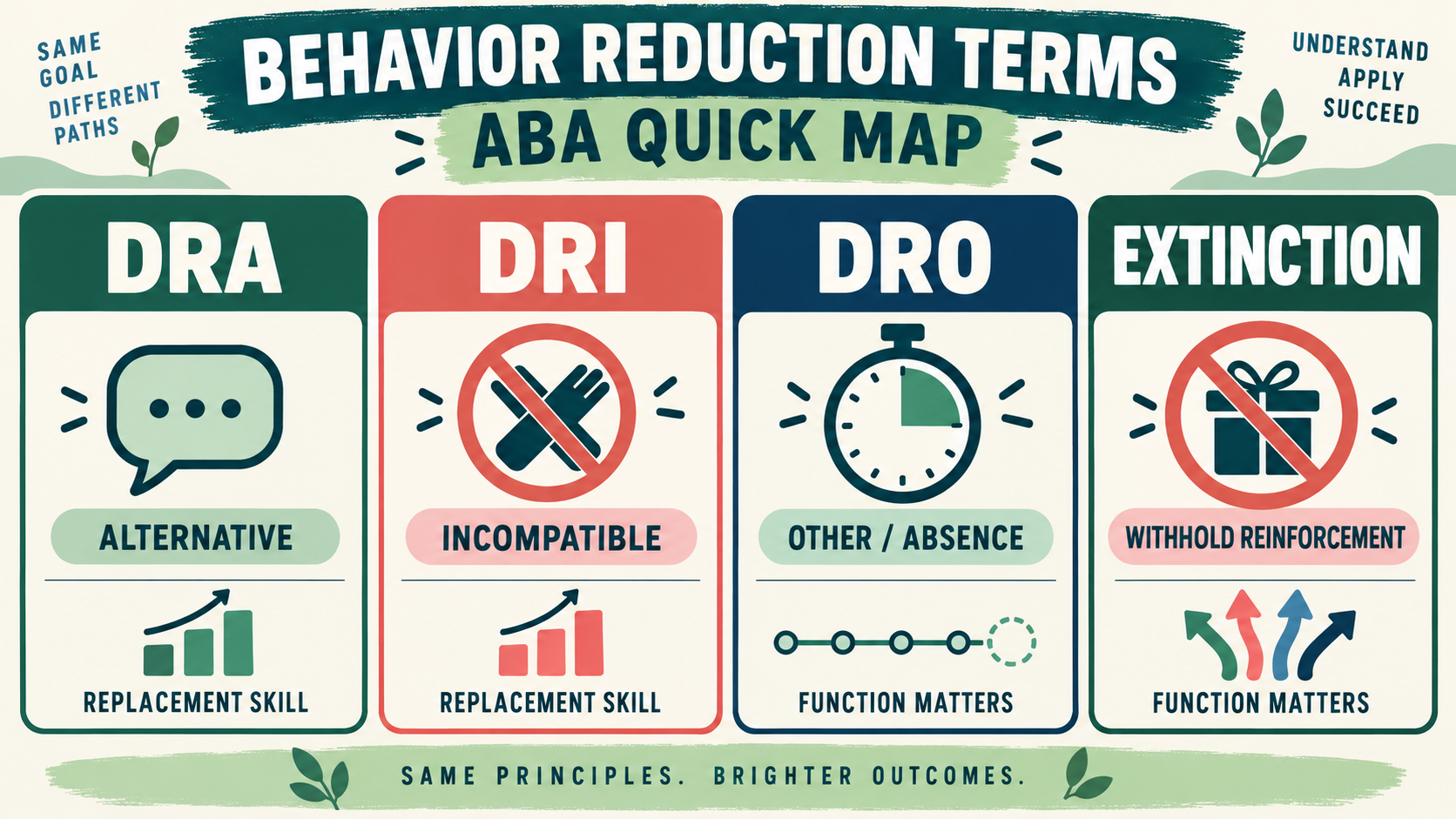
Differential reinforcement procedures reduce a problem response by arranging reinforcement for a specified alternative, incompatible response, or period without the target response. The acronym tells you what earns reinforcement, so read the final letter carefully: it stands for differential reinforcement of the named behavior or condition.
| Term | What earns reinforcement | Exam distinction |
|---|---|---|
| DRA Alternative behavior | A specified response that serves as an alternative to the target, such as requesting help. | The alternative does not have to be physically incompatible; it must be defined and reinforced. |
| DRI Incompatible behavior | A response that cannot occur at the same time as the target, such as hands in pockets instead of hitting. | The incompatibility must be logically or physically true, not merely preferred by the instructor. |
| DRO Other behavior | The absence of the target during a defined interval, or the occurrence of any response other than the target, depending on the DRO arrangement. | The interval and reset rule matter; DRO does not automatically teach a functional communication response. |
| DRL Low rates | A response that occurs at or below a defined rate, when some occurrence is acceptable. | DRL is for reducing frequency, not necessarily eliminating a response that is unsafe or unacceptable at any rate. |
DRA is often useful for practical communication or coping responses. DRI still needs a meaningful, feasible incompatible response, while DRO does not automatically teach what the learner should do during an interval. Write the procedure, schedule, reinforcer, and decision rule rather than inferring them from the acronym.
How Does Extinction Fit Into Behavior Reduction?
Extinction means discontinuing the reinforcer that previously maintained a behavior. It is defined by the functional relation, not by ignoring a person in every situation. If attention maintained the target, attention may be withheld according to the plan; if escape maintained it, task removal may no longer follow the target. The functional assessment and safety plan determine whether that description is accurate.
Extinction should not be presented as a standalone shortcut. The plan should teach and reinforce a replacement response, specify how staff respond to escalation or safety risk, and identify who can pause or modify the procedure. The team must monitor data and learner experience rather than continue blindly.
On the BCBA exam, distinguish extinction from punishment. Extinction removes the maintaining reinforcer after the target response; punishment presents or removes a consequence that decreases future responding. Both terms depend on their effect and contingency, not on whether an adult believes the consequence is unpleasant. An answer choice that calls any withholding of attention “extinction” without identifying the maintaining relation is incomplete.
What Is the Difference Between Antecedent and Consequence Strategies?
An antecedent strategy changes what happens before the response. Examples include offering choices, adjusting task difficulty, using a visual schedule, changing the response effort, arranging a high-probability sequence, or providing an appropriate prompt. A consequence strategy changes what follows the response. Examples include reinforcing a replacement, implementing a differential-reinforcement schedule, or applying an assessment-supported extinction contingency.
Antecedent strategies can reduce the value of the problem behavior or increase the value and availability of the replacement. They do not prove that the behavior’s function has changed. Consequence strategies can strengthen the replacement and reduce reinforcement for the target, but they also do not excuse unclear instructions, inaccessible materials, or an overly difficult task.
A strong plan connects both sides: make the replacement easier to use, teach it before a crisis, prompt it when appropriate, reinforce it quickly, and measure whether the target and replacement change together. If the target drops while the learner’s communication and participation also drop, the team needs to examine whether the intervention is producing meaningful improvement.
How Do Replacement Skills Connect to Reduction?
A replacement behavior is not simply any response the adult prefers. It should be observable, socially meaningful, efficient, and functionally relevant. For escape-maintained behavior, that might be an appropriately taught break request. For attention-maintained behavior, it might be a greeting, tap, sign, or communication-device response. For tangible-maintained behavior, it might be requesting, waiting, or choosing from available options.
The teaching plan should include a prompt hierarchy, prompt-fading rule, reinforcement schedule, and generalization opportunities. Reinforce the replacement before expecting it to compete with a well-established problem behavior. Make sure the learner can use the response when the motivating operation is present; teaching a request only when the desired item is already freely available does not test the full contingency.
Replacement teaching also protects the meaning of reduction. A lower rate is not enough if the learner is merely being restricted, ignored, or prompted continuously. The desired outcome is safer, more independent, and more effective behavior that expands participation.
How Should You Read Behavior-Reduction Data?
Data terms tell you what changed and whether the change matters. Frequency counts events; rate adjusts frequency for time; duration measures how long a response lasts; latency measures time from an instruction or event to the response; and percentage summarizes defined opportunities. Choose measurement based on the dimensions that matter for the target.
Pair target data with replacement-skill data. A graph showing fewer episodes of aggression is incomplete if it does not show whether requests, waiting, or safe transitions increased. Also inspect opportunities, prompt level, setting, staff, schedule, and treatment integrity. A reduction that occurs only when a particular staff member is present may not represent generalization.
Look for level, trend, variability, immediacy, overlap, and consistency across relevant contexts. Avoid claiming that a procedure caused change when the team changed reinforcement, staffing, task demands, and measurement at the same time. Data-based decision-making means using the pattern to decide whether to continue, fade, modify, or pause a plan—not merely placing a graph in a report.
What Does the BCBA Exam Test?
Most questions can be solved by translating the scenario into a contingency. Identify the target, the antecedent, the consequence, the function, and what is reinforced. Then ask whether the procedure changes the target directly, teaches a replacement, changes the antecedent, or changes the consequence.
- DRA: reinforce a specified alternative response.
- DRI: reinforce a response that cannot occur with the target.
- DRO: reinforce an interval or condition in which the target is absent, according to the defined arrangement.
- DRL: reinforce a response at or below a criterion when some occurrence remains acceptable.
- Extinction: stop delivering the reinforcer that maintained the target response.
- Function-based treatment: arrange consequences and teaching around the identified function.
Be cautious with absolute answer choices such as “always use extinction,” “ignore the behavior,” or “reinforce any behavior that is not the target.” The exact response definition, interval, function, safety context, and replacement plan determine whether the label fits.
What Mistakes and Ethical Risks Should You Avoid?
Behavior reduction can become unsafe when the vocabulary hides the learner’s experience. A broad label can lead to an overly broad intervention; a consequence selected without a functional assessment can strengthen the wrong response; and a plan that suppresses behavior without teaching communication can make the learner less able to participate.
- Using “noncompliance” or “tantrum” without an observable definition.
- Calling a replacement functional even though it is slower, harder, or unavailable when needed.
- Counting prompted responses as independent mastery.
- Applying DRO without teaching what the learner should do during the interval.
- Calling any withheld attention extinction without identifying the maintaining reinforcer.
- Continuing a plan despite distress, risk, escalation, or loss of communication without clinical review.
The BACB’s professional standards require competent, individualized, and respectful decision-making. Plans should account for assent and refusal, accessible communication, cultural and contextual variables, least-restrictive alternatives, and safety. Technical terms make documentation clearer; they do not replace supervision or clinical judgment.
Reduction of Problem Behavior Terms ABA FAQ
What is the most important behavior-reduction term to learn first?: Learn the distinction between target behavior and function first. Once you know what response is occurring and what consequence maintains it, DRA, DRI, DRO, extinction, and replacement teaching become easier to classify.
Is DRA the same as teaching a replacement behavior?: Not always. DRA is a differential-reinforcement arrangement in which a defined alternative is reinforced. A replacement program may include DRA, but it also usually includes teaching, prompting, fading, generalization, and function-based decision rules.
Does DRO teach a functional communication response?: Not by itself. DRO reinforces the absence of the target under a defined interval or condition. If functional communication is the desired outcome, teach and reinforce that response directly rather than assuming DRO will create it.
Is extinction the same as ignoring problem behavior?: No. Extinction means withholding the reinforcer that maintained the target response. Ignoring may be part of a plan in some attention-maintained arrangements, but it is not a universal definition and may be unsafe or inappropriate in other contexts.
What should I remember for the BCBA exam?: Define the response, identify the function, match the consequence to that function, and check what replacement is being reinforced. Then inspect the exact schedule, interval, prompt, and data rule before selecting an answer. After reviewing the terms, use the free BCBA mock exam as a study checkpoint. It is an independent study aid, not an official BACB product, clinical authorization, or guarantee of certification.
The exam-ready summary is simple: define the target, identify its function, teach a meaningful replacement, reinforce the right response, and measure both reduction and improved participation. That is the logic behind reduction of problem behavior terms ABA.
Take the Free BCBA Mock Exam
If you want a low-pressure way to check your recall, use the free practice resource below. Take the Free BCBA Mock Exam



