
Intraverbal associations list searches usually point to “What goes with ___?” or “What is related to ___?” responses in ABA language teaching. The learner hears a verbal cue, produces a related verbal response, and receives a social or otherwise arranged consequence. The important BCBA distinction is not the object pair itself. It is the source of stimulus control: the response is evoked by another person’s words rather than by seeing the item in front of the learner.
Table of Contents
- What Is an Intraverbal Association?
- Original Intraverbal Associations List
- Association Versus Fill-In, Category, and Function Tasks
- How to Build an Intraverbal Associations List for Study
- Prompting, Stimulus Control, and Measurement
- BCBA Exam Reasoning and Common Traps
- FAQ
- Quick Review Checklist
- Take the Free BCBA Mock Exam
This guide gives you an original study list, explains how associations differ from fill-ins and categories, and shows how to judge prompting, independence, and generalization. It is study guidance, not an individualized language program. A real learner’s communication system, preferences, assent, assessment data, and supervising professional should guide any clinical decision. Table of Contents
What Is an Intraverbal Association?
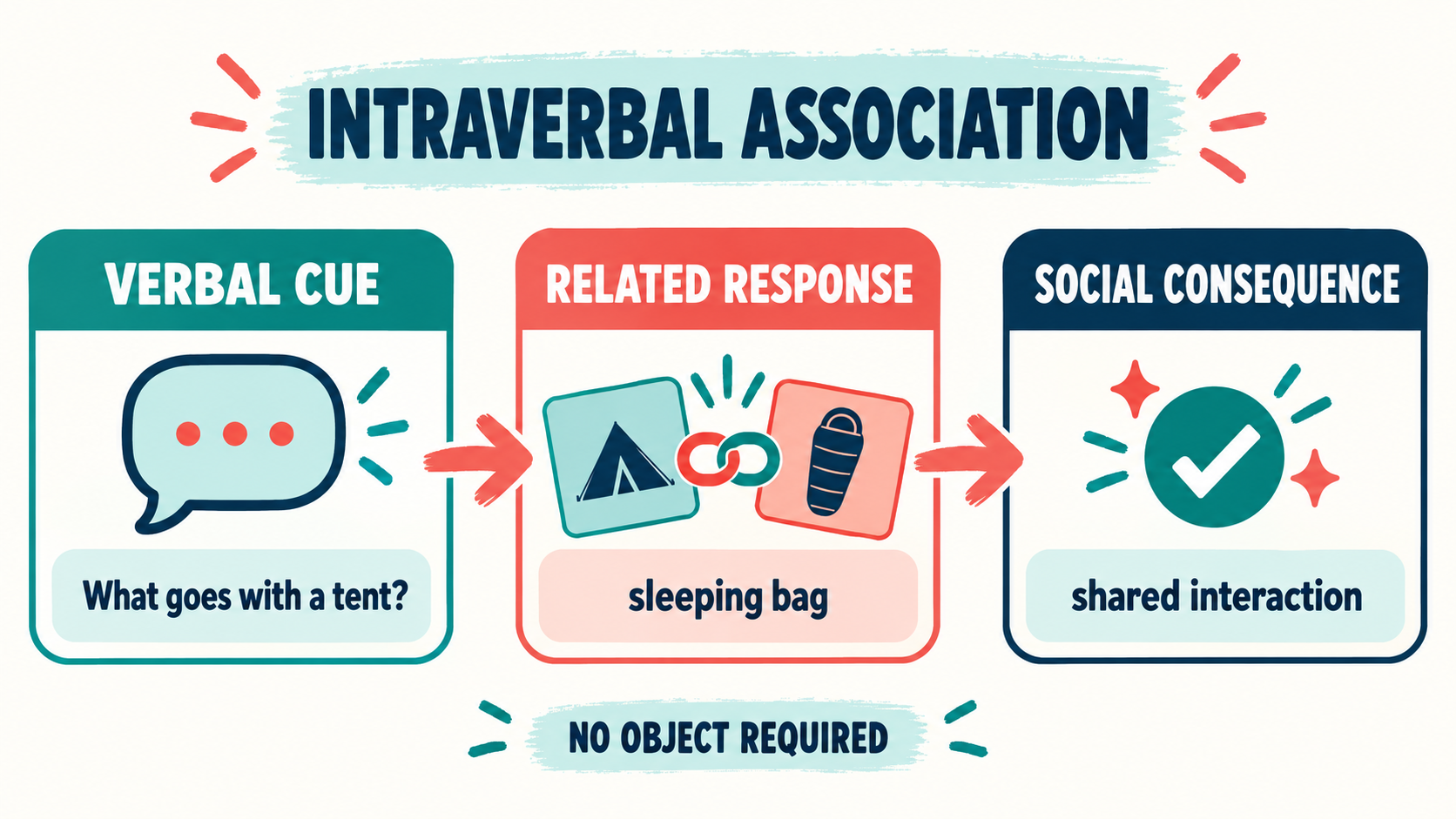
An intraverbal is a verbal response controlled by another person’s verbal behavior without point-to-point correspondence between the cue and the response. In plain language, someone says something, and the learner answers or continues with a related word or phrase. An association task is one format for practicing that relation. For example, a teacher might ask, “What goes with a tent?” and the learner might answer, “A sleeping bag.” The learner does not have to see a tent or a sleeping bag for the response to be relevant.
The word association describes the relationship between the cue and the answer, not a single mandatory answer. “What goes with a picnic?” might evoke “blanket,” “basket,” or “food,” depending on the learner’s history and the scoring rule. A useful study list therefore records the cue, the intended relation, the acceptable answer set, and the reason an answer is accepted. It should not pretend that every everyday association has one objectively correct response.
For exam reasoning, start with the controlling variable. If the learner sees a picture of a bicycle and says “bike,” that may be a tact. If the learner hears “What do you ride?” and says “bike” without the picture present, the verbal cue is doing the important work. If the learner repeats “bike” immediately after the teacher says “bike,” the response is echoic rather than an association. The same word can appear in different operants; the antecedent and correspondence determine the analysis.
The current BCBA Test Content Outline is the appropriate source for current examination scope. A list of examples can support studying, but it is not an official BACB question bank or a substitute for understanding stimulus control, measurement, skill acquisition, and generalization.
Original Intraverbal Associations List
The examples below are newly written study prompts. They are deliberately not a reproduction of the ABLLS-R protocol or another commercial assessment appendix. Read each cue aloud, hide the response column, and decide in advance what counts as correct. Where more than one response is reasonable, write an answer rule instead of marking every alternative wrong.
| Verbal cue | Possible response | Relation to notice |
|---|---|---|
| What goes with a tent? | Sleeping bag | Common activity or setting partner |
| What goes with a picnic? | Blanket, basket, or food | Multiple answers may be socially reasonable |
| A camera needs a ___ for extra storage. | Memory card | Object-to-support relationship |
| What might you wear with a raincoat? | Rain boots | Contextual co-occurrence |
| What goes with a sketchbook? | Pencil | Tool-to-activity relationship |
| A calendar helps you keep track of ___. | Dates or appointments | Object-to-use relationship |
| What goes with a lunchbox? | Lunch or an ice pack | Routine-based association |
| What goes with a music stand? | Sheet music | Activity-material relationship |
Use the list as a retrieval tool, not a test of whether the learner shares the adult’s preferred association. If the target is “What goes with a picnic?” decide whether “blanket,” “basket,” and “food” are all accepted before scoring. If the target is a narrower academic response, define the cue and answer more precisely. Good measurement begins with a clear response rule.
Association Versus Fill-In, Category, and Function Tasks
Intraverbal materials can look similar on the surface. The exam-relevant question is what verbal stimulus controls the response and what relation the question is testing. A response can be verbal in all four examples below without belonging to the same instructional task.
| Task type | Example cue | What separates it |
|---|---|---|
| Association | What goes with a tent? | A related partner, support, setting, or companion response is selected. |
| Fill-in | Peanut butter and ___. | The verbal frame or familiar phrase narrows the missing response. |
| Category | Name three things you can eat. | The answer must meet a stated class rule, often with several responses. |
| Function | What do you use to keep a notebook closed? | The cue asks for what an item does or what tool serves a specified purpose. |
These labels are study organizers, not mutually exclusive properties of every question. A function question can also produce an association, and a fill-in can be built from a familiar association. For a BCBA item, follow the wording and the response rule supplied in the stem rather than relying on the fact that all answers are spoken.
How to Build an Intraverbal Associations List for Study
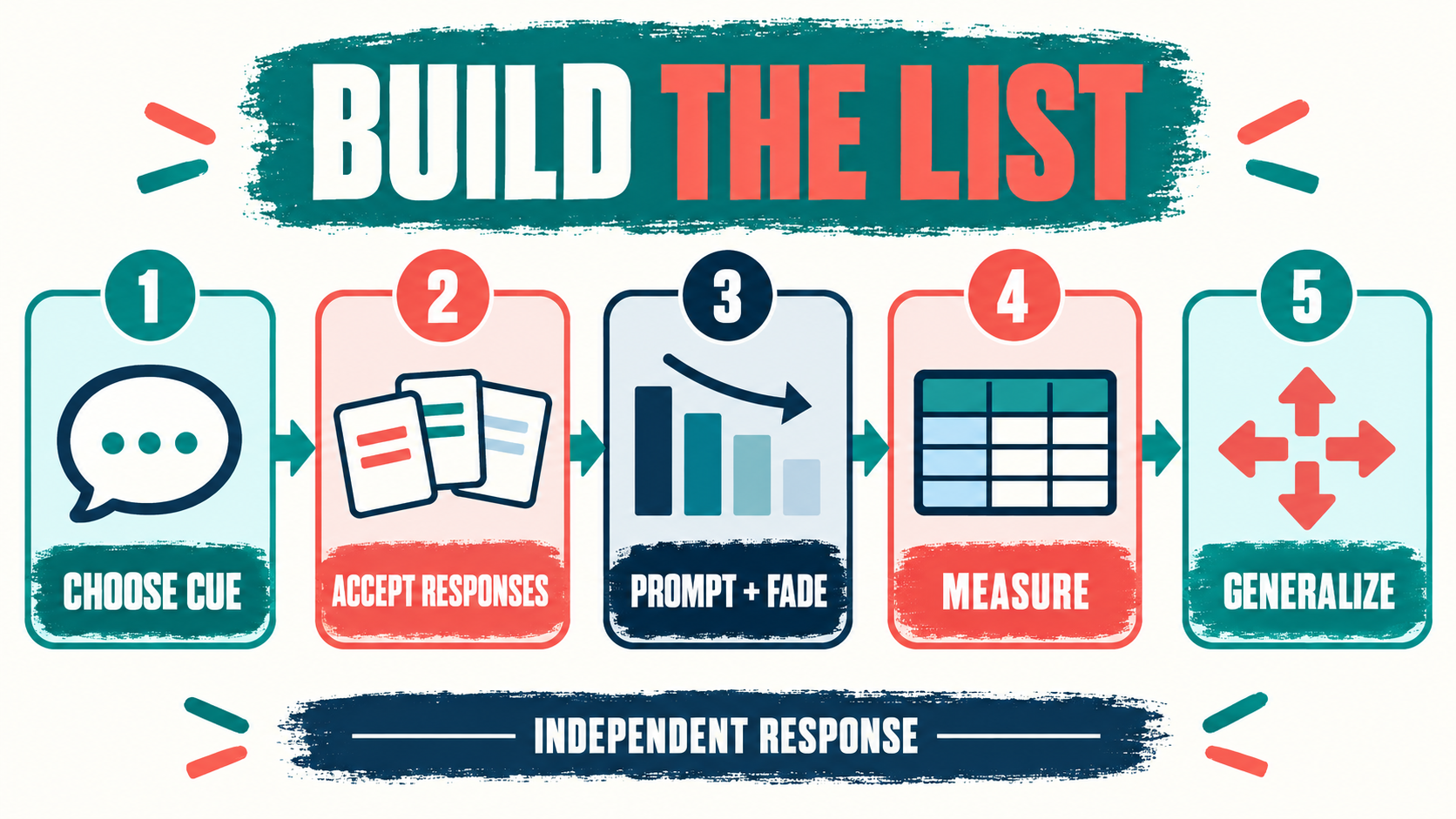
A high-quality list is small enough to review and precise enough to teach a distinction. Use the following workflow when creating your own study sheet or evaluating a resource:
- Choose the relation. Decide whether the pair represents a partner, tool, routine, setting, material, or another clearly stated relationship. Avoid a cue that could mean five unrelated things.
- Write the verbal cue. Make the cue audible and complete. If the target is a question, record the exact wording. If the target is a sentence frame, mark the location of the response.
- List acceptable responses. Identify one expected response or a justified response set. Do not mark a reasonable answer wrong just because it is not the adult’s favorite example.
- Check the controlling variable. Hide the pictures and objects. Ask whether the learner could answer from the verbal cue alone. If a visual card is required, you may be measuring a different relation.
- Plan a prompt and fade. If the learner needs help, use a prompt that supports the target response and then reduce it. The final test should show control by the natural verbal cue, not by a permanent model or written answer.
- Test variation. Change the speaker, wording, materials, location, and acceptable response form when the learning goal calls for generalization. Do not confuse memorizing one cue-answer pair with flexible language.
For study purposes, color-code your notes by relation rather than by difficulty: partner, tool, routine, category, or function. Then cover the response column and say the cue aloud. If you can recognize the answer only when you see the printed pair, the sheet is functioning as a visual matching aid, not yet as an intraverbal retrieval exercise.
Prompting, Stimulus Control, and Measurement
Prompting is useful when it transfers control to the intended cue. Suppose the target cue is “What goes with a sketchbook?” and the learner does not respond. A teacher might provide an echoic model, a partial verbal prompt, or another approved prompt matched to the learner’s communication system. The prompt should be faded according to the teaching plan. If the learner always waits for the model, the model—not the question—is controlling the response.
Separate independent, prompted, incorrect, and no-response trials in the data. Add latency when the timing of the answer matters, and record which response variants are accepted. A simple percentage can hide an important difference: eight independent answers out of ten is not the same as ten answers after a full verbal model. For a study question, the strongest answer usually names the measure that matches the target and the prompt level that qualifies the result.
Generalization means more than adding more cards. Check whether the learner responds to a new but equivalent question, a different communication partner, a new setting, or a different acceptable modality when relevant. For example, “What goes with a lunchbox?” and “What might you pack in a lunchbox?” are not automatically equivalent cues. The relation and response requirement need to be analyzed before calling the change a generalization test.
Research on intraverbal responding can inform study, but a research finding is not a ready-made protocol for every learner. The peer-reviewed study on emergent intraverbal forms is one example of how researchers define targets and test untaught relations. For current professional boundaries and exam scope, use the BACB materials and qualified supervision rather than treating a web list as clinical direction.
BCBA Exam Reasoning and Common Traps
Intraverbal association questions often hide the answer in a small detail about the antecedent. Use this quick reasoning sequence:
- Underline the cue. Is the learner hearing a question, a sentence frame, a model, or a label paired with an object?
- Check correspondence. Is the response repeating the same words, or does it differ while remaining related?
- Identify the response rule. Is one answer required, or are several category or association responses acceptable?
- Separate prompt from target control. A correct answer after a prompt may be prompted performance, not independent responding.
- Look for generalization. New wording, people, settings, and response forms can test whether the relation is flexible.
| Tempting shortcut | Better analysis |
|---|---|
| “The word is spoken, so it is an intraverbal.” | Analyze the antecedent, point-to-point correspondence, and whether an object or picture is controlling the response. |
| “There is only one correct association.” | Check whether the question defines a narrow answer or allows a response set that meets the relation. |
| “Prompted accuracy proves mastery.” | Separate independent from prompted performance and examine transfer to new exemplars. |
| “More cards automatically mean generalization.” | Vary the relevant dimensions deliberately and confirm that the response relation remains intact. |
For additional scenario practice, use the free BCBA mock exam. It is independent study practice, not BACB material, recalled exam content, or a certification guarantee.
FAQ
What is an intraverbal association in ABA?: It is a related verbal response evoked by another verbal cue without point-to-point correspondence. A prompt such as “What goes with a tent?” may evoke “sleeping bag,” even when the learner does not see either item. The exact response rule should be defined before scoring.
Are intraverbal associations the same as fill-ins?: They can overlap, but they are not identical. A fill-in uses a verbal frame with a missing response, while an association task asks the learner to produce a related partner, tool, setting, or companion. Analyze the wording and the relation being tested instead of treating all verbal completion tasks as one category.
Can a learner give more than one correct answer?: Yes, when the cue is broad and several responses meet the defined relation. For a study list, record the acceptable response set. For a clinical program or assessment, the supervising professional should define the scoring rule and consider cultural, linguistic, and communication variables.
How do I study an intraverbal associations list?: Hide the response column, read the verbal cue aloud, answer without the visual pair, and mark independent versus prompted responding. Then vary the wording and examples. Study the controlling-variable distinction alongside the list so you can explain why an answer is an intraverbal rather than only memorize a pair.
An effective intraverbal associations list is not the longest list. It is a clear set of original examples with defined relations, reasonable response rules, prompt-fading logic, and a way to test independent responding across variations. That is the difference between memorizing pairs and understanding the verbal behavior concept a BCBA-style question is testing.
Quick Review Checklist
Use this final checklist to turn intraverbal associations list into exam-ready reasoning. The goal is not to memorize a label in isolation; it is to identify the relevant evidence and explain why the best answer fits the scenario. Key ideas to review:
- State the central definition or decision point for intraverbal associations list in your own words.
- Identify the detail that makes intraverbal associations list different from its closest related ABA term.
- Separate the observable facts in a scenario from assumptions that are not supported by the facts.
- Write one example and one nonexample so you can recognize the concept in a new setting.
Exam application checks:
- Ask what the question is actually requesting before comparing the answer choices.
- Mark the antecedent, response, consequence, or other evidence that supports the selected answer.
- Look for a distractor that describes a related process but does not answer the specific question.
Final self-check:
- Explain how you would verify the interpretation with clear observations or data.
- Change one detail in the scenario and decide whether your answer should change.
- Give a one-sentence rationale that a supervisor or study partner could evaluate.
Take the Free BCBA Mock Exam
If you want a low-pressure way to check your recall, use the free practice resource below. Take the Free BCBA Mock Exam



