

ABA CONCEPTS · BEHAVIOR CHANGE The cleanest way to understand shaping within and across topographies in ABA is to ask what measurable dimension is changing. Is the learner’s response form changing across approximations, or is the same response form being refined in rate, duration, latency, volume, force, or another dimension?
Table of Contents
- What Does Shaping Change?
- What Is Shaping Within Response Topographies?
- What Is Shaping Across Response Topographies?
- How Do You Tell Within From Across?
- How Do Successive Approximations Work?
- How Is Shaping Different From Chaining or Prompting?
- What Should You Measure?
- What Are the BCBA Exam Takeaways?
- Frequently Asked Questions
- Sources for Further Study
- Take the Free BCBA Mock Exam
What Does Shaping Change?
Shaping is differential reinforcement of successive approximations toward a defined terminal behavior or performance criterion. The practitioner reinforces a response that is closer to the target than the current approximation and gradually changes the criterion. The important detail is not simply that a learner improves. The program identifies a measurable dimension and uses reinforcement to move that dimension toward a socially meaningful goal.
Topography means the observable form of a response: what the response looks or sounds like. Other dimensions include frequency, rate, duration, latency, magnitude, force, and intensity when those dimensions can be measured reliably. A shaping question becomes easier when you identify the dimension before you look at the labels. If the form changes, think about shaping across response topographies. If the form stays recognizable while another measurable dimension changes, think about shaping within a response topography.
This distinction is conceptual, not a license to select a goal without consent, assessment, or social-validity review. The target should matter to the learner’s participation, communication, independence, health, or safety. A practitioner should define the response, select a reasonable criterion, measure it, and review whether the reinforcement plan is producing a useful change.
What Is Shaping Within Response Topographies?
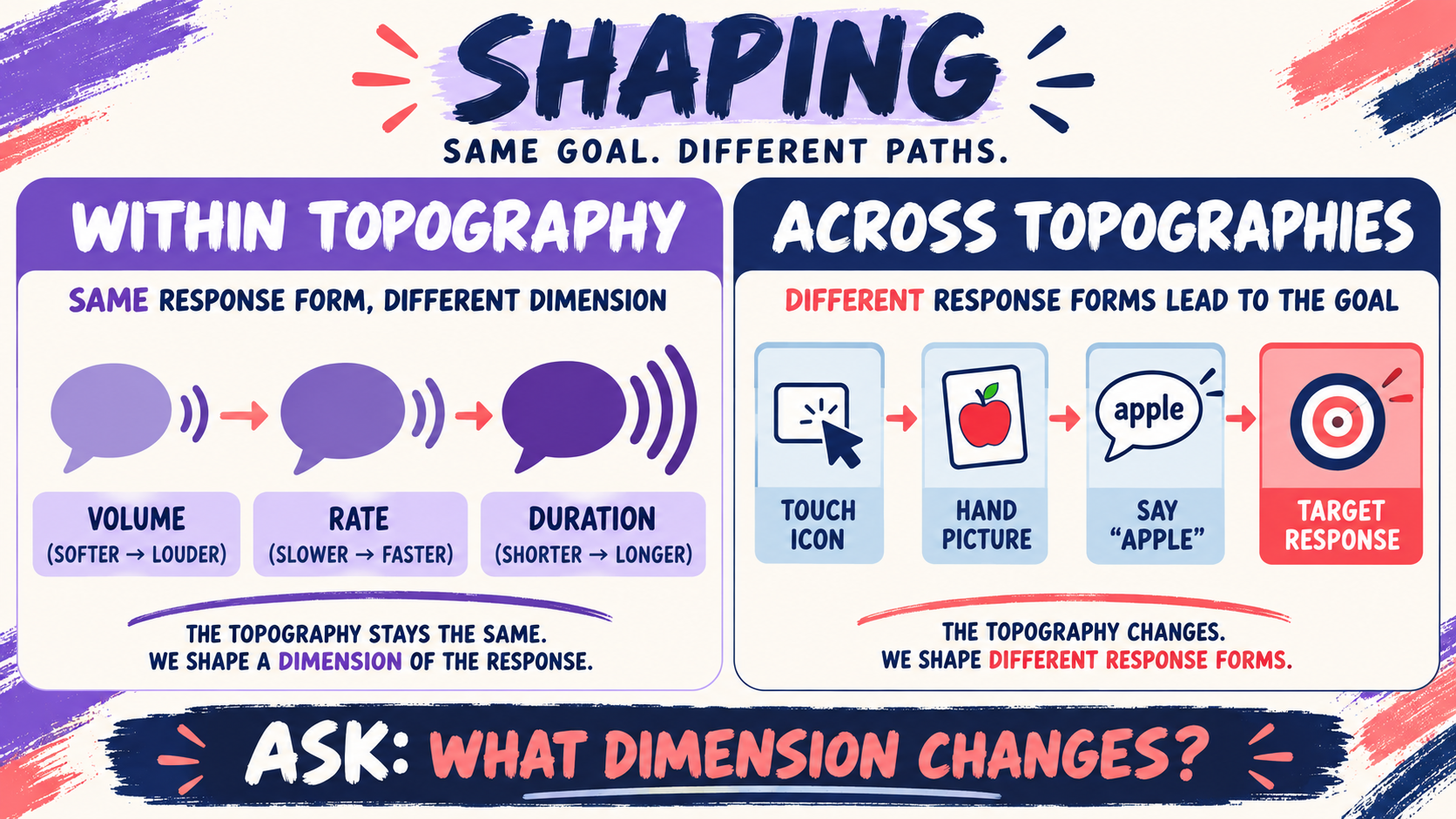
Shaping within response topographies occurs when the response form remains essentially the same while another measurable dimension is gradually changed. The person already performs the response in some form. The instructional task is to refine how often, how long, how quickly, how loudly, or with how much force it occurs.
Imagine a learner who can speak but uses a very loud voice in a library. The response form—speaking—remains recognizable. A plan could shape voice volume by reinforcing successively quieter approximations that still allow communication. The dimension being changed is volume, not a sequence of different responses. Other examples might include increasing the duration of on-task engagement, decreasing latency to begin a familiar response, or increasing the rate of fluent responses.
Within-topography shaping does not mean that the response is identical on every trial. Natural variation is expected. The question is whether the response class or form remains stable enough that the measured change is in another dimension. Operational definitions and a graph help prevent a vague judgment such as “the response looks better” from becoming the criterion.
What Is Shaping Across Response Topographies?
Shaping across response topographies occurs when successive approximations change in form as the learner moves toward the terminal response. The learner may begin with a response already in the repertoire, and the practitioner reinforces a closer form until the final response is established.
For a simple communication example, a learner who reaches toward a preferred item might first receive reinforcement for a clear orientation toward the item, then for an intentional gesture, then for touching a communication symbol, and finally for an agreed-upon request. The approximations differ in topography. The exact sequence would depend on the learner’s repertoire, access method, and approved teaching plan; the example is a conceptual illustration, not a universal protocol.
Across-topography shaping is not the same as chaining. In shaping, the criterion changes the form or dimension of a response toward one terminal response. In chaining, separate component responses are linked into a behavioral sequence. A learner may need both procedures in one program, but the question “what changes between approximations?” still helps you identify the procedure being described.
How Do You Tell Within From Across?
Use this three-question screen:
- Name the response. What does the learner do that can be observed and measured?
- Compare the approximations. Does the response form change, or does the same form change in rate, duration, latency, magnitude, volume, or another dimension?
- Check the criterion. Is reinforcement being differentially delivered for a closer approximation while the previous criterion is no longer the active goal?
| Question | Within a response topography | Across response topographies |
|---|---|---|
| What changes? | A measurable dimension such as duration, rate, latency, volume, or force. | The observable response form changes toward the terminal response. |
| What stays recognizable? | The response form or response class remains substantially the same. | The form may look different at each approximation. |
| Typical example | Shape speaking volume from loud to an appropriate conversational level. | Shape a communication response from an orientation or gesture toward a defined request form. |
| Likely distractor | Calling a change in response speed “a new topography” without evidence that the form changed. | Calling a chain simply shaping because each step is taught with reinforcement. |
How Do Successive Approximations Work?
A defensible shaping plan makes the approximation ladder visible before teaching begins, while leaving room to adjust based on data. Start by defining the terminal response and the dimension that matters. Then identify a response the learner can already perform or is likely to perform. Reinforce that approximation, observe the data, and move the criterion only when the current performance is stable enough for the next step.
- Define the terminal behavior in observable, measurable terms.
- Choose a starting approximation that is in the learner’s repertoire or reasonably accessible.
- Deliver the planned reinforcer for the approximation and measure the response.
- Raise or otherwise adjust the criterion gradually, based on performance and learner assent.
- Stop reinforcing the old criterion as the active goal while keeping the teaching context safe and clear.
- Probe generalization, maintenance, and socially valid use rather than practicing only in one artificial arrangement.
Differential reinforcement is the engine of the procedure. If every approximation continues to contact the same reinforcement forever, the criterion may stop advancing. Conversely, raising the criterion too quickly can produce errors, frustration, or loss of the response. The right pace comes from data and clinical judgment, not from a fixed number of steps.
How Is Shaping Different From Chaining or Prompting?
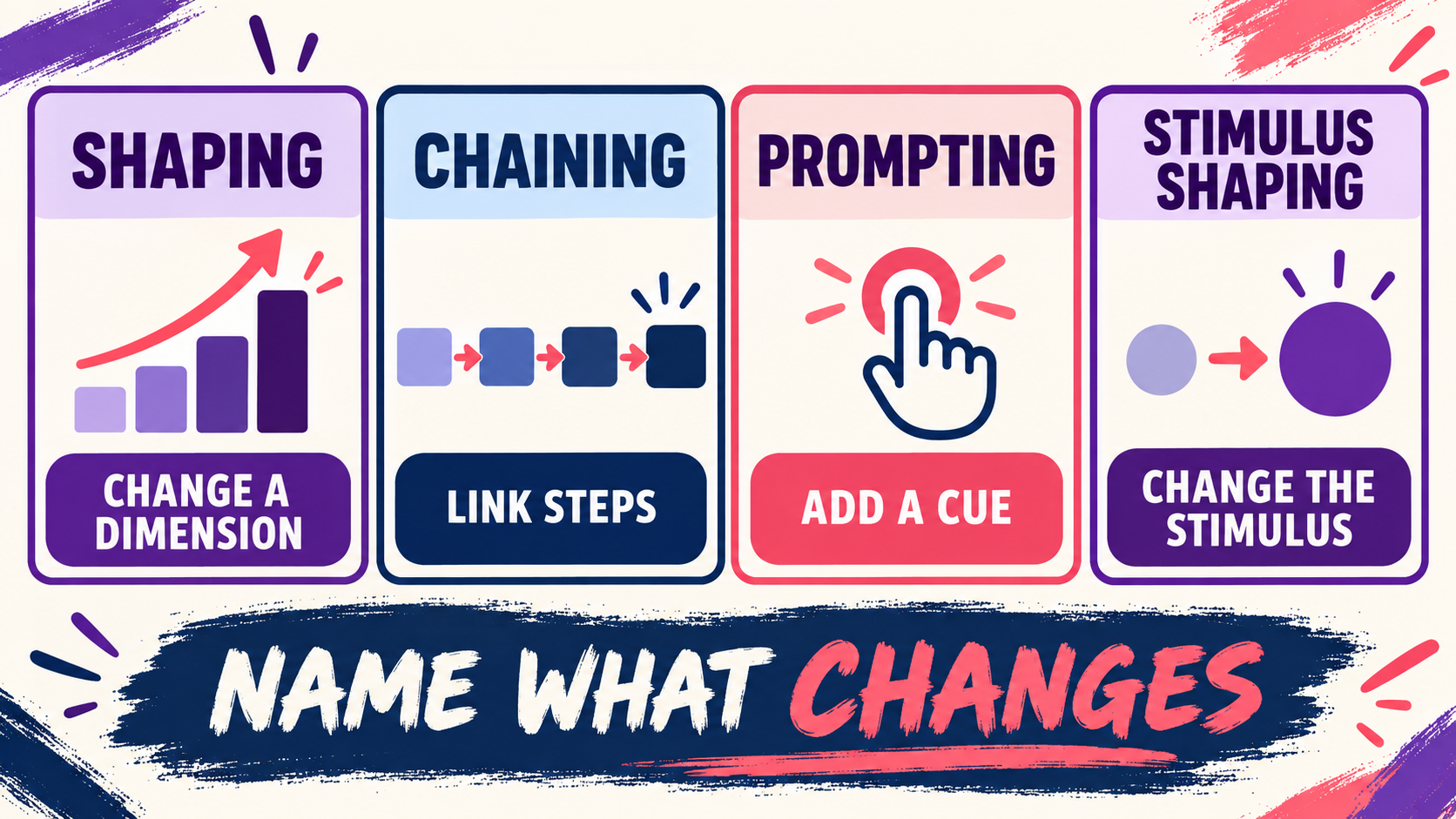
Exam questions often place related procedures next to each other. Shaping changes a measurable dimension of a response through successive approximations. Chaining teaches a sequence by linking component responses. Prompting adds an antecedent aid to evoke a response, followed by a plan to fade that aid. Stimulus shaping gradually changes the physical features of a stimulus so discrimination can be taught. These procedures can be combined, but their defining changes are different.
- Shaping: the criterion moves toward a target dimension or response form.
- Chaining: separate steps are connected into a functional sequence.
- Prompting: an added cue increases the likelihood of the correct response.
- Stimulus shaping: stimulus features are gradually changed while the learner contacts the relevant discrimination.
A quick worked example: teaching a learner to wash hands by teaching wet hands, soap, rub, rinse, and dry in a sequence is primarily a chaining question. Teaching the learner to tolerate an increasingly long handwashing duration is a within-topography shaping question. Teaching the learner to respond correctly when a visual cue is present and then fading that cue is a prompting or stimulus-control question. The surface activity can be similar; the controlled change identifies the procedure.
What Should You Measure?
Measure the dimension named in the goal. If the goal is duration, record duration. If it is latency, define when the timer starts and stops. If it is topography, define the response forms and the approximation criterion. Also record independent responding, prompts, reinforcement, errors, and side effects when those data help the team decide whether the plan is working.
Do not let the phrase “closer to the target” remain subjective. A graph, operational definition, and criterion change make the shaping process easier to supervise and easier to explain on an exam. Review whether the terminal behavior is meaningful, whether the learner can communicate protest or request a break, and whether the teaching arrangement respects dignity and safety.
What Are the BCBA Exam Takeaways?
For a question about shaping within and across topographies in ABA, ignore the topic label for a moment and inspect the approximations. If form stays the same but another measurable dimension changes, the answer points to shaping within a response topography. If form changes across approximations toward a terminal response, the answer points to shaping across response topographies.
- Topography is the observable form of the response.
- Within-topography shaping changes another measurable dimension of a recognizable response.
- Across-topography shaping changes the response form across successive approximations.
- Chaining links separate responses; prompting adds an antecedent aid.
- Define the target and measure the dimension before selecting the label.
For more scenario practice in behavior-change procedures and exam distinctions, the site’s free BCBA mock exam is an independent study resource. It is not official BACB content and does not guarantee certification.
Frequently Asked Questions
Is shaping only used when a behavior is completely new?: No. Shaping can build a new response form or refine a measurable dimension of a response that already occurs. The important issue is the differential reinforcement of successive approximations.
Is changing voice volume shaping within topography?: It can be, if speaking remains the recognizable response form and volume is the dimension being changed. The operational definition and data should show that the form is not actually being replaced by a different response.
Is shaping the same as reinforcing every small improvement?: Not exactly. Shaping uses differential reinforcement and a changing criterion toward a defined target. Reinforcing improvement without a measurable criterion may be helpful teaching, but it does not by itself demonstrate a shaping procedure.
Sources for Further Study
- BACB BCBA Test Content Outline, 6th edition — current exam-domain language, including shaping dimensions of behavior.
- A Review of Studies on Response Shaping — peer-reviewed conceptual and research review.
- Prompting and Stimulus Shaping Procedures — example of why stimulus shaping should be distinguished from response shaping.
- Revisiting Topography-Based and Selection-Based Verbal Behavior — additional discussion of response form and verbal behavior.
Take the Free BCBA Mock Exam
If you want a low-pressure way to check your recall, use the free practice resource below. Take the Free BCBA Mock Exam



